




Who should use this material-selection guide?
- Interior designers preparing a cabinet finish and material schedule.
- Contractors who want fewer moisture, fixing, and installation issues.
- Developers managing consistent specifications across multiple units.
- Dealers and B2B buyers comparing factory quotations beyond a board name and price.
Key takeaways for cabinet specifications
- Use plywood first for sink bases, utility cabinets, long shelves, high-load storage, and projects with credible moisture exposure.
- Use MDF for painted cabinet doors, shaker profiles, routed details, and other smooth decorative fronts.
- Use particle board in controlled dry interiors when melamine finish, flatness, and budget efficiency are the priorities.
- Board type alone does not predict performance. Thickness, density, grade, edge treatment, hardware fixing, and installation conditions matter.
- A component-level material schedule is more reliable than a quotation that says only “plywood cabinets” or “MDF cabinets.”
How Do Plywood vs MDF vs Particle Board Cabinets Compare for B2B Projects?
On mobile, swipe left or right to view all table columns.
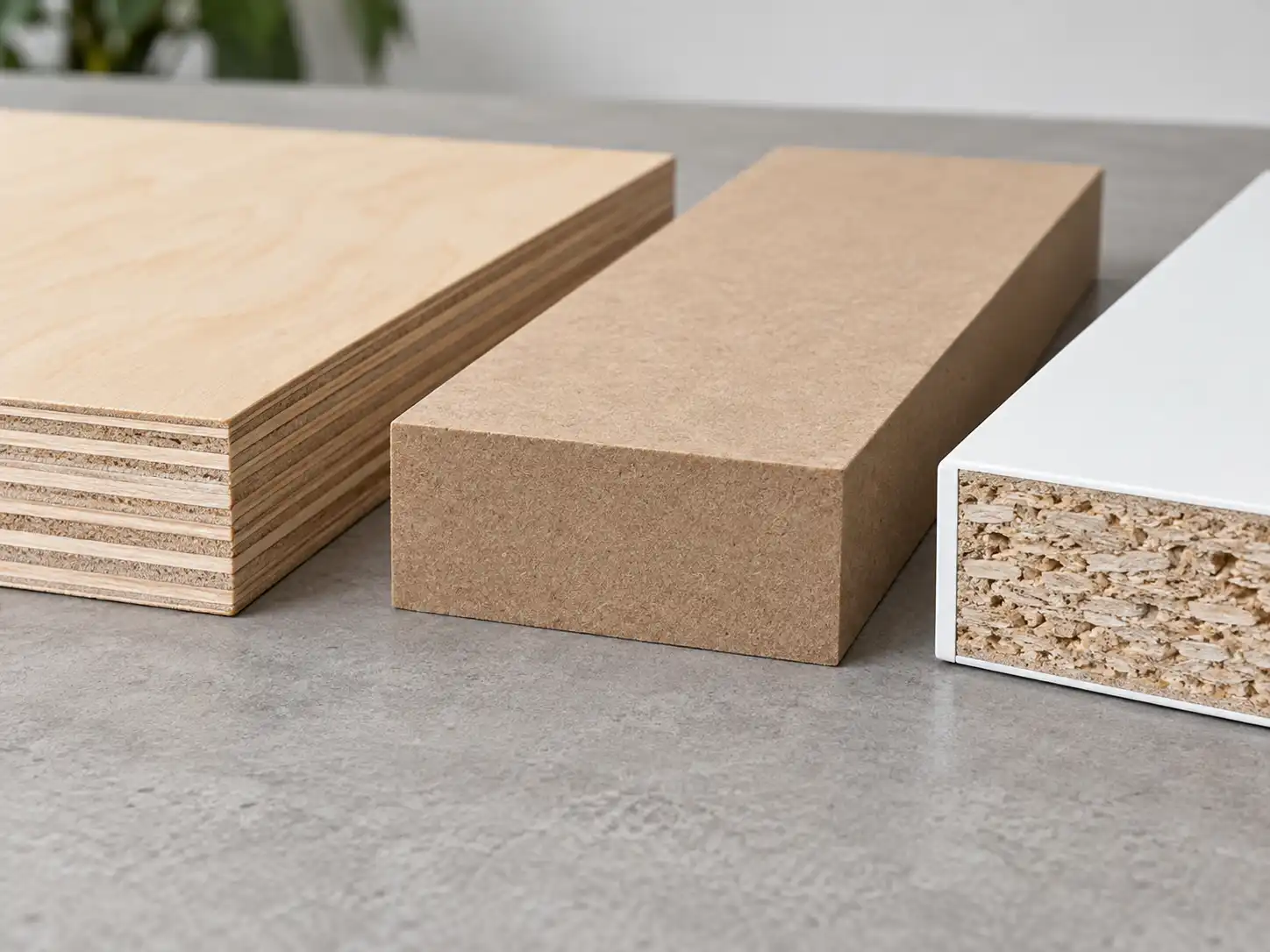
| Material | Best cabinet use | Key strengths | Main limits | What to specify |
|---|---|---|---|---|
| Plywood | Carcasses, sink units, long shelves, heavy-use storage | Good screw holding; layered structure; better moisture tolerance than standard fiberboard | Higher cost; quality varies by core and adhesive; not waterproof | Grade, thickness, core quality, face finish, edge and cutout sealing |
| MDF | Painted doors, lacquered fronts, shaker and routed panels | Smooth, uniform surface; clean machining; excellent paint preparation | Heavy; edges can swell after unprotected water exposure | Standard or moisture-resistant grade, paint system, profile, edge preparation |
| Particle board | Dry-area melamine carcasses, wardrobes, office storage | Economical, flat, efficient for panel processing | Lower moisture and edge screw tolerance; damaged edges are difficult to repair | Density, thickness, edge banding, connector/hardware system, wet-zone exclusions |
Decision rule: specify by function, not by marketing label
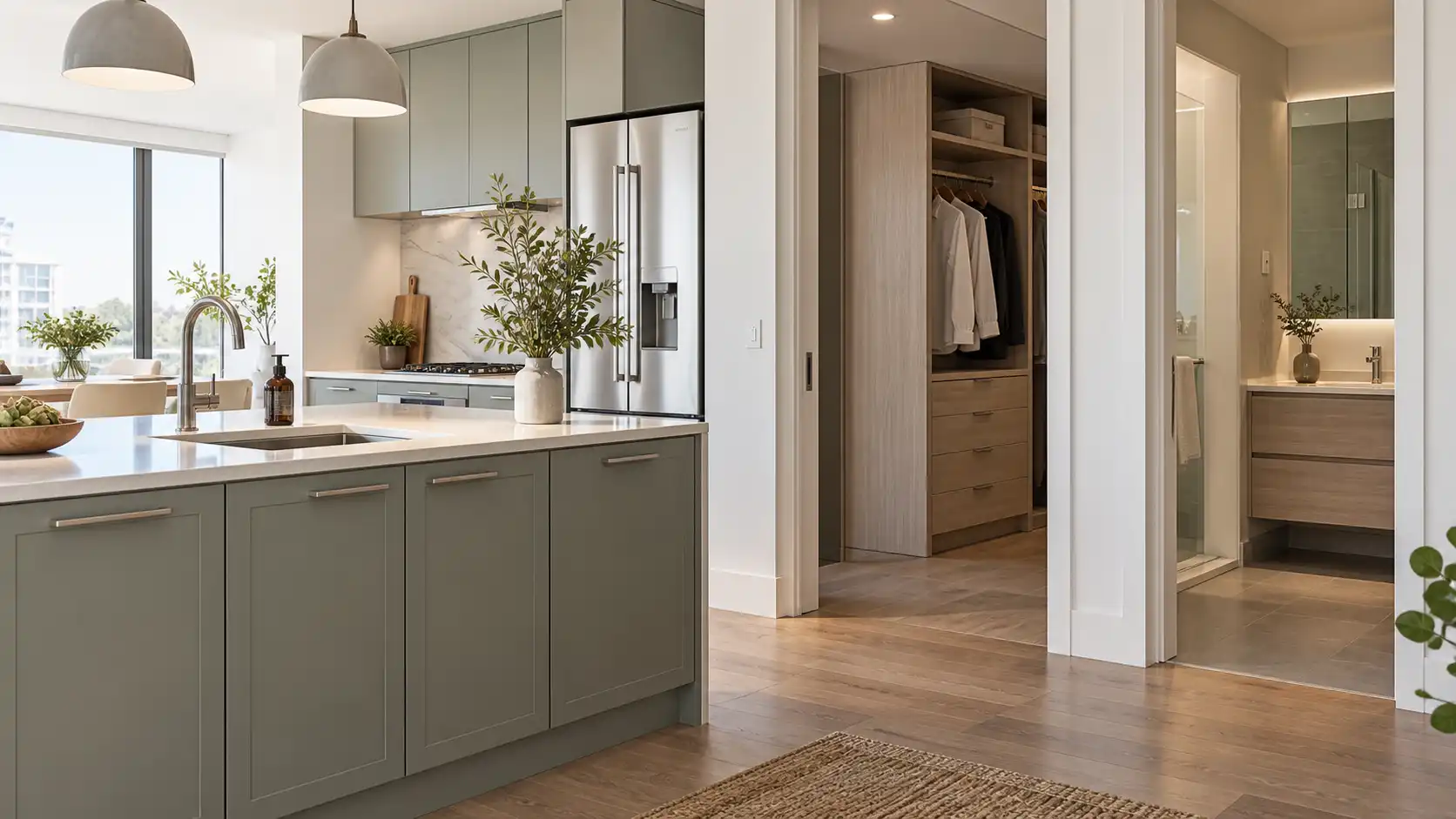
A mixed-board cabinet package is often the most practical solution. This plywood vs MDF vs particle board cabinets comparison supports a component-based schedule: an apartment kitchen may use plywood for the sink-base carcass, MDF for painted doors, and melamine-faced particle board for dry interior shelves. That combination puts cost where it matters while protecting high-risk components. It also gives the factory a clear basis for drawing review and QC.
When is plywood the right cabinet material?
Plywood is built from cross-layered wood veneers. The construction generally gives better resistance to fastener pull-out and handling stress than standard particle board, making it useful for cabinet boxes, wall-hung units, wide shelves, and components that may be assembled more than once.
Specify plywood early for sink bases, laundry rooms, garages, coastal homes, and cabinets with long unsupported spans or high hardware loads. Still, “plywood” is incomplete as a specification. Confirm the panel thickness, veneer/core quality, adhesive performance, void control, exposed-edge treatment, and protection around plumbing cutouts. Plywood resists moisture better than many standard panel products, but standing water can still enter an unsealed cut edge or damaged laminate.
Best for: Cabinet carcasses in damp or high-use zones, long shelves, heavy pantry units, and project cabinetry with more handling.
Not recommended as an automatic upgrade: Low-risk dry components where a different substrate achieves the finish and budget target more efficiently.
When is MDF the better choice for cabinet doors?
MDF is a dense, uniform wood-fiber panel. Its lack of grain and smooth face make it a dependable substrate for painted, lacquered, PET, routed, fluted, and shaker-style door fronts. It allows profiles to be machined cleanly and gives coating systems a more consistent base than many veneer-core panels.
For a painted kitchen, MDF is typically specified for the door and visible end-panel system rather than for every hidden cabinet component. The factory should confirm the grade, primer and paint sequence, edge sealing, sheen, color-control sample, and treatment of handle or hinge drilling. In bathrooms, laundries, and poorly ventilated rooms, select moisture-resistant MDF only where suitable and keep vulnerable edges away from standing water.
Best for: Painted or routed fronts where visual finish and profile accuracy are critical.
Not recommended for: Exposed wet locations without a clear water-management and edge-sealing plan.
When can particle board be suitable for cabinets?
Particle board uses wood particles and resin pressed into a panel. In cabinet manufacturing, it is widely paired with melamine decorative surfaces because it is flat, economical, and efficient to machine in volume. It can be an appropriate solution for wardrobe interiors, bedroom storage, office cabinetry, and dry kitchen components.
Its limitations must be designed around. Lower-density board, weak edge banding, repeated dismantling, and poorly placed fasteners can create premature failures. The B2B specification should call out panel density and thickness, edge-band thickness and adhesive, connector type, hardware fixing points, and which cabinets are excluded from particle board use. Do not compare a particle-board quotation with plywood solely by unit price; compare the finished component, hardware, processing, and warranty process.
Best for: Dry interior carcasses and melamine cabinet systems with controlled installation conditions.
Not recommended for: Sink bases, unprotected bathroom units, or locations where water ingress and repeated disassembly are likely.
Plywood vs MDF vs Particle Board Cabinets: Which Material Fits Each Component?
On mobile, swipe left or right to view all table columns.
| Component or project condition | Recommended starting point | Why | Production check before approval |
|---|---|---|---|
| Kitchen sink-base carcass | Plywood or a suitable moisture-resistant board | Plumbing leaks, cutouts, and cleaning create a higher moisture risk | Seal cut edges; protect the base; show plumbing cutouts on drawings |
| Painted or shaker door | MDF | Smooth face and clean routing support a consistent painted finish | Approve profile, primer, sheen, color sample, and edge sealing |
| Melamine dry-area carcass | Particle board or plywood | Both can support efficient panel processing; budget and load decide | Confirm density, thickness, connectors, and edge banding |
| Long shelf or pantry span | Plywood, thicker engineered panel, or reinforced shelf | Reduces visible sag and hardware stress | State clear span, load expectation, thickness, and support locations |
| Wardrobe interior | Particle board or plywood | Dry use allows more cost flexibility | Confirm hanging loads, shelf span, connectors, and moving/assembly needs |
| Bathroom vanity | Plywood or component-specific moisture-resistant board | Humidity and splash risk need more robust detailing | Detail toe-kick, wall/floor clearance, sealing, ventilation, and service openings |
| Multi-unit developer project | Mixed schedule by component | Repeatability and replacement control can be more valuable than one premium board | Freeze material codes, samples, tolerances, labels, and spare-parts rules |
How Should Designers Specify Plywood vs MDF vs Particle Board Cabinets?
The schedule should translate a visual concept into a factory-verifiable instruction. At minimum, list the carcass, door, shelf, back panel, filler, toe-kick, and decorative wall-panel materials separately. For each component, record board type, thickness, finish code, edge treatment, hardware interface, and wet-zone requirements.
Also identify sink and appliance cutouts, wall-hung cabinet loads, long shelf spans, color-match requirements, and interfaces with stone, tiles, lighting, and plumbing. A factory can quote accurately from a clear schedule; it cannot reliably infer a moisture-risk decision from a render alone.
Factory insight: what affects board performance after the material is selected?

For plywood vs MDF vs particle board cabinets, material selection should be reviewed alongside the manufacturing process. At KEJIA, a technically sound board can still underperform if the system around it is vague. During drawing approval and pre-production review, check:
- Panel construction: Thickness and material code match each cabinet component, especially shelves, backs, fillers, and toe-kicks.
- Edge protection: Edge-band thickness, adhesive coverage, exposed edges, and plumbing or hardware cutouts are defined.
- Hardware fixing: Hinge plates, drawer slides, connectors, and wall-hanging points suit the substrate and panel thickness.
- Finish continuity: Doors, end panels, fillers, edge bands, and replacement parts have an approved control sample and color-batch process.
- Installation tolerance: Drawings identify wall variations, appliance clearances, scribe panels, and adjustment space.
- Packing and replacement: Cartons are room-coded, faces and corners are protected, and spare hardware or replacement panels are traceable.
For overseas projects, use material codes on shop drawings rather than vague labels such as “white board” or “premium plywood.” That is particularly important where painted MDF, melamine particle board, and plywood laminate might look similar but behave differently.
Plywood vs MDF vs Particle Board Cabinets: Common B2B Specification Mistakes
On mobile, swipe left or right to view all table columns.
| Mistake | Why it creates a project risk | How to prevent it |
|---|---|---|
| Selecting one board for every part | Doors, sink units, shelves, and dry carcasses face different loads and moisture paths | Use a component-level schedule |
| Calling plywood waterproof | Unsealed cutouts and damaged edges can still absorb water | Specify sealing and installation protection |
| Using standard MDF in a wet-risk location | Water entry can swell the fiber core and damage the finish | Use a suitable grade and seal all vulnerable edges |
| Choosing low-density particle board for demanding hardware | Fixings may loosen under repetitive loads | Confirm density, connector layout, screw type, and hardware |
| Comparing quotes by board name only | Grade, thickness, core quality, edging, and hardware vary widely | Request a technical schedule, sample, and shop-drawing review |
| Approving color without a control sample | Door, edge-band, filler, and panel tones can diverge in batch production | Sign off on a physical sample and batch-control method |
Cabinet material checklist before requesting a quotation
- List the substrate for carcasses, doors, shelves, backs, fillers, toe-kicks, and wall panels.
- State thickness, grade, finish, edge-band requirement, and exposed-edge treatment for each component.
- Mark sink units, plumbing cutouts, bathrooms, laundry cabinets, and other wet-risk zones.
- Define shelf spans, expected loads, wall-hanging points, and appliance interfaces.
- Confirm hinges, slides, connectors, and screw-fixing requirements with the factory.
- Request approved material, finish, edge-band, and hardware samples before batch production.
- Include shop-drawing approval, QC checkpoints, carton labels, packing protection, and replacement-parts rules in the purchase order.
Frequently asked questions
When Comparing Plywood vs MDF vs Particle Board Cabinets, Is Plywood Always Better?
No. When comparing plywood vs MDF vs particle board cabinets, plywood is often the stronger starting point for carcasses that face moisture, load, or repeated assembly. MDF is usually better for painted and routed fronts, while particle board can be a practical dry-area melamine solution. Choose the material by cabinet component, environment, finish, hardware, and budget rather than applying one substrate everywhere.
Is MDF suitable for kitchen cabinet doors?
Yes. MDF is commonly used for painted, lacquered, shaker, and routed kitchen doors because it provides a smooth, consistent surface. The project should confirm the MDF grade, primer and coating system, routed profile, hinge drilling, and sealed edges. It is less suitable where water can repeatedly reach unprotected edges.
Is particle board acceptable for kitchen cabinets?
It can be appropriate for dry kitchen carcasses and melamine components when the board density, edge banding, hardware, and installation conditions are controlled. It should not be used as a blanket solution for sink bases or unprotected wet zones. Ask the factory to identify material exceptions by cabinet component in the quotation.
Which cabinet material holds screws best?
Plywood generally provides stronger screw holding than standard particle board, particularly where a fixing is loaded or repeatedly used. Results also depend on thickness, screw type, pilot holes, edge distance, and connector design. MDF can work well for face fixings, but its edges need careful fastening design. Confirm hardware details in the shop drawings.
Can plywood, MDF, and particle board be combined in one kitchen?
Yes. Combining substrates is often the most cost-effective B2B approach. A typical combination is plywood for a sink-base carcass, MDF for painted doors, and melamine-faced particle board for dry interiors. The factory must manage dimensional compatibility, edge treatment, finish matching, and color consistency across the full package.
What should a contractor request from a cabinet manufacturer?
Request a component-level material schedule, samples, shop drawings, hardware list, packing plan, carton labels, QC checkpoints, and a replacement-parts process. The documents should identify the substrate for each main component and any wet-zone protection. This makes substitutions, site coordination, and after-sales claims easier to control.
Does moisture-resistant board remove the need for sealing and ventilation?
No. Moisture-resistant grades improve tolerance; they do not eliminate risk from standing water, leaking plumbing, poor ventilation, or unsealed cut edges. The detail around a sink, vanity, appliance opening, and floor interface still determines service life. Include sealing and installation protection in the project specification.

Choose a cabinet material system, then verify it with drawings and samples
Plywood vs MDF vs particle board cabinets can each be the right choice when used in the right place. For B2B projects, the safest process is to specify board type by component, identify moisture and load risks, approve samples, and lock the details in shop drawings before batch production.
Request a material recommendation for your project
Further reading
For composite-wood compliance context, consult the U.S. EPA composite wood products guidance. Where verified sourcing is relevant to your project, see FSC chain of custody certification.