
Introduction
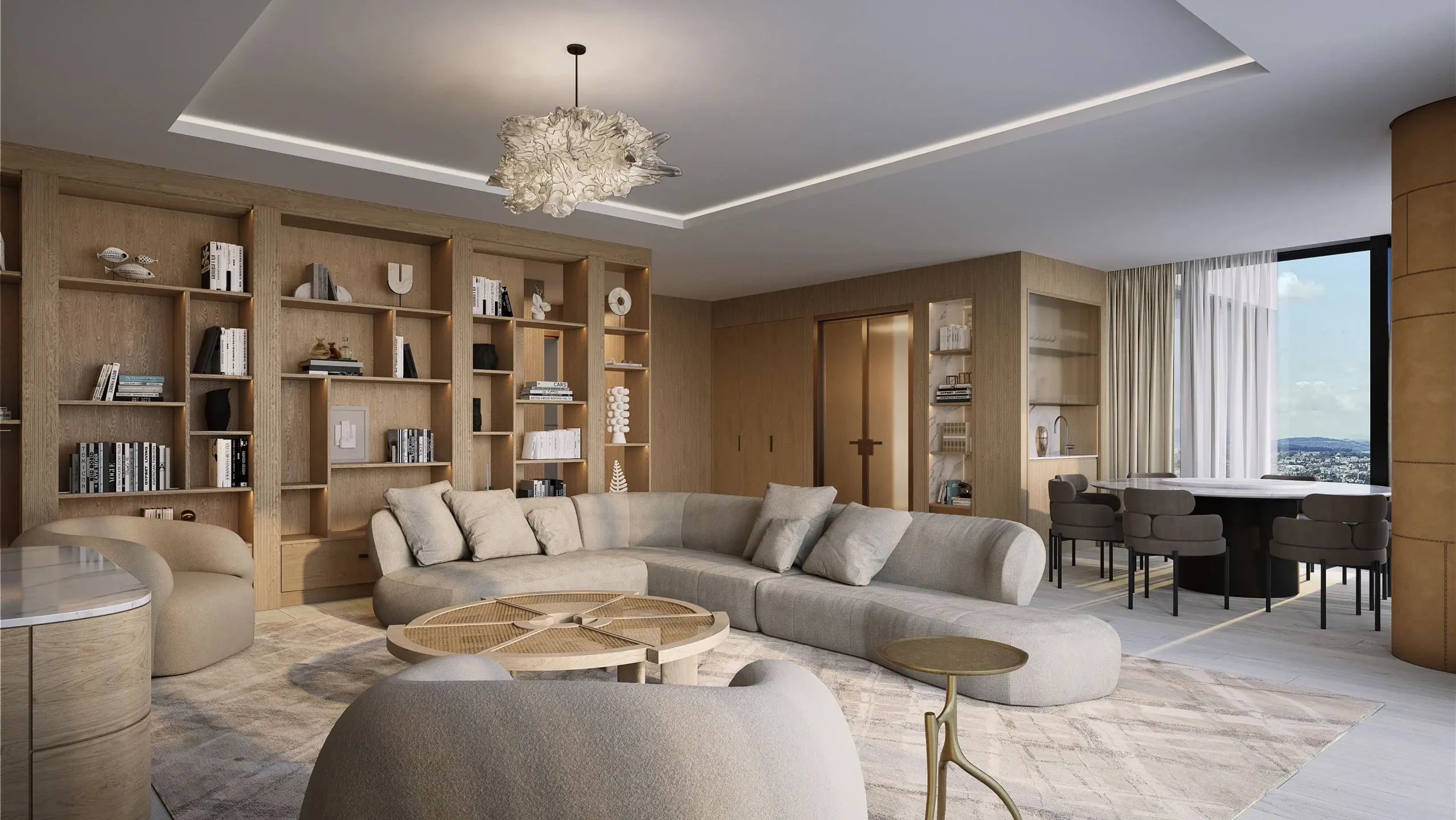
Factory direct kitchen cabinets from China are no longer just a low-budget sourcing option. More contractors, kitchen studios, and cabinet dealers are now using Chinese manufacturers to reduce project costs while still offering custom-looking cabinetry with better margins.
That’s why many distributors, contractors, and kitchen studios are now searching for something very specific:
Factory-direct pricing without factory-direct disasters.
The real question is no longer:
“Can China make cheap cabinets?”
Everybody already knows that.
The real question is:
How do you separate stable factories from trading-company packaging and low-end mass production?
Many dealers now compare factory direct kitchen cabinets against local semi-custom brands to improve margin flexibility without sacrificing customization options.
Because in this industry, two cabinets can look nearly identical in photos while having completely different long-term performance once installed in a real home.
Especially in humid climates, rental properties, or busy family kitchens, the differences start showing fast:
- edge swelling
- hinge sagging
- drawer instability
- peeling thermofoil
- weak back panels
- misaligned drilling
- inconsistent color batches
Most buyers only realize where the real cost savings came from after the containers arrive.
Core Takeaways
| Key Question | Short Answer |
|---|---|
| Is factory-direct from China actually cheaper? | Yes — mainly because you remove multiple distribution layers, not because materials are “free.” |
| Can Chinese factories produce high-quality cabinets? | Absolutely. Many already manufacture for Western brands privately. |
| Where do bad imports usually fail? | Edge sealing, hardware quality, panel density consistency, moisture control, and packaging. |
| Is RTA always lower quality? | No. Well-engineered RTA can outperform poorly assembled local cabinets. |
| What matters more than board material alone? | Production consistency and edge-sealing stability. |
| Biggest mistake buyers make? | Comparing quotes without understanding internal specifications. |

Technical Analysis
Why Factory Direct Kitchen Cabinets Are Becoming Popular in 2026
The biggest misunderstanding about factory direct kitchen cabinets is assuming lower pricing automatically means lower durability.
Many overseas buyers assume cabinet pricing is mainly about wood species or board material.
In reality, a large percentage of cost differences comes from:
- manufacturing consistency
- hardware systems
- finish stability
- labor structure
- logistics layers
- packaging standards
- waste control during production
Two factories may both say:
“18mm plywood cabinet with soft-close hardware.”
But the actual product can behave very differently after installation.
Example: The Hidden Difference in “18mm Plywood”
One factory may use:
- stable multi-layer core
- calibrated moisture content
- better veneer bonding
- PUR edge sealing
- CNC drilling accuracy within tighter tolerance
Another may use:
- inconsistent core density
- recycled filler layers
- cheaper glue systems
- unstable lamination
- weaker packaging protection
Online photos usually won’t show any of this.
But installers notice immediately.
And homeowners notice after one humid summer.
The Real Cost Structure Behind Cabinets
Here’s roughly where cabinet costs usually go in factory-direct production:
| Cost Area | What Actually Matters |
|---|---|
| Board Material | Plywood grade, core stability, density consistency |
| Edge Banding | EVA vs PUR affects moisture resistance long term |
| Hardware | Hinge cycle life matters more than branding alone |
| Finish Process | PET, lacquer, melamine, acrylic all age differently |
| Labor | CNC precision and assembly consistency |
| Packaging | Export protection quality is massively underrated |
| Shipping | Container efficiency changes total landed cost significantly |
One important industry reality:
Good factories are rarely the absolute cheapest suppliers on Alibaba.
Usually, the dangerously cheap quotes come from somewhere:
- thinner back panels
- downgraded hardware
- low-density particleboard
- inconsistent drilling
- weaker carton protection
- lower-spec edge sealing
That’s how the numbers get compressed.
Head-to-Head Comparison Table
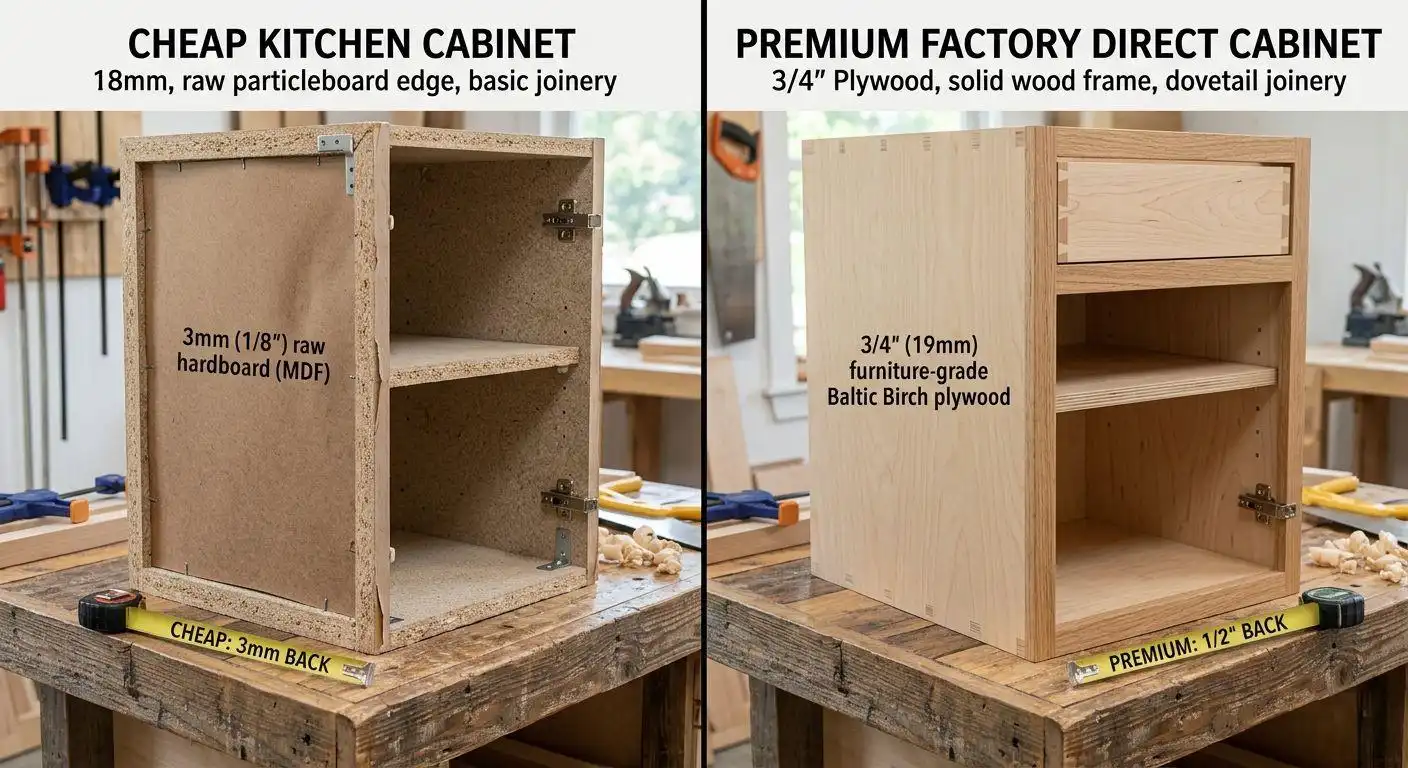
| Dimension | Cheap Import Cabinets | Stable Factory-Direct Cabinets |
|---|---|---|
| Panel Consistency | Often inconsistent | More controlled production |
| Edge Banding | Basic EVA | PUR or upgraded EVA systems |
| Moisture Resistance | Weak in humid environments | More stable long term |
| Hardware Lifespan | Entry-level generic | Tested soft-close systems |
| Packaging | Minimal export protection | Reinforced corner & flat-pack protection |
| Installation Accuracy | Frequent alignment issues | Cleaner CNC tolerances |
| Long-term Stability | Problems appear after 1–3 years | More predictable aging |
| Best For | Lowest upfront budget | Dealers, contractors, premium renovations |
Why RTA Is No Longer “Cheap Cabinet Technology”
A lot of buyers still associate RTA cabinets with low-end apartment projects from 15 years ago.
That’s outdated thinking.
Modern CNC-based RTA production can actually produce:
- tighter dimensional consistency
- easier international shipping
- lower freight waste
- faster installation workflows
- scalable customization
The important distinction is this:
Good RTA engineering is not the same thing as cheap flat-pack furniture.
Many factories now produce:
- custom sizing
- integrated lighting channels
- aluminum-framed glass doors
- handleless systems
- synchronized grain matching
- premium drawer systems
…all within RTA structures.
The better factories are essentially combining:
- modular logistics
with - semi-custom manufacturing flexibility.
That’s where overseas distributors gain pricing leverage.
Common Industry Pitfalls
1. “Soft-Close” Means Almost Nothing by Itself
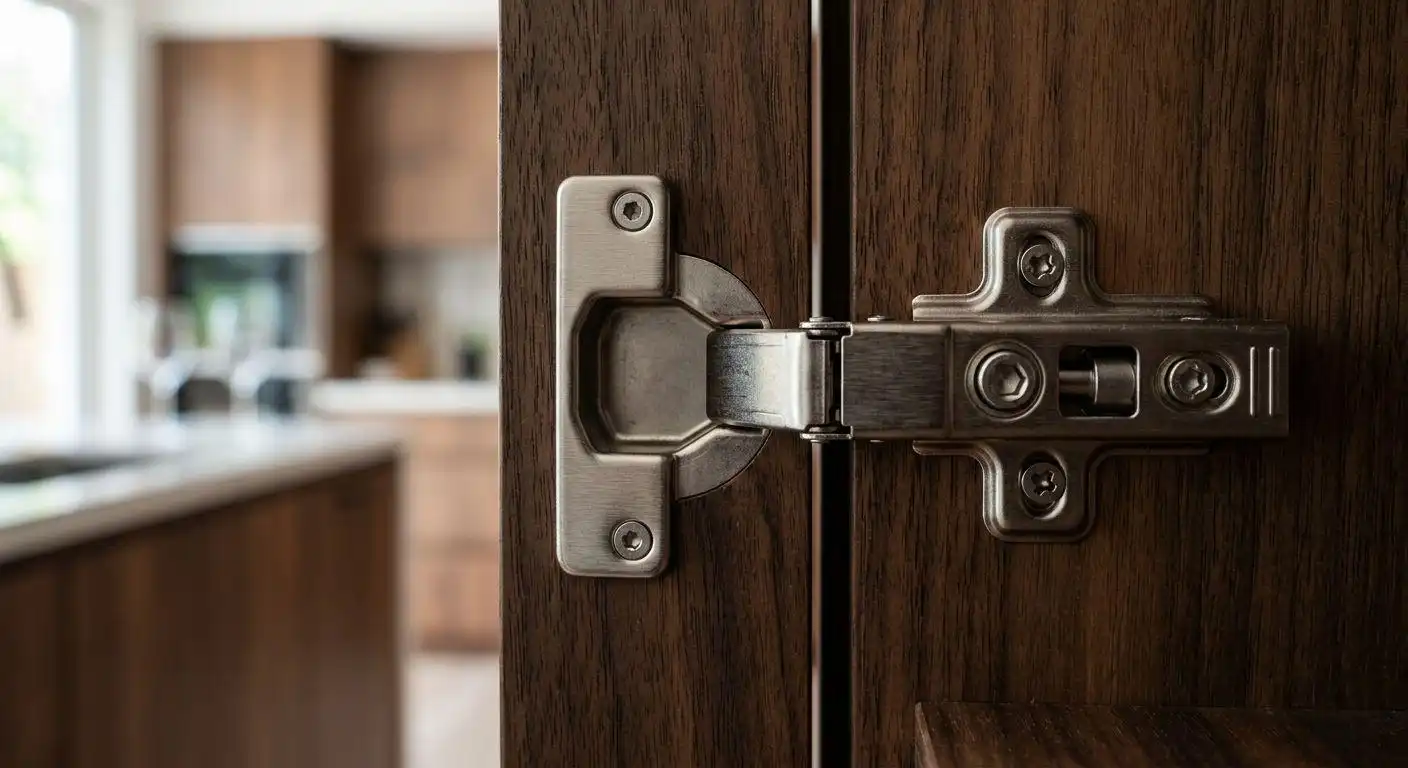
This is one of the most abused terms in cabinet sourcing.
A hinge can technically be soft-close and still fail early under daily use.
What actually matters:
- cycle testing
- hinge arm thickness
- damping consistency
- mounting plate stability
Some low-cost hinges feel acceptable during showroom testing but lose damping strength surprisingly fast.
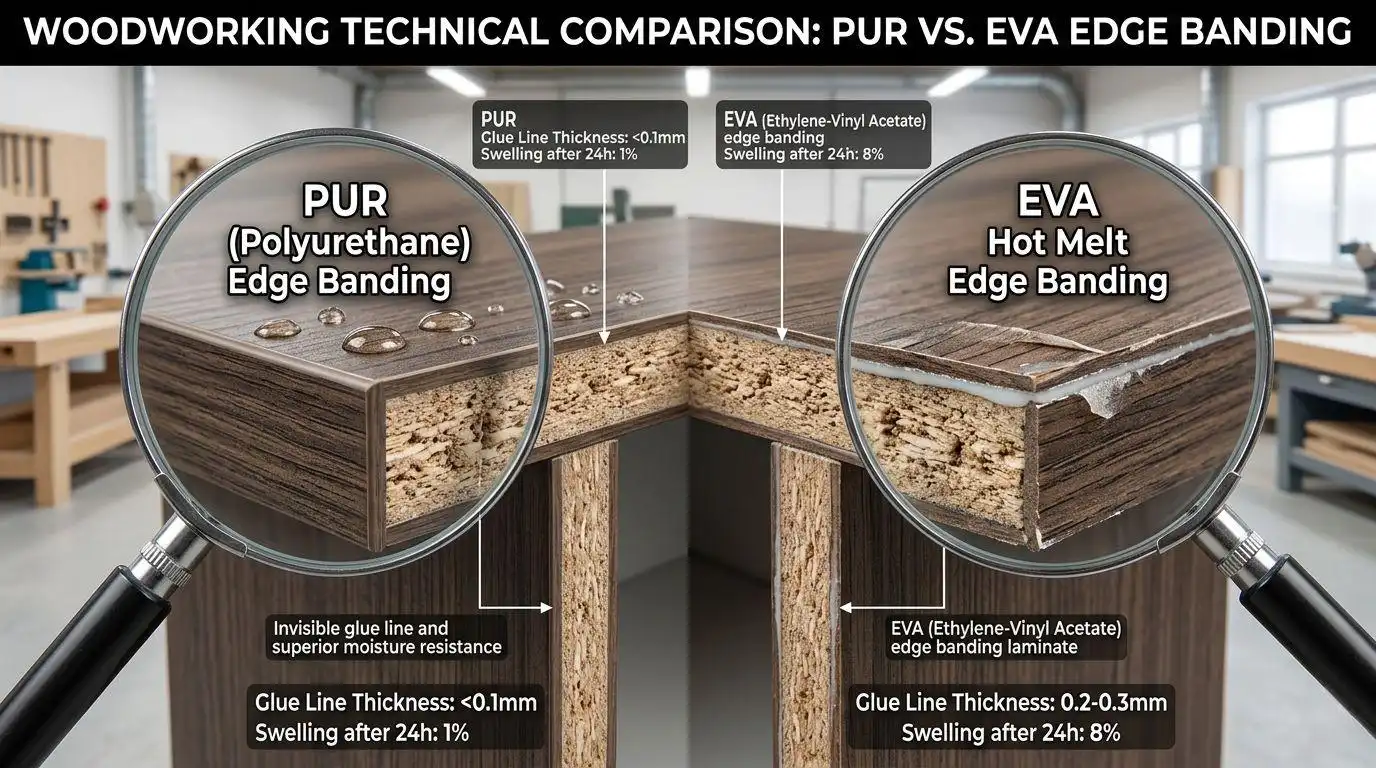
2. Edge Banding Problems Usually Appear Late
Many first-time importers focus heavily on door finish appearance.
Experienced buyers usually inspect the edge sealing first.
Because this is where humidity problems begin.
EVA Edge Banding
Lower cost and widely used.
But cheaper EVA systems are more vulnerable to:
- steam exposure
- long-term edge lifting
- visible glue lines
PUR Edge Banding
More resistant to moisture and heat.
Especially important for:
- coastal climates
- luxury rentals
- high-usage family kitchens
A lot of factories advertise PUR now because buyers learned to ask for it. But some only apply PUR on visible components, not the full cabinet system.
That detail matters.
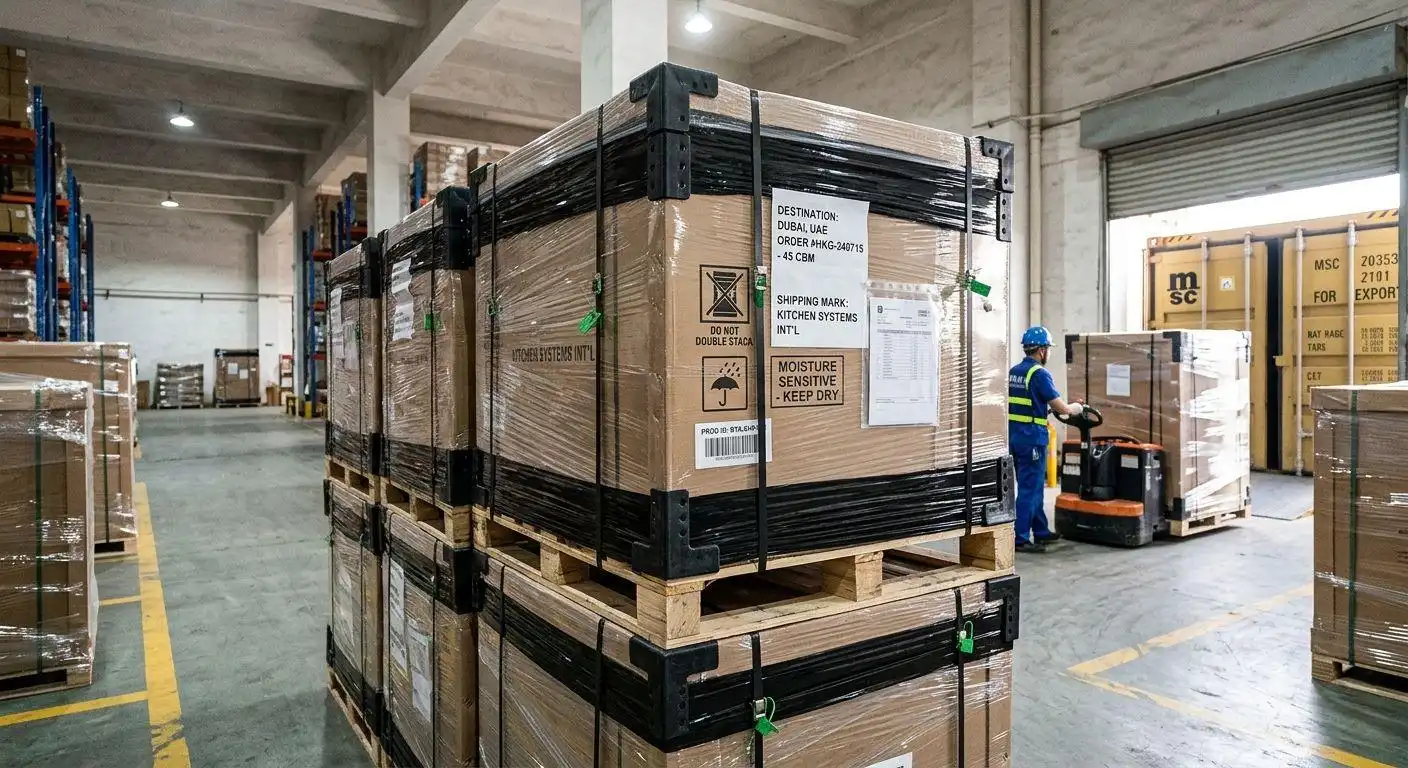
3. Freight Damage Can Destroy an Otherwise Good Product
This gets underestimated constantly.
Even decent cabinets become a nightmare if packaging is weak.
Experienced factories usually invest more heavily in:
- corner protection
- internal reinforcement
- pallet structure
- anti-moisture wrapping
- carton compression resistance
Especially for long ocean transit.
Cheap packaging often becomes expensive replacement claims later.
Which One Fits Your Project?
Best Fit for Factory-Direct Custom Programs
Dealers & Kitchen Studios
You gain:
- margin flexibility
- private labeling opportunities
- broader finish selections
- lower landed cost per project
Especially valuable when competing against expensive local semi-custom brands.
Contractors & Developers
Factory-direct sourcing works well when:
- layouts repeat
- volume offsets logistics complexity
- installation crews understand RTA systems
The savings become much more meaningful at scale.
For contractors handling multi-unit projects, factory direct kitchen cabinets often reduce overall procurement costs significantly.
High-End Residential Projects on Controlled Budgets
This is probably the fastest-growing segment.
A lot of homeowners want:
- cleaner European aesthetics
- custom sizing
- premium-looking finishes
…but without paying luxury showroom markups locally.
That gap is exactly where strong factory-direct suppliers compete.
Insider Reality
The Most Expensive Part Is Often Stability — Not Materials
This surprises many buyers.
The industry likes talking about plywood vs particle board because it’s easy marketing.
But factories know the harder part is actually:
- process consistency
- drilling accuracy
- moisture control
- finish stability
- edge quality repeatability
That’s where experienced factories separate themselves.
A poorly controlled plywood cabinet can still perform badly.
A well-engineered cabinet using quality engineered board can outperform it long term.
Many “Factories” Are Actually Trading Companies
This is extremely common.
Some are honest and transparent.
Some are not.
Red flags:
- no real production videos
- inconsistent technical answers
- vague hardware specifications
- no CNC workflow explanation
- refusal to show packaging standards
- changing lead times
Real factories usually speak very specifically about:
- drilling systems
- panel structures
- edge technology
- packaging methods
- production tolerances
Because they actually deal with these problems daily.
Conclusion
Buying kitchen cabinets factory direct from China can absolutely reduce costs without automatically sacrificing quality.
But the good results rarely come from chasing the lowest quote.
The better strategy is understanding:
- where factories cut costs
- which specifications actually affect longevity
- how production consistency impacts installation
- what performs differently after several years of use
Most experienced importers eventually realize something important:
The gap between “cheap cabinets” and “good value cabinets” is usually not visible in product photos.
It shows up later:
- in edge stability
- in hinge performance
- in installation accuracy
- in how the cabinets age after real daily use
That’s the part worth paying attention to before placing a container order.