



I swing a sledgehammer for a living. Every month, my crew and I tear out five-year-old “luxury” kitchens that are literally falling apart at the seams. The homeowners are always in shock. They tell me they spent a fortune, they point to the glossy showroom brochure, and they ask me why their expensive investment looks like garbage.
The answer is always the same: they were lied to about their custom kitchen cabinet materials.
When you walk into a slick showroom, the salesperson wants you to focus on the shiny hardware, the trendy paint colors, and the soft-close hinges. They do not want you looking at the raw edges, the box construction, or the glue line. But as a contractor, I can tell you that the doors are just the skin. The skeleton—the core material of the cabinet box—determines whether your kitchen lasts fifty years or fifty months.
If you are planning a major renovation, put down the color swatches. Here are the five biggest lies the industry tells you about custom kitchen cabinet materials, and what you actually need to demand for your home.
Lie #1: “These are Solid Wood Cabinets”
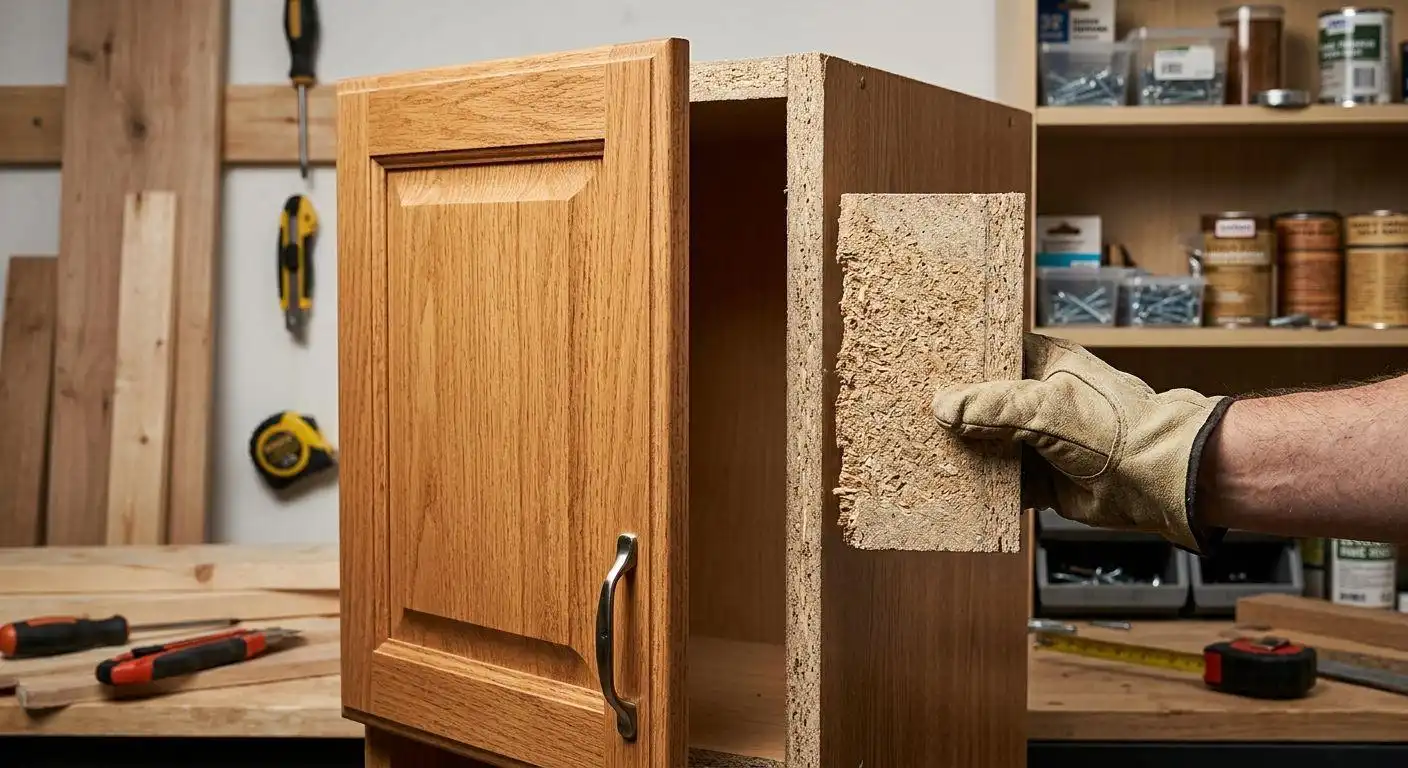
This is the oldest trick in the book. A salesperson slaps a beautiful, heavy oak door and calls the entire setup “solid wood.” But if you pull out a drawer and look at the actual cabinet box (the carcass), you will almost always find cheap particleboard hiding behind the face frame.
Building an entire cabinet box out of solid wood is actually a terrible idea because solid wood warps, expands, and cracks with seasonal humidity changes. The industry knows this. However, instead of using high-quality engineered cores, many domestic brands substitute the cheapest, lowest-density particleboard they can legally use to save a few dollars.
When evaluating custom kitchen cabinet materials, you must separate the door from the box. For the doors, solid wood or high-grade MDF (for painted finishes) is fine. But for the box itself, you should demand furniture-grade, multi-layer plywood. Plywood offers superior cross-grain stability, meaning it will hold its perfectly square shape whether you live in humid Florida or freezing Toronto.
Lie #2: “The Standard Edge Banding is Waterproof”
Let’s talk about the silent killer of modern kitchens: the dishwasher steam vent.
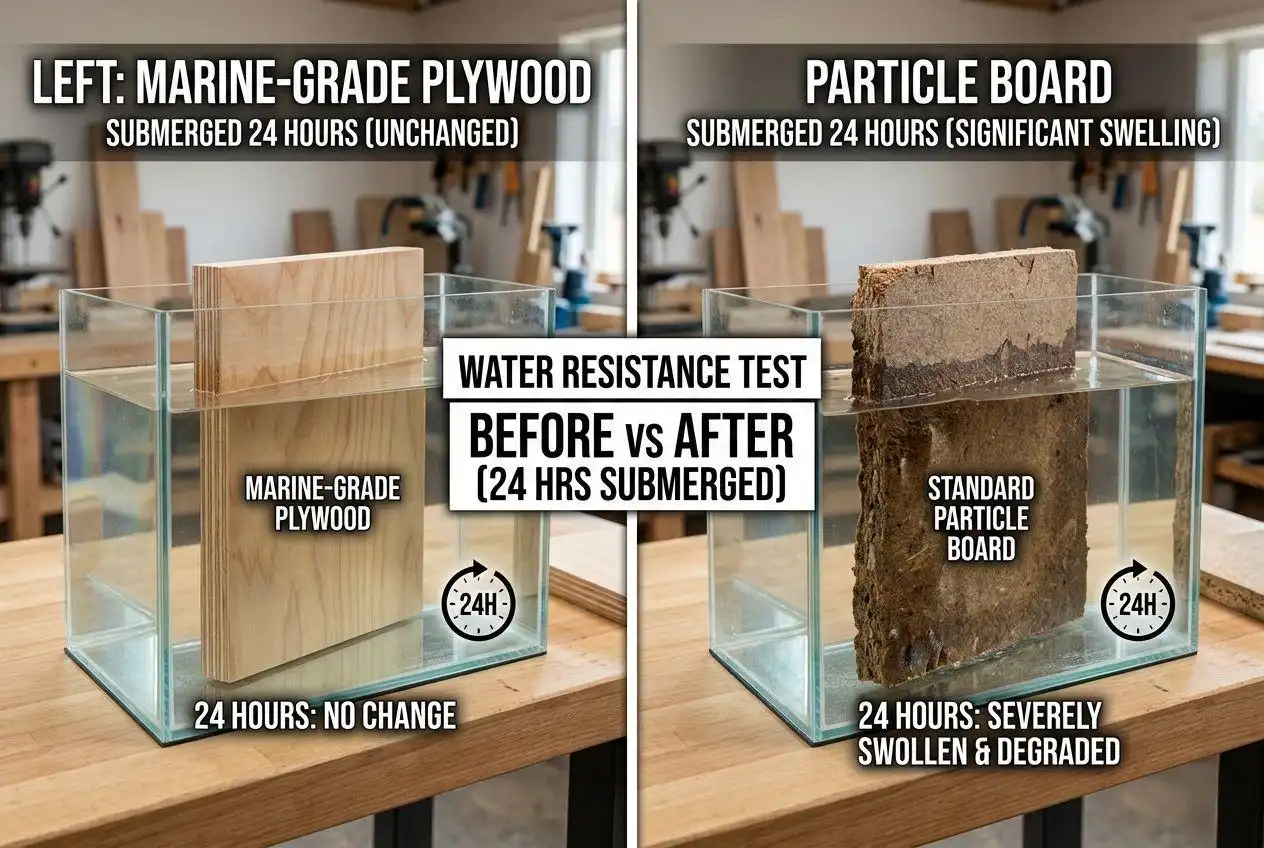
When your dishwasher runs its drying cycle, it vents hot, wet steam directly against the side of the adjacent cabinet. If you bought standard custom kitchen cabinet materials, the edges of those cabinet boxes are sealed using EVA (Ethylene Vinyl Acetate) glue. EVA glue is essentially a heavy-duty hot melt adhesive. What happens when you apply hot steam to hot melt adhesive? It reactivates. The glue melts, the edge banding peels off, and the raw particleboard underneath sucks up the moisture like a sponge. Within a year, that cabinet side will swell up to twice its thickness.
This is why I force my clients to look at the chemistry of their custom kitchen cabinet materials. You must insist on PUR (Polyurethane) seamless edge banding.
PUR adhesive cures through a chemical reaction with moisture in the air, creating a permanent, waterproof, and heat-proof bond. Once PUR glue sets, you cannot melt it again. We routinely take PUR-banded plywood samples, toss them into a bucket of water on the job site, and leave them over the weekend. Come Monday morning, you can wipe them off and install them. Try that with a showroom particleboard sample, and you’ll return to a bucket of mush.
Lie #3: “Upgraded Hardware Makes Up for the Core”
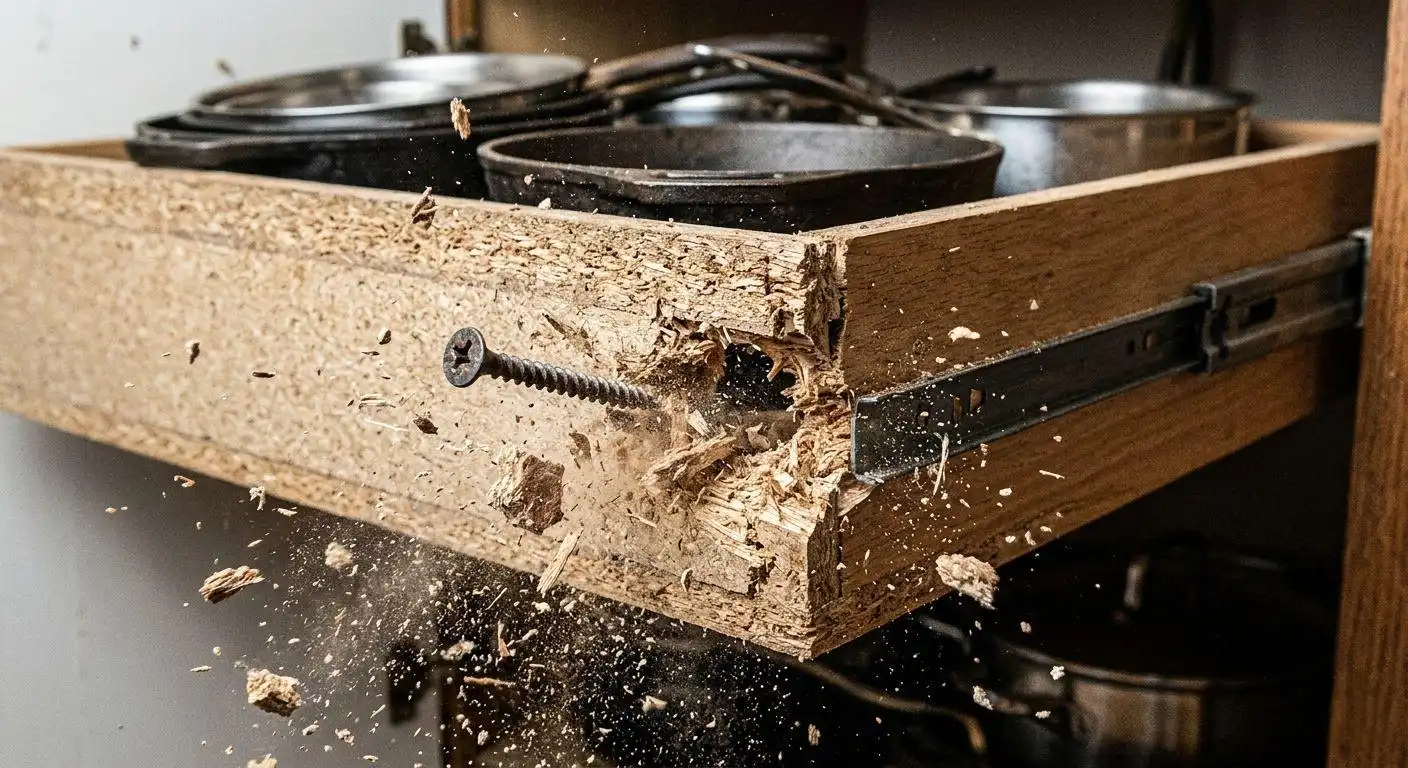
Showrooms love to upsell you on heavy-duty, German-engineered drawer slides that are rated to hold 100 pounds. That sounds fantastic until you load your massive 36-inch wide drawer with two Le Creuset cast-iron Dutch ovens, a stack of heavy ceramic plates, and slam it shut.
Here is the physics lesson the showroom skipped: a 100-pound drawer slide is only as strong as the wood holding the screws. This is called “screw retention” or nail-holding power.
If your custom kitchen cabinet materials consist of low-density particleboard, those screws are biting into glued sawdust. Over time, the constant vibration of opening and closing that heavy drawer will cause the sawdust to crumble. The screws will strip out, and your expensive drawer slide will rip right out of the cabinet wall.
When you specify your custom kitchen cabinet materials, ensure that all drawer bottoms are constructed from a minimum of 5/8-inch or 3/4-inch plywood, and that the cabinet sides (where the hardware mounts) are equally dense. Good hardware cannot fix bad wood.
Lie #4: “All Plywood is Created Equal”
Once a homeowner gets wise to the particleboard scam, they march into the showroom and demand “all-plywood construction.” The salesperson smiles, checks a box, adds a 20% upcharge, and the homeowner thinks they won. They didn’t.
Not all plywood qualifies as premium custom kitchen cabinet materials. Many mass-market manufacturers use cheap, imported soft-wood plywood with voids (empty air pockets) between the internal layers. If your installer drives a cabinet screw right into one of those hidden air pockets, the screw has nothing to grab onto, and the cabinet won’t be securely anchored to your wall.
Furthermore, you have to consider the glue used to press those plywood layers together. Cheap plywood off-gasses formaldehyde into your home for years. As a contractor, I don’t want to breathe that in while I’m cutting it, and you certainly don’t want your kids breathing it in while they eat breakfast.
High-end custom kitchen cabinet materials strictly utilize CARB2-compliant (California Air Resources Board) or EPA TSCA Title VI compliant hardwood plywood. This ensures the wood is incredibly dense, void-free, and safe for your indoor air quality.
Lie #5: “You Have to Pay a Local Premium for Quality”
The final lie is that the only way to get these high-end materials—PUR edge banding, dense hardwood plywood, and anti-fingerprint PET finishes—is to pay $50,000 to a local boutique custom shop.
The reality of 2026 is that local showrooms are essentially just middlemen. They take your order, send it to a massive factory, and mark up the price by 300% to cover their retail rent and commission checks.
The smartest builders and homeowners bypass this retail markup entirely. By sourcing your custom kitchen cabinet materials directly from advanced manufacturing facilities that specialize in international platform operations, you get access to the exact same (or better) industrial CNC machinery, PUR edge banders, and premium raw materials at a fraction of the domestic retail price.

Frequently Asked Questions (FAQ)
Q: Are MDF doors considered bad custom kitchen cabinet materials? A: No, not for doors. Medium-Density Fiberboard (MDF) is actually the superior material for painted cabinet doors because it does not expand and contract like solid wood, meaning your paint will never crack at the joints. Just don’t let them use MDF for the cabinet boxes or shelves, as it sags under heavy weight.
Q: How can I visually check the custom kitchen cabinet materials in a showroom? A: Pull out a drawer and look at the exposed, unpainted bottom edge of the cabinet box. If it looks like compressed oatmeal, it’s particleboard. If you see alternating horizontal lines, it’s plywood. Also, look closely at the edge banding. If you see a thick, dark glue line between the tape and the wood, it’s cheap EVA glue. PUR glue lines are virtually invisible.
Q: What is the best material for a kitchen island countertop to match high-end cabinets? A: Sintered stone. It is rapidly replacing quartz in high-end North American homes. It is fired at extreme temperatures, making it impervious to UV fading, heat (you can set a hot pan directly on it), and scratches.
Q: Do premium custom kitchen cabinet materials really increase home value? A: Absolutely. Savvy home buyers and home inspectors know the difference between a kitchen that needs a gut-renovation in five years and one that will last decades. High-quality plywood carcasses and heavy-duty hardware are major selling points.
Conclusion: Stop Paying for “Luxury” Sawdust
The kitchen is the engine of your home. It deals with boiling water, steam, grease, heavy cast-iron pans, and constant daily impact. You cannot build a durable engine out of weak components.
When you sit down to plan your budget, ignore the fancy showroom lighting and focus entirely on the engineering. The right custom kitchen cabinet materials—specifically CARB2-compliant plywood cores and PUR seamless edge banding—are the non-negotiable foundations of a kitchen that will actually last.
Stop letting retail middlemen charge you premium prices for inferior construction. You deserve contractor-grade durability wrapped in a beautiful, modern aesthetic.
Ready to see what real custom cabinetry looks like? Don’t gamble your renovation budget on showroom promises. Contact our manufacturing team directly today. Send us your floor plan or dimensions, and we will walk you through a transparent quote based on premium, export-grade custom kitchen cabinet materials.
[Click here to Request Your Free Quote or Material Sample Pack].