


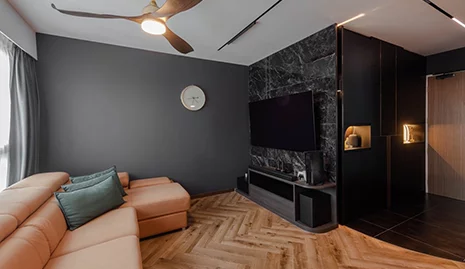


Choosing a custom cabinet manufacturer is less about a showroom logo than whether the supplier can document the exact cabinet body, door finish, hardware, production controls, and delivery terms in your order. For designers, contractors, dealers, and factory-direct homeowners, the safest comparison is a written specification plus traceable material and acceptance records—not a render or a generic certificate. This guide explains seven checks to complete before signing a kitchen-cabinet contract, so the cabinets delivered to site match the samples, drawings, and price you approved.
Quick Answer: What Makes a Custom Cabinet Manufacturer Reliable?
A reliable manufacturer can turn a design brief into a controlled production specification. It can identify who is responsible for each production step, name the panel and finish in the quote, provide documents that match the selected material, approve samples before batch production, and define packing, delivery, installation, and warranty responsibilities in writing.
Price matters, but it is not a substitute for those controls. A low quote with an unspecified cabinet body, vague hardware, or no approved finish sample is difficult to compare and even harder to correct after production begins.
Who this guide is for
- Interior designers preparing finish schedules and cabinet drawings.
- Contractors who need fewer installation changes and missing-part claims.
- Developers and B2B buyers comparing factory-direct cabinet quotes.
- Dealers and showrooms selecting samples and product lines.
- Homeowners who want to source a project directly from a cabinet factory.
Key takeaways
- Specify the surface, substrate, edge banding, hardware, and thickness separately.
- Ask for documents for the exact panel or component in your order, not a generic certificate.
- Approve a physical door and carcass sample before mass production.
- Separate production completion, shipment, delivery, and installation dates in the contract.
- Inspect alignment, finish, edge treatment, and hardware operation before final acceptance.
1. Confirm Who Designs, Produces, and Finishes the Cabinets
The name on a showroom does not, by itself, explain who produces the cabinet carcass, sprays the doors, installs the hardware, packs the order, or owns the after-sales claim. A supplier may manage some work in-house and source other components. That is not automatically a problem; unclear responsibility is the problem.
Before comparing prices, ask for a simple production-responsibility map. It should identify the party responsible for the cabinet body, door finish, stone or metal accessories, hardware installation, packing, shipping coordination, and defect resolution.
Questions to ask before requesting a quote
- Which parts are produced in your facility, and which are supplied by named partners?
- Who reviews drawings before production and records approved revisions?
- Who is responsible if the finish differs from the signed sample?
- Can you show a recent, relevant project with similar materials and packing requirements?
- Who provides replacement doors, panels, or hardware after delivery?
For background on KEJIA’s product scope and factory information, see its custom cabinet manufacturer profile. Treat any supplier’s profile as a starting point for due diligence, not as a replacement for project-specific specifications.
2. Specify the Substrate, Surface, and Hardware Separately
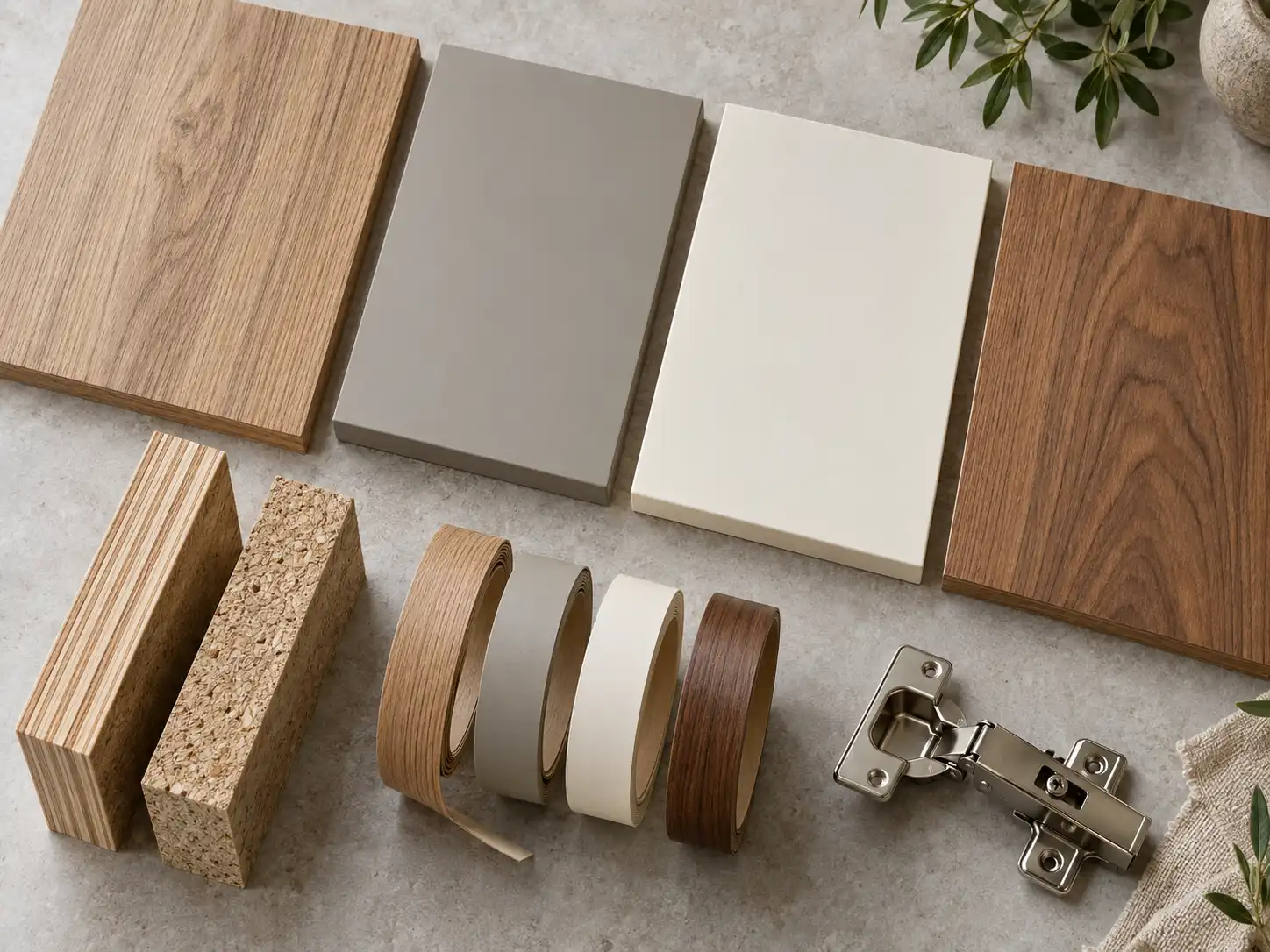
Material names are frequently used too broadly. “PET,” “melamine,” “veneer,” and “lacquer” normally describe a visible surface system or finish. They do not tell you the core panel, thickness, edge treatment, or hardware quality. Two doors can look similar in a render while performing differently in a humid kitchen, a rental apartment, or a high-use hospitality project.
Use this comparison table in every quote review.
On mobile, swipe left or right to view all table columns.
| Item to specify | Why it matters | What to write in the quote |
|---|---|---|
| Cabinet body substrate | Affects screw holding, moisture resistance, weight, and cost. | Panel type, grade, thickness, and intended use for sink or dry areas. |
| Door surface | Affects color, texture, repairability, and light reflection. | Melamine, PET, lacquer, veneer, or another stated finish; include color code and sheen. |
| Edge banding | Exposed edges affect appearance and moisture protection. | Edge material, thickness, adhesive system, and visible-edge locations. |
| Hardware | Determines daily operation and replacement compatibility. | Hinge, runner, lift-up, and pull-out brand/model or an approved equivalent. |
| Interior fittings | Often disappear from a headline price. | Shelf type, drawer box, pull-out basket, lighting, handles, and quantity. |
Material comparison: what should you choose?
- Melamine-faced board: Practical for value-focused projects and cabinet interiors when the specified panel and edge treatment suit the use case.
- PET-faced doors: Often selected for clean contemporary colors. Confirm the surface finish, substrate, edge detail, and sample color under the project’s actual lighting.
- Lacquered doors: Useful where a controlled sheen or custom color is important. Approve the gloss level and check repair and color-consistency procedures.
- Wood veneer: Appropriate when real wood character is part of the design. Confirm whether it is natural or engineered veneer, the stain or coating reference, grain direction, and batch-matching process.
Example specification line for a cabinet quote
Base cabinet carcass: [panel type], [thickness], [finish], sealed exposed edges; door: [surface system], [color/finish code], [sheen]; hinges: [brand/model or approved equivalent]; drawing revision: [number/date].
This one line is more useful than a quote that only says “premium PET cabinets.” For product and finish references, buyers can also review KEJIA’s kitchen cabinet and door-panel range.
3. Match Compliance Documents to the Exact Material You Are Buying

Environmental or compliance documentation should answer three questions: what product was tested, which standard applies, and whether that product is actually included in your order. A document for one panel does not automatically cover a different panel, finish, adhesive, or destination market.
For US-bound projects, the relevant discussion often concerns composite wood products such as hardwood plywood, MDF, and particleboard. The US EPA’s formaldehyde standards guidance explains the scope and labeling requirements under TSCA Title VI. Do not describe an unlisted product as compliant simply because another material in the project has documentation.
What to check on a test report or certificate
- Supplier or panel-producer name and the precise product name.
- Test standard, laboratory or certification body, report number, and report date.
- Panel category, thickness, surface condition, and stated application.
- Destination-market requirement and whether it applies to the finished component.
- Purchase-order line, batch, or delivery documentation that connects the report to your order.
Ask the supplier to attach applicable documents to the final specification package. Avoid language such as “all materials are certified” unless every material and the scope of certification can be demonstrated.
4. Verify Factory Capability and Quality-Control Records
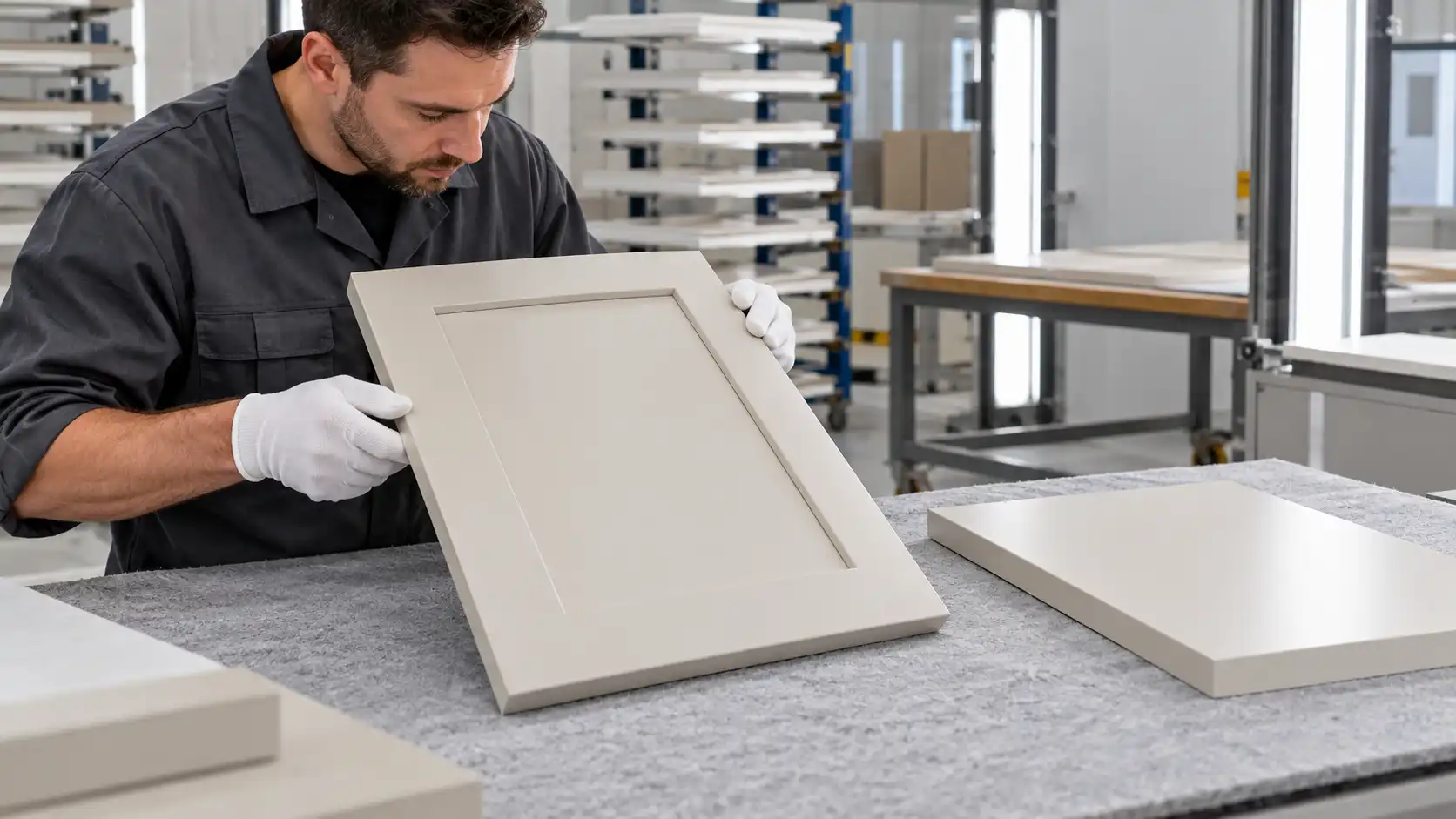
Factory size and machinery photos are useful context, but they are not proof that your project will be made to the right standard. The stronger signals are operational: a controlled drawing-review process, signed samples, incoming-material checks, in-process inspection, final inspection, and packaging labels that correspond to room and cabinet identifiers.
A practical custom cabinet manufacturer should be able to explain how it manages drawing revision control; panel thickness, color, and damage checks; hole position, door-gap, edge-banding, and finish checks; batch consistency for lacquer, PET, or veneer doors; final counts and room labels; and defect reports or replacement parts after delivery.
Evidence that is useful—and evidence that is not
Useful evidence includes a dated approval sample, inspection record, packing list, project-specific drawings, and photos that identify the relevant component without exposing confidential customer information. A broad factory brochure, a stock image of machinery, or a generic quality slogan is not enough to resolve a discrepancy in a live order.
When possible, agree on a final-inspection standard before the order is packed. Identify the sample to compare, the cabinet numbers to inspect, acceptable defect criteria, the number of units to check, photo format, and corrective-action deadline. For repeat apartment, hotel, or dealer orders, retain the first approved unit as a production benchmark for batch color, door alignment, drilling positions, and packing. It also shortens dispute resolution and protects installation schedules.
5. Approve Samples, Drawings, and Finish Before Batch Production
Do not approve a kitchen from a rendering alone. Screen color, lighting, camera settings, and material availability can all make a rendering differ from the manufactured finish. Ask for a physical door sample and, where important, a cabinet-body, countertop, handle, and edge-banding combination.
The approval record should include the sample date, color or finish code, sheen, grain direction where applicable, drawing revision, and the name of the person authorized to approve it. Keep the signed sample or a clearly documented reference sample until installation is complete.
For projects with several rooms or repeat units, agree on what variation is acceptable before production. This is especially important for wood veneer, natural stone, painted finishes, and any finish viewed under mixed lighting.
6. Put Lead Time, Packaging, and Installation Scope in Writing
“Lead time” is not one date. It can refer to drawing approval, production completion, ready-to-ship status, vessel departure, local delivery, or installation completion. Separate those milestones so a delay can be identified and managed.
On mobile, swipe left or right to view all table columns.
| Contract item | Confirm before signing |
|---|---|
| Production start | Trigger event, usually final drawings, deposit, and approved samples. |
| Production completion | Inspection point and photo or inspection-record requirement. |
| Packing | Carton or crate method, protection for finished doors, labels, and spare parts. |
| Shipping | Incoterm, loading responsibility, documents, insurance, and destination port or address. |
| Delivery and installation | Who unloads, checks quantities, installs, adjusts doors, and removes packaging. |
| Warranty and replacements | Contact person, response time, photo requirements, and method for replacement parts. |
For a complex whole-house package, a room-by-room packing list helps installers locate kitchen, wardrobe, vanity, and wall-panel items without opening every crate. Before requesting a project quotation, check KEJIA’s contact and inquiry page for the information the sales team needs.
How to compare two cabinet quotations fairly
Put both quotations into one comparison sheet before making a decision. Use the same cabinet numbers and room names as the drawing set, then record the specification rather than only the total price. If Supplier A includes plywood sink-base cabinets, soft-close drawer runners, and room-labeled crates while Supplier B does not name those items, the totals are not directly comparable.
For every cabinet group, compare quantity, dimensions, and drawing revision; carcass panel, door finish, edge banding, and hardware model; accessories such as pull-out baskets, waste bins, lighting, handles, and fillers; packing method, shipment terms, insurance, and destination charges; and exclusions, substitutions, lead-time assumptions, and warranty responsibilities.
Mark each field as “specified,” “different,” or “not stated.” Ask for a written clarification for every “not stated” field before awarding the order. This process often reveals that the apparent price gap comes from different scopes rather than different manufacturing efficiency. Where the project requires a substitute, document the original item, proposed alternative, technical difference, price impact, and approver in a revised quotation and drawing revision.
7. Use an Installation Acceptance Checklist Before Final Payment
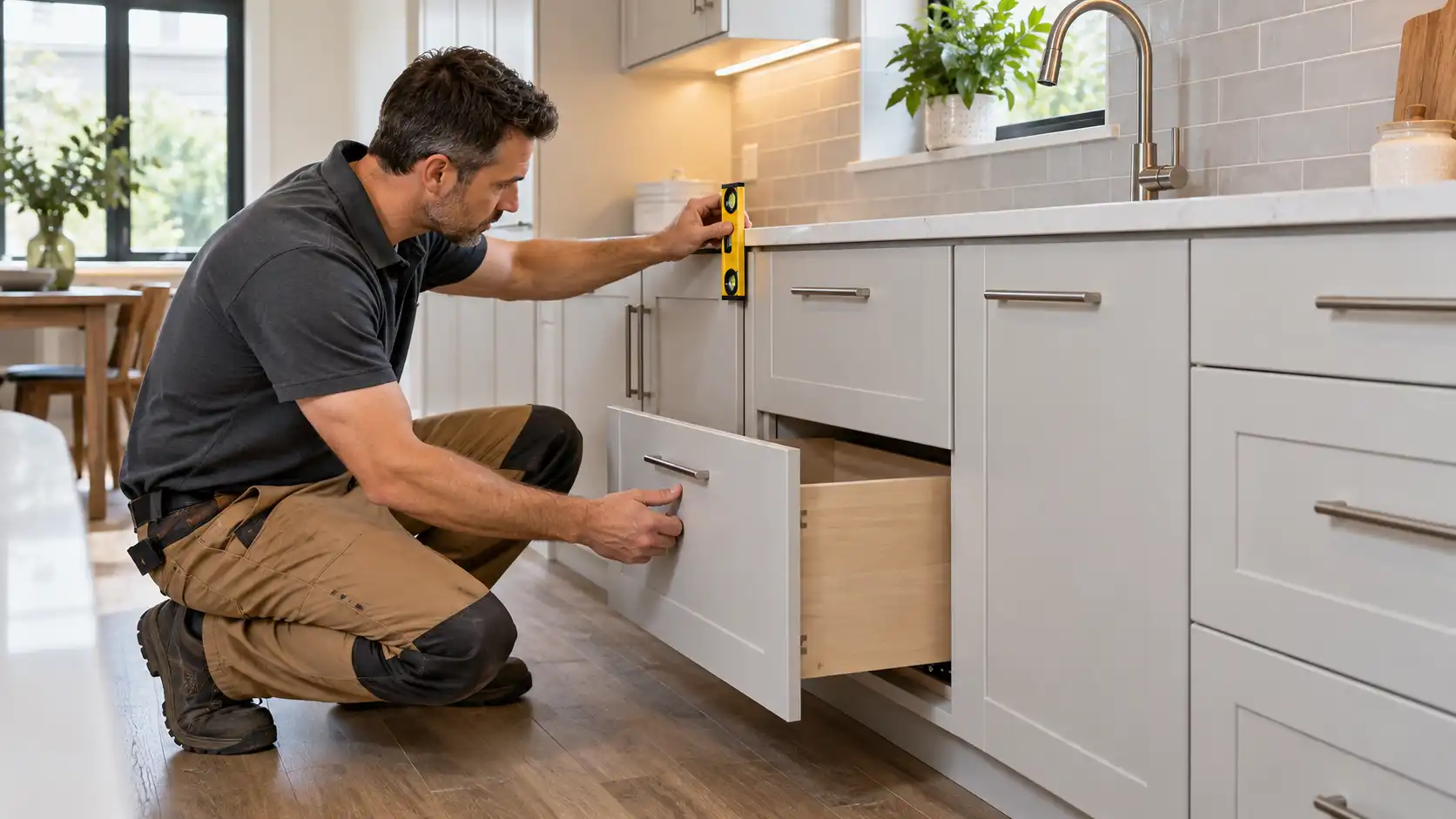
Acceptance is where the written specification becomes visible. Inspect cabinets in good lighting and compare them with the approved drawing and sample. Note issues by room, cabinet number, photo, and required correction date; this is much more actionable than saying that the kitchen “does not look right.”
Installation acceptance checklist
- Cabinet dimensions and appliance openings match the approved drawings.
- Cabinets are level, plumb, secure, and aligned with adjacent units.
- Door gaps, drawer operation, and soft-close function are consistent.
- Door color, sheen, grain direction, and veneer matching meet the signed sample.
- Exposed edges are sealed, clean, and free from chips or glue residue.
- Handles, hinges, runners, pull-outs, and accessories match the specification.
- All cartons, hardware bags, spare parts, and room labels have been counted.
- Punch-list items have a named owner and written completion date.
Common Mistakes That Create Avoidable Cabinet Problems
- Comparing only total price. Compare a line-by-line specification and inclusion list instead.
- Using a finish name as a full material specification. Add substrate, thickness, edge treatment, and hardware.
- Accepting generic certificates. Request documentation that maps to the actual order line.
- Approving only a render. Sign off on physical samples under relevant lighting.
- Using one “lead-time” date. Split approval, production, shipping, delivery, and installation milestones.
- Ignoring packing until the order is finished. Confirm labels, protection, and replacement-part packing before loading.
- Paying final balance before a defined inspection. Use a room-by-room punch list and correction process.
Frequently Asked Questions
Is a cabinet brand always the actual manufacturer?
Not necessarily. A brand may manage design, sales, installation, or after-sales service while one or more factories make components or perform finishing. The useful question is not whether every step is in one facility; it is whether production responsibility and warranty ownership are stated clearly for your order.
What should a custom cabinet manufacturer provide before production?
At minimum, request an itemized quotation, final drawings, a material and hardware specification, approved finish samples, the agreed production schedule, relevant compliance documents, a packing approach, and an after-sales contact. The documents should carry a revision number or date so the team works from the same version.
What should be included in a custom cabinet quote?
The quote should identify the cabinet body, doors, hardware, interior accessories, handles, countertop scope if included, packing, shipping terms, installation scope, tax or duty assumptions, lead time, and warranty. Any “or equivalent” substitution should require written approval before it is used.
Are PET, melamine, lacquer, and veneer interchangeable?
No. They can create different visual effects and have different production, maintenance, and matching considerations. More importantly, each surface can be paired with different substrates and edge details. Choose according to the intended room, budget, design reference, lighting, and performance requirement—not by a surface name alone.
How do I verify a cabinet material certificate?
Match the report to the named product, manufacturer, panel type, standard, date, and destination-market requirement. Then connect it to the purchase order or batch documentation. If the supplier cannot show how the document relates to the selected material, treat it as background information rather than proof for your order.
When should I approve cabinet samples?
Approve samples after the design direction and material specification are stable but before batch production begins. For finishes sensitive to color or grain variation, keep a signed reference sample and record the viewing conditions. Changes after approval should trigger a revised drawing, quote, and production date.
Request a Cabinet Specification Review
If you are comparing suppliers or preparing a kitchen-cabinet project, send KEJIA your drawings, finish references, destination market, required delivery date, and installation scope. The team can help turn those inputs into a material and specification review before quotation. You can also review the existing customization FAQs before contacting the team.