




Quick answer: Contractors and developers should choose cabinet hardware around how the project will be used, how the cabinet is built, the size of each door or drawer, site tolerances, the replacement plan, and the written warranty. A catalogue finish or headline price is not enough. Concealed soft-close hinges work well for most doors, but tall or wide doors may need a particular opening angle, cup position, or more hinges. Full-extension drawer runners need a verified load rating and a drawer box made to suit the runner. Lift-up systems help where a swing door would get in the way, but they must be calculated for the finished door weight and left accessible for adjustment. For multi-unit projects, set out the hardware brand or approved equivalent, quantity, test basis, adjustment range, and spare-parts process before production starts.
Who this guide is for
- Contractors coordinating cabinet installation, handover, and defects management.
- Developers standardising kitchen, wardrobe, vanity, or amenity-space specifications across repeated units.
- Project procurement teams comparing cabinet quotations with different hardware allowances.
- Designers and site managers who need hardware choices to match drawings, door sizes, and appliance clearances.
Key takeaways
- A hardware name alone is not a specification. Record the model, application, load or door-weight range, finish, adjustment, and warranty route.
- Hinge quantity and hinge type must follow the door’s size, weight, material, and opening requirement.
- A full-extension runner can be the right choice for access but the wrong choice if the drawer box, load, or side clearance is not designed around it.
- Lift-up hardware should be selected only after final door dimensions, handle position, and cabinet clearance are known.
- Hardware warranty is meaningful only when it states the covered component, project handover point, claim evidence, and availability of replacement parts.
- A pre-production sample cabinet and a site adjustment plan can prevent repeat defects across multi-unit installations.
Cabinet hardware decision matrix for project teams
On mobile, swipe left or right to view all table columns.
| Hardware area | Best starting choice | Select it when | Confirm before release | Common project risk |
|---|---|---|---|---|
| Hinged doors | Concealed soft-close hinge | Standard kitchen, wardrobe, vanity, and utility doors | Door height, weight, overlay/inset, opening angle, number of hinges, screw holding | Door sag, collision with pull-out units, poor reveal adjustment |
| Heavy or tall doors | Heavy-duty concealed hinge with a calculated hinge count | Tall pantry, wide wardrobe, thick or glass-framed doors | Actual door weight, centre rail, handle pull, substrate and fixing points | Too few hinges or weak screws cause long-term misalignment |
| Drawers | Concealed full-extension soft-close runner | Drawers need full access and a clean premium appearance | Dynamic load rating, drawer-box width, side clearance, anti-tilt requirement | Runner binding after an out-of-square carcass or overloaded drawer |
| Cost-led drawers | Side-mount ball-bearing runner | Utility units or approved value-engineered areas | Extension requirement, noise expectation, mounting clearances, drawer box material | Visible runner, lower adjustment tolerance, inconsistent close feel |
| Lift-up doors | Lift-up mechanism matched to the exact door weight | Overhead cabinets, appliance garages, restricted swing zones | Door size, weight, handle location, opening clearance, adjustment access | Door rises too quickly, will not stay open, or hits ceiling/soffit |
| Warranty and spares | Project-coded approved hardware schedule | Multi-unit, hotel, rental, or repeat programme | Coverage period, exclusions, claim procedure, replacement lead time, spare SKU list | No traceability when a component fails after handover |
Cabinet Hardware Selection for Contractors: Choosing Hinges
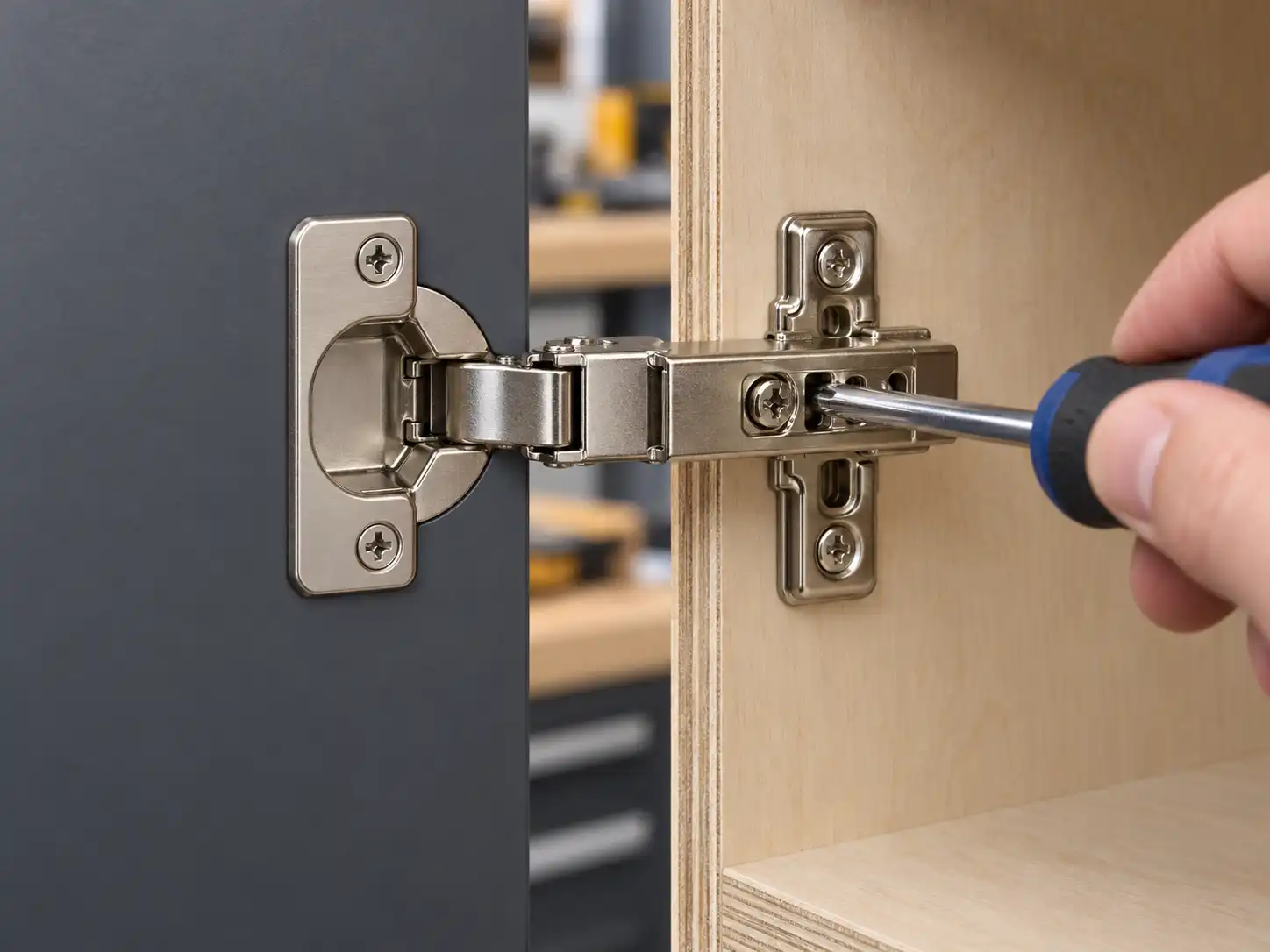
For most standard doors, a concealed soft-close hinge is a sensible starting point. It closes in a controlled way and still allows fine adjustment after installation. But “soft close” is not a complete specification. The hinge has to suit the door construction, whether it is full overlay, half overlay, inset, or a special corner; the opening angle; the door’s thickness and weight; the cabinet material; and anything close by, such as a pull-out, wall, or appliance.
Start with the approved door schedule: height, width, thickness, material, finish, handle position, and opening direction. A tall lacquered pantry door does not behave like a short melamine base-unit door. It may need more hinges, a different mounting plate, a wider opening angle, or a restrictor so it does not strike a wall or appliance handle. The factory should calculate and record the hinge count for each non-standard door rather than applying one fixed count throughout the project.
For projects that combine kitchen cabinets, wardrobes, or bathroom vanities, review the relevant KEJIA custom cabinet products alongside the door and hardware schedule. The selected hardware still needs to match the final cabinet construction and intended use.
Hinge selection rules that reduce call-backs
- Specify the application: State overlay, inset, corner, angled, or blind-corner use rather than writing only “soft-close hinge.”
- Verify door mass and geometry: Use final door material and dimensions; do not estimate from an early render.
- Check opening conflict: Confirm appliance handles, pull-out baskets, walls, and adjacent doors with the elevation and plan.
- Match screws to the carcass: Screw holding in particle board, MDF, and plywood differs. Pilot holes, screw type, and mounting plate design matter.
- Retain adjustment access: After installation, the installer must still be able to adjust side, depth, and height without damaging the finish.
Which drawer runners work best for cabinet projects?
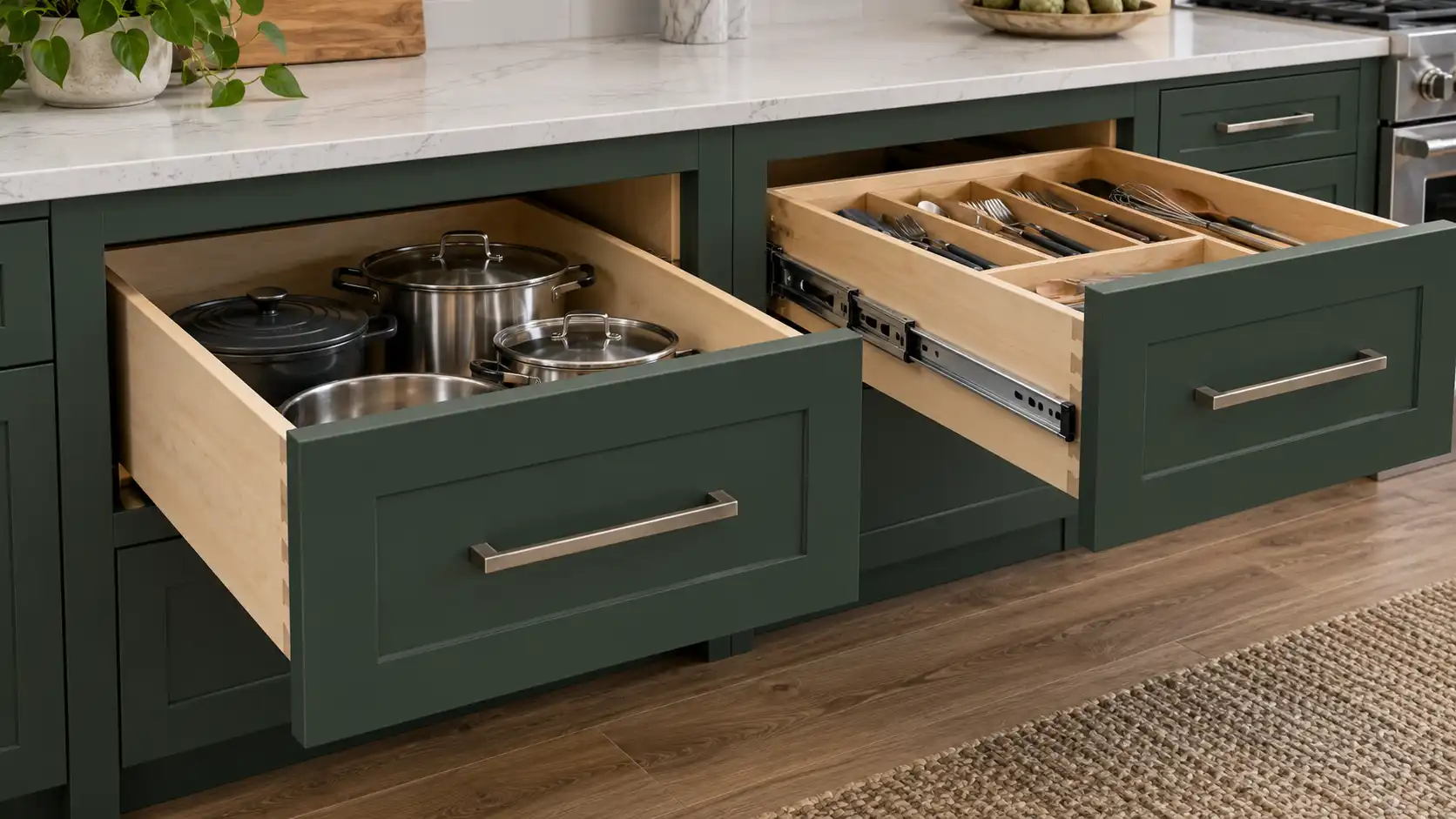
Choose a runner that suits the drawer load, the access required, cabinet tolerances, and the expected level of use. In many mid- to high-specification kitchens and wardrobes, concealed full-extension soft-close runners are a good fit: the drawer opens fully and the mechanism is hidden. They work particularly well for deep drawers carrying cookware, pantry supplies, or wardrobe accessories, provided the cabinet and drawer box are made to the runner’s dimensional requirements.
A quoted load rating needs context. Check whether it is static or dynamic, the runner length and test condition, and whether it applies to the pair. Then look at what the drawer will actually hold. A wide pan drawer full of stoneware puts a very different load on the runner than a shallow cutlery drawer. If users may open several wide drawers in the same cabinet at once, the design may need anti-tilt or interlock hardware.
On mobile, swipe left or right to view all table columns.
| Runner question | What to specify | Why the contractor or developer should care |
|---|---|---|
| Drawer function | Cutlery, pan, pantry, file, wardrobe, or utility drawer | Function determines access, likely load, and internal fittings. |
| Extension | Partial, three-quarter, or full extension | Full extension improves access but needs compatible runner and box dimensions. |
| Load | Stated dynamic load rating and test basis | Avoids a low-rated runner in a wide, heavily loaded drawer. |
| Drawer box | Material, height, width, base detail, and drilling pattern | A runner is only reliable when the box is made to its installation specification. |
| Carcass tolerance | Internal width, squareness, and fixing faces | An out-of-square cabinet can cause binding even with good hardware. |
| Adjustment and removal | Front adjustment and drawer release method | Makes final alignment, cleaning, and replacement faster after handover. |
When is lift-up hardware the right choice?
Lift-up hardware works well when an upper cabinet door needs to stay above the user’s working area or when a side-hinged door would block a walkway. It can suit appliance garages, overhead wall units, display cabinets, and compact kitchens. It should not be added as a late cosmetic upgrade. The mechanism has to match the finished door’s height, width, thickness, material, and handle position.
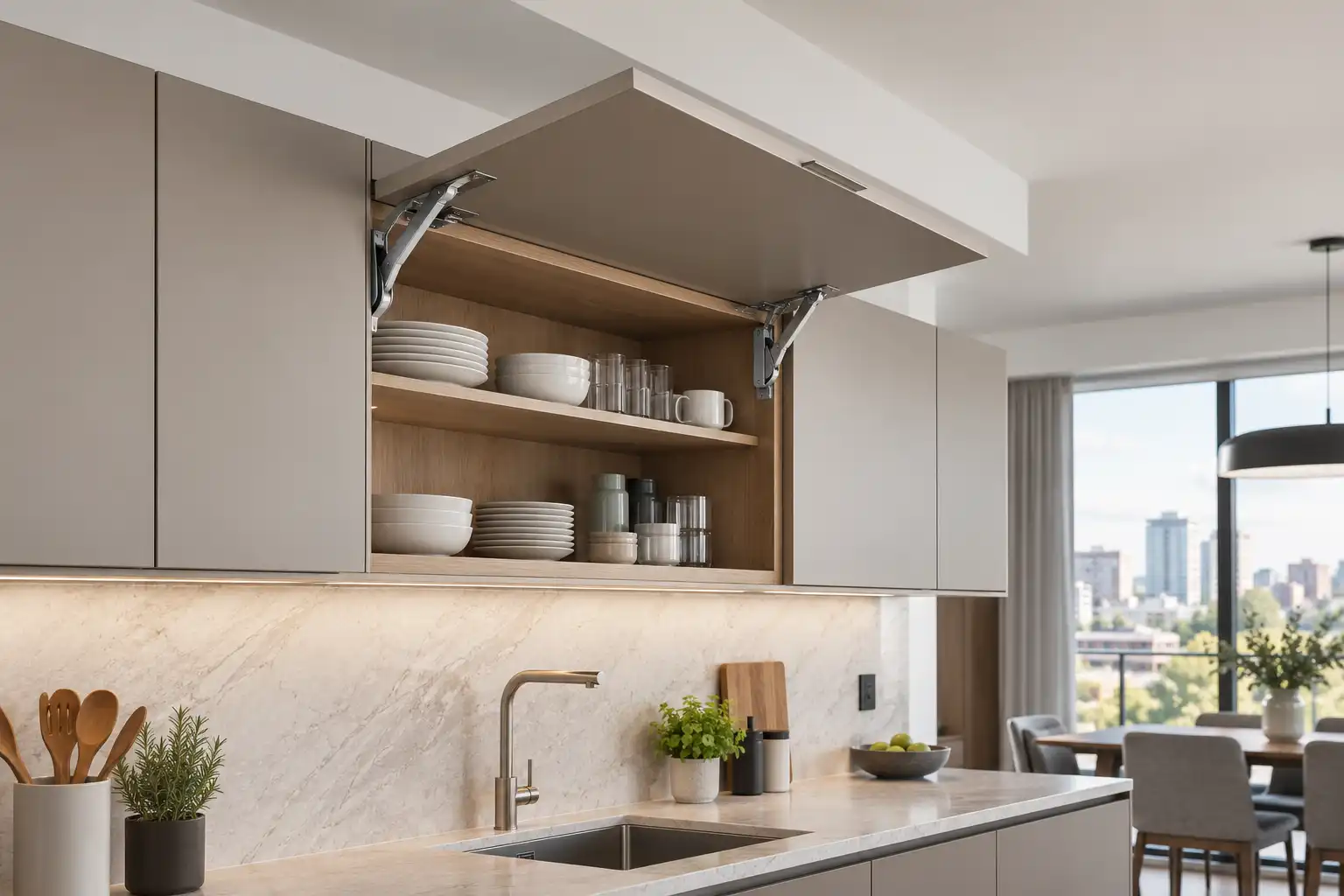
There are several motion patterns: parallel lift, flap, bi-fold, and stay-lift. The right option depends on the clearance above the cabinet and how the user reaches the door. A door that looks fine in a rendering can still hit a bulkhead, ceiling, pendant light, or sprinkler line on site. The specification should say how high the door needs to open, whether it needs more than one stop position, how the handle will be reached, and how the mechanism can be adjusted after installation.
For developers, lift-up systems make most sense where the extra cost and future replacement needs are justified. In a rental-apartment programme, standard hinges may be easier to maintain on secondary cabinets. A premium show unit, executive apartment, or amenity pantry may benefit from lift-up hardware, provided the project has a reliable route for spare parts.
What should a cabinet hardware warranty include?
A hardware warranty needs to work as a project document. A logo in the quotation does not clarify what the project can claim. Separate the hardware maker’s product warranty from the cabinet manufacturer’s responsibility for correct selection, drilling, installation, and adjustment. A runner may be covered for a manufacturing defect, while damage from an overloaded drawer, a water leak, incorrect site fixing, or unauthorized modification may be excluded.
The warranty should state the hardware series or approved equivalent, covered parts, coverage period, start date, exclusions, claim evidence, contact route, and availability of replacements. For a multi-unit development, ask for an approved hardware schedule and a small, labelled spare kit. It should cover the hinges, mounting plates, runner components, lift-up mechanisms, and adjustment tools that recur in the project, and it should use the final cabinet and room codes.
For load ratings, drilling patterns, adjustment limits, and test information, use the current manufacturer hardware technical documentation for the actual series specified. Do not assume that one hardware model has the same data as another model from the same brand.
Factory insight: hardware must be checked with the cabinet, not on a sample board
At KEJIA, we review hardware during shop-drawing approval, then test it in a representative cabinet before batch production. A hinge can work well on a small sample door but still need a different cup position or an extra hinge on a tall finished panel. A runner can slide smoothly in a test box and bind later if the production carcass has a different internal width or the site wall is out of plumb.
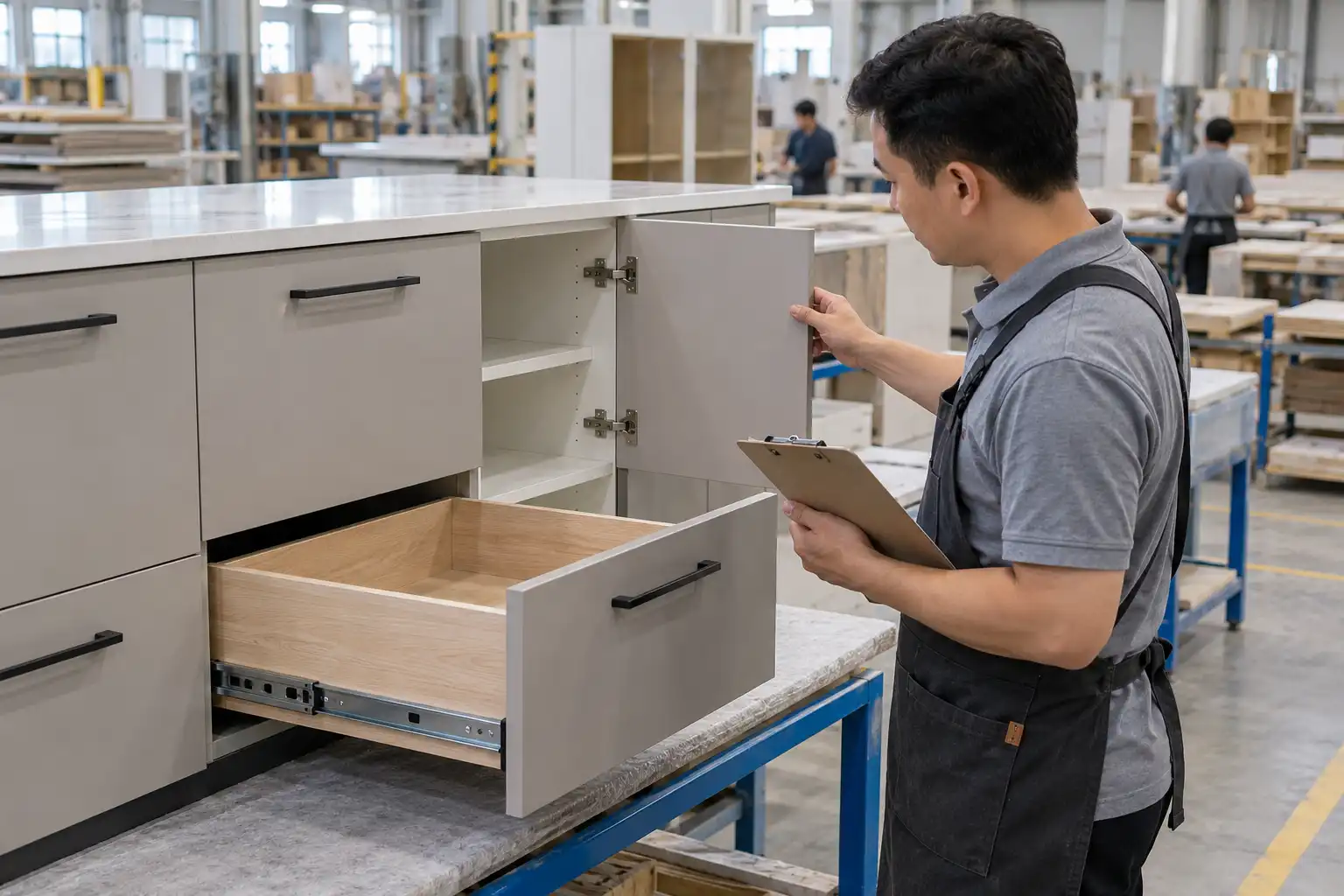
The factory review should cover final door weight, panel substrate, screw holding, hinge cup drilling, runner drilling positions, reveal gaps, soft-close action, lift-up door balance, and any clash with handles or internal accessories. During pre-shipment inspection, the team should open and close representative doors and drawers, check alignment and operation, match hardware labels to the approved schedule, and pack loose hardware by cabinet or room code. For repeat projects, keep the approved sample and hardware schedule as the reference for later phases and replacements.
Six common hardware selection mistakes and how to prevent them
1. Accepting “brand or equivalent” without an approval rule
An equivalent product can differ in load rating, adjustment, mounting pattern, or warranty process. Name the approved model, or set out the technical criteria and approval route before allowing a substitution.
2. Using one hinge count for every door
Door size, substrate, finish, and handle pull change the load. Require a hinge calculation for tall, wide, glass-framed, or heavy doors.
3. Selecting runners by price rather than drawer use
A low-cost runner in a wide cookware drawer often turns into an after-sales issue. Match runner length and dynamic load to the actual drawer contents and cabinet size.
4. Adding lift-up doors after services are coordinated
Late selection can cause conflicts with soffits, lighting, sprinkler lines, or appliance ventilation. Freeze door motion and clearance during shop-drawing review.
5. Ignoring installation tolerances
Cabinets fitted against uneven walls or floors need enough adjustment range and careful shimming. Check the setting-out line, wall condition, and front alignment before blaming the hardware.
6. Leaving spares and warranty evidence until handover
After occupancy, it is harder to identify a component or prove the original configuration. Keep a cabinet-code hardware schedule, dated inspection records, and a labelled spare kit.
Pre-production cabinet hardware checklist

- Confirm final cabinet elevations, door schedule, drawer schedule, and revision number.
- List hardware model, finish, application, and approved equivalent for each cabinet code.
- Calculate hinge quantity for non-standard, tall, wide, or heavy doors.
- Confirm required hinge opening angle, restrictor, overlay/inset condition, and nearby clearance.
- State runner extension, dynamic load rating, drawer-box dimensions, and anti-tilt requirement where applicable.
- Match every lift-up mechanism to the finished door size and weight; check ceiling, bulkhead, and handle clearance.
- Produce and approve one representative cabinet or sample unit with final hardware before batch production.
- Verify panel substrate, screw type, drilling points, and screw holding at hardware fixing locations.
- Include adjustment and operation checks in the factory QC record and site handover checklist.
- Approve labelled project spares, warranty coverage, claim contact, and replacement lead-time process.
Frequently asked questions
How many hinges does a tall cabinet door need?
There is no universal number. It depends on the finished door’s height, width, weight, material, handle load, hinge series, and how often it will be opened. Use the hinge manufacturer’s calculation guidance, and have the cabinet manufacturer confirm the count on the approved door schedule. A standard base-unit hinge quantity should not be carried over to a tall pantry or wardrobe door.
Are soft-close hinges suitable for rental apartments?
Usually, yes, if the hinge suits the door and the project has a replacement process. Soft-close can reduce slamming, but a rental programme should favour robust, widely available hardware and keep spare mounting plates or hinges under the relevant cabinet codes. There is little value in specifying complex mechanisms for low-value areas without a maintenance plan.
Should developers specify a hardware brand?
Naming a brand can help control expected quality, but the project still needs a series or model, technical requirements, and an approved-equivalent procedure. A different product from the same brand may have another load rating, adjustment range, or warranty. The cabinet schedule should make the required performance clear.
What runner load rating is needed for a kitchen pan drawer?
It depends on the drawer width, runner length, drawer-box construction, and expected contents. Ask for a stated dynamic load rating for the runner pair, then compare it with a realistic load of cookware and tableware. Wide drawers or intensive-use projects may need a higher-rated system and a cabinet design that carries the load properly.
Can lift-up hardware be fitted to any upper cabinet?
No. The mechanism must match the door’s finished dimensions and weight, the cabinet depth, the internal space, and the clearance above the unit. It also needs access for installation and adjustment. Select it on approved shop drawings rather than treating it as a late site change.
What is the difference between a hardware warranty and a cabinet warranty?
A hardware warranty usually covers defects in the hinge, runner, or lift mechanism itself. A cabinet manufacturer’s warranty may also cover selection, drilling, installation instructions, and factory assembly. The contract should clarify both scopes, exclusions, claim evidence, and who supplies a replacement component.
What hardware spares should a multi-unit project keep?
Keep the parts most likely to need adjustment or replacement: common hinges, mounting plates, runner components, soft-close parts, lift-up mechanisms where used, fasteners, and adjustment tools. Set quantities by cabinet and hardware code after looking at repeat counts, usage risk, and lead time. Avoid an undocumented percentage.
Request a project hardware recommendation before production
Hardware needs to be specified as part of the cabinet system. Doors, drawers, substrate, drilling, installation tolerance, and after-sales support all need to line up. Before releasing a project to production, send project drawings to KEJIA with the door and drawer schedule, project type, expected use, and warranty requirements. We can recommend hinges, runners, and lift-up systems, then set out the related QC checks and a practical spare-parts schedule.