




Who should use this manufacturer evaluation guide?
- Importers building a shortlist for a US multifamily cabinet package.
- Importers moving from samples to their first repeated production order.
- Developer procurement teams reviewing the importer’s proposed manufacturer.
Which findings should drive your supplier decision?
- Verify the legal seller, production site, and payment beneficiary together.
- Compare evidence of production control, not the number of machines in a brochure.
- Approve a cabinet assembly as well as decorative finish samples.
- Resolve missing compliance records and uncontrolled substitutions before release.
- Agree inspection, packing, and replacement responsibilities in writing.
Is a factory or trading company the better choice?
A manufacturer performs production operations; a trading company coordinates supply from other businesses. Some manufacturers also use a separate export company or outsource specialist operations. Ask for the actual operating arrangement instead of assuming that the sales company’s name describes every activity.
The choice depends on whether the supplier can control the specified cabinet system and remain accountable throughout the order.
On mobile, swipe left or right to view all table columns.
| Evaluation point | Manufacturer route | Trading company route | Evidence to request |
|---|---|---|---|
| Production access | Direct access may simplify technical review | Access depends on agreements with the producing factory | Named site, live walkthrough, and inspection-access arrangement |
| Product scope | Best for a repeatable package within the factory’s capabilities | Best for coordinating several product categories or specialist producers | Process map showing who makes each item |
| Engineering | Factory staff may resolve machining and assembly details directly | Technical questions may pass between organizations | Named drawing owner and an example of a resolved revision |
| Quality control | Confirm who can stop production and authorize rework | Confirm how the trader checks and releases factory output | Inspection records and corrective-action responsibilities |
| Replacement support | Confirm records and materials remain available for repeat parts | Confirm access to the original producer and specification | Cabinet-code, finish-reference, and claims procedure |
Best for direct factory sourcing: importers with a defined cabinet package and staff able to approve technical details. Best for a trading company: importers needing coordination across several producers, with disclosed sourcing and agreed inspection rights.
Not recommended: either route when the production location is concealed, responsibility changes between departments, or inspection is refused. A factory label does not prove dependable delivery; a transparent intermediary should be judged on its controls.
For private-label responsibilities, see the OEM and ODM cabinet manufacturing guide.
How do you verify a custom cabinet manufacturer in China?
Request the Chinese legal company name, business license, Unified Social Credit Code, registered address, production address, and contracting contact. Compare the seller on the quotation with the entity named in the proposed order and payment instructions.
Company registration is one starting point. The Government of Canada’s guidance on due diligence in China identifies China’s National Enterprise Credit Information Publicity System as a source for checking registration, business scope, address, and license status. These identity checks are relevant to supplier verification; that Canadian guidance is not a US product-compliance standard.
Registration alone does not establish factory ownership, capacity, or workmanship. If the seller, factory operator, and payment beneficiary differ, request a documented explanation of their roles. Verify changed payment details through an independently established company contact before payment.
Next, connect the company to the proposed production site. Request a live walkthrough that follows a cabinet component through cutting, edge banding, drilling, assembly, inspection, and packing, including any outsourced stages. A prerecorded tour can introduce the business, but it cannot establish which line will handle your order.
What audit evidence should a shortlisted supplier provide?
Ask for anonymized records that connect to one order or sample. A folder of unrelated certificates, workshop images, and shipping photographs may show activity without showing control of the cabinet system you intend to buy.
Use this evidence table during supplier comparison. The actions are recommended procurement decisions, not an industry certification scheme.
On mobile, swipe left or right to view all table columns.
| Audit area | Evidence to request | What to verify | Hold point |
|---|---|---|---|
| Seller and factory identity | License details, site address, entity relationship explanation | Quote, order, producer, and beneficiary roles are consistent | Unexplained entity or address mismatch |
| Production capability | Process map, live tour, proposed order routing | Required construction and finish processes are covered | Critical operations have no identified owner |
| Drawing control | Anonymized shop drawing and revision log | Cabinet codes, units, dimensions, and approvals match | Production relies on unrecorded chat changes |
| Materials and hardware | Component schedule, supplier records, exact hardware models | Sample and quotation describe the same build-up | Unapproved substitutions remain possible |
| US composite-wood scope | Applicable compliance records and label examples | Records relate to the materials being offered | Generic claim with no traceable supporting records |
| Sample and finish approval | Representative cabinet and signed finish reference | Construction, visible edges, function, and finish agree | Decorative chip is the only acceptance reference |
| QC and rework | Inspection sheet and closed defect example | Measured results, acceptance criteria, and recheck are recorded | No evidence that defects are closed before packing |
| Schedule and capacity | Milestone plan and material availability confirmation | Approval, production, inspection, and dispatch dates are separated | Dispatch is promised without a production-release basis |
| Packing and replacements | Carton specification, packing list, claims workflow | Unit/cabinet codes trace parts through delivery and replacement | Missing parts cannot be identified from records |
Mark each line Verified, Pending, or Unacceptable, with a reviewer, date, and evidence reference. Keep critical pending items open until evidence closes them. Do not let a strong showroom presentation compensate for an unresolved identity or material-compliance issue.
What should the sample prove before a project order?
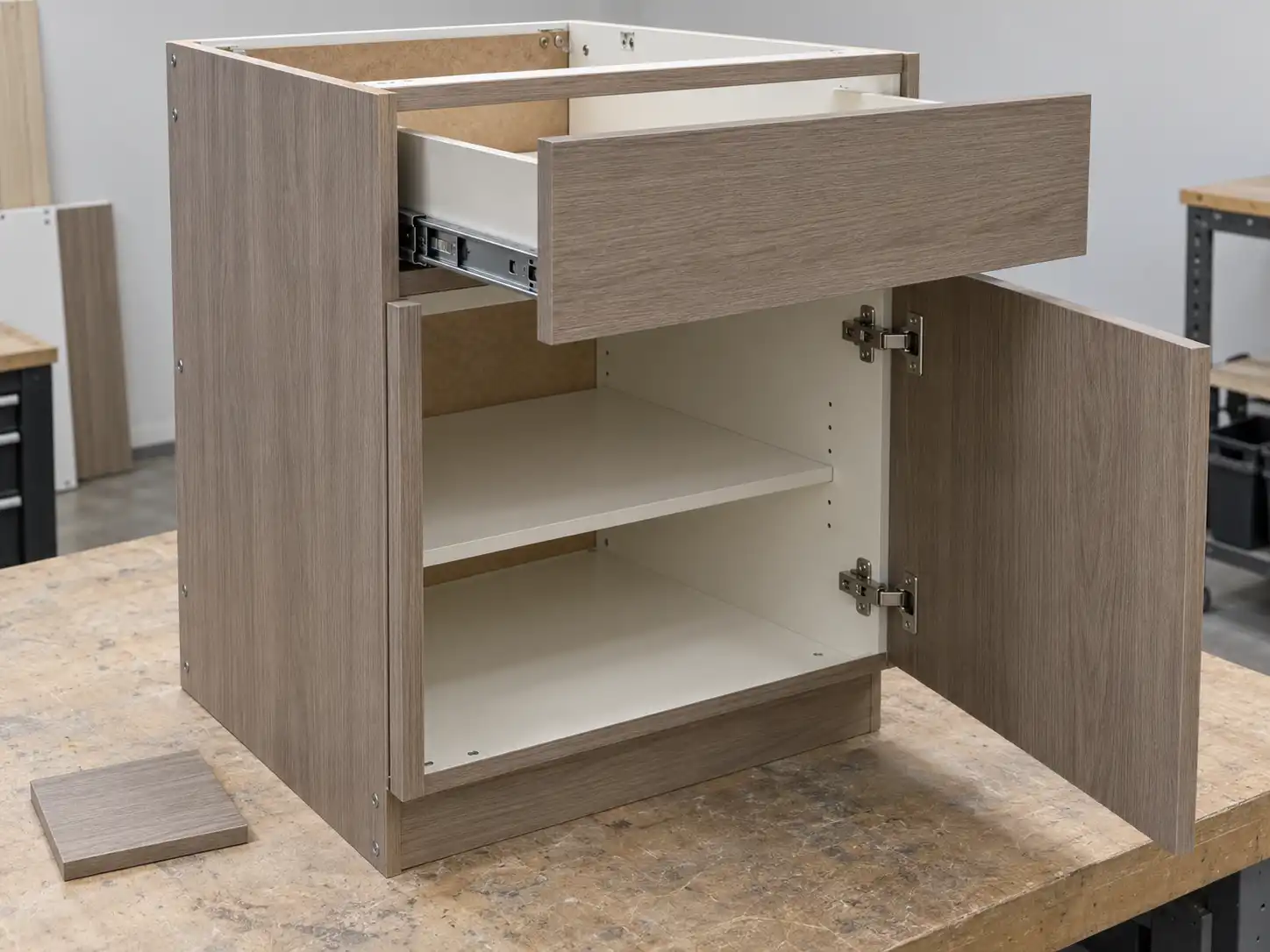
A door sample shows appearance. A representative cabinet assembly also reveals how the supplier controls fit and construction. Select a sample with features that matter to the apartment package, such as a drawer, exposed end panel, finished edge, or service opening.
Inspect the sample against a written schedule covering carcass and back-panel construction, door substrate, surface finish, edge treatment, joints, fasteners, hinge model, and drawer runner model. Operate the hardware and check access for adjustment and installation. Agree any required load or durability tests separately; a brief showroom demonstration is not a performance test.
Record sample identity, drawing revision, component specification, and finish reference. Define viewing conditions for appearance approval, including lighting and viewing distance. Photographs help document defects but should not be the sole reference for color or sheen.
For a repeated layout, request a pilot assembly where installation risk justifies it. Confirm fillers, door swings, appliance clearances, service access, and assembly instructions before repeating the design. Sample approval should identify what is accepted and which corrections must carry into production.
What US material documentation should you check?
For cabinets containing regulated composite wood, check the TSCA Title VI scope. EPA explains that finished goods generally do not require separate formaldehyde emissions testing and certification, but must use compliant composite wood panels and meet applicable recordkeeping and labeling requirements. Certain non-exempt laminated products have additional requirements. See the EPA compliance FAQ for regulated stakeholders.
Request records identifying the panel producer and the material offered, applicable certification details, supplier compliance statements, and label examples. Check that the documentation can be connected to the proposed cabinet materials and subsequent shipment. An unrelated certificate or an “eco-friendly” description is not enough.
Confirm importer responsibilities with the project’s qualified compliance adviser or customs broker. This check addresses composite-wood emissions, not every requirement for the shipment, local installation, or cabinet performance. No KEJIA certification status is asserted by this guide.
How can you assess production control beyond the showroom?
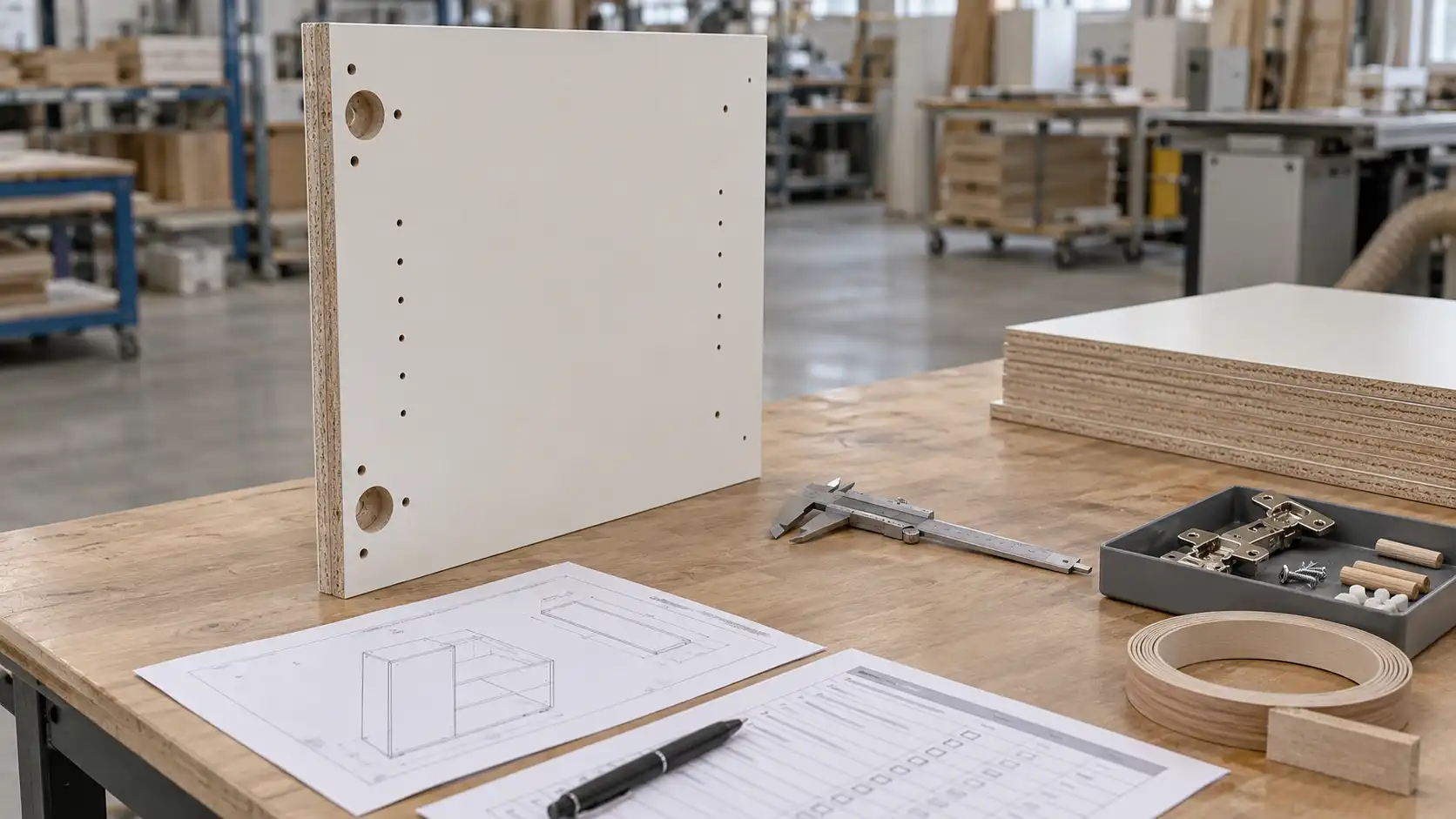
Manufacturing evaluation example: a left-hand and right-hand base cabinet can share the same finish while requiring different drilling and door orientation. If a late layout change reaches the drawing team but not machining or packing, a visually acceptable cabinet may still arrive with the wrong configuration.
Ask the supplier to demonstrate how one changed cabinet code moves through drawing approval, cutting and drilling files, hardware allocation, inspection, and carton labeling. Check who withdraws the obsolete revision and whether work already started is reviewed. This is a recommended audit exercise, not a report of a KEJIA project result.
Also examine a defect record. It should identify the affected component, the requirement it failed, the correction, and the reinspection result. A photo captioned “QC passed” gives little information without the drawing, sample, or measured criterion behind it.
For finish consistency, ask how adjacent fronts and later replacements are compared with the approved reference. Confirm whether a replacement may require matching several visible fronts together. Neither a retained color code nor a spare door guarantees an invisible match across later production batches.
How should quotations and delivery promises affect selection?
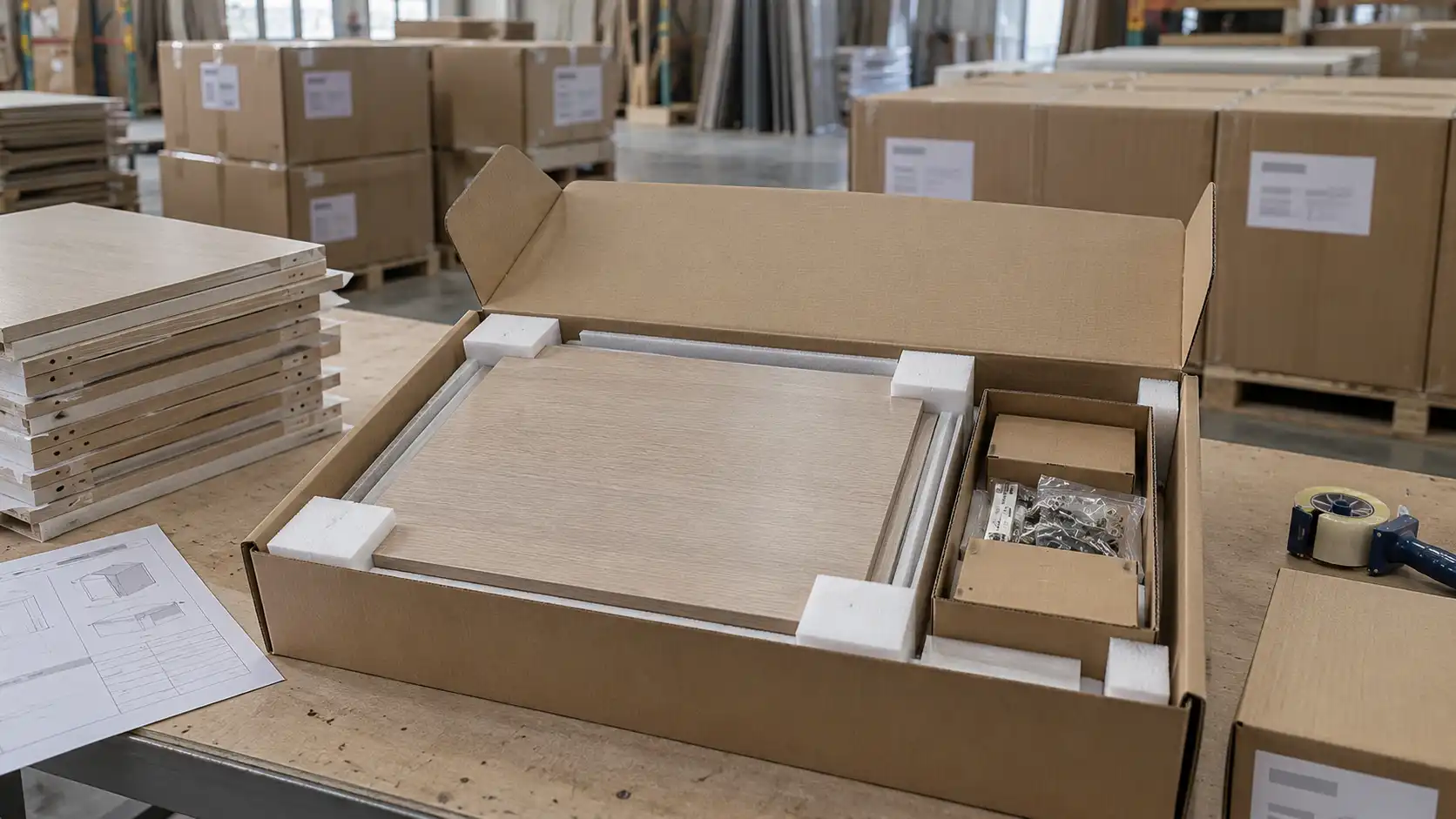
Issue the same coded scope to every candidate and ask each to list deviations. Compare cabinet construction, hardware, decorative panels, fillers, accessories, packing, and inspection scope before comparing totals. Use the cabinet quotation comparison guide for the detailed commercial review.
Specify the selected Incoterms® rule, named place or port, and version. The ICC Incoterms overview explains the rules’ role in allocating transport-related responsibilities, costs, and risks. Keep installation, payment milestones, acceptance criteria, and defect remedies explicit in the order documents.
Ask when the production clock starts and what can change the schedule. Separate sample approval, drawing release, material readiness, manufacturing, inspection, dispatch, transit, and site delivery. A date measured from the first inquiry is not equivalent to a confirmed schedule after technical approval.
For repeated apartments, confirm labels connect cartons to unit, room, cabinet, and component codes. Agree how claims are documented, who pays agreed replacement costs, and how replacement timing will be confirmed. “Warranty included” is insufficient without the practical process.
Which supplier-selection mistakes create avoidable risk?
- Treating a showroom as a factory audit. Display quality cannot demonstrate batch control. Review the actual production route and order records.
- Choosing by company type alone. The label can hide subcontracting or coordination gaps. Identify the producer and accountable owner for each stage.
- Approving appearance without construction. A finish chip cannot reveal assembly or hardware problems. Review a representative cabinet and component schedule.
- Accepting a generic certificate. Its scope may not match the materials offered. Connect the documentation to the producer, material, and order.
- Comparing incomplete prices. Missing panels, packing, or hardware distort totals. Normalize scope and record exclusions first.
- Leaving defects for arrival. Rework can become harder after shipment. Agree factory inspection, correction, and release criteria in advance.
What belongs in your factory evaluation checklist?
Use one record per candidate. The following is a practical starting checklist; adapt it to the project specification.
- Record the legal seller, license identifier, actual factory, and beneficiary relationship.
- Name the engineering, production, QC, and export contacts.
- Identify in-house and outsourced processes for the proposed package.
- Attach the drawing revision, cabinet schedule, quantities, and governing units.
- Confirm exact materials, hardware models, and substitution-approval rules.
- Record sample approval and any corrections still pending.
- Connect applicable US composite-wood records to the offered materials.
- Agree dimensional, appearance, function, and inspection criteria.
- Record the milestone schedule and conditions for production release.
- Approve unit-coded packing and replacement-part identification.
- Agree inspection access, defect closure, and claims responsibilities.
- Sign off each critical evidence gap before the relevant commitment.
Keep the checklist within the wider B2B custom cabinet buying checklist so supplier approval remains connected to specification, purchasing, and delivery.
What do US importers ask before choosing a manufacturer?
Is buying directly from a factory always cheaper?
No. Compare the same construction, finish, hardware, order quantity, packing, and delivery scope. A factory quote may exclude coordination or services included by a trader. Assess the complete purchase scope and the team’s ability to manage approvals and inspection before treating a lower cabinet price as a saving.
Can a remote factory audit replace an on-site visit?
A remote audit can screen identity, process coverage, communication, and records. It has limits: the supplier controls the camera, and a video cannot independently establish every production condition. Use on-site or independent inspection where unresolved issues, order value, technical complexity, or the consequences of failure justify further verification.
What is the most useful sample for repeated apartment kitchens?
Choose a representative assembly that tests the important construction and installation details, supported by approved finish samples. A drawer base or another technically demanding unit may expose more than a plain display door. Record its specification and corrections, then verify that the repeated production order uses those same controlled references.
Does a TSCA Title VI statement prove overall cabinet quality?
No. It addresses a specific composite-wood compliance context. It does not establish cabinet dimensions, finish matching, hardware durability, installation suitability, or packaging performance. Verify the applicable documentation, then assess those other requirements against the signed drawings, material schedule, sample references, and separately agreed inspection or test criteria.
How should an importer evaluate minimum order quantities?
Ask for the minimum quantity by cabinet system, finish, special component, and shipment arrangement. Also ask whether samples or pilot units have different terms. A supplier-wide MOQ may conceal finish-batch or hardware constraints. Confirm the conditions for repeat orders and replacements as well as the first project quantity.
What should happen when the supplier cannot provide evidence?
Record what is missing, why it matters, who will provide it, and when it is due. Allow anonymized or confidential review where appropriate. Keep the relevant decision pending. If a critical requirement remains unverifiable, remove the supplier from that order’s shortlist instead of replacing verification with a verbal assurance.
Request a factory evaluation checklist for your US project
Request the factory evaluation checklist from KEJIA. Include your US project location, apartment unit count, cabinet scope, procurement stage, and target delivery window. Mention “factory evaluation checklist” in the message so the request is clear.
Use the same evidence requirements when evaluating KEJIA and every other candidate. A useful shortlist records what has been verified, what remains open, and who is responsible for closing each issue before the order advances.