
The modern kitchen has transitioned from a mere utility zone into a highly engineered “living laboratory.” In this evolution, the cabinet is no longer a passive wooden box but a dynamic interface that integrates lighting, power, and kinetic motion. When we conduct a factory technical analysis of under kitchen cabinet lights and smart storage, we are evaluating how to merge electrical infrastructure with structural joinery without compromising the integrity of either.
For developers and high-end homeowners, the goal is “Invisible Technology”—systems that perform flawlessly but remain hidden within the cabinetry’s DNA.
1. Advanced LED Integration: The Thermal and Optical Challenge
The primary search intent for under kitchen cabinet lights focuses on visibility, but the engineering challenge is heat dissipation and light consistency.
The Thermal Sink Factor
LED strips, particularly the high-output COB (Chip on Board) versions we prefer, generate significant localized heat. In a standard wooden cabinet, wood acts as an insulator, trapping heat and leading to “LED decay” (where the light dims or shifts color over 12–18 months).
-
The Factory Solution: We CNC-mill a dedicated 12mm deep channel into the bottom panels of the wall cabinets. We then press-fit an anodized aluminum extrusion. This aluminum acts as a passive radiator, pulling heat away from the LED diodes and dissipating it into the air, extending the life of the system to over 50,000 hours.
Diffusion and the “Polka-Dot” Problem
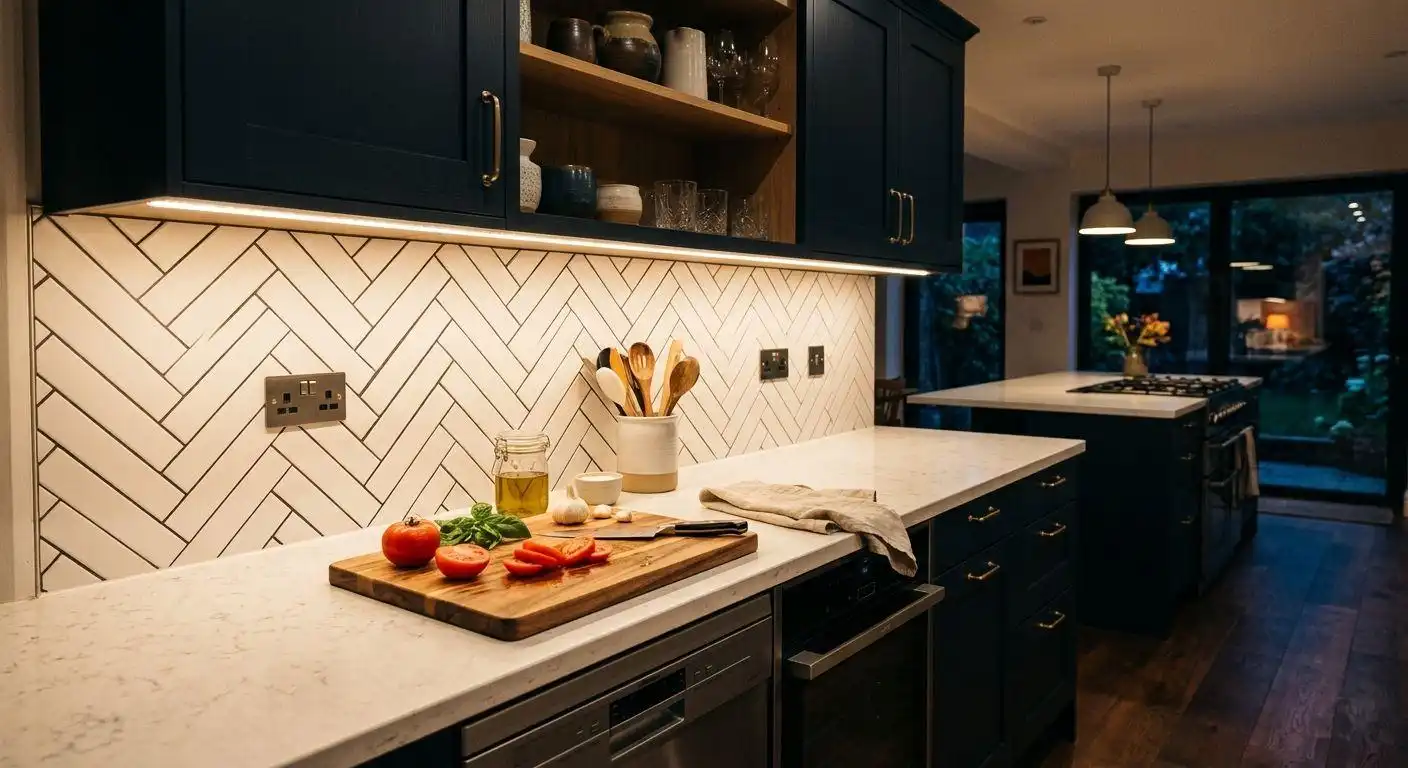
Cheap LED installations suffer from visible “dots” reflected on glossy quartz countertops. To achieve a professional finish, our integrated under kitchen cabinet lights utilize high-density strips (120+ LEDs per meter) paired with a frosted polycarbonate diffuser. The diffuser is engineered with a specific opacity to blend the individual light points into a single, seamless bar of light, providing uniform task illumination for food preparation.
2. Kinetic Engineering: The Physics of Smart Storage
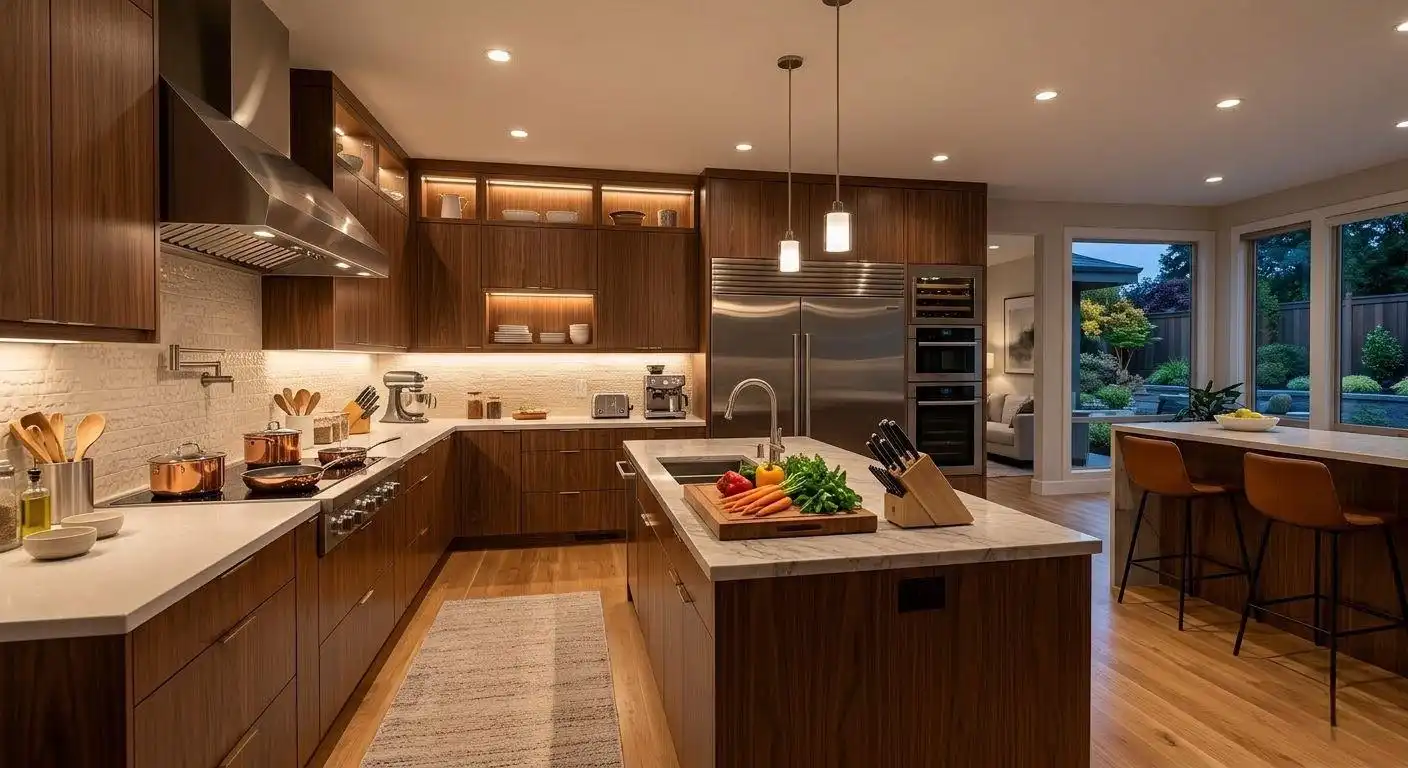
Smart storage is more than just wire baskets; it is about managing the inertia of heavy loads. When a user pulls out a pantry unit containing 50kg of dry goods, the mechanical stress on the cabinet carcass is immense.
Dynamic Load Distribution (DLD)
In our factory technical analysis, we test storage hardware based on DLD metrics. For “Magic Corner” or “LeMans” units, the pivot points are reinforced with steel mounting plates. Unlike standard retail cabinets where hardware is screwed directly into the wood, we use M5 through-bolts that clamp onto the 18mm plywood core. This prevents the “hinge-tear” effect that occurs when heavy smart-storage units are operated frequently.
Vertical Lift Logistics
The 2026 trend for “Hidden Kitchens” involves motorized wall cabinet inserts. These systems allow the entire internal shelf to descend to the countertop level.
-
The Engineering Requirement: This requires a reinforced top-rail system capable of supporting the motor’s torque. We utilize a dual-actuator system to ensure the shelf stays perfectly level during its 450mm travel path, preventing glassware from shifting or tipping.
3. Sensor Logic and Smart Home Connectivity
A truly smart kitchen responds to the user’s presence. We have moved beyond manual switches to integrated sensor logic.
IR and Capacitive Sensing
We offer two primary integration methods for under kitchen cabinet lights:
-
Infrared (IR) Wave Sensors: Embedded into the gable of the cabinet. A simple hand wave toggles the light. This is critical for preventing cross-contamination during raw food handling.
-
Capacitive Touch Dimming: The hardware itself becomes the switch. Touching a specific metal trim or a “touch-sensitive” spot on the wood veneer allows the user to dim the lights from 10% to 100%.
Smart Hub Integration
Our factory-installed drivers are now compatible with Zigbee 3.0 and Matter protocols. This means your under kitchen cabinet lights can be synced with the home’s circadian rhythm—bright cool light in the morning to stimulate productivity, and warm, dimmed amber light in the evening to prepare the body for rest.
4. Space Management: The Interior Anatomy
The “Internal Volume Efficiency” (IVE) of a cabinet is a key performance indicator. Standard cabinets often have 20–30% “dead space.” Smart storage recovers this.
Drawer-in-Drawer Systems
To maintain a clean, minimalist exterior, we utilize a “hidden drawer” system. Behind a large 360mm pot-drawer front, we integrate a 60mm cutlery drawer. This requires precision milling of the side panels to accommodate two sets of slides (Blum Legrabox or equivalent) within a single carcass footprint.
Waste Management Engineering
Modern waste separation requires significant space. Our integrated waste units are floor-mounted within the sink base, featuring a specialized “Odour-Seal” lid that remains fixed to the cabinet sides while the bins pull out. This involves a complex gasket system that ensures the kitchen remains fresh despite housing organic waste.
5. Technical Specification Table: The Factory Standard
For B2B procurement, we adhere to the following technical benchmarks for integrated systems:
| System Component | Material/Standard | Performance Metric |
| LED Profile | 6063-T5 Anodized Aluminum | Heat dissipation up to 15W/meter |
| Circuitry | 22AWG Copper Wiring | Low voltage drop over 5-meter runs |
| Storage Finish | Chrome-Plated Carbon Steel | 48-hour neutral salt spray test (NSS) |
| Slide Mechanism | Synchronized Full-Extension | 100,000 cycles at 40kg load |
| Power Supply | Class 2 SELV Transformer | Short-circuit and overload protection |
6. Installation Logistics: The “Last Mile” of Tech Integration
The most common failure point for under kitchen cabinet lights is not the hardware, but the wiring path.
-
Concealed Wiring Channels: In our factory, we mill 8mm deep “cable runs” on the top and back of the cabinet boxes. This allows the installer to daisy-chain multiple cabinets together without any wires being visible inside the cupboards or under the units.
-
The “Driver Garage”: We designate a specific ventilated area, usually above the refrigerator or inside a decorative crown molding, to act as the “Driver Garage.” This keeps the transformers accessible for maintenance but completely hidden from view.
7. FAQ: Engineering and Implementation
Q: Does integrating electronics reduce the structural lifespan of the wood?
A: If done incorrectly, yes. However, by using CNC-milled channels rather than haphazard drilling, we maintain the structural tension of the plywood. Our designs are stress-tested to ensure that the 12mm light channels do not create “shear points” in the panel.
Q: How do you manage power for island cabinets with smart storage?
A: For islands, we utilize “Power Loops” through the toe-kick area. We install pop-up sockets into the stone countertop which are pre-wired through the cabinet carcass into a floor-mounted junction box.
Q: What is the maintenance protocol for motorized storage?
A: The motors are sealed units and require no lubrication. We recommend a “Cycle Check” every 12 months to ensure the limit switches are still calibrated to the correct height.
8. Conclusion: The Invisible Infrastructure
Mastering under kitchen cabinet lights and smart storage requires a factory that thinks like an electronics manufacturer and a furniture builder simultaneously. The value of a modern kitchen is no longer just in its square footage, but in its “Internal Intelligence.” By specifying integrated lighting and kinetic hardware at the factory level, you are ensuring a level of precision that on-site retrofitting can never achieve.
As a dedicated custom cabinetry factory, we invite architects and developers to collaborate with our engineering team to create the next generation of intelligent kitchens.