
Введение
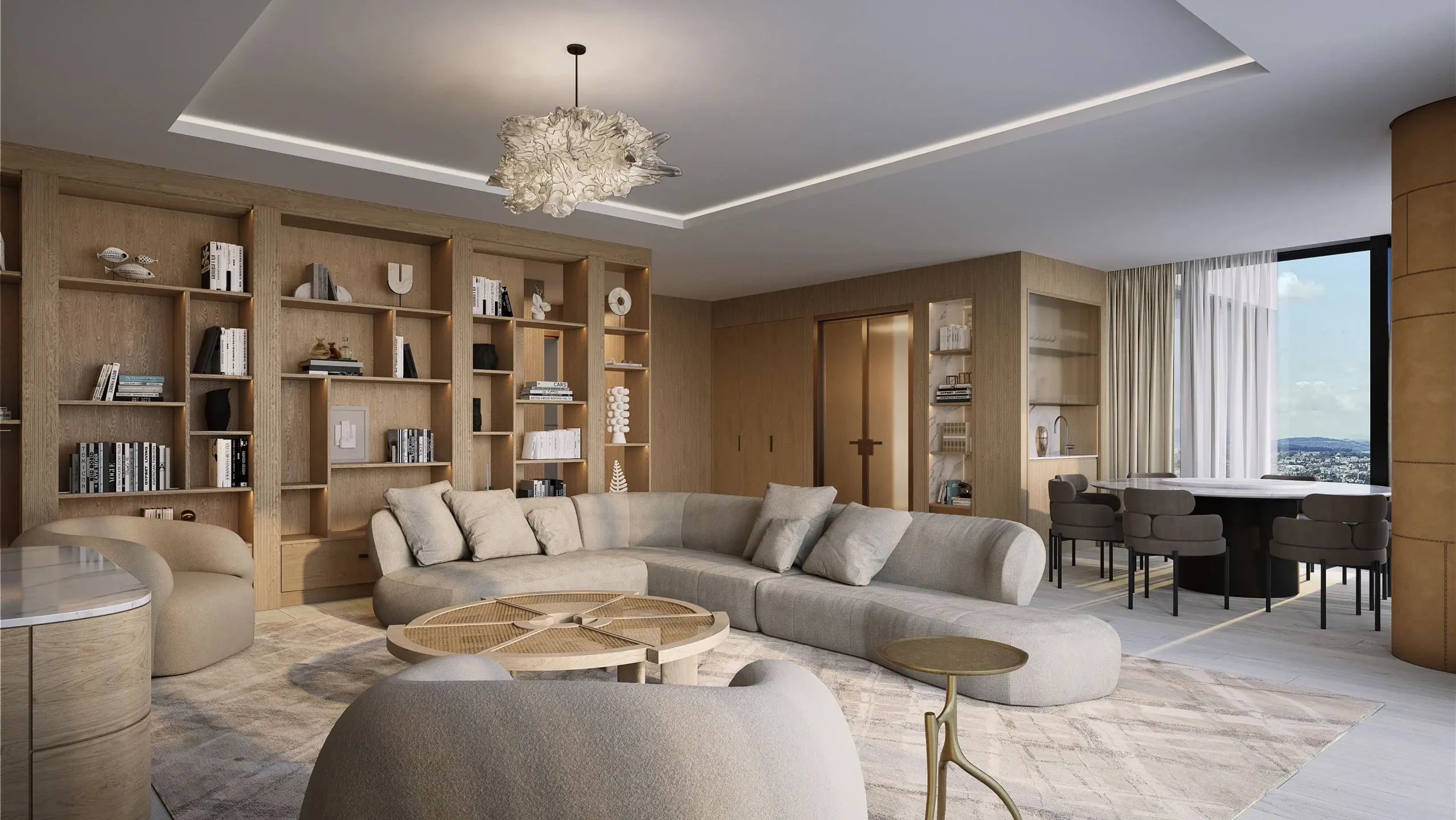
Solid wood vs plywood cabinets is one of the most common comparisons homeowners make before ordering custom kitchen cabinets.
Many people assume solid wood cabinets are automatically better because they cost more. Others believe plywood is simply a budget alternative.
After years in cabinet manufacturing, we’ve found that both assumptions can be misleading. Some of the most expensive kitchens we build use plywood cabinet boxes, while many solid wood components are reserved for doors and decorative details.
Understanding the difference between solid wood vs plywood cabinets can help homeowners avoid expensive mistakes and choose materials that perform better over the long term.
Core Takeaways:Solid Wood vs Plywood Cabinets: Why Homeowners Often Get Confused
| Key Point | Solid Wood Cabinets | Фанерные Шкафы |
|---|---|---|
| Best Use | Doors, frames, decorative panels | Cabinet boxes, shelves, structural parts |
| Moisture Behavior | Expands and contracts more obviously | More stable because of cross-layer structure |
| Long-Term Shape | Can warp, cup, or crack if conditions are poor | Usually keeps its shape better |
| Appearance | Natural grain and warmer texture | Depends on veneer, laminate, or finish |
| Расходы | Usually higher | More cost-efficient for structure |
| Factory Preference | Used carefully in selected areas | Commonly used for strong cabinet construction |
| Best For | Furniture-style details | Kitchens, wardrobes, vanities, utility cabinets |
Why This Comparison Matters
Cabinets are not judged only by how they look in photos.
Most cabinet problems appear slowly:
- A door gap becomes uneven.
- A drawer no longer closes smoothly.
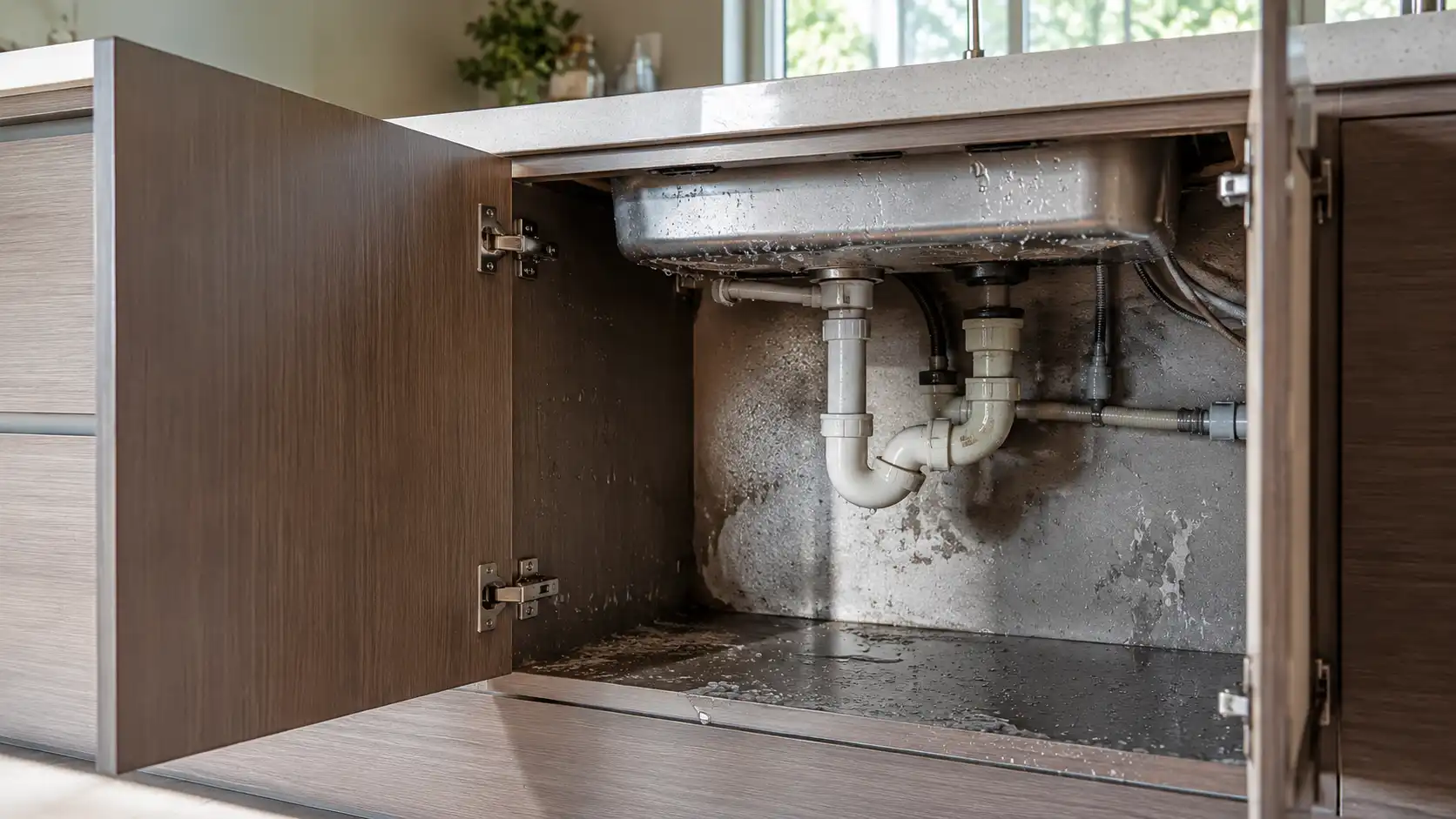
- The sink cabinet starts swelling near the edge.
- A tall pantry cabinet begins to twist slightly.
- Shelves sag under long-term weight.
- Painted joints show hairline cracks.
These issues often have less to do with surface style and more to do with material movement, moisture control, machining accuracy, and cabinet structure.
This is why experienced cabinet makers do not simply ask, “Which material sounds more expensive?”
They ask:
Where will this material be used, and how will it behave after years of use?
That is the real comparison.
What Happens in a 24-Hour Water Soak Test?
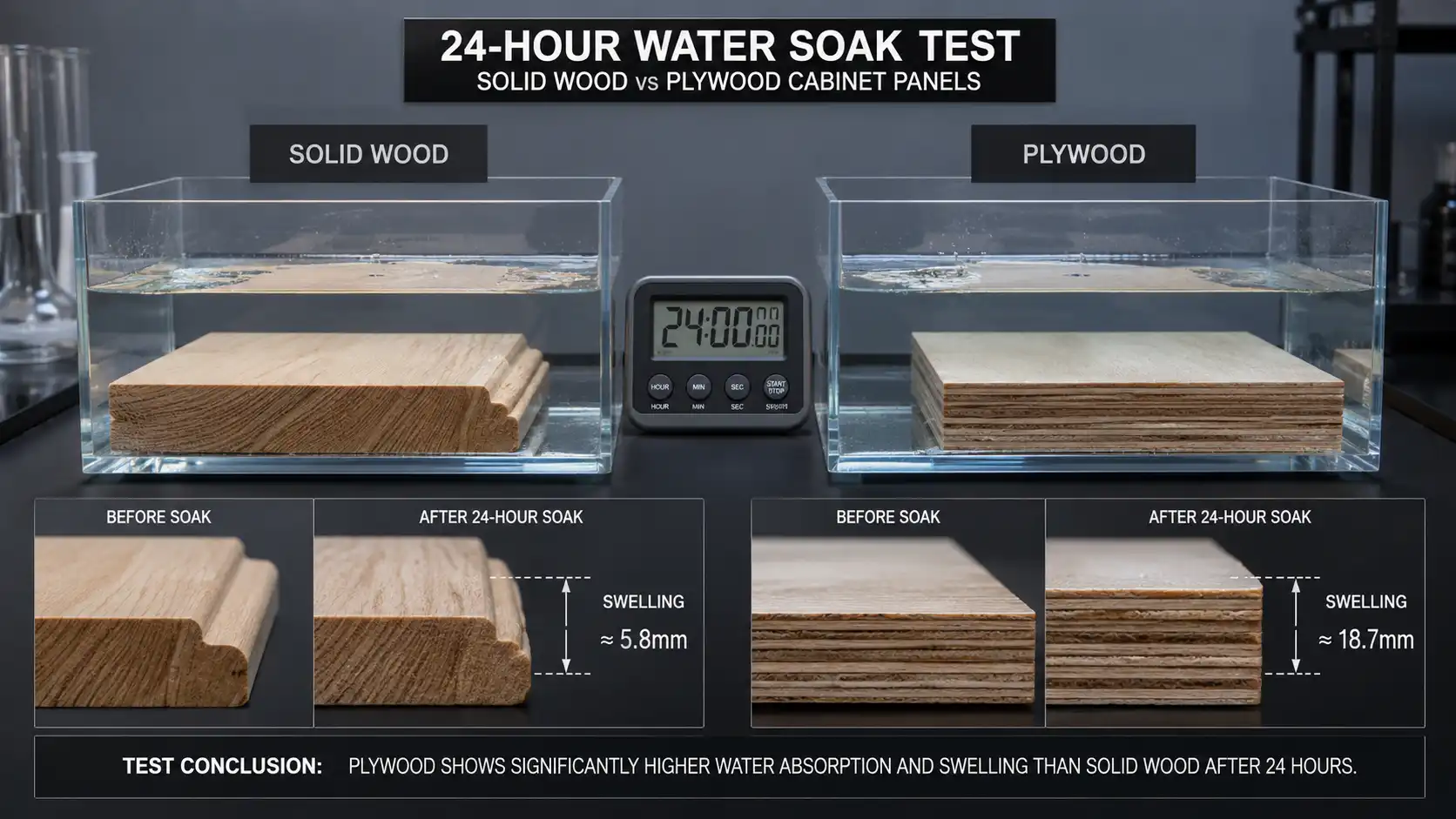
A 24-hour water soak test is not a perfect copy of real kitchen use.
Nobody expects a cabinet to sit underwater for a full day.
But the test is useful because it exposes one thing very clearly:
How does the material react when moisture gets inside?
In this type of test, samples are usually checked for:
- Thickness swelling
- Edge expansion
- Surface bubbling
- Layer separation
- Warping
- Drying recovery
- Structural damage
The result is not just about “waterproof” or “not waterproof.”
No wood-based cabinet material should be treated as fully waterproof.
The real question is:
Which material loses stability faster after moisture exposure?
How Solid Wood Behaves Around Moisture
Solid wood is a living material, even after it has been cut, dried, and finished.
It still responds to humidity.
That is both its beauty and its problem.
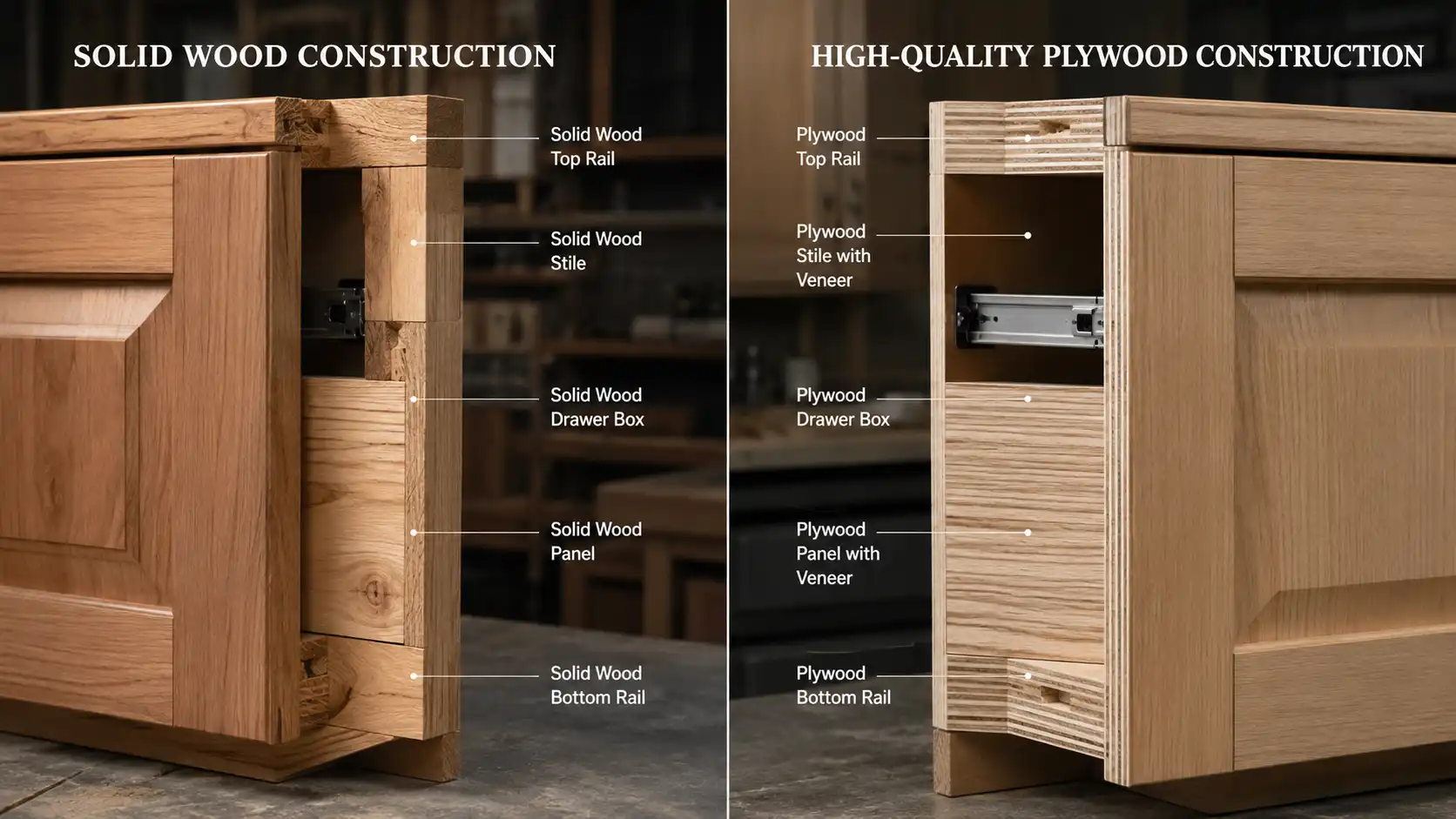
The Grain Direction Matters
Solid wood does not expand equally in every direction.
It moves more across the grain than along the grain.
This means a wide solid wood panel may expand, shrink, cup, or twist when humidity changes.
In a dry showroom, this may not show up.
In a real kitchen, especially near sinks, dishwashers, ovens, or poorly ventilated rooms, the movement becomes easier to see.
Why Solid Wood Can Still Be Valuable
Solid wood is not a bad material.
Good solid wood doors, frames, and decorative parts can look beautiful and last for many years.
It has a warmth that engineered boards cannot fully copy.
For furniture-style kitchens, classic American cabinets, painted shaker doors, or exposed wood grain designs, solid wood still has its place.
But using solid wood everywhere is not always smart.
A full solid wood cabinet box may sound premium, but it can create more movement than necessary.
In cabinet manufacturing, more expensive does not always mean more stable.
How Plywood Behaves Around Moisture
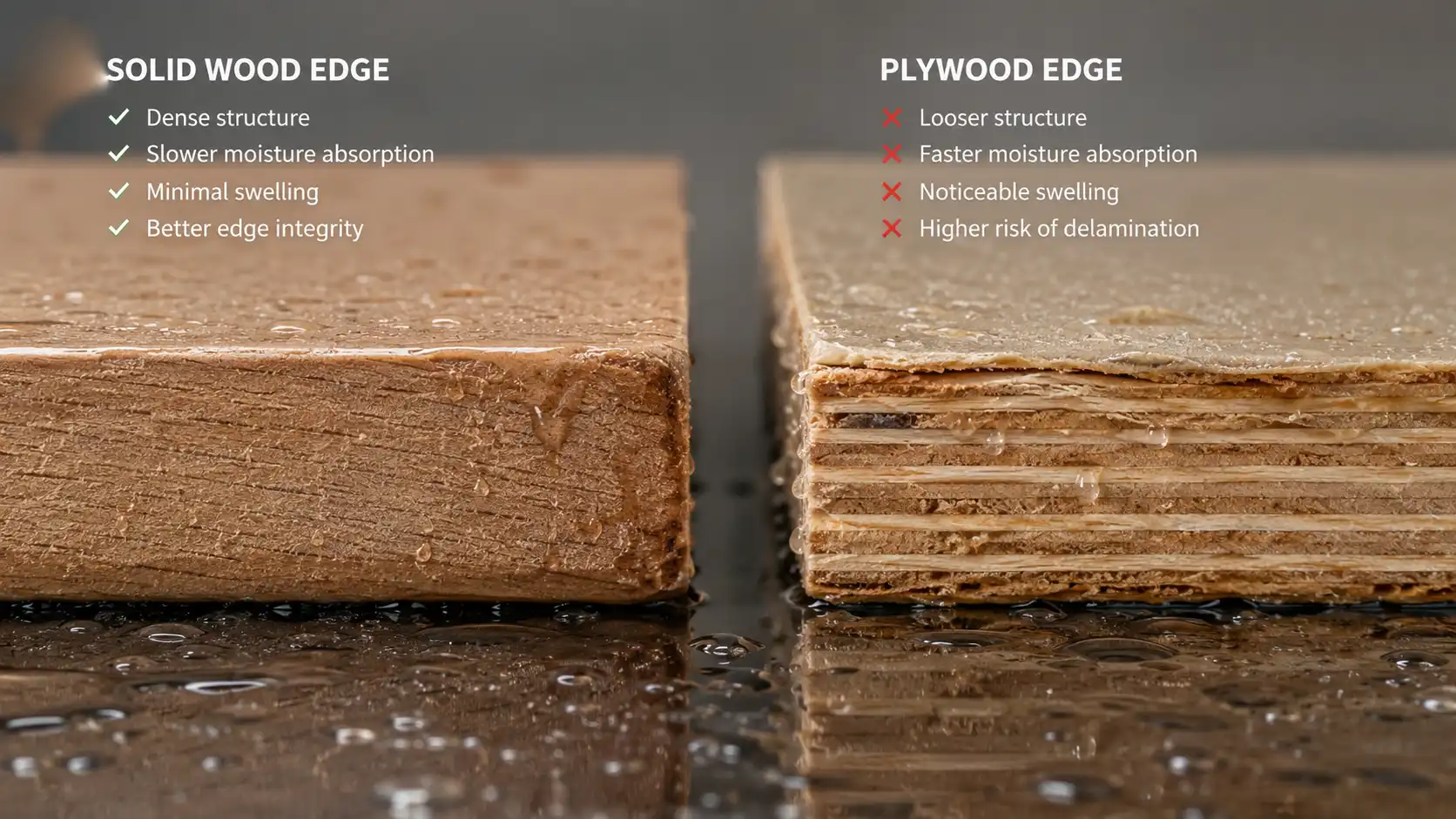
Plywood is made by bonding thin layers of wood veneer together.
Each layer is usually arranged with the grain direction crossing the next layer.
This cross-grain structure is the main reason plywood performs well in cabinet boxes.
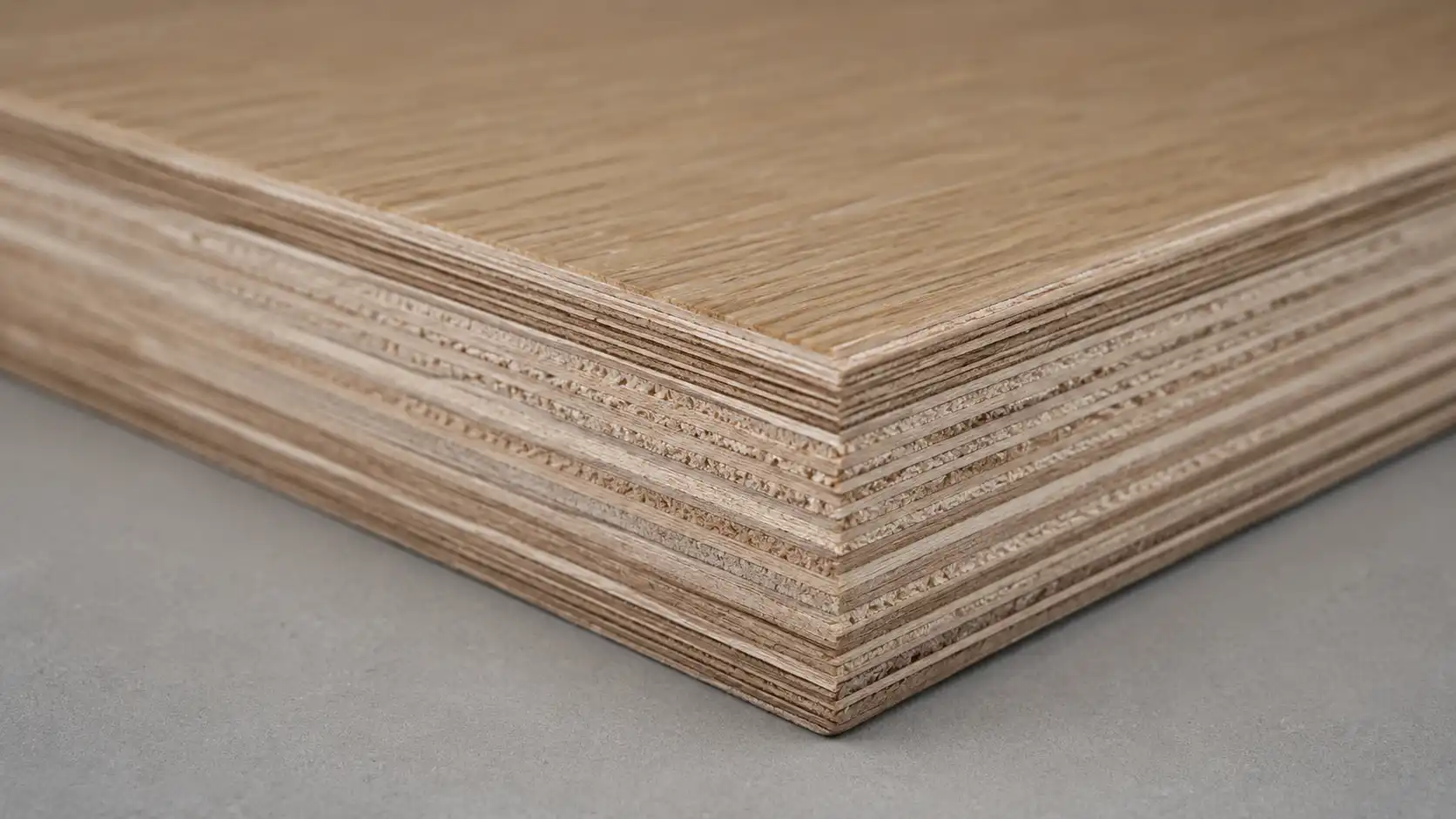
Why Cross-Layer Construction Helps
When one layer wants to move in one direction, the next layer helps control that movement.
The result is better dimensional stability.
This is why plywood is often used for:
- Cabinet boxes
- Tall cabinet side panels
- Shelves
- Sink cabinet structure
- Wardrobe carcasses
- Built-in storage systems
A good plywood panel will not make a cabinet invincible.
But compared with solid wood, it usually reacts more calmly to humidity changes.
The Important Detail: Not All Plywood Is Equal
This is where many sales conversations become misleading.
Some companies say “plywood” as if the word alone proves quality.
It does not.
Plywood quality depends on:
- Core material
- Veneer thickness
- Glue quality
- Pressing quality
- Moisture resistance grade
- Panel flatness
- Edge treatment
- Factory cutting accuracy
Cheap plywood can still delaminate, bend, or have weak internal gaps.
Good plywood feels different when it is cut, drilled, assembled, and loaded with hardware.
Factory workers can tell quickly.
A bad board fights you during assembly. A good board stays flat, holds screws properly, and keeps the cabinet square.
Head-to-Head Comparison Table
| Измерение | Твердая древесина | Фанера |
|---|---|---|
| Moisture Resistance | Sensitive to humidity changes; movement depends on wood species and drying quality | More stable due to layered construction; better for humid or high-use areas |
| Долговечность | Strong, but can crack or warp if poorly dried or exposed to unstable humidity | Strong and predictable when using quality core and proper glue |
| Glue Line Appearance | Not usually relevant unless joined panels are visible | Depends on edge finishing, veneer, laminate, or banding quality |
| Расходы | Higher material and labor cost | Usually more practical for cabinet structure |
| Long-Term Stability | Natural movement is unavoidable | Better shape retention in cabinet boxes |
| Screw Holding | Good in solid sections, weaker near split grain or end grain | Good when plywood core is dense and well pressed |
| Best For | Doors, frames, decorative panels, furniture details | Cabinet carcasses, shelves, wardrobes, vanities, kitchen boxes |
| Common Risk | Warping, cracking, seasonal joint movement | Low-grade plywood may have voids, delamination, or poor edge strength |
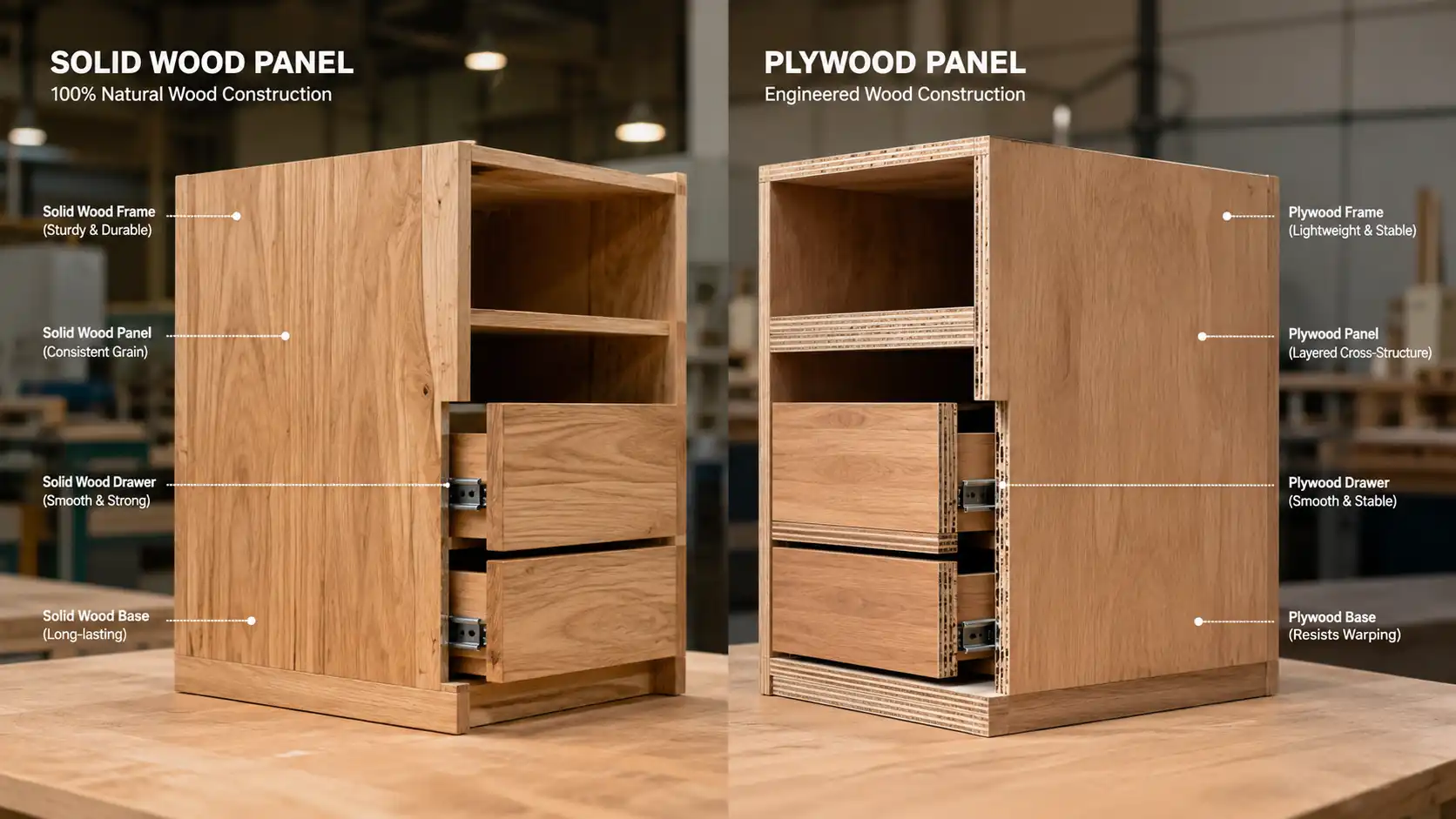
The Biggest Misunderstanding: “Solid Wood Cabinet” Is Not Always Fully Solid Wood
Many customers think a solid wood cabinet means every part is made from solid wood.
In most modern cabinet production, that is not how it works.
A cabinet may be marketed as “solid wood” because it has:
- Solid wood door frames
- Solid wood face frames
- Solid wood decorative trims
- Solid wood exposed parts
But the cabinet box may still be plywood, particle board, MDF, or another engineered panel.
This is not automatically dishonest.
Sometimes it is actually the better construction method.
The problem is when salespeople use “solid wood” as a vague selling point without explaining which parts are solid wood and which parts are engineered board.
For homeowners, the better question is:
Which parts are solid wood, which parts are plywood, and why?
That question usually gets you a much more honest answer.
Common Industry Pitfalls
Pitfall 1: Paying Extra for Solid Wood in the Wrong Place
Solid wood can be worth the money for doors, frames, and visible furniture details.
But using solid wood for every hidden structural part may not bring real value.
For a kitchen cabinet box, stable plywood often makes more sense.
You are not paying for romance there. You are paying for square corners, strong shelves, reliable hinges, and long-term alignment.
Pitfall 2: Ignoring the Sink Cabinet
The sink cabinet is where weak material choices show up first.
Even careful homeowners eventually deal with small leaks, wet cleaning tools, pipe condensation, or water around the base panel.
If the cabinet box material and edge treatment are poor, swelling can start quietly.
This is why many experienced manufacturers pay special attention to:
- Bottom panel protection
- Edge sealing
- Back panel ventilation
- Sink cabinet base structure
- Moisture-resistant plywood or upgraded panels
The sink cabinet is not the place to save a few dollars.
Pitfall 3: Believing Surface Finish Solves Everything
A good finish helps.
But finish does not cancel material movement.
Paint, veneer, PET, laminate, or lacquer can protect the surface, but the inner structure still matters.
If the panel core is unstable, the cabinet will still show problems later.
This is especially true for tall cabinets and large doors.
A beautiful surface on a weak structure is still a weak cabinet.
Pitfall 4: Comparing Samples Instead of Full Cabinet Construction
A small sample board can look perfect.
The real cabinet is different.
It has screws, hinges, drawer runners, shelves, back panels, toe kicks, sink cutouts, appliance openings, and long vertical panels.
Material performance must be judged inside the full cabinet system.
That is why factory-side experience matters.
The material does not work alone. It works with machining, hardware, edge sealing, installation, and room conditions.
Which One Fits Your Project?
For Kitchen Cabinets
For most kitchens, plywood is usually the safer choice for cabinet boxes.
Kitchens face steam, heat, cleaning moisture, appliance vibration, and daily heavy use.
Solid wood can still be used for doors, frames, and decorative parts, but plywood often gives better long-term cabinet structure.
For Bathroom Vanities
Moisture risk is higher.
Plywood is usually more practical than solid wood for the box structure.
If the bathroom has poor ventilation, the cabinet design should also include good edge sealing and moisture-resistant finishing.
For Wardrobes
Wardrobes usually face less direct water exposure.
Both materials can work, depending on design style and budget.
For large built-in wardrobes, plywood offers better stability for tall panels.
Solid wood can be used where natural texture is visible and meaningful.
For Luxury Furniture-Style Cabinets
Solid wood has a stronger role here.
If the design includes exposed frames, decorative posts, raised panels, or traditional craftsmanship, solid wood can add real character.
But even in this case, many manufacturers still combine solid wood with plywood for hidden structure.
That combination is often more stable than using solid wood everywhere.
Budget Advice
If the budget is limited, do not spend all of it on the word “solid wood.”
A smarter budget usually goes into:
- Better cabinet box material
- Better hinges and drawer runners
- Better edge sealing
- Better machining precision
- Better installation
- Better moisture protection around sink areas
These details affect daily use more than many homeowners expect.
A cabinet that opens smoothly after years of use feels more valuable than a cabinet that only sounded expensive on the quotation.
Factory-Side Reality
From the factory side, plywood is not just a “cheaper alternative.”
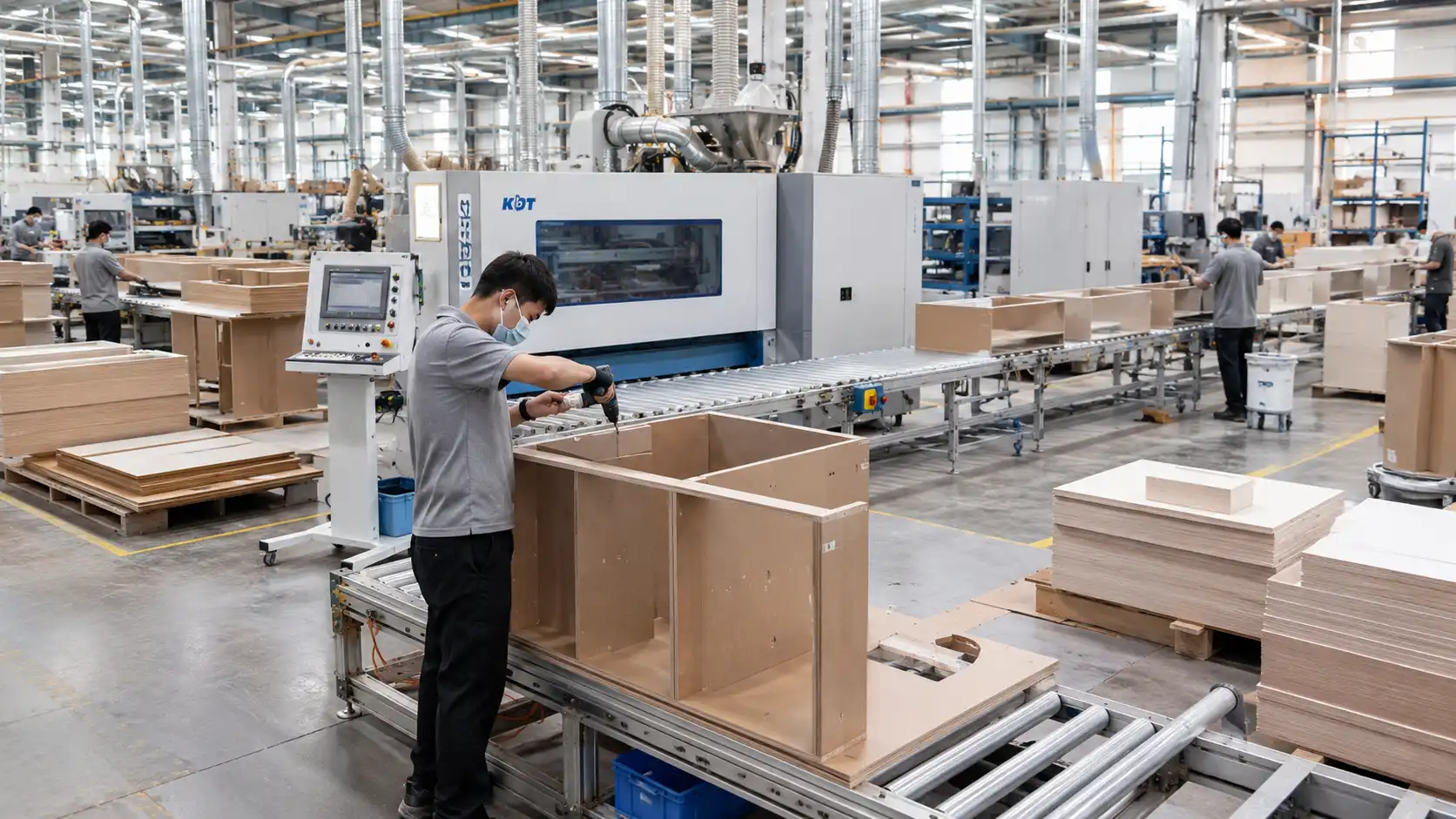
Good plywood is easier to control in production.
It stays flatter during cutting, drilling, assembly, packing, and shipping.
For export cabinets, this matters even more.
Cabinets may travel long distances, sit in containers, pass through different climates, and then be installed in homes with completely different humidity conditions.
A material that behaves predictably is valuable.
Solid wood needs more careful selection, drying, machining, finishing, and storage.
If one of those steps is not controlled well, problems may appear later.
This is why serious cabinet manufacturers do not treat solid wood and plywood as enemies.
They use each material where it makes sense.
That is usually the most reliable approach.
Часто задаваемые вопросы
Are plywood cabinets better than solid wood cabinets?
For cabinet boxes, plywood is often better because it is more stable and less likely to move with humidity changes.
For doors and decorative parts, solid wood can still be a strong choice.
Is solid wood more expensive than plywood?
Usually, yes.
Solid wood material cost and processing cost are generally higher.
But higher cost does not automatically mean better performance in every cabinet part.
Are plywood cabinets cheap?
Not necessarily.
High-quality plywood cabinets can be used in premium custom projects.
The key is plywood grade, core quality, edge sealing, hardware, and manufacturing accuracy.
Can solid wood cabinets warp?
Yes.
Solid wood naturally expands and contracts with moisture changes.
If the wood is poorly dried or used in a humid environment, warping or cracking risk becomes higher.
What is the best cabinet material for humid climates?
For humid climates, quality plywood is usually a safer choice for cabinet boxes.
Moisture-resistant panels, sealed edges, and good ventilation are also important.
Заключение
The solid wood vs plywood cabinets debate often focuses on the wrong question.
Instead of asking which material sounds more premium, homeowners should focus on where each material performs best.
Solid wood remains an excellent choice for cabinet doors and decorative components, while plywood continues to be one of the most reliable options for cabinet box construction.
That is why many premium custom kitchens combine both materials rather than choosing one exclusively.
Understanding the strengths and limitations of solid wood vs plywood cabinets can help you make a smarter long-term investment.
Planning a Custom Cabinet Project?
В KEJIA Furniture, we manufacture custom kitchen cabinets, wardrobes, bathroom vanities, TV cabinets, and whole-house storage systems for homeowners, builders, designers, and overseas projects.
We help clients compare cabinet materials based on climate, budget, design style, and long-term use—not just material names on a quotation.
Contact us to discuss your custom cabinet project and get a practical factory-side recommendation.