


Quick Answer
If you’re choosing between plywood vs. particle board cabinets, plywood is generally the better long-term investment because it offers higher structural strength, better moisture resistance, and improved screw-holding performance.
However, that doesn’t automatically mean particle board is a poor choice.
Many modern kitchens use particle board successfully, especially when high-quality boards, proper edge sealing, and professional manufacturing are involved. The right material depends on your budget, climate, cabinet construction, and expected lifespan—not marketing claims.
As a custom cabinet manufacturer, we’ve produced kitchens using both materials for different markets. The best choice often depends on where the cabinets will be installed and how they will be used.
Key Takeaways
| Factor | Фанерные Шкафы | Шкафы из ДСП |
|---|---|---|
| Strength | ★★★★★ | ★★★☆☆ |
| Moisture Resistance | ★★★★★ | ★★☆☆☆ |
| Weight | Середина | Heavy |
| Screw Holding | Отличный | Good |
| Warp Resistance | Отличный | Умеренный |
| Расходы | Выше | Ниже |
| Lifespan | 20–30+ Years | 10–20 Years |
| Best For | Long-term kitchens | Budget projects |
In This Guide
This article answers the questions homeowners ask most often before ordering cabinets:
- Is plywood really worth the extra cost?
- Do particle board cabinets fall apart?
- Which material lasts longer?
- Which performs better in humid climates?
- Are expensive cabinets always plywood?
- What material do cabinet manufacturers actually recommend?
If you’re comparing cabinet materials before remodeling your kitchen, these answers can help you avoid an expensive mistake.
Why Cabinet Material Matters More Than Many Homeowners Think
Cabinet doors usually receive most of the attention.
People compare colors, finishes, handles, and countertop materials.
But the cabinet box is what determines how the kitchen performs after years of daily use.
The cabinet box supports:
- Countertop weight
- Sink installations
- Heavy cookware
- Drawer systems
- Door hinges
- Everyday opening and closing
If the cabinet structure loses stability, changing the doors or hardware won’t solve the problem.
That is why professional cabinet manufacturers evaluate cabinet materials long before discussing finishes.
What Is Plywood?
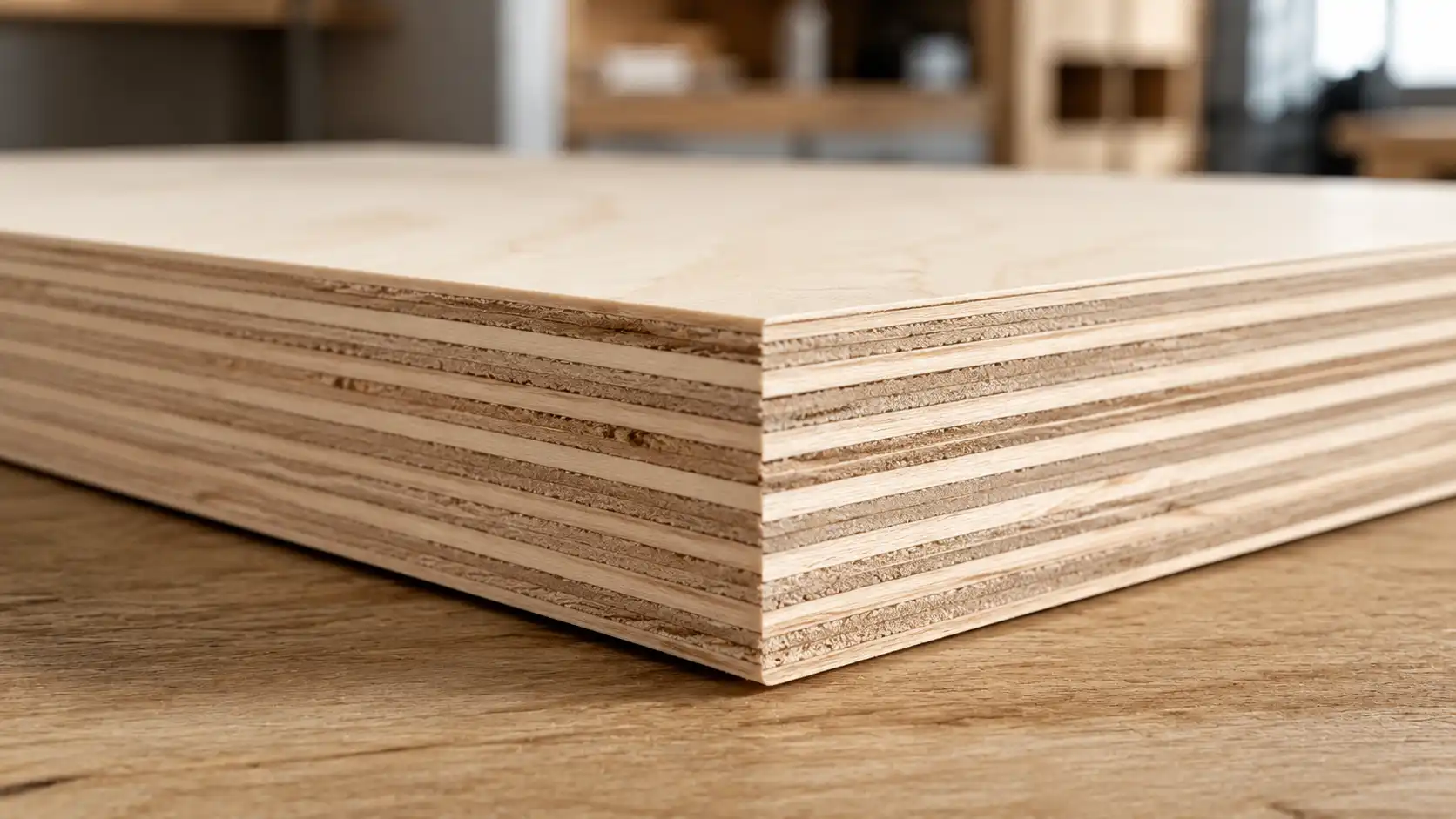
Plywood is manufactured by bonding multiple layers of wood veneer together.
Each layer is rotated so that the wood grain runs in a different direction.
This cross-layer construction distributes stress throughout the panel.
The result is a board that is stronger and more dimensionally stable than many engineered wood products.
Why This Matters
Because each layer supports the next, plywood is less likely to:
- Warp
- Crack
- Split
- Sag
- Expand unevenly
This structural design explains why plywood has remained one of the preferred materials for premium kitchen cabinets.
What Is Particle Board?
Particle board is produced by compressing wood particles, sawdust, and wood chips with resin under high pressure.
Unlike plywood, particle board has a uniform internal structure.
It contains no wood veneer layers.
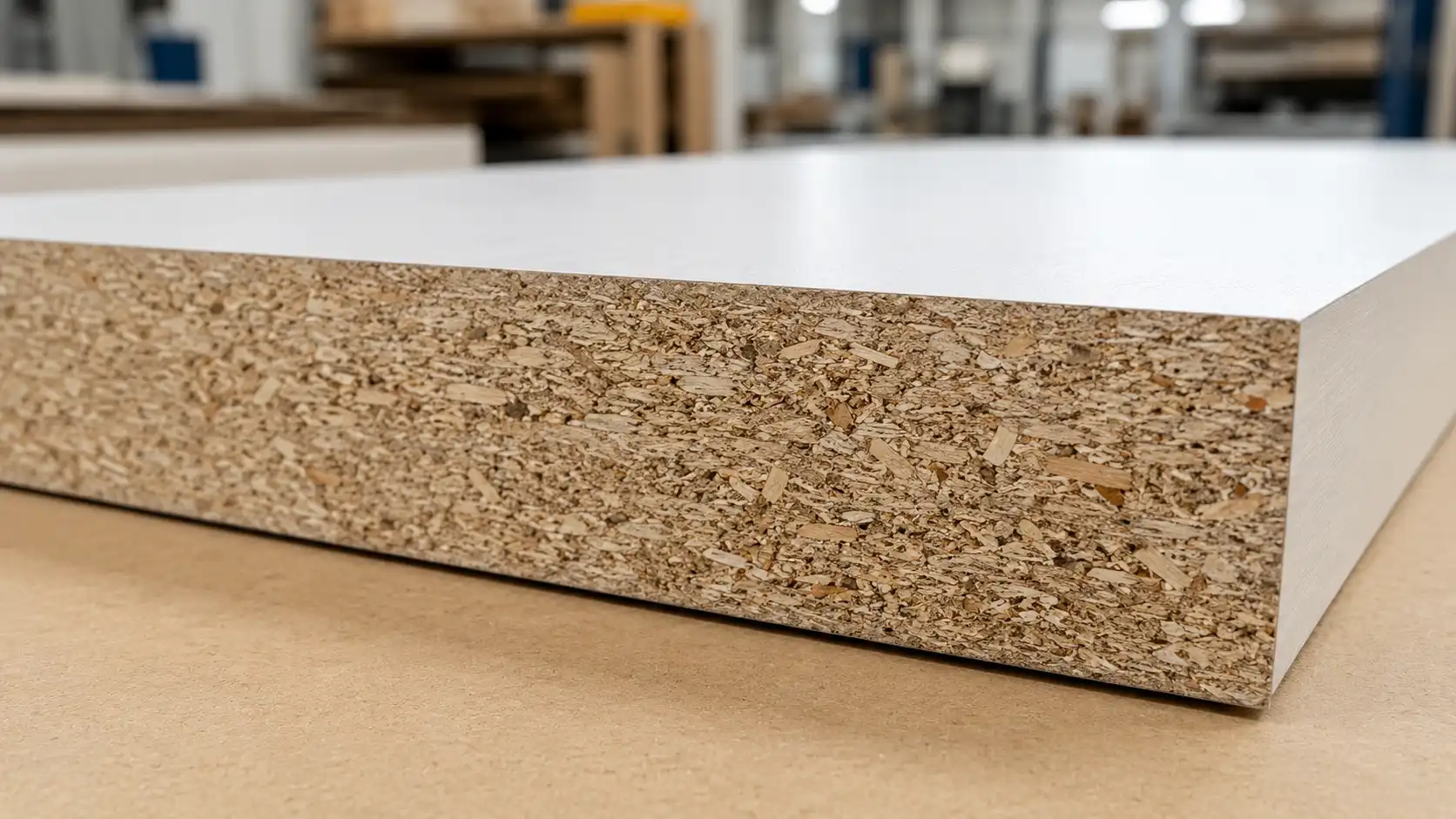
Modern manufacturing has improved particle board considerably over the past decade.
Today’s high-density particle board is much stronger than many homeowners expect.
High-quality European particle board can perform very well when combined with:
- Precision machining
- Durable edge banding
- Moisture-resistant surfaces
- Quality hardware
This is why many well-known European cabinet brands continue to use particle board in specific product lines.
Plywood vs. Particle Board Cabinets: Material Comparison
1. Strength
Winner: Plywood
Plywood distributes force across multiple veneer layers.
This allows it to better resist bending and structural movement.
Heavy stone countertops, oversized drawers, and fully loaded pantry cabinets place significant stress on cabinet boxes.
Plywood generally handles these loads more effectively over long periods.
Particle board performs well under normal household conditions but may lose structural integrity sooner if subjected to repeated heavy loads.
2. Moisture Resistance
Winner: Plywood
Moisture is one of the biggest enemies of kitchen cabinets.
Small plumbing leaks under sinks are surprisingly common.
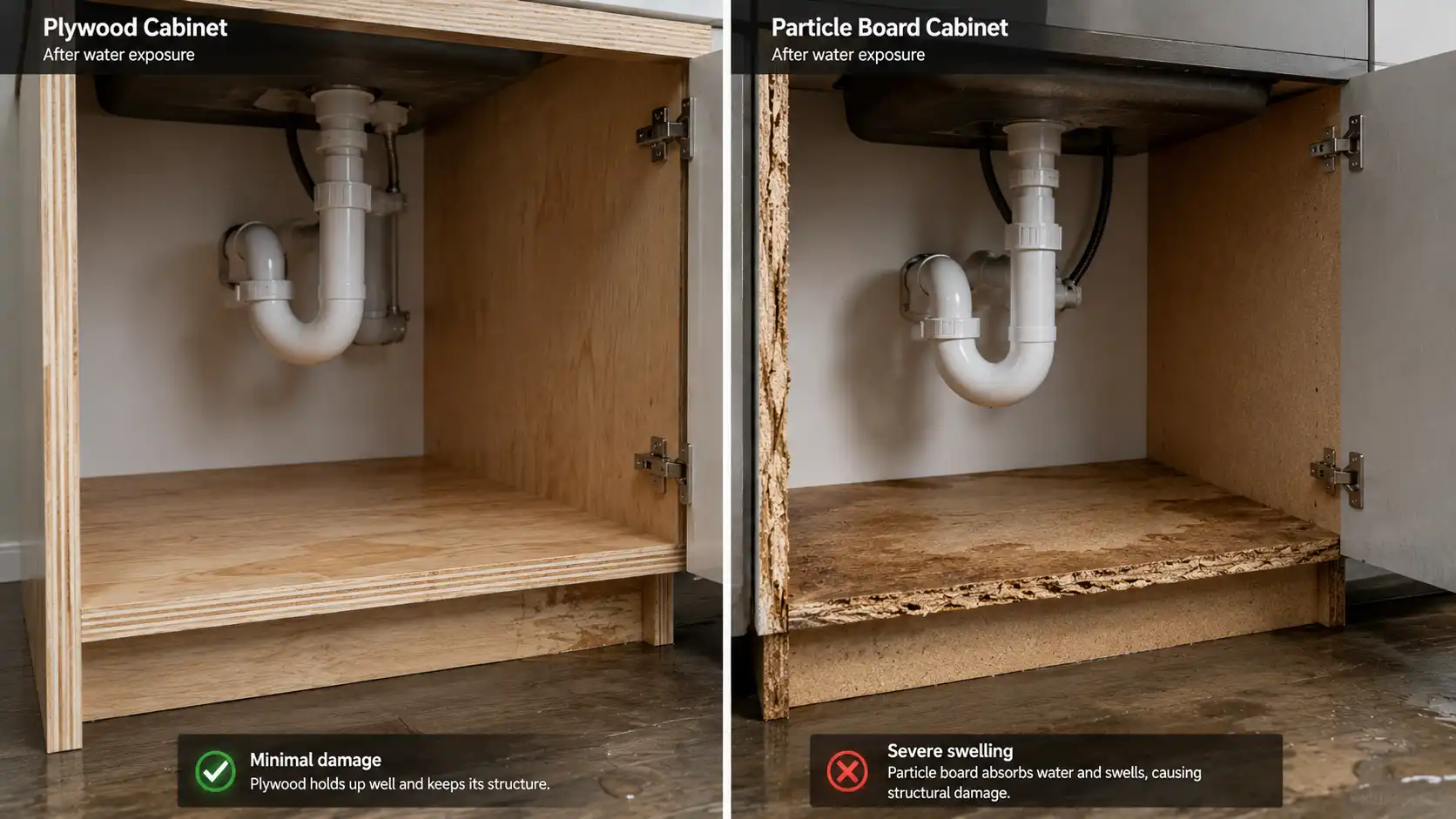
When moisture enters plywood, it usually dries without causing severe structural damage.
Particle board behaves differently.
If water penetrates exposed edges, the compressed wood particles can swell.
Once swelling occurs, the material rarely returns to its original dimensions.
Manufacturer Insight
In our factory, we pay close attention to sink cabinets.
Regardless of the board material, we recommend:
- Waterproof edge banding
- Proper sink sealing
- Leak detection
- Moisture-resistant cabinet interiors
Good installation practices often matter as much as the board itself.
3. Screw Holding Performance
Winner: Plywood
Kitchen cabinets rely on screws to secure:
- Hinges
- Drawer slides
- Shelf supports
- Connecting hardware
Because plywood contains continuous wood fibers, screws grip more securely.
Particle board also performs well initially, but repeated removal and reinstallation can gradually reduce holding strength.
For kitchens expected to remain in place for decades, plywood offers an advantage.
4. Weight
Many homeowners assume plywood is heavier.
In reality, particle board is often denser.
This increases shipping weight.
For international cabinet exports, total shipment weight can influence transportation costs.
Manufacturers consider this factor when recommending materials for overseas projects.
5. Surface Flatness
Winner: Particle Board
This category surprises many buyers.
Particle board has an extremely smooth and uniform surface.
Because of this, it performs exceptionally well with:
- Melamine finishes
- PET doors
- High-gloss laminates
- Decorative veneers
Many premium European cabinet manufacturers select particle board specifically because it produces highly consistent decorative surfaces.
Surface quality is one reason particle board remains widely used despite its reputation.
Manufacturer Perspective: What We Actually Use
One of the biggest misconceptions in the cabinet industry is that professional manufacturers always choose plywood.
That simply isn’t true.
Different materials serve different purposes.
For projects requiring maximum structural durability, especially in humid climates, plywood is often our recommendation.
For modern kitchens using premium decorative panels and precise CNC manufacturing, high-density particle board can deliver excellent results while helping homeowners manage their budgets.
The decision is rarely as simple as “good” versus “bad.”
Instead, experienced manufacturers evaluate:
- Climate
- Budget
- Cabinet design
- Countertop weight
- Hardware specifications
- Expected service life
before recommending a material.
Does More Expensive Always Mean Better?
Not necessarily.
One of the biggest marketing myths in the cabinet industry is that plywood automatically means higher quality.
We’ve seen expensive plywood kitchens assembled with poor hardware, weak edge banding, and inaccurate machining.
We’ve also seen particle board kitchens perform exceptionally well after more than a decade because the manufacturing quality was excellent.
Material is only one part of cabinet quality.
Other factors include:
- Качество кромкооблицовки
- CNC machining accuracy
- Cabinet joinery
- Hardware systems
- Moisture protection
- Installation quality
A well-built cabinet using quality particle board often outperforms a poorly manufactured plywood cabinet.
Common Myths About Cabinet Materials
Myth 1: Particle Board Always Falls Apart
Modern high-density particle board is significantly stronger than older products manufactured decades ago.
Quality varies widely depending on the manufacturer.
Myth 2: Plywood Is Waterproof
Plywood resists moisture better than particle board, but it is not waterproof.
Long-term water exposure can still damage plywood.
Myth 3: Every Luxury Cabinet Uses Plywood
Many premium European brands successfully use engineered particle board because of its surface consistency and manufacturing precision.
Plywood vs. Particle Board Cabinets (Continued)
Durability Comparison: Which Material Lasts Longer?
Cabinet lifespan depends on much more than the board itself.
Daily use, humidity, hardware quality, installation accuracy, and maintenance all influence how long a kitchen will perform.
That said, the cabinet material still plays an important role.
| Особенность | Фанера | ДСП |
|---|---|---|
| Structural Stability | Отличный | Good |
| Impact Resistance | Отличный | Умеренный |
| Moisture Resistance | Отличный | Умеренный |
| Screw Holding | Отличный | Good |
| Long-Term Durability | 20–30+ Years | 10–20 Years |
Expert Insight
For homeowners planning to stay in the same house for many years, plywood often provides better long-term value.
For investment properties, rental homes, or projects with tighter budgets, high-quality particle board remains a practical and widely used solution.
Cost Comparison
One of the first questions homeowners ask is whether plywood is worth the additional investment.
The answer depends on what you’re paying for.
In most markets, plywood cabinet boxes typically cost 10–30% more than comparable particle board cabinet boxes.
However, material is only one component of the total kitchen budget.
A kitchen renovation also includes:
- Столешницы
- Аппаратное обеспечение
- Бытовая техника
- Установка
- Освещение
- Plumbing
- Flooring
For this reason, upgrading from particle board to plywood may increase the total renovation budget by less than many homeowners expect.
Which Material Performs Better in Humid Climates?
Humidity changes everything.
In coastal regions or areas with high annual humidity, cabinet materials are exposed to greater environmental stress.
Plywood generally performs better because its cross-laminated construction allows it to resist expansion and contraction more effectively.
Particle board performs well when properly protected, but exposed edges are more vulnerable if water reaches the core.
Manufacturer Recommendation
For humid environments, we recommend:
- Moisture-resistant plywood whenever possible
- PUR edge banding for improved moisture protection
- Careful sink cabinet waterproofing
- Prompt repair of plumbing leaks
The material alone cannot compensate for poor installation or neglected maintenance.
Which Material Is Better for Different Types of Projects?
| Project Type | Recommended Material |
|---|---|
| Luxury custom home | Фанера |
| Coastal residence | Фанера |
| Family home | Plywood or premium particle board |
| Apartment renovation | Premium particle board |
| Rental property | Premium particle board |
| Budget remodel | Premium particle board |
| Long-term forever home | Фанера |
The goal is not to choose the most expensive material.
The goal is to choose the material that fits the project.
What We See in Real Manufacturing Projects
After manufacturing custom kitchen cabinets for clients in North America, Europe, and Australia, one observation appears consistently.
Many homeowners spend a great deal of time comparing board materials but pay very little attention to cabinet construction.
In reality, cabinet performance depends on a complete system.
A cabinet built with:
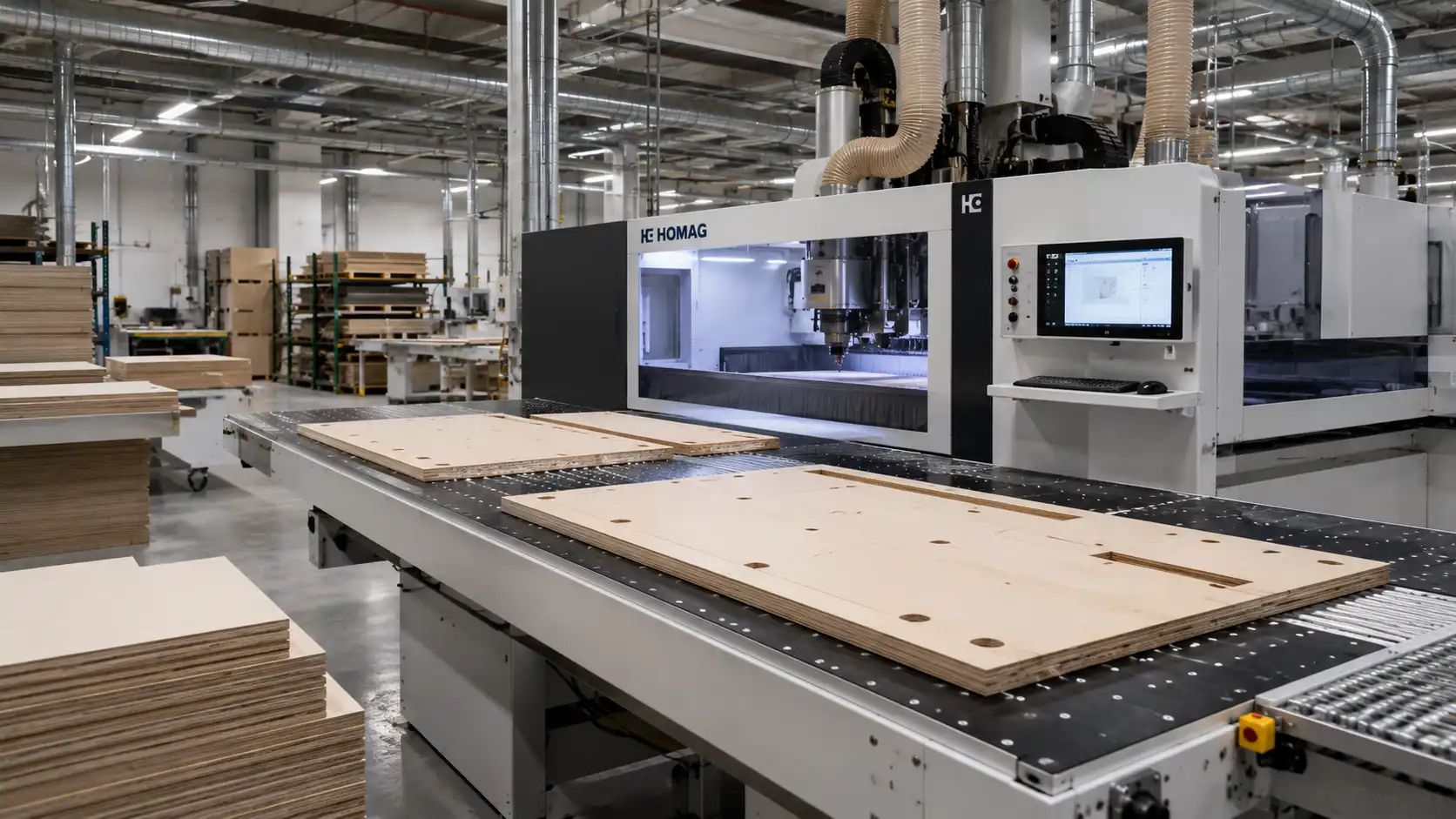
- Precision CNC machining
- Durable edge banding
- High-quality hinges
- Strong drawer slides
- Proper assembly
will usually outperform a cabinet built with premium materials but poor manufacturing standards.
Material selection should never be evaluated in isolation.
Common Buying Mistakes
Choosing Material Based Only on Price
The cheapest option may not deliver the best long-term value.
At the same time, the most expensive option is not automatically the best choice.
Evaluate the complete cabinet system rather than a single specification.
Ignoring Edge Banding Quality
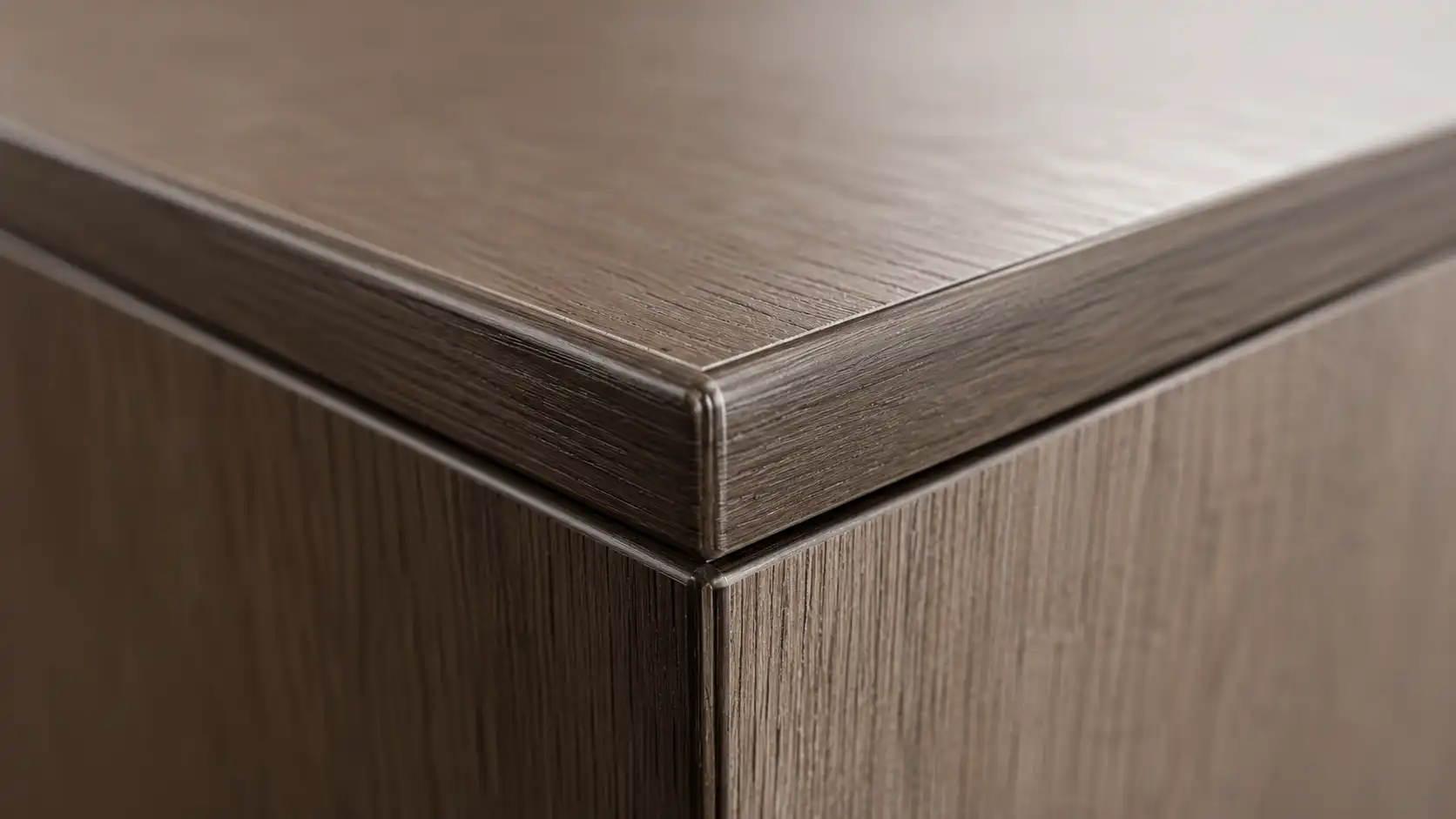
One of the first areas where moisture enters a cabinet is through exposed panel edges.
Quality edge banding helps protect the core material regardless of whether the cabinet is made from plywood or particle board.
Overlooking Hardware
Premium boards cannot compensate for low-quality hinges or drawer slides.
Soft-close hardware, proper installation, and accurate adjustment all influence how a kitchen performs over time.
Assuming Every Manufacturer Uses the Same Material
Two cabinets described as “plywood” may differ significantly in quality.
Likewise, particle board from different suppliers can vary in density, moisture resistance, and manufacturing consistency.
Always ask about:
- Board specifications
- Core density
- Edge banding technology
- Hardware brands
- Manufacturing process
Expert Recommendation
If your budget allows, plywood is generally the better choice for homeowners planning a long-term kitchen renovation.
However, if you’re working with an experienced manufacturer using premium engineered boards, high-quality particle board can also deliver excellent performance for many years.
Rather than asking:
“Which material is the best?”
Ask:
“Which material is best for my project?”
That question usually leads to a better decision.
Часто задаваемые вопросы
Is plywood always better than particle board for kitchen cabinets?
Not always. Plywood offers better strength and moisture resistance, but premium particle board can perform very well in many residential kitchens.
Why do some luxury cabinet brands use particle board?
High-density particle board provides a smooth, stable surface for decorative finishes and performs well when combined with quality manufacturing.
Can particle board cabinets last 20 years?
Yes. When manufactured properly and protected from excessive moisture, quality particle board cabinets can provide many years of reliable service.
Which material is better for sink cabinets?
Plywood is generally recommended because it offers better moisture resistance if small plumbing leaks occur.
Are plywood cabinets worth the extra cost?
For homeowners planning to stay in their homes for many years, many professionals believe the additional investment is worthwhile.
Does cabinet material affect resale value?
Cabinet quality can influence buyer perception, but overall design, layout, craftsmanship, and condition usually have a greater impact than board material alone.
Is particle board environmentally friendly?
Many engineered particle boards make efficient use of recycled wood fibers and are manufactured to strict formaldehyde emission standards such as CARB P2 or EPA TSCA Title VI.
Can plywood warp?
Yes. Although plywood is more dimensionally stable than particle board, prolonged moisture exposure or improper storage can still cause movement.
Which material holds screws better?
Plywood generally provides stronger screw-holding performance because of its layered wood veneer construction.
What should I ask my cabinet supplier before ordering?
Ask about:
- Board type
- Board thickness
- Moisture resistance
- Edge banding technology
- Hardware brands
- Гарантия
- Manufacturing process
Final Verdict
There is no universal winner in the debate over plywood vs. particle board cabinets.
Plywood offers outstanding strength, durability, and moisture resistance, making it an excellent choice for homeowners seeking maximum long-term performance.
Particle board, on the other hand, has evolved significantly. When produced by reputable manufacturers using modern equipment and quality edge sealing, it remains a reliable and cost-effective option for many kitchen projects.
The best cabinet material is the one that matches your home’s environment, your renovation budget, and the quality standards of the manufacturer you choose.
Focus on the complete cabinet system—not just the board inside it.
Contact KEJIA
At KEJIA, we manufacture fully customized kitchen cabinets using carefully selected materials based on your project’s requirements—not one-size-fits-all recommendations.
Whether you’re considering plywood or premium engineered particle board, our design and production teams can help you choose the right solution for your home, budget, and lifestyle.
Contact us today to discuss your custom kitchen cabinet project.
Related Articles: