




Plywood vs MDF vs Particle Board for Cabinets: Which Material Should You Specify?
For most cabinet projects, there is no single “best” board. Plywood is usually the safer choice for cabinet boxes exposed to higher moisture, repeated assembly, or heavier loads. MDF is often the better substrate for smooth painted doors and routed profiles. Particle board can be a practical, cost-controlled option for dry interior applications when it has a suitable density, sealed edges, and compatible hardware. For designers, contractors, and B2B buyers, the right decision depends on the cabinet component, environment, finish, hardware, and required service life – not on the board name alone.
Who This Cabinet Material Guide Is For
- Interior designers preparing cabinet specifications and finish schedules.
- Contractors and builders reducing installation and rework risk.
- Dealers and showrooms explaining material choices to customers.
- B2B buyers comparing quotations from custom cabinet manufacturers.
Key Takeaways
- Specify plywood first for sink bases, utility areas, humid climates, and cabinets that will be assembled repeatedly.
- Choose MDF when a smooth, stable surface is required for painted or routed door fronts.
- Use particle board for suitable dry-area projects where cost, flatness, and melamine finishes are priorities.
- A board’s performance also depends on density, thickness, edge sealing, fasteners, hardware, and manufacturing quality.
- Ask for a component-level material schedule instead of accepting one substrate for every cabinet part.
Plywood vs MDF vs Particle Board for Cabinets
Quick Comparison
| Материал | Best use | Main strengths | Main risks | Typical specification concern |
|---|---|---|---|---|
| Фанера | Cabinet boxes, sink units, heavy-use storage | Good screw holding, layered construction, stronger moisture tolerance than standard fiberboard | More expensive; surface may require veneer or laminate | Grade, thickness, core quality, edge treatment |
| МДФ | Painted doors, routed panels, decorative fronts | Smooth, uniform, easy to machine and paint | Swells if water reaches unprotected edges; heavier than particle board | Moisture-resistant grade, primer, edge sealing |
| Particle board | Dry-area carcasses, melamine cabinets, budget-controlled projects | Flat, economical, consistent for panel processing | Lower screw-holding and moisture tolerance than plywood; edge damage can be difficult to repair | Density, thickness, edge banding, connector selection |
What Is the Difference Between the Three Cabinet Materials?
Фанера
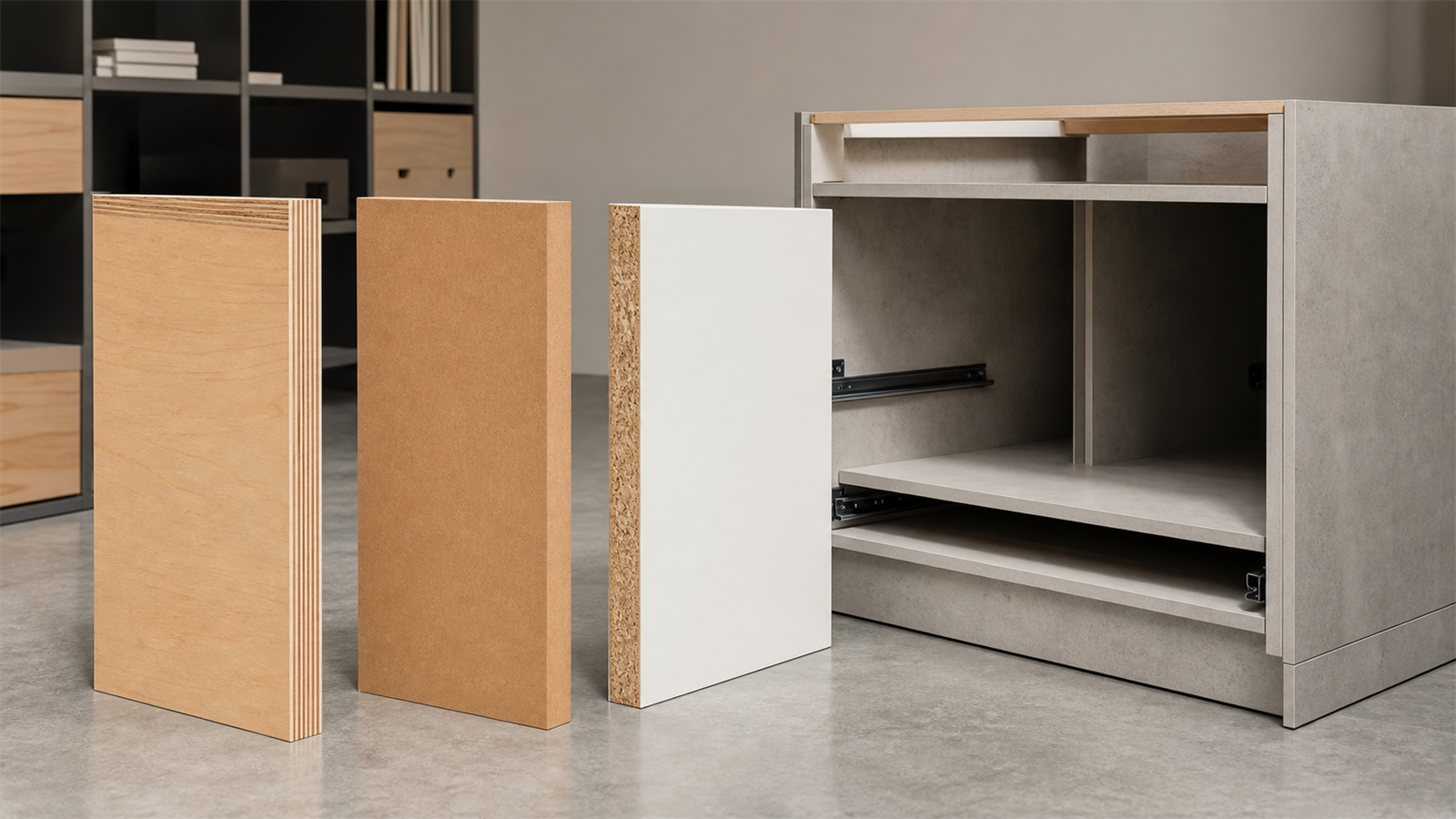
Plywood is made from thin wood veneers bonded in layers, usually with alternating grain directions. This layered structure gives it useful strength and screw-holding performance for cabinet boxes, shelving, and components that may be removed and reinstalled. However, “plywood” is not a complete specification. The project should identify thickness, core construction, face quality, adhesive performance, and whether exposed edges will be sealed or covered.
Plywood is commonly recommended for sink bases, laundry cabinets, garages, coastal homes, and commercial interiors where cabinets experience more handling. It is not waterproof simply because it is plywood. Standing water, unsealed cutouts, and poorly protected edges can still cause damage.
МДФ
MDF is manufactured from refined wood fibers bonded into a dense, uniform panel. Its smooth face makes it highly suitable for lacquered, painted, PET, and routed cabinet doors. Designers often choose MDF for shaker profiles, fluted fronts, and other details where a clean machined surface matters.
For cabinet production, moisture-resistant MDF and standard MDF should not be treated as interchangeable. The specification should also cover primer, paint system, edge preparation, and the treatment of cutouts. MDF performs best when its edges are fully sealed before exposure to humidity or cleaning water.
ДСП
Particle board uses wood particles compressed with resin. It is widely used in melamine-faced cabinets because it offers a flat, economical substrate for factory-applied decorative surfaces. It can work well in bedrooms, offices, living rooms, and dry kitchens when the panel density, connectors, and edge banding are properly selected.
The main failure points are usually moisture reaching the core, weak fastener placement, damaged edges, or unsuitable repeated assembly. A low-cost particle board quotation should therefore be evaluated by density, thickness, edge banding quality, hardware system, and replacement policy – not price alone.
Which Material Is Best When Choosing Plywood vs MDF vs Particle Board for Cabinets?
| Cabinet component | Recommended starting point | Why | What to confirm before production |
|---|---|---|---|
| Sink-base carcass | Plywood or moisture-resistant board | More exposure to leaks and plumbing cutouts | Edge sealing, base protection, plumbing cutout treatment |
| Painted cabinet door | МДФ | Uniform face for paint and routing | Moisture resistance, primer, paint sheen, sample approval |
| Melamine door or carcass | Particle board or plywood | Efficient factory finishing and consistent panel sizing | Surface durability, edge banding, color batch |
| Long shelf or wide span | Plywood, reinforced board, or thicker panel | Reduces sagging and handling damage | Span, thickness, support pins, load requirement |
| Wardrobe interior | Particle board or plywood | Dry indoor use allows cost and finish flexibility | Hanging load, connector type, edge protection |
| Bathroom vanity | Plywood or moisture-resistant MDF by component | Higher humidity and water exposure | Sealant plan, toe-kick protection, exposed edge finish |
How Should Designers Choose Cabinet Materials by Project Type?
For residential kitchens
Use a component-based specification. A practical schedule may use plywood for sink units and high-load areas, MDF for painted doors, and melamine particle board for dry interior parts. For a premium or high-humidity project, plywood can be used more widely, but the finish and edge details still need approval.
For wardrobes and bedrooms
Particle board is often suitable for dry wardrobe interiors and melamine-faced panels. Plywood becomes more valuable where shelves are long, hanging loads are high, or the cabinets will be dismantled for relocation. MDF is generally selected for painted or decorative door fronts rather than every internal component.
For bathrooms, laundry rooms, and coastal locations
Start with the moisture path: sink, plumbing, floor, ventilation, and cleaning routine. Specify moisture-resistant substrates where exposure is credible, then protect all cut edges and service openings. No board should be presented as a substitute for correct installation, ventilation, and leak prevention.
For multi-unit or developer projects
Consistency and replacement logistics may matter more than choosing the most expensive material. Lock the material schedule, finish samples, edge banding, hardware, carton labels, and approved tolerances before batch production. A repeatable specification is easier to inspect and replace than a vague “premium board” description.
What Factory Details Affect Material Performance?
The board is only one part of the cabinet system. At KEJIA, a useful production review should cover:
- Panel thickness and component use, including shelves, backs, fillers, and toe-kicks.
- Edge banding thickness, adhesive application, and the treatment of exposed or cut edges.
- Hinge and drawer-slide fixing points, especially where repeated use creates stress.
- Cabinet dimensions, spans, joining methods, and installation tolerances.
- Finish matching across doors, panels, fillers, and replacement parts.
- Packaging protection for corners, finished faces, hardware, and labeled cartons.
For overseas projects, drawings should show material codes and not only color names. The same “white” finish may vary between a melamine panel, painted MDF door, and edge band. A signed sample or control panel reduces disputes during batch production.
Common Material-Specification Mistakes
| Mistake | Why it creates risk | Prevention |
|---|---|---|
| Using one board for every component | Different parts have different loads and exposure | Create a component-level material schedule |
| Treating plywood as waterproof | Unsealed edges and cutouts can still absorb water | Seal edges and specify installation protection |
| Choosing MDF for an exposed wet area without edge treatment | The fiber core can swell after water entry | Use a suitable grade and seal all vulnerable edges |
| Selecting low-density particle board for heavy hardware | Fasteners may loosen under repeated load | Confirm density, fixing method, and hardware compatibility |
| Comparing quotations by board name only | Quality varies by grade, thickness, and process | Request technical data and a physical sample |
| Skipping color-batch approval | Door and panel tones may not match across production | Approve a control sample and batch-matching process |
Cabinet Material Selection Checklist for an RFQ
- Identify each material by component: carcass, door, shelf, back, filler, and toe-kick.
- State board type, thickness, grade, surface finish, and edge banding.
- Mark wet zones, plumbing cutouts, sink units, and high-load shelves.
- Confirm hinge, drawer-slide, connector, and screw-fixing requirements.
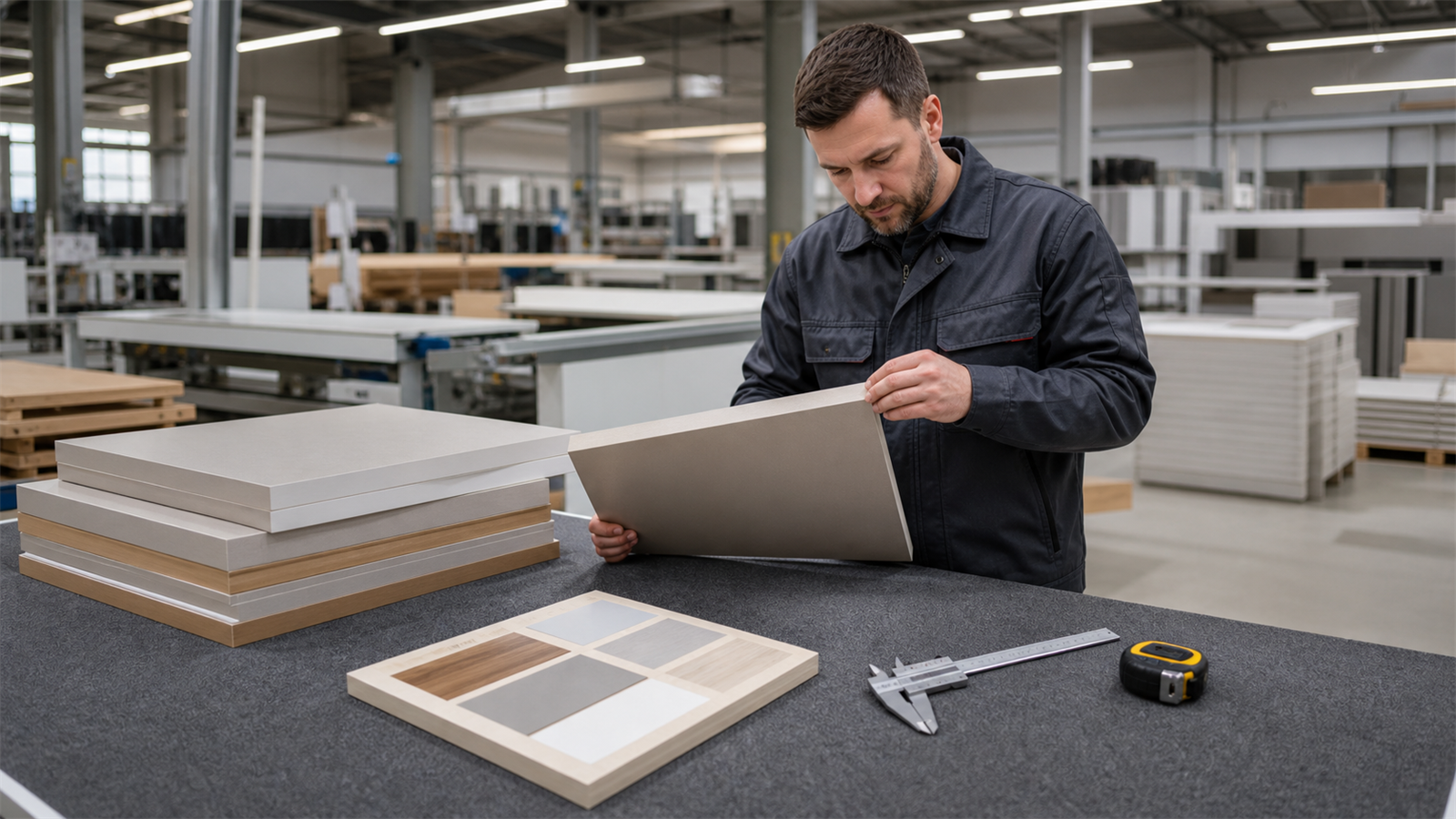
- Request physical samples for board, edge band, door finish, and hardware.
- Confirm carton labeling, packing method, spare parts, and replacement process.
- Agree on drawing approval, QC checkpoints, and acceptable tolerances before production.
Часто задаваемые вопросы
Is plywood always better than MDF or particle board for cabinets?
No. Plywood is often stronger and more moisture-tolerant, but MDF can produce a better painted door and particle board can provide a cost-effective melamine solution. The correct choice depends on the component and environment. Specify the material where it adds performance, rather than upgrading every panel without a clear project benefit.
Is MDF suitable for kitchen cabinet doors?
Yes, especially for painted, lacquered, routed, or shaker-style doors. Use an appropriate grade, confirm the paint system, and protect edges and cutouts. MDF is less suitable where water can repeatedly reach an unsealed edge. A finish sample should be approved before batch production.
Is particle board acceptable for kitchen cabinets?
It can be acceptable for dry-area carcasses and melamine-faced components when the panel density, edge banding, hardware, and installation are appropriate. Sink units and high-moisture zones need more careful material selection and edge protection. Ask the manufacturer to separate these areas in the quotation.
Which material holds screws best?
Plywood generally offers stronger screw-holding performance than standard particle board, but the result also depends on screw type, pilot holes, edge distance, panel thickness, and assembly method. MDF can hold suitable fixings well in the face, but its edges require careful design. Confirm hardware fixing details with the manufacturer.
What should a contractor request from a cabinet factory?
Request a material schedule, approved samples, shop drawings, hardware list, packing plan, carton labels, QC checkpoints, and replacement-parts process. The quotation should identify the substrate for each major component. This makes material substitutions and installation questions easier to control.
Can different materials be combined in one kitchen?
Yes. Combining materials is often the most practical approach. For example, plywood may be used in sink bases, MDF for painted doors, and melamine particle board for dry interiors. The factory should control dimensions, finish matching, edge details, and color batches across the complete cabinet package.
Conclusion: Specify the Material by Function
Plywood, MDF, and particle board can all be valid cabinet materials when their use matches the project conditions. Designers should specify by component, moisture exposure, finish, load, and installation method. Contractors should verify edges, hardware fixing, packing, and drawings. B2B buyers should compare the complete technical specification rather than a single board label.