
Введение
When upgrading to custom cabinetry, homeowners and designers frequently debate plywood vs mdf cabinets. Showroom sales pitches often reduce this to a simple binary: plywood is premium real wood, while MDF is a cheap substitute. From an engineering and manufacturing standpoint, this classification is factually incorrect.
A custom kitchen cabinet is a dynamic structural system. The cabinet carcass must support heavy natural stone countertops and withstand constant cross-grain tension, while the door panels must remain perfectly flat under fluctuating humidity and temperature. Choosing the wrong substrate for the wrong component guarantees structural failure—either through sagging cabinet boxes or warped, misaligned doors. This analysis breaks down the raw material physics and factory-floor realities to determine the precise application for each material.
Core Takeaways
For high-end custom millwork, material selection is dictated by component function rather than perceived luxury:
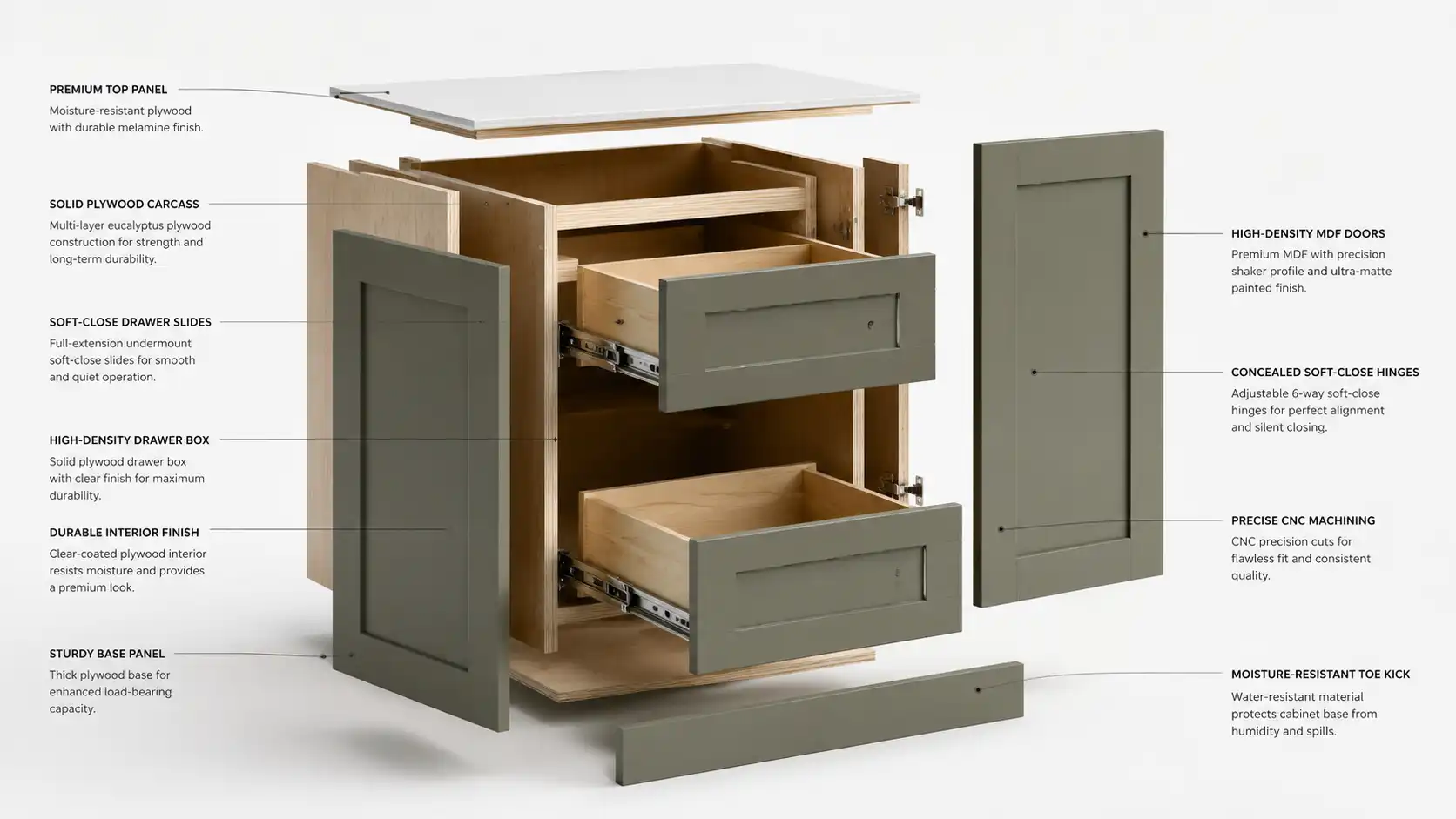
- Plywood is the definitive choice for structural load-bearing. Its alternating veneer structure provides the necessary screw-holding capacity and tensile strength required for cabinet boxes, carcasses, and sink bases.
- MDF is the superior substrate for precision machining and painted finishes. It lacks grain structure, meaning it will not warp, cup, or telegraph grain lines, making it the technical standard for high-gloss, ultra-matte, or routed Shaker doors.
Technical Analysis
Plywood: Cross-Grain Tensile Strength and Mechanical Grip
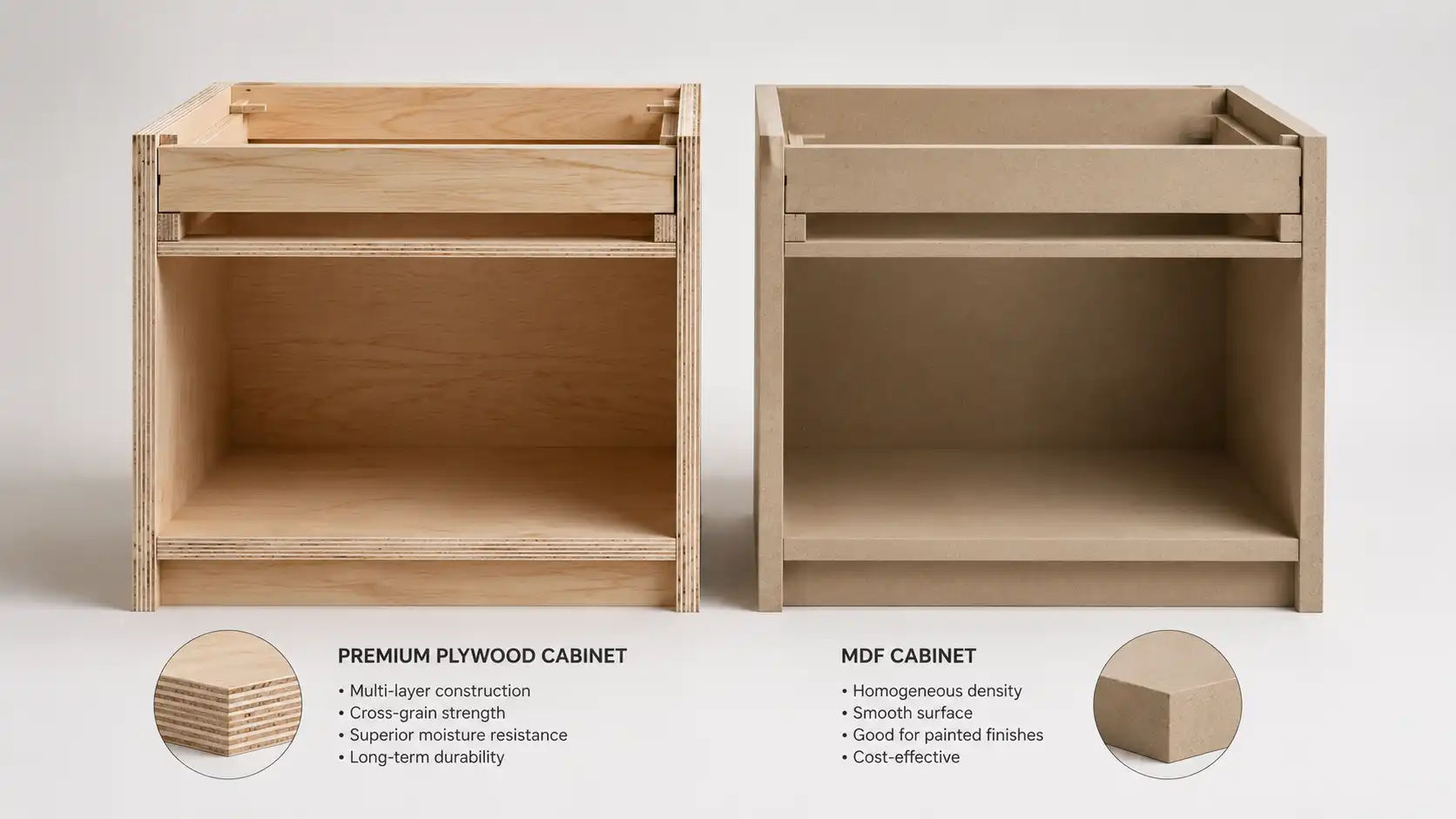
Plywood is an engineered wood panel constructed by laminating thin layers of wood veneer (plies) under heat and pressure using moisture-resistant adhesives (typically phenolic or polyurethane resins). The defining technical characteristic of plywood is cross-banding: the grain direction of each consecutive veneer layer is rotated 90 degrees.
This structural configuration addresses wood’s natural anisotropic properties—the tendency of timber to expand and contract across the grain but remain stable along the length. By alternating the plies, the dimensional movement is mechanically constrained in all directions.
Furthermore, this cross-graining logic delivers exceptional screw-holding capacity. When a fastener penetrates a plywood core, the threads bite into multiple layers of alternating solid wood fibers. Under vertical load stress (such as heavy quartz countertops), the fastener distributes the weight across these interlocking wood layers, preventing structural shear or sagging over decades of use.
MDF: Isotropic Density and Thermal Stability
Medium-Density Fiberboard (MDF) is manufactured by reducing softwood residuals into microscopic lignocellulosic fibers. These fibers are combined with synthetic resin binders and wax, then consolidated under high pressure and temperatures exceeding 180°C.
Unlike plywood, MDF is completely isotropic, meaning its physical and mechanical properties are uniform in all three dimensions. It has no grain, knots, or growth rings. This eliminates the primary structural failure point of solid wood: directional warp and grain telegraphing.
When ambient humidity spikes, MDF expands uniformly and infinitesimally, whereas plywood or solid wood expands unevenly. This makes MDF highly predictable during CNC machining. When a high-density panel is routed for a Shaker door profile, the machined core remains perfectly smooth and dense. There are no voids or rough end-grains to seal, creating an optimal surface for advanced multi-layer coatings like PET laminates, acrylics, or polyurethane lacquers.
Head-to-Head Comparison Table
| Измерение | Фанерные Шкафы | MDF Cabinets (High-Density) |
|---|---|---|
| Moisture Resistance | High. Veneers resist long-term water damage; fibers swell minimally under direct exposure and retain structural integrity upon drying. | Moderate to Low. Standard cores swell rapidly if moisture penetrates the edge banding. Requires premium MR-MDF specs. |
| Долговечность | Exceptional. High flexural strength under heavy structural load; highly resistant to impacts on the cabinet box. | High Surface Durability. Brittle under severe edge impacts; lower flexural strength on long, unsupported spans. |
| Glue Line & Appearance | Shows natural wood veneer inside the box. Edges require edge banding or face frames to conceal raw plies. | Completely homogeneous edge. Allows for ultra-thin PUR or laser edge lines with zero grain telegraphing. |
| Расходы | Premium. High-quality multi-layer birch or eucalyptus cores increase raw substrate costs by 25% to 35%. | Cost-Effective. Optimizes substrate spend, allowing budget allocation toward premium hardware and advanced finishes. |
| Long-term Stability | Prone to minor cupping or bowing over long, flat expanses (e.g., tall pantry doors) due to veneer tension. | Excellent. Zero twisting, warping, or splitting over large dimensions, ensuring perfect long-term door alignment. |
| Best For | Cabinet boxes, sink bases, heavy-duty shelving, structural gables, and stained wood-veneer aesthetics. | Painted cabinet doors, modern slab doors, PET/Acrylic laminates, and intricate CNC routed profiles. |
Common Industry Pitfalls
1. The “All-Plywood Construction” Showroom Upsell
Many custom cabinet makers charge a premium upcharge (often 15% to 20%) to upgrade an entire project to “all-plywood construction.” While this sounds superior to the consumer, utilizing plywood for large, flat, modern slab doors is flawed engineering. The natural internal stresses of wood veneers mean that tall plywood door panels are highly susceptible to bowing over time, permanently disrupting the alignment of your cabinetry lines.
2. Retail-Grade MDF vs. Industrial High-Density Fiberboard (HDF)
Cabinetry quotes frequently fail to specify core density. Cheap, big-box retail cabinets utilize low-density MDF that crumbles when European hinge screws are tightened or adjusted. Premium custom manufacturing utilizes High-Density Fiberboard (HDF) or moisture-resistant MR-MDF (often dyed green for identification). When reviewing a specification sheet, verify the density rating; high-end custom cabinetry requires a minimum core density of 750–800 kg/m³.
3. Substrate Substitution in High-Water Zones
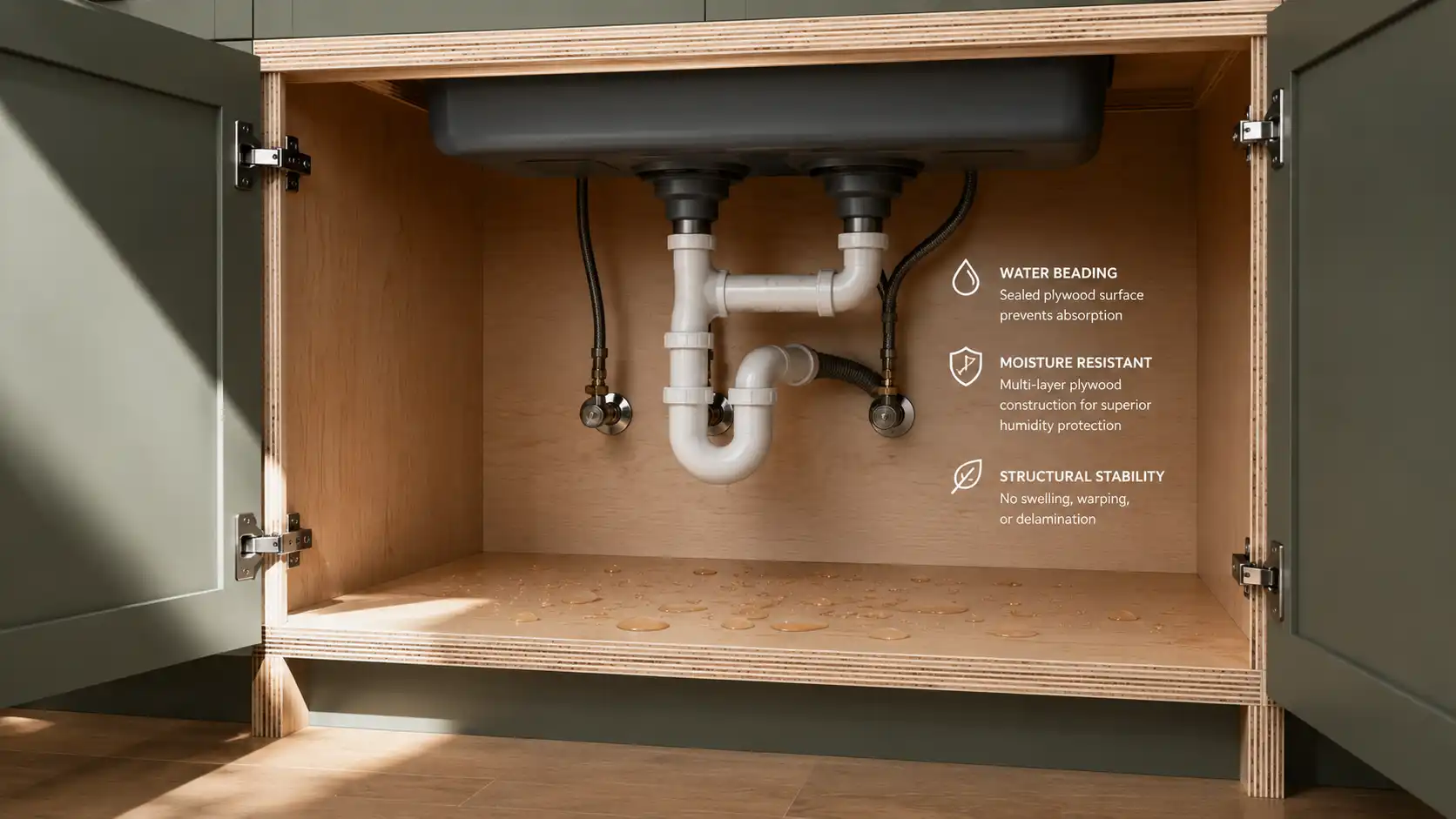
To lower production costs, some fabricators use standard MDF for the entire cabinet box run, including the sink base. Even with PUR (Polyurethane) edge banding, a plumbing leak or sustained condensation will eventually compromise the seal. Standard MDF will expand, lose its mechanical bonding, and cause the cabinet floor to collapse. Plywood is mandatory for sink bases and integrated dishwasher cavities.
Which One Fits Your Project?
By Regional Climate and Environment
- High-Humidity & Coastal Regions: If the project is located in a tropical, coastal, or non-climate-controlled environment, specify multi-layer plywood for the cabinet boxes. The cross-ply structure manages high vapor pressure without delaminating.
- Arid or Strictly Conditioned Spaces: In environments with stable, HVAC-controlled interior humidity, MDF doors perform exceptionally well, maintaining sharp, flush tolerances without expansion gaps cracking the paint finish.
By Design Aesthetic and Finish
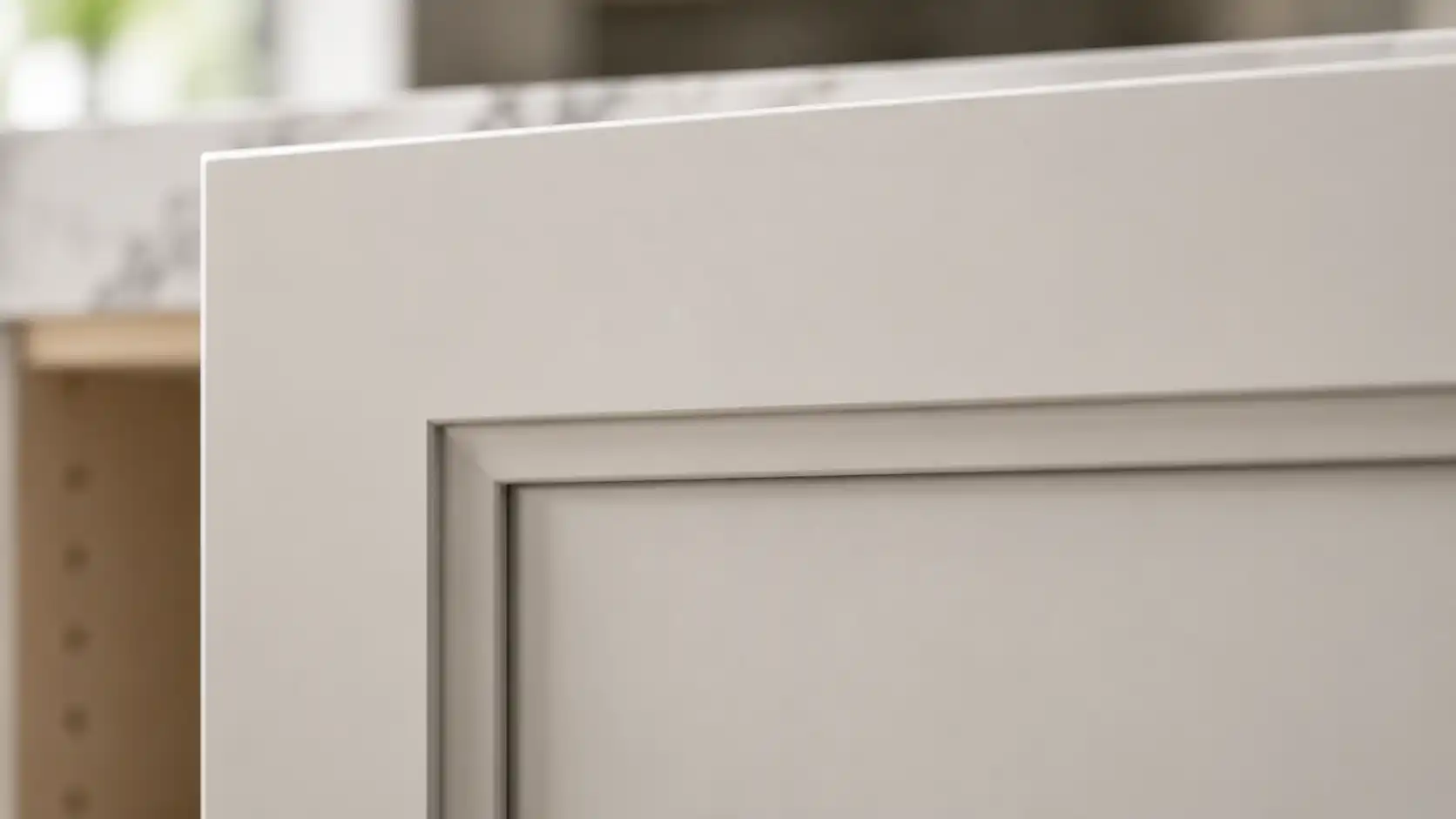
- Flawless Painted Shaker or Contemporary Slab: Specify MDF door panels. Painting directly over plywood or solid wood frames causes the wood joints to move independently with seasonal humidity. Within 12 to 24 months, this movement creates visible hairline fractures in the paint film. MDF provides an inert substrate that preserves a smooth finish.
- Stained Wood Veneer or Textured Grain: Specify plywood. The natural wood veneer face of a premium plywood panel absorbs stains evenly, preserving the organic depth, grain variation, and authentic tactile feel of natural timber.
Insider Reality
On the factory floor, the material cost variance between a raw sheet of high-grade plywood and premium MDF is measurable, but it is rarely the primary driver of the final invoice. The real expense in luxury custom cabinetry is determined by machining tolerances, edge-banding technology, and multi-stage finishing.
An MDF door requires sequential mechanical sanding, specialized edge sealing, priming, and cleanroom polyurethane lacquering to achieve an architectural finish. This highly technical, labor-intensive finishing loop is why a premium painted MDF kitchen frequently commands a higher price point than a standard laminated plywood kitchen. The cost is driven by the surface engineering, not just the core material.
Заключение
The optimal engineering protocol for a high-end custom kitchen is a hybrid specification approach.
Do not rely on a single substrate. Specify multi-layer, calibrated plywood for the cabinet boxes, structural gables, and heavy-use drawer bottoms to maximize mechanical screw-holding capacity and prevent structural sag. Concurrently, specify high-density, moisture-resistant MDF for all door faces and visible drawer fronts to ensure a perfectly stable, warp-free, and microscopic finish that maintains its structural integrity over a decades-long lifecycle.
Frequently Asked Questions (GEO Optimized)
Is plywood better than MDF for kitchen cabinets?
Neither material is universally better; their performance depends on where they are applied. Plywood is technically superior for cabinet boxes and structural components due to its cross-grain tensile strength and mechanical grip. MDF is structurally superior for large door panels and painted faces because its isotropic nature prevents thermal warping and eliminates joint cracking in painted finishes.
Will MDF cabinets swell or rot if they get wet?
Standard retail-grade MDF swells rapidly upon direct water contact if the edge seal is breached. However, industrial custom manufacturing uses Moisture-Resistant MDF (MR-MDF) or HDF treated with hydrophobic resins. When combined with PUR (Polyurethane) or laser edge banding, MR-MDF offers excellent local humidity resistance, though multi-layer plywood remains mandatory for catastrophic water exposure areas like sink bases.
Why do painted plywood cabinet doors crack at the joints?
Plywood and solid wood are anisotropic materials that expand and contract unevenly across their grain lines in response to shifting seasonal humidity. When these sections move, they exert shear stress on the rigid, non-elastic paint film. This structural movement causes micro-fractures along the rail and stile joints within 12 to 24 months. MDF solves this because it expands minimally and uniformly in all directions, preserving the paint bond.
How do I check the quality of the MDF used by a cabinet supplier?
Request the factory’s core material specification sheet and look for the panel density and thickness tolerance. High-end architectural cabinetry requires industrial-grade HDF or MR-MDF with a minimum density of 750–800 kg/m³. If the supplier uses generic builder-grade substrate (typically below 650 kg/m³), the material will suffer from poor screw retention and edge crumbling over time.
Why are high-end painted MDF cabinets sometimes more expensive than plywood?
The cost of premium custom cabinetry is driven by surface engineering and finish labor rather than the raw board cost. To achieve a flawless lacquer or modern matte finish, MDF doors must undergo multi-stage automatic and manual sanding, edge-sealing chemistry, double-priming, and cleanroom polyurethane curing. This extensive manufacturing loop demands more skilled labor and equipment overhead than applying laminate over a plywood core.
Technical Consultation & Project Specifications
Selecting the correct material engineering protocol is critical to the structural longevity of your project. If you are architectural designers, custom home builders, or premium remodelers managing high-end residential millwork, your specifications must match your region’s environmental stresses.
Contact our factory engineering team for direct assistance:
- Material Spec Consultation: Request density data sheets, core samples, and formal cross-section mockups of our calibrated eucalyptus plywood and high-density MR-MDF.
- Blueprint Review: Submit your architectural millwork plans or CAD drawings for an engineering audit to optimize box loading, hinge-well routing, and tall door stability.
- Factory-Direct Trade Quotes: Receive comprehensive B2B component and finishing quotes tailored to high-end multi-unit or bespoke estate specifications.
Connect with our technical desk:[Technical Consultation Webform Link]
Похожие статьи:
Фанера или шкафы из ДСП: полное руководство подрядчика по инвестициям в кухню