





Who should use this guide
This guide is for:
- Developers ordering cabinetry for apartments, hotels, offices, or retail projects.
- Dealers who need support for FSC-related customer requests.
- Procurement teams comparing cabinet factories.
- Designers specifying veneer, plywood, MDF, particleboard, or solid-wood components.
- Buyers who need to check a sourcing claim before placing a project order.
Start with the order, not the FSC logo
A cabinet order is rarely made from one wood material. There may be melamine-faced particleboard inside the carcass, MDF in painted doors, plywood in sink bases, veneer on visible panels, and solid wood in decorative elements. Glass, metal, stone, hardware, and lighting are outside the wood-sourcing claim.
That matters because a broad statement such as “FSC cabinets” can hide too much. The buyer should ask which specific cabinet parts are intended to carry an FSC claim. If the answer is “all materials,” ask for the bill of materials. If the answer is “the cabinet carcass only,” put that into the project record.
A clear claim is more useful than an ambitious but vague one.
FSC wood sourcing: what buyers should verify
| Buyer question | What to check | Evidence to request | Warning sign |
|---|---|---|---|
| Who holds the certificate? | Legal entity name, certificate code, factory or trading company role | Current certificate record from FSC Search | Certificate belongs to an unrelated company |
| Is the certificate active? | Status, valid dates, certification type, listed sites | Time-stamped FSC Search result | Old PDF with no live verification |
| Does the scope fit the order? | Product groups, manufacturing or trading activity, relevant site | Public certificate scope and supplier explanation | Generic certificate with no link to cabinet production |
| Which cabinet parts are included? | Carcass, doors, shelves, fillers, veneer, solid-wood parts | Project material schedule | Supplier calls the whole cabinet FSC without a component list |
| Is there an FSC claim for the sale? | Claim on relevant sales or delivery documents | Invoice, order confirmation, delivery note, or controlled project record | FSC logo on a brochure but no claim on the transaction |
| Has the project changed? | Board substitutions, door changes, added timber parts | Revised material schedule and approval record | Production uses a different panel from the approved file |
A Chain of Custody certificate has boundaries
FSC Chain of Custody certification tracks identified FSC material through the supply chain and separates it from ineligible material. It can cover manufacturers, traders, multiple sites, and, in some cases, projects. FSC’s Chain of Custody overview explains the basic system.
The important word is scope.
A certificate may belong to a head office while the factory making the cabinets is a different legal entity. A company may be certified for trading but not for the manufacturing activity a buyer assumes is covered. A multisite certificate can include several facilities, but buyers should still verify that the relevant production site is included.
Использовать FSC Search rather than relying only on a certificate PDF sent by email. The database lets buyers search certificate holder names, certificate codes, status, country, certification type, and product-related information. Save a dated record with the project file.
A valid certificate is a good starting point. It is not the finished answer.
Map the cabinet to the actual wood components
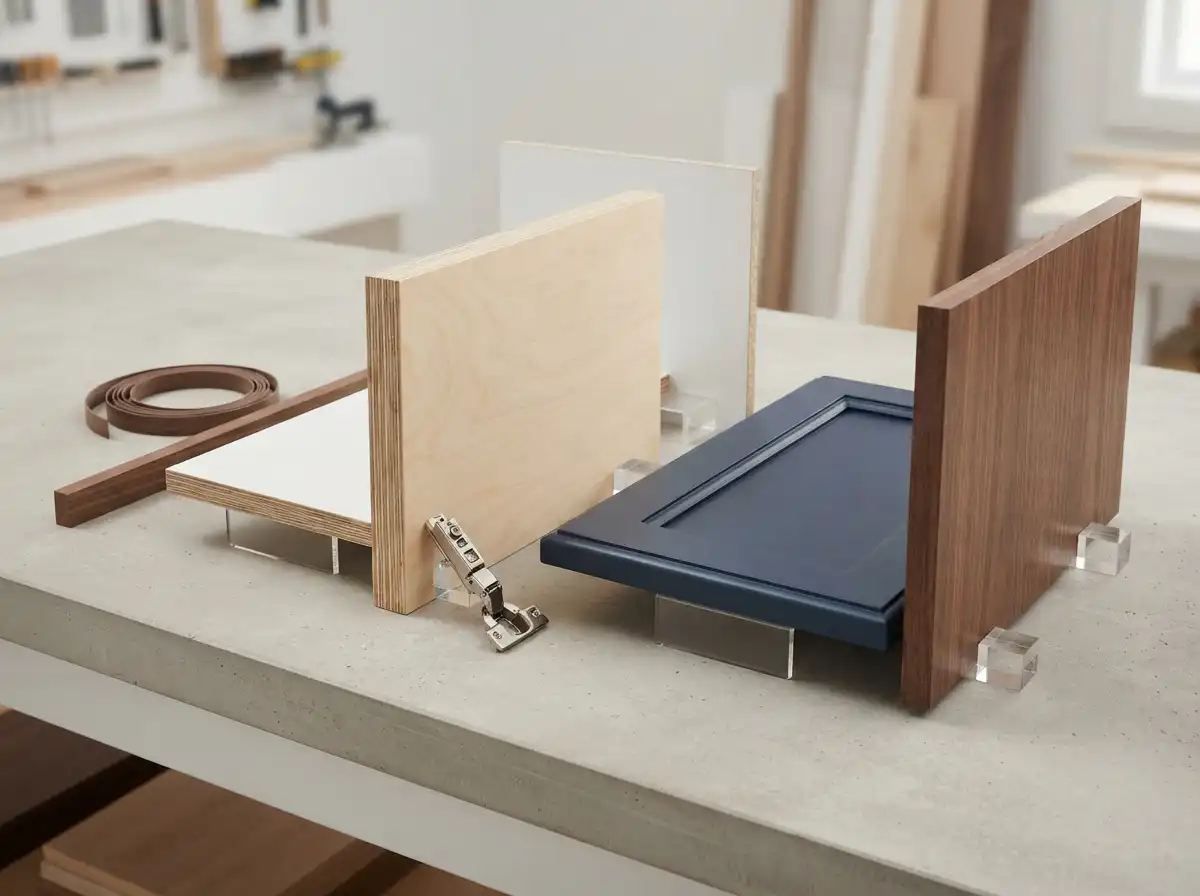
For a custom cabinet package, the factory should prepare a short material map. It does not need to become a forty-page report. One page can often do the job.
The map should identify:
- Cabinet carcass board and panel source
- Door and drawer-front substrate
- Back-panel and shelf material
- End panels, fillers, and decorative timber parts
- Veneer or solid-wood components
- Product or cabinet codes covered by the order
- Intended FSC claim, where applicable
This step is particularly useful when the design changes during sampling. A buyer may approve a melamine carcass, then later add timber slats, veneer end panels, or painted MDF doors. Those changes affect the material picture. They should not be treated as invisible design tweaks.
The sales document is where the claim becomes traceable
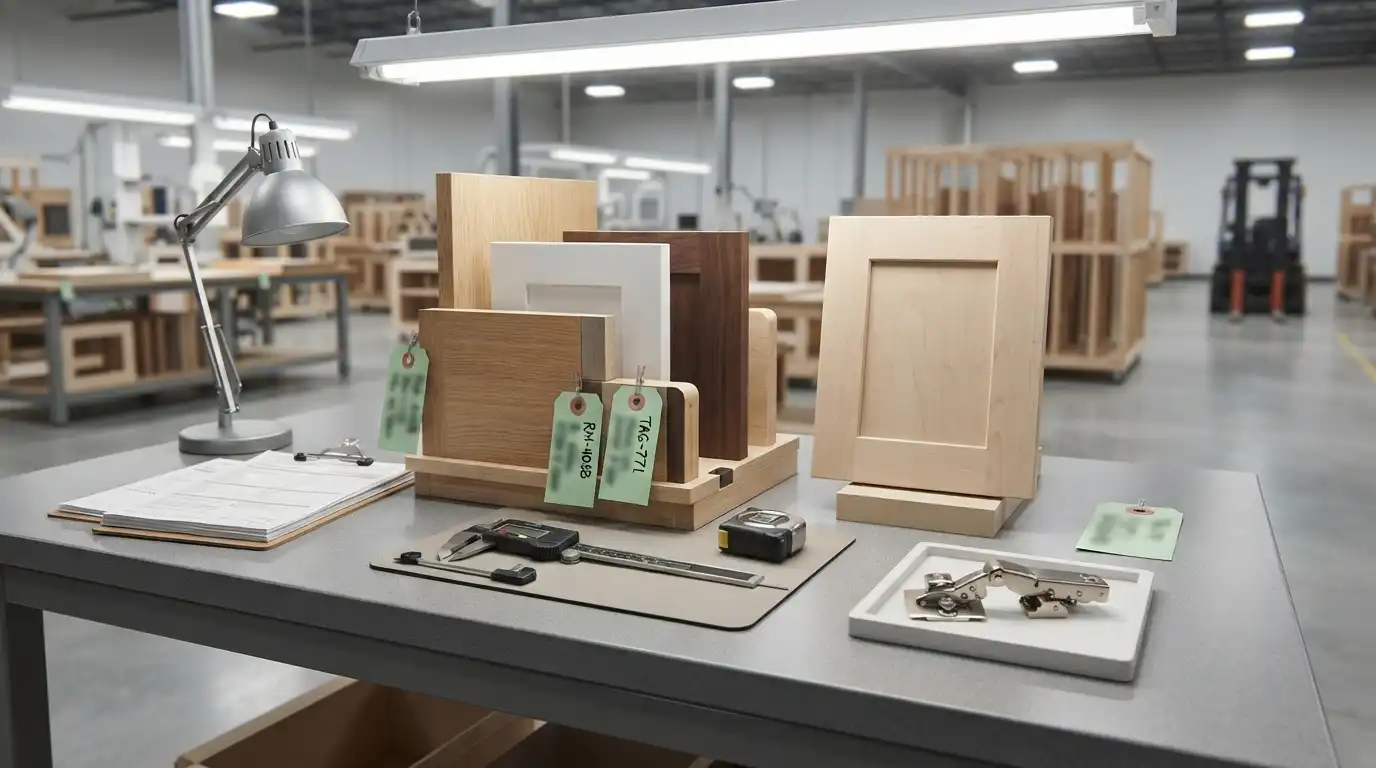
A certificate tells you who can operate inside the FSC system. A sales document connects the claim to a transaction.
FSC’s Chain of Custody standard requires sales documents for products sold with FSC claims to identify the seller, customer, issue date, product description, quantity, and FSC claim, among other required information. Custom-manufactured projects may be recorded through job orders or project overviews within the certificate holder’s material-accounting system. FSC Chain of Custody standard
For a cabinet buyer, that means the order confirmation, invoice, delivery note, or project record should make sense alongside the cabinet schedule. If the project contains 120 kitchen carcasses and 240 painted doors, the file should not simply say “FSC furniture.”
Ask for the description used for the project claim before the order is released. That avoids awkward corrections when the goods are already packed.
Do not treat FSC 100%, FSC Mix, and FSC Recycled as interchangeable
The claim matters.
FSC 100% refers to material from FSC-certified forests. FSC Mix can include FSC-certified material together with other eligible material categories permitted by the FSC system. FSC Recycled relates to reclaimed-material inputs. These are different claims with different input rules.
Buyers do not need to run the factory’s material accounting system. They do need to avoid collapsing every FSC reference into one phrase in a tender response or product brochure.
If a client has stated a required claim, write it into the purchase order. If the client has asked only for “FSC-certified wood,” clarify what they mean before production. A claim that cannot be supported by the supplier’s records should not be printed on cartons, catalogues, or project handover documents.
Dealers need to separate stock claims from project claims
A dealer may have an FSC-certified supplier and still sell cabinet packages that are outside a particular claim. This can happen when a customer chooses a different panel, adds a non-covered decorative part, or buys from several production sources.
Keep stock and project orders separate in the paperwork. For a custom order, record the dealer purchase order, cabinet schedule, supplier’s FSC claim, and any approved substitutions. A short trail is enough if it is consistent.
If a tender requires a project-level FSC outcome, seek advice early. FSC has a project-certification route, but that is different from assuming a factory’s ordinary Chain of Custody certificate automatically certifies the whole construction or fit-out project.
What KEJIA checks before production
At KEJIA, an FSC request needs to be attached to the project order before the material schedule is locked. The factory reviews the destination market, requested claim, certificate-holder information, panel availability, and cabinet components in the approved drawings.
The production record should then connect cabinet codes with their panel and finish selections. When a project has repeated rooms or units, room-coded packing makes later checks easier. If an approved component changes, the material record changes with it.
The practical rule is simple: do not let a sustainability claim live only in the sales presentation. It needs a place in the order, the material schedule, and the shipping documents.
Mistakes that create weak FSC claims
Relying on a certificate screenshot
A screenshot can be old, incomplete, or issued for another company. Search the current certificate record and save the result with the project file.
Checking the certificate but ignoring its scope
The certificate holder may be valid, while the relevant factory site or product activity is outside scope. Look at the entity and activity, not only the logo.
Calling every wood component FSC
A cabinet has different panel types and decorative parts. State exactly which parts carry the claim.
Losing track of substitutions
A change from one board supplier to another may be commercially sensible, but it still needs review before the claim is carried forward.
Using FSC language in marketing without transaction evidence
A brochure is not a sales document. Project claims should be supported by the supplier’s records and the relevant order paperwork.
FSC sourcing checklist for cabinet projects

- State the destination market and client requirement.
- Name the intended FSC claim in the RFQ or purchase order.
- Verify the certificate holder in FSC Search.
- Check current certificate status, site, and scope.
- Identify the cabinet components expected to carry the claim.
- Request a project material map.
- Match cabinet codes to the material schedule.
- Confirm how the FSC claim will appear on the sales or delivery documents.
- Record approved material substitutions.
- Save the certificate-search result with the order file.
- Keep claim-related records with the shipping and handover documents.
For related material controls, see the formaldehyde and panel emissions guide and the cabinet production readiness checklist.
Frequently asked questions
Does an FSC Chain of Custody certificate mean every cabinet is FSC?
No. The certificate shows that an organisation operates within the FSC Chain of Custody system for its certified scope. Buyers still need to identify the relevant cabinet materials and verify the FSC claim connected to the particular sale or project.
How can I check whether an FSC certificate is valid?
Search the supplier name, licence code, or certificate code in FSC Search. Check the current status, certificate holder, certification type, dates, and scope. Save a time-stamped record with the purchase order.
What documents should a cabinet buyer request?
Ask for the certificate reference, a project material map, cabinet schedule, relevant FSC claim on the sales documentation, and records of approved substitutions. The exact file will depend on the project and the supplier’s role.
Can a dealer advertise a cabinet range as FSC?
Only use FSC claims and trademarks in the way permitted by the applicable FSC rules and the actual supply-chain records. A dealer should not assume that one certified supplier makes every product or configuration eligible for the same claim.
What is the difference between FSC 100% and FSC Mix?
They are different FSC claims. FSC 100% relates to material from FSC-certified forests. FSC Mix is based on a permitted combination of input categories under FSC rules. Do not replace one claim with the other in a quotation or tender response.
What should happen when the cabinet material changes?
Treat the change as part of normal project control. Update the material schedule, check whether the original claim still applies, and obtain revised project documentation before the revised materials enter production.

Request FSC Sourcing Documentation
Send KEJIA the cabinet schedule, destination market, required FSC claim, material direction, and target shipment date. We can review the material map, available sourcing documents, project-record format, and claim-supporting information before production begins.