





For procurement teams, a custom cabinet quote is comparable only when the scope behind it is equally clear. This custom cabinet cost breakdown shows where a cabinet project price changes: quantities and dimensions, carcass and door materials, finishes, hardware, countertops and accessories, engineering, packing, and the named delivery point under the agreed Incoterms® rule. A low unit price may exclude drawings, export packing, destination charges, installation, or replacement parts. Ask every manufacturer to price the same specification, list exclusions in writing, and identify the delivery term and named place before selecting a supplier.
Who This Guide Is For
- Procurement teams consolidating bids for apartment, villa, hotel, or retail projects.
- Contractors who need a cabinet price that matches site-ready installation scope.
- Developers comparing standardization, lead time, and landed-cost risk.
- Importers, dealers, and B2B buyers sourcing from a custom cabinet manufacturer in China.
Key Takeaways for Cabinet Quote Comparison
- Compare a completed scope, not only a price per linear metre or per cabinet set.
- Specify wet-zone carcasses, exposed edges, and screw-holding requirements as separate line items.
- Door finish, hardware level, interior fittings, and non-standard dimensions need quantities and specifications.
- Incoterms® allocate delivery tasks, costs, and risk; they do not create a fully landed project price.
- Drawings, room labels, packaging, inspection, and replacement-parts terms should be visible in the quotation.
Use this custom cabinet cost breakdown as a bid-comparison framework: it turns a headline price into a decision record for scope, delivery, and project risk.
What Should a Custom Cabinet Cost Breakdown Include?
A dependable quotation connects a price to a technical baseline. It identifies each room or cabinet group, dimensions or drawing revision, material construction, visible finishes, hardware, accessories, packing, production lead time, payment milestones, delivery term, and exclusions. For an early tender, ask for an estimate with stated assumptions and a later drawing-based revision instead of treating a concept price as final.
On mobile, swipe left or right to view all table columns.
| Quote component | What to specify | How it changes cost | Procurement check |
|---|---|---|---|
| Cabinet carcass | Panel type, thickness, moisture resistance, edge banding, back panel, shelf load | Plywood, moisture-resistant panels, thicker shelves, and sealed edges usually cost more than basic board construction. | Separate sink bases and bathroom vanities from dry storage. |
| Doors and finish | Melamine, PET, lacquer, veneer, glass, color code, sheen, edge detail | Finish material, coating process, color matching, and door machining change material and labor. | Request sample references and a batch color-variation tolerance. |
| Hardware and interiors | Hinges, slides, pull-outs, baskets, lighting, handles, quantities | Premium hardware and functional accessories can materially increase the set price. | Use a room-by-room schedule; define “standard hardware.” |
| Engineering | Drawing revisions, curved units, appliances, cut-outs, site interfaces | More coordination, machining, and testing increase cost and lead time. | Freeze appliances, utilities, and interface dimensions before release. |
| Packing and documents | Flat-pack/assembled, protection, room labels, packing list, photo records | Stronger export packing and labeling add cost but reduce damage and site labor. | Approve a packing proposal before comparing freight. |
Custom Cabinet Cost Breakdown: Which Factors Change the Price Most?

Quantity, layout repetition, and module sizes
Repeated, drawing-approved modules are easier to batch, inspect, pack, and replace than a project made entirely of one-off cabinetry. Procurement should distinguish repeated components from genuine custom work. Show the room count, cabinet type, and quantity so volume assumptions cannot disappear inside one lump sum.
Substrate, finish, and moisture protection
Panel price is only part of the cost. Cutting behavior, edge-banding quality, surface preparation, paint or laminate process, and the service environment also matter. For bathroom vanities and kitchen sink bases, specify panel construction and sealed exposed edges. For painted MDF doors, state sheen and approved color sample; for veneer, define grain direction and matching expectation.
Hardware and functional fittings
Hinges, drawer slides, lift systems, pull-out baskets, organizers, LED lighting, and integrated handles need a bill of quantities. “Soft close” is a function, not a brand, load capacity, finish, or warranty. Compare identical opening type, quantity, load requirement, and grade.
Changes after quotation and production release
Late changes create cost through revised drawings, changed material orders, machining, and rework. Appliance sizes, wall dimensions, countertop cut-outs, door opening directions, and finished-floor levels are particularly high risk. Maintain a drawing revision register and price post-release changes as variations.
Packing, shipment, and destination handling
Cabinets are volume-sensitive goods. Flat-pack and assembled units require different packing, container space, handling, and site labor. Room-coded cartons, edge protection, moisture barriers, spare hardware, and clear packing lists should be priced as part of the delivery plan.
How Do Incoterms® Change a Custom Cabinet Cost Breakdown?
Incoterms® rules divide delivery tasks, costs, and risk between seller and buyer. They do not determine cabinet quality, payment terms, ownership transfer, customs duties, or the exact services a project needs. Always state the rule, its version, and the precise named place in the purchase contract. The ICC Incoterms® rules identify Incoterms® 2020 as the current ruleset.
On mobile, swipe left or right to view all table columns.
| Term often discussed | Typical use | Buyer must clarify | Cost-comparison risk |
|---|---|---|---|
| EXW | Buyer collects from the supplier’s named premises. | Loading, export clearance, origin charges, insurance, and all onward transport. | The price can look low because export and logistics work is outside it. |
| FOB (named port) | Common for sea-freight orders where the buyer controls main carriage. | Port, export packing, origin handling, booking deadline, and container loading. | FOB prices at different ports or with different packing scope are not comparable. |
| CIF (named destination port) | Seller arranges ocean freight and insurance to the named port. | Terminal charges, customs clearance, inland delivery, and insurance conditions. | Freight inclusion can obscure costs after port arrival. |
| DAP (named place) | Delivery to an agreed destination before unloading. | Exact delivery point, vehicle access, unloading, import clearance, duties/taxes, and site restrictions. | “Delivered” may be misread as including unloading, installation, and tax. |
Use the ICC guidance, a freight forwarder, and a local customs adviser to validate the selected rule and operational responsibilities for each project. This page is procurement guidance, not legal or customs advice.
Custom Cabinet Cost Breakdown: What Is Commonly Excluded?
An exclusion is not automatically a problem. It becomes a problem when two bids use different exclusions and the buyer cannot see them. Request an included / excluded / optional schedule with every quote.
On mobile, swipe left or right to view all table columns.
| Common exclusion | Why it is separate | RFQ question |
|---|---|---|
| Site measurement and installation | Needs local labor, access planning, and final field verification. | Who measures final openings, installs cabinets, seals joints, and handles punch-list work? |
| Countertop templating and joining | Often depends on final installed cabinets and local stone fabrication. | Does the price include stone, template, cut-outs, transport, joining, and installation? |
| Appliances, sinks, taps, and electrical work | These are separate trades or buyer-nominated products. | Which models are included, and who provides cut-out data and connections? |
| Freight, destination charges, duties, and taxes | They depend on route, Incoterms®, customs status, and local regulations. | List each logistics leg and each destination cost paid by the buyer. |
| Changes after approval | They may require drawings, materials, machining, and repacking. | What is the variation process, pricing basis, and lead-time effect? |
| Spare parts and after-sales attendance | Scope varies by project location and service model. | What spares, touch-up materials, replacement-panel process, and response terms are included? |
Factory Insight: Making a Custom Cabinet Cost Breakdown Auditable
At KEJIA, a quotation should move from an estimate to a production-ready price through documented decisions. We recommend separating cabinet carcass, door finishes, hardware, accessories, countertops, packing, and logistics instead of hiding all cost in a single cabinet-set rate. Drawing review should check appliance interfaces, opening directions, panel junctions, and installation tolerances before release. For overseas projects, agree room-coded labels, carton contents, packing lists, and photo records before shipment. Define wet-area exposure and edge treatment in the RFQ; changing it after production release costs more than specifying it early.

Six Custom Cabinet Cost Breakdown Mistakes That Create Budget Surprises
- Comparing only a headline total. Use a common bid schedule with materials, quantities, and exclusions.
- Accepting “same as drawing” without a revision number. Cite an issue date and revision on every priced package.
- Leaving hardware as a generic allowance. Use a hardware schedule with grade and quantity.
- Calling a term “delivered” without a named place. State the Incoterms® rule, version, and named place.
- Treating packing as cosmetic. Approve labeling and protection before shipping.
- Forgetting site interfaces. Assign ownership for appliances, plumbing, power, wall conditions, and final measurements.
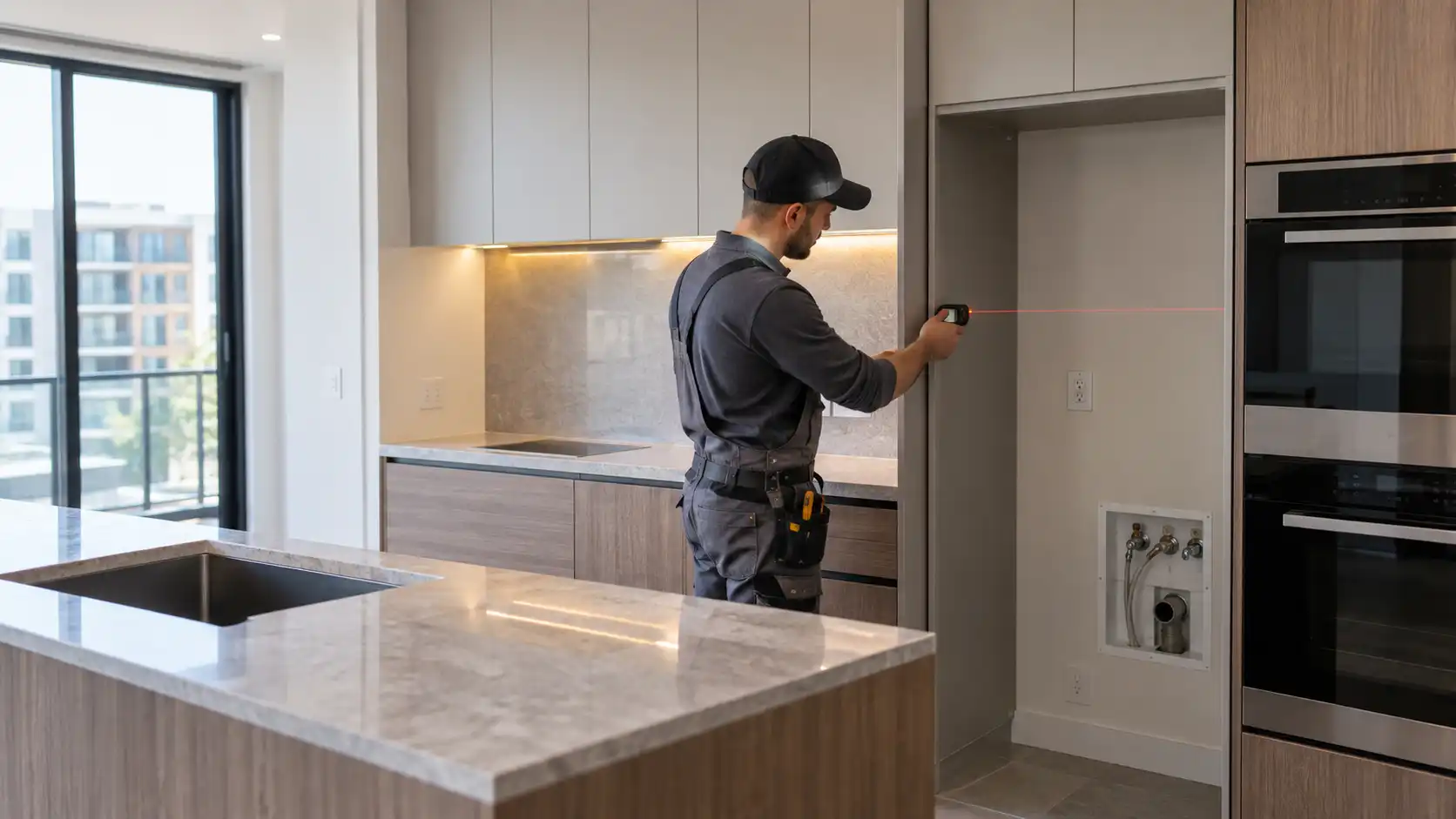
RFQ Checklist for a Defensible Custom Cabinet Cost Breakdown
- Provide plans, elevations, room names, and the latest drawing revision.
- Identify cabinet group, quantity, target dimensions, and room location.
- State carcass, door, finish, countertop, hardware, handle, and accessory requirements.
- Provide appliance, sink, and lighting models or technical cut sheets.
- Identify wet areas and applicable fire, moisture, or local compliance requirements.
- State whether drawings, samples, inspection, export packing, freight, installation, or spare parts are included.
- Name the required Incoterms® rule, version, and delivery place, or request clearly labelled alternatives.
- Ask for lead time from drawing approval, payment milestones, validity, variation process, and replacement procedure.
Custom Cabinet Cost Breakdown: Frequently Asked Questions
Is a price per linear metre enough to buy custom cabinets?
No. It can help with an early budget but cannot reliably cover heights, fittings, appliance panels, tall units, islands, finishes, and installation conditions. Use it only with assumptions, then obtain a room-by-room drawing-based quotation before approval.
Which material has the biggest impact on the quote?
The relevant comparison is the performance required in each location. Wet-zone carcasses may need better moisture resistance and sealed edges, while doors are driven by the selected finish and appearance standard. Price material construction separately from door finish and hardware.
Why can two manufacturers quote differently from the same drawings?
They may interpret unlisted materials, hardware, countertop scope, packing, freight, or installation differently. Issue a common specification and obtain an inclusions/exclusions schedule before judging the price difference.
Does FOB include shipping to my project site?
No. FOB concerns delivery to the named port of shipment. Confirm main freight, insurance, destination charges, customs clearance, inland transport, unloading, and installation separately.
Is CIF the same as a fully landed cabinet cost?
No. CIF includes cost, insurance, and freight to the named destination port, but not automatically customs duties, taxes, clearance, terminal charges, inland delivery, unloading, or installation.
What should be fixed before production starts?
Freeze drawings, room dimensions, panel and finish samples, hardware schedule, appliance data, packing method, labels, delivery term, and payment milestones. Document who approves samples and variations.
Should export packing be in the cabinet quote?
Yes, at least as a clear priced and described line. State flat-pack or assembled construction, protection, labels, cartons/pallets/crates, packing list, and spare hardware so transit protection can be balanced against freight volume and site labor.
Request a Project Cost Estimate
Send KEJIA your drawings, room schedule, target market, material preferences, and required delivery term. We will return a project cost estimate with cabinet scope, key assumptions, cost drivers, packing approach, and exclusions clearly identified, so your team can compare options before production decisions are locked.