




Compare Cabinet Quotations: 7 Proven Ways to Avoid Losses
The best way to compare cabinet quotations is to turn every proposal into the same scope before looking at the total price. For contractors, designers, developers and B2B buyers, compare drawings, quantities, cabinet construction, door finishes, hardware, countertops, packing, commercial terms, lead time, QC and replacement obligations line by line. A lower quote can be valid–but it is not comparable if it omits fillers, end panels, interior fittings, stone cut-outs, export packing or site-ready labels. Start with one controlled RFQ and ask each supplier to return a priced bill of materials with assumptions clearly stated.
Who Should Use This Cabinet Quote Comparison Method?
- Contractors tendering a villa, apartment, hotel or multi-unit residential project.
- Interior designers protecting a material specification and installation intent.
- Developers and procurement teams who need a defensible supplier-selection record.
- Cabinet dealers and distributors assessing private-label or project supply options.
Key Takeaways
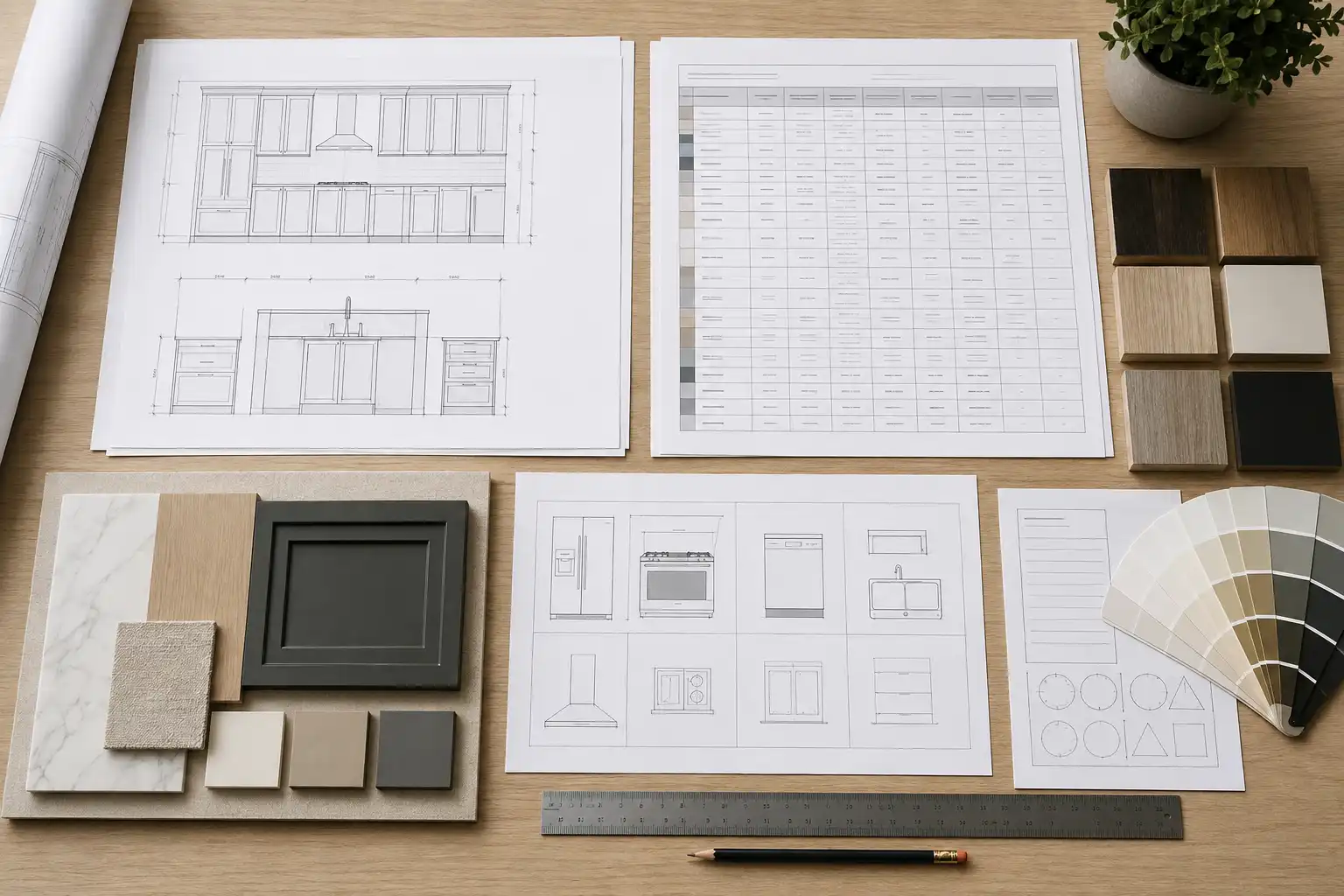
- Never compare cabinet quotation totals until scope, units and commercial terms are normalized.
- The drawings and room-by-room quantities are the anchor; a price without them is an allowance, not a finished comparison.
- Door finish, carcass, edge banding and hardware must each be identified rather than bundled as “high quality.”
- Ask which items are excluded: appliances, countertops, delivery, taxes, installation tools, fillers, cut-outs or special packing.
- Compare confirmed production lead time from drawing approval–not from the date of the first inquiry.
- A supplier’s change-control, QC and replacement process can prevent a low initial quote from becoming an expensive project delay.
What Must Be the Same Before You Compare Prices?
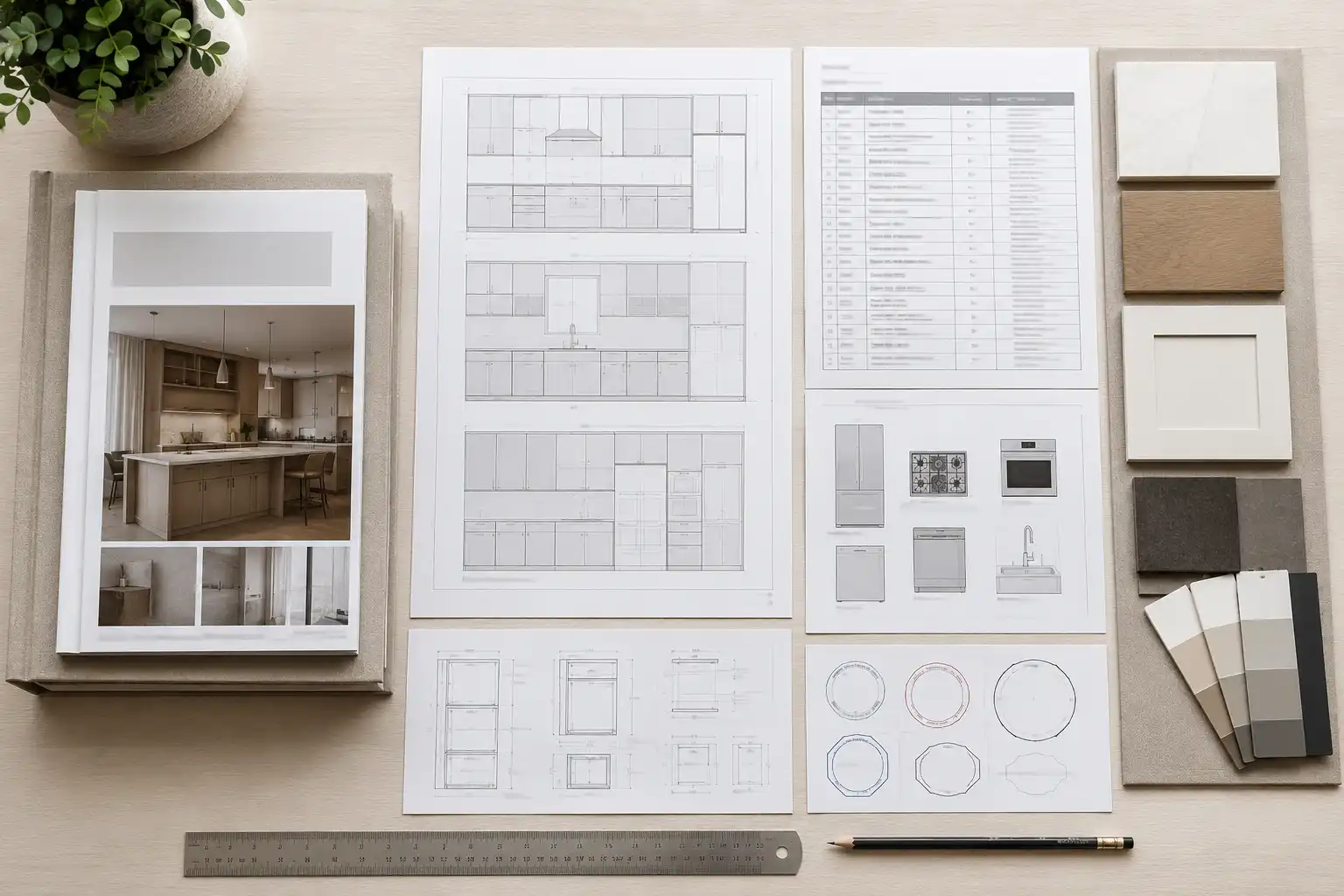
Send all shortlisted suppliers the same RFQ package: room plans, elevations, appliance schedule, material/finish schedule, site country, requested delivery term and deadline. Give each cabinet type a code. Ask suppliers to quote that code, quantity and unit consistently. If one supplier must design from incomplete concept drawings, label the quote “budget estimate” and do not compare it directly with a fully engineered offer.
| Comparison item | What a comparable quote should state | Why it changes the price | Buyer action |
|---|---|---|---|
| Drawing scope | Revision number, room/elevation codes, dimensions and quantities | Missing cabinets, fillers or panels distort totals | Issue one controlled drawing set to every bidder |
| Cabinet box | Board type, thickness, back panel, edge sealing and finish | Construction and moisture protection vary materially | Separate carcass price from door price if needed |
| Door/front | Finish, substrate, color/decor code, profile and edge | “Lacquer” or “wood grain” alone is not a specification | Attach approved sample or performance requirement |
| Аппаратное обеспечение | Hinge/slide brand, series, opening type and accessory list | A quote can omit pull-outs, organizers or soft-close hardware | Require a hardware schedule by cabinet code |
| Countertop and accessories | Material, thickness, cut-outs, sinks, lighting, handles | Often priced separately or excluded | List every included and excluded accessory |
| Packing and delivery | Carton/crate method, room labels, destination and Incoterm | Damage risk and freight responsibility can shift | Confirm export packing and delivery term in writing |
| Время выполнения | Calendar days from approval, deposit and material confirmation | Early promises may not include approvals or shipping | Record the start event and the delivery milestone |
| QC and after-sales | Inspection points, photo report, spare parts and claim process | Replacement lead time affects site handover | Compare the remedy, not only the warranty wording |
How to Compare Cabinet Quotations Using a Like-for-Like Matrix
Create one spreadsheet where the rows are the same rooms and cabinet codes for every supplier. Columns should separate supply scope, material specification, unit price, quantity, total, exclusions, lead time and clarification. Do not let a supplier’s internal room names become the comparison structure; use your own codes.
Step 1: Freeze the RFQ package
Issue a document register with drawing revision, finish schedule, appliance list and quotation deadline. If a design change occurs, send it to all bidders and request a revision number. This prevents one supplier from pricing an older layout while another prices the latest version.
Step 2: Separate base cabinets, fronts and accessories
Ask for a bill of materials or line-item breakdown that distinguishes cabinet carcasses, doors/drawer fronts, handles, hinges, drawer slides, pull-outs, lighting, glass, countertops and installation accessories. You do not need to force every supplier into the same manufacturing method; you do need enough transparency to see whether the quoted scope is equivalent.
Step 3: Record assumptions and exclusions
The most important text in a quotation is often the small-print assumption. List each one as a separate variance. Examples include “countertops excluded,” “site measurement by buyer,” “standard export carton only,” “no appliance installation,” “taxes excluded,” or “filler panels based on final site dimensions.” An assumption is not necessarily a problem, but an unrecorded assumption makes the price misleading.
Step 4: Compare commercial terms separately from product price
An EXW, FOB, CIF or DDP price does not transfer the same responsibilities. Use the ICC’s Incoterms 2020 overview to align the requested delivery term, named place and responsibility split. Keep ocean/air freight, insurance, duties, local delivery and installation outside the cabinet product comparison unless every quote includes the same elements.
Step 5: Score risk as well as price
Give each supplier a separate technical-compliance score and delivery-risk score. A proposal that is 4% lower but lacks a hardware schedule, pre-shipment inspection record and replacement policy may be the more expensive choice if it delays installation. Record price variance and risk variance side by side for the decision meeting.
Cabinet Quote Comparison Scorecard
| Decision area | Evidence to request | Strong response | Warning sign |
|---|---|---|---|
| Scope accuracy | Coded room-by-room quotation | Every cabinet code and quantity matches drawings | One lump-sum figure with no quantity breakdown |
| Material clarity | Door, carcass and edge specification | Codes, thicknesses and samples tied to quote | “E0 board” or “premium finish” without details |
| Аппаратное обеспечение | Schedule by cabinet type | Brand/series and included accessories named | “Soft close” used as the only hardware description |
| Technical review | Shop drawing process and lead time | Written approval milestones and revision control | Production timing begins before drawings are locked |
| Quality control | Inspection plan and photo/report sample | Defined checkpoints and issue escalation | “We inspect everything” with no record or criteria |
| Packing | Packing drawings/photos and labeling plan | Protected corners, component identification, room labels | Generic cartons with no project labeling explanation |
| Delivery and claims | Incoterm, named destination and replacement process | Responsibility and lead time clearly allocated | Ambiguous delivery point or verbal warranty promise |
| Commercial reliability | Payment milestones and change-order procedure | Transparent schedule tied to approval gates | Unpriced changes or undefined final-balance conditions |
Which Quotation Differences Matter Most in Cabinet Projects?
Carcass construction and wet-zone details
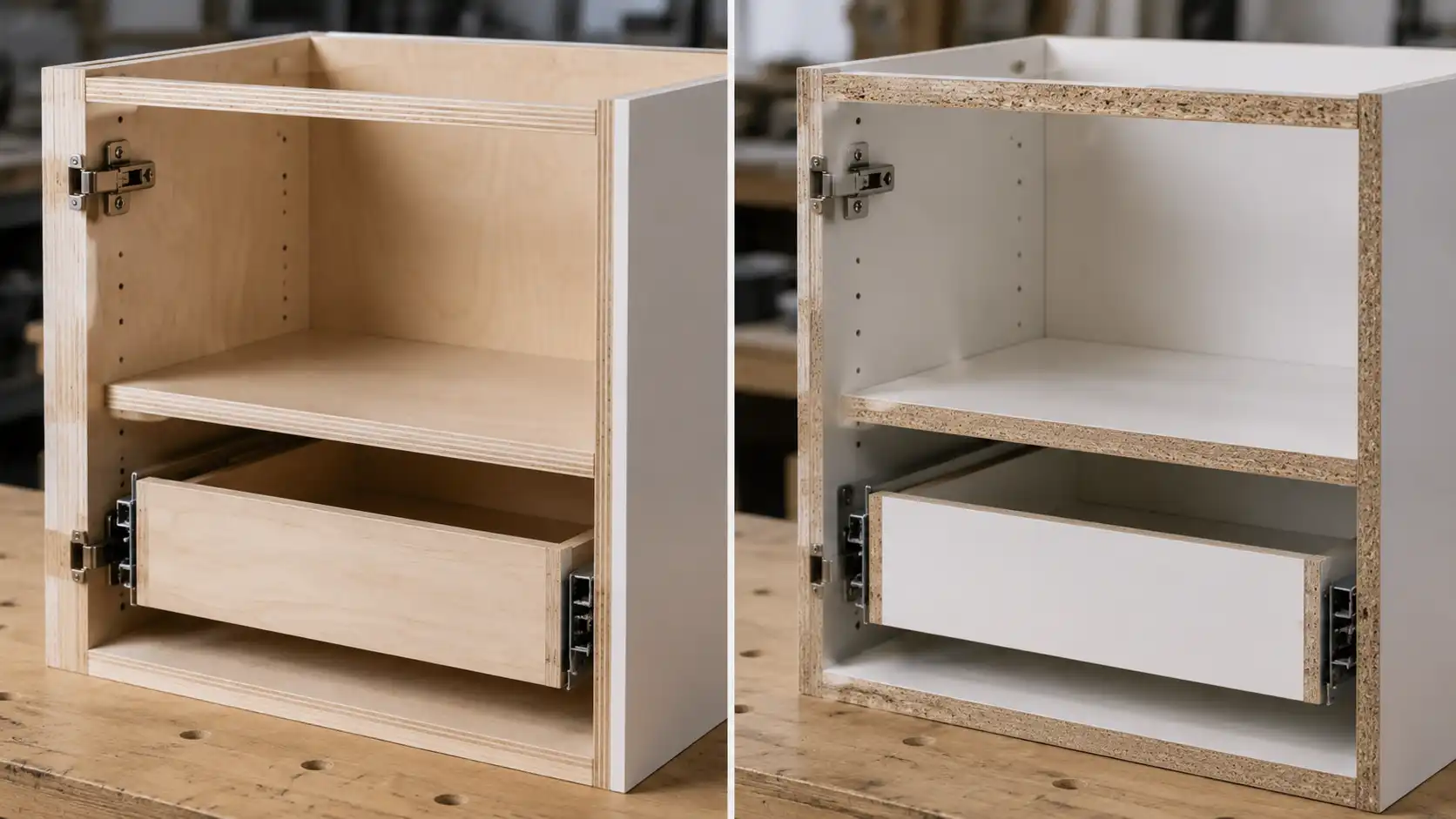
Two cabinets can look identical in a rendered elevation yet be priced from different carcass boards, back-panel thicknesses, shelf construction and edge-sealing methods. Ask which construction is used at sink bases, bathroom vanities and appliance-adjacent units. Confirm who supplies cut-out protection, service access panels and adjustment allowances. These details rarely make a dramatic difference in a brochure but can matter on site.
Door finish and sample control
“Matte white,” “wood grain” and “lacquer” are descriptions, not full specifications. Compare face material, substrate, color/decor reference, gloss level, edge treatment and whether a physical sample is tied to the contract. For veneer, ask about species, grain direction and matching. For lacquer, ask about sheen and the approved control sample. For PET or melamine, ask for the board/decor code and edge-band matching method.
Hardware and interior accessories
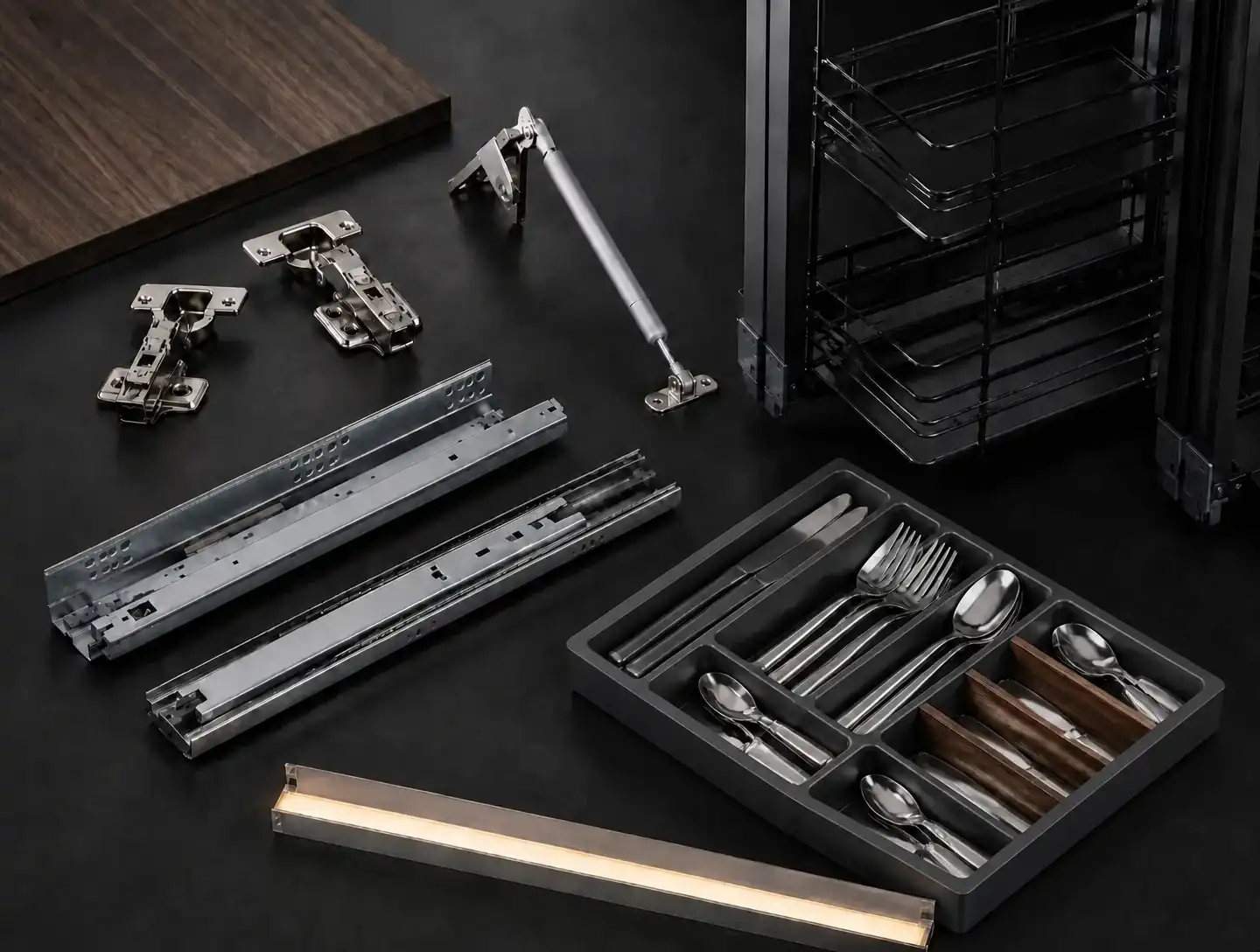
Compare hinges, slides, lift systems, pull-outs, bins, organizers and lighting separately. “Soft-close” is a function, not a complete hardware schedule. The supplier should state the brand or specified equivalent, series, load requirement where relevant, quantity and which cabinet codes receive each accessory. This prevents an apparently low quote from later becoming a list of unpriced upgrades.
Packing, labels and installation readiness
For overseas or multi-unit projects, packaging is part of the product. Ask how doors are protected, whether fragile items are crated, whether cartons carry room/cabinet labels, and how an installer identifies a cabinet against an elevation. A packaging plan is also a coordination test: a supplier who can explain labeling, packing lists and replacement-part identification is more likely to have considered site delivery.
Manufacturer Insight: Questions to Ask Before You Award the Order
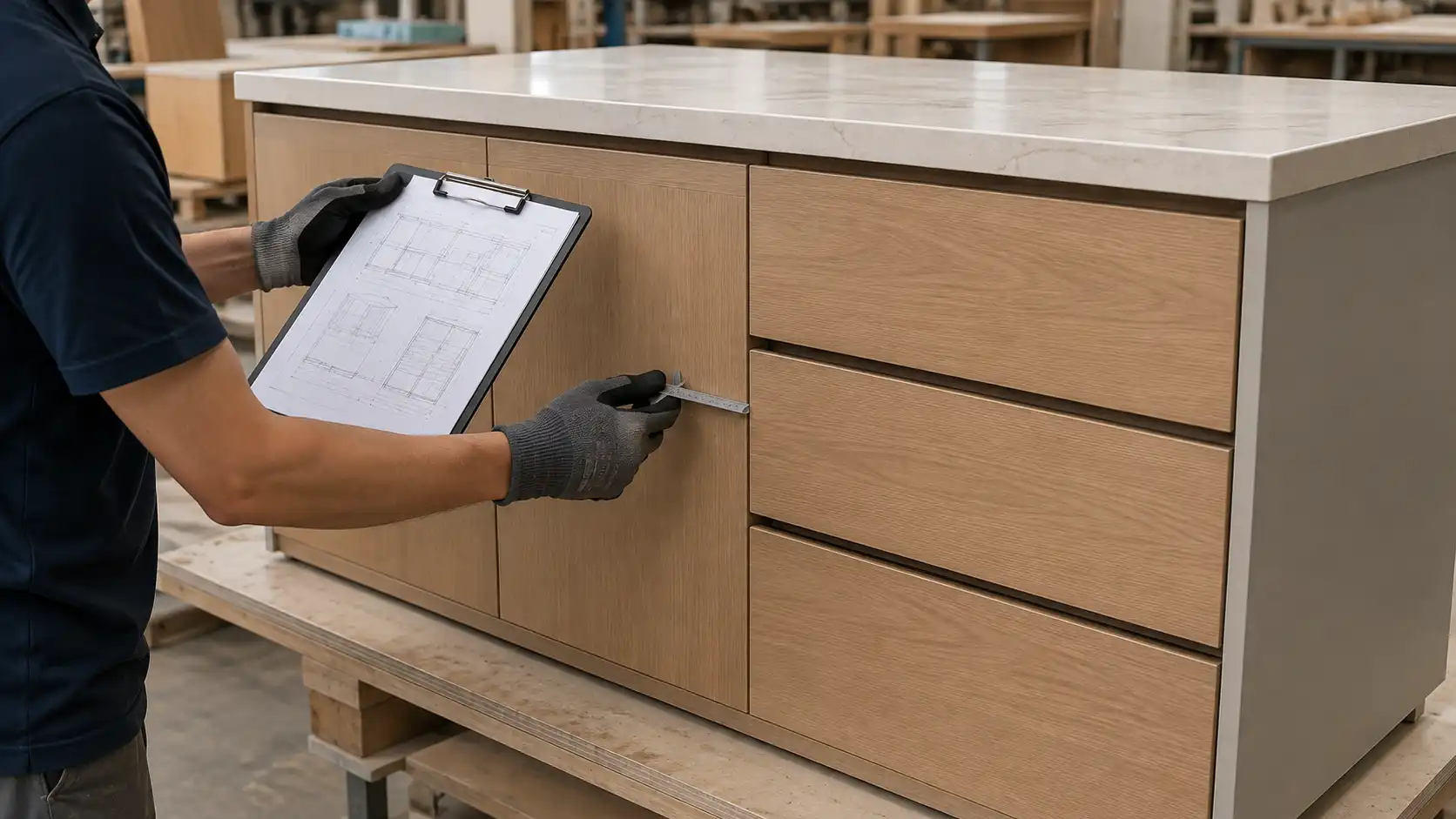
At KEJIA, the most productive quotation comparisons begin with a drawing review–not a price target. A factory needs to clarify wall conditions, appliance models, countertop interfaces, filler logic, door opening direction and finish intent before the offer can become project-ready. The quotation should then show what is included, what is provisional and what must be confirmed at shop-drawing stage.
Ask every shortlisted manufacturer to explain its approval sequence: sample confirmation, shop drawings, order release, production inspection, packing photos, shipment documents and replacement handling. Ask for a sample packing label and a sample QC record. If a project requires formal performance evidence, discuss the test method and scope; ANSI/KCMA A161.1 can be a useful North American reference, but buyers should confirm whether it applies to the exact cabinet system offered. Learn more about KEJIA’s custom cabinet manufacturing background.
Seven Quotation Comparison Mistakes to Avoid
- Choosing by grand total alone. Normalize scope first, then compare total price.
- Accepting generic material language. Require finish, substrate, thickness, edge and hardware details.
- Comparing different drawing revisions. Use a document register and reprice changes across all bidders.
- Treating a budget estimate as a fixed quote. Mark incomplete-design pricing as provisional.
- Leaving Incoterms vague. State the agreed term, named place and responsibility for freight, insurance and local handling.
- Ignoring packing and labeling. Include the delivery format needed by the installation team.
- Assuming warranty wording solves claims. Evaluate inspection evidence, spare parts, response path and replacement lead time.
Cabinet RFQ and Quotation Comparison Checklist
- Issue one controlled package: plans, elevations, cabinet codes, appliance schedule and finish schedule.
- State the project destination, required delivery date and preferred Incoterm.
- Request a room-by-room quotation, not only a lump sum.
- Require door, carcass, edge banding and hardware details for every relevant cabinet type.
- List countertops, sinks, lighting, handles, glass and organizers as included or excluded.
- Ask suppliers to identify assumptions, provisional sums and exclusions in a separate column.
- Confirm lead time from the correct trigger: final drawing approval, deposit and material confirmation.
- Ask for the shop-drawing, sample, QC, packing and shipment-document sequence.
- Request a sample packing label, packing-list format and claim/replacement process.
- Score technical compliance, commercial clarity and delivery risk before ranking price.
Часто задаваемые вопросы
Why are cabinet quotes with the same drawings so different?
The drawings may be the same, but the assumed cabinet construction, door finish, hardware, accessory scope, packing and commercial terms may differ. First compare each supplier’s inclusions and exclusions. A price difference becomes meaningful only after the rows, quantities and requirements have been normalized.
Should a cabinet quotation include shop drawings?
The initial quotation can be based on tender drawings, but it should state the shop-drawing stage, who approves it and when production lead time begins. Final shop drawings are normally a controlled approval deliverable after order award or a paid design stage. Do not treat a tender rendering as fabrication-ready information.
How detailed should a cabinet bill of materials be?
It should be detailed enough to identify each cabinet type, quantity, door finish, carcass construction, hardware, accessories and exclusions. You may not receive a factory’s full internal costing sheet, but a room-by-room scope breakdown is essential for comparing bids and controlling variations.
What should be included in an overseas cabinet quote?
Confirm product scope, export packing, labels, documentation, Incoterm, named delivery point, lead time and responsibility for freight and insurance. Clarify whether freight, duties, local delivery, unloading and installation are included or excluded. Do not compare an FOB cabinet quote with a delivered-duty-paid quote as if they were the same product price.
Is “soft-close hardware” enough detail?
No. Ask for the hardware brand or approved equivalent, series, item type, quantity, location and any load rating relevant to the design. Lift-up doors, wide drawers, pull-outs and tall pantry systems have different requirements; a generic soft-close statement does not confirm the complete accessory scope.
How can I check a cabinet supplier’s QC process?
Ask for defined inspection stages, example photo reports, packing images and a procedure for recording nonconformities before shipment. The key question is not whether the supplier says it performs QC, but what is checked, how it is documented, who signs off and how a discrepancy is resolved.
When should I ask about replacement parts?
Before you award the project. Confirm how doors, panels, hardware and damaged components are identified, how claims are evidenced, who pays freight under different causes, and the expected replacement lead time. This matters especially for phased installations and overseas projects where one missing component can stop a room handover.
Make the Lowest Cabinet Quote Truly Comparable
The right cabinet supplier is not automatically the bidder with the lowest total. It is the supplier whose scope is transparent, technical commitments match the drawings, commercial terms are understood and delivery controls fit the installation plan. For a side-by-side factory quotation, send KEJIA your drawings, finish schedule, project destination and target delivery date. We can return a clarified scope, material recommendation and packing/QC plan for review.