




Who should use this checklist
- Contractors procuring kitchens, wardrobes, vanities, or whole-house packages for a project.
- Developers comparing custom cabinet manufacturers for repeated apartment, hotel, or villa units.
- Dealers and showroom buyers building a stable private-label or OEM cabinet range.
- Designers preparing a complete RFQ instead of asking factories to interpret a mood board.
Key takeaways
- A useful RFQ contains drawings, room and cabinet codes, quantities, materials, hardware, appliance data, delivery terms, and the approval process.
- Compare manufacturers on production controls, drawings, QC, packing, and replacement support—not only on a unit price.
- Approve a physical sample and, where risk is high, a pilot unit before bulk production.
- Match cabinet materials and packaging to wet zones, climate, storage time, and transport method.
- Make inspection and claims procedures part of the order before a deposit is paid.
B2B cabinet buying checklist at a glance
On mobile, swipe left or right to view all table columns.
| Buying stage | Decision to close | Evidence to request | Warning sign |
|---|---|---|---|
| Scope | What is included in each room and unit type? | Coded drawing set, cabinet schedule, quantities | A quote based only on photos or a total room area |
| Technical review | Can the package be manufactured and installed? | Shop drawings, appliance and service coordination notes | “We will solve it on site” for basic interfaces |
| Materials | What will be visible and what will face moisture or wear? | Door, carcass, edge, countertop, and hardware specification | Generic labels with no sample or construction detail |
| Supplier capability | Can the factory repeat the approved quality? | Factory process, sample policy, QC plan, project references | Unclear who makes drawings or checks output |
| Commercial comparison | Are proposals genuinely comparable? | Itemized quotation, exclusions, Incoterms® rule, payment milestones | One lump-sum price with undefined inclusions |
| Approval | What is the production reference? | Signed sample record and pilot-unit criteria | Approval from a screen image alone |
| Delivery | Can cartons reach the correct installation location? | Unit-coded packing list, loading and delivery plan | Cartons labelled only by generic cabinet type |
| After-sales | How are damaged or incorrect parts handled? | Spare-parts list, claim process, replacement lead time | “Warranty available” without written steps |
1. Define the buying scope before asking for a price
Factories can quote quickly from a rough layout, but a rapid preliminary price is not a controlled project purchase. Start with a scope matrix that lists every room type, cabinet code, quantity, dimensions, door style, carcass material, hardware, countertop interface, and accessories. Separate standard units from non-standard units, and identify what is excluded: appliances, stone, installation, lighting, handles, internal accessories, or freight.
Minimum RFQ package
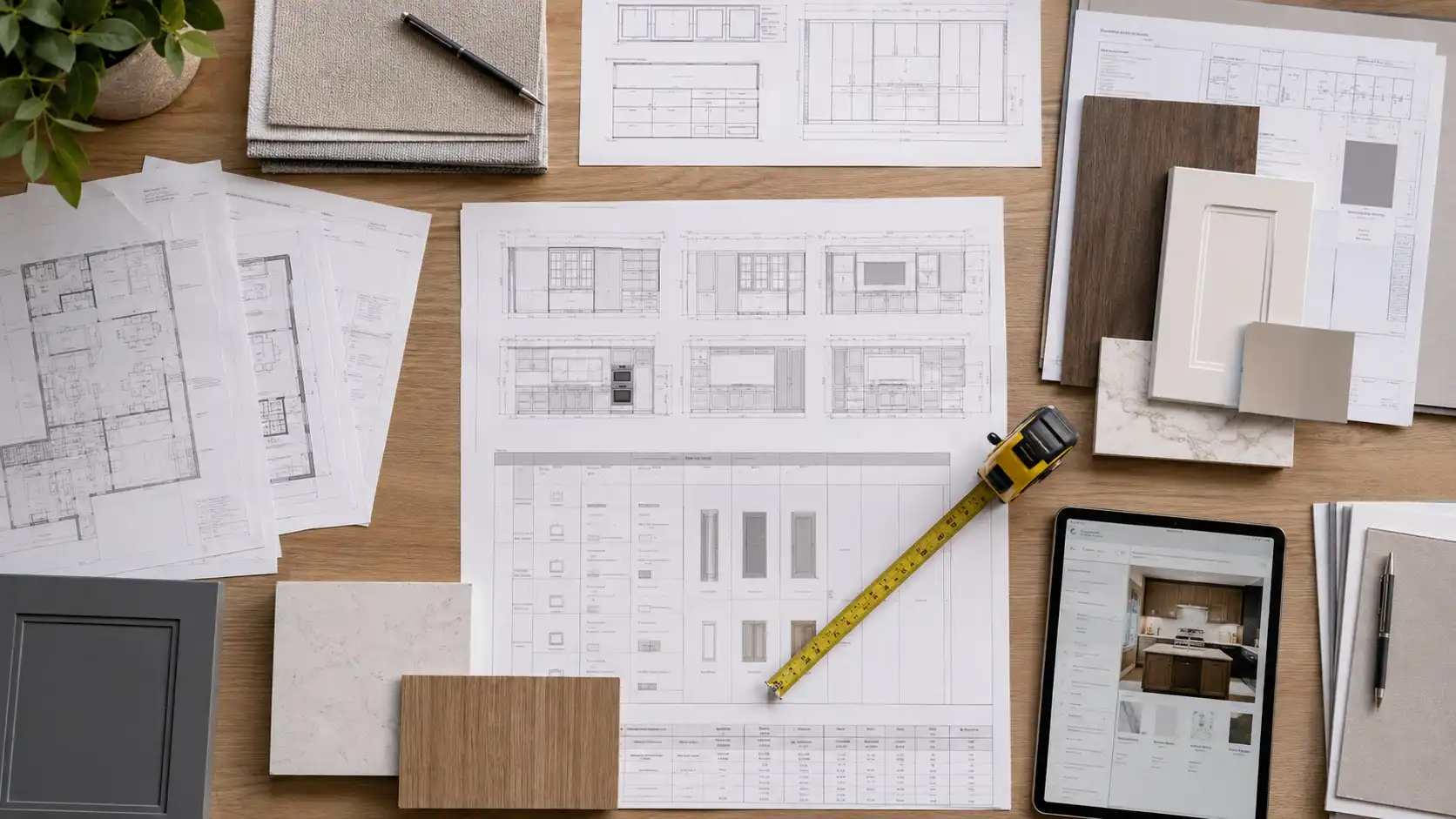
Send plans, elevations, sections where needed, a cabinet schedule, finish schedule, appliance cut sheets, site location, target delivery date, and intended Incoterms® rule. State the destination market and project type because climate, code requirements, packaging, and expected use can change the specification. Ask manufacturers to list assumptions separately from confirmed requirements.
Use a common bid basis
Give every bidder the same issue date and revision number. If the design changes, issue a controlled revision and request a price impact statement. This prevents a cheap quotation from quietly omitting end panels, fillers, hardware, packing upgrades, or technical drawing work that another manufacturer included.
2. Turn design intent into a buildable cabinet specification
Cabinet procurement often fails when a visual brief is mistaken for a construction specification. A photo may communicate style but not panel thickness, substrate, edge treatment, hinge quality, grain direction, drawer loading, or installation tolerance. Ask what each visible and hidden component will be, where it will be used, and how it will be finished.
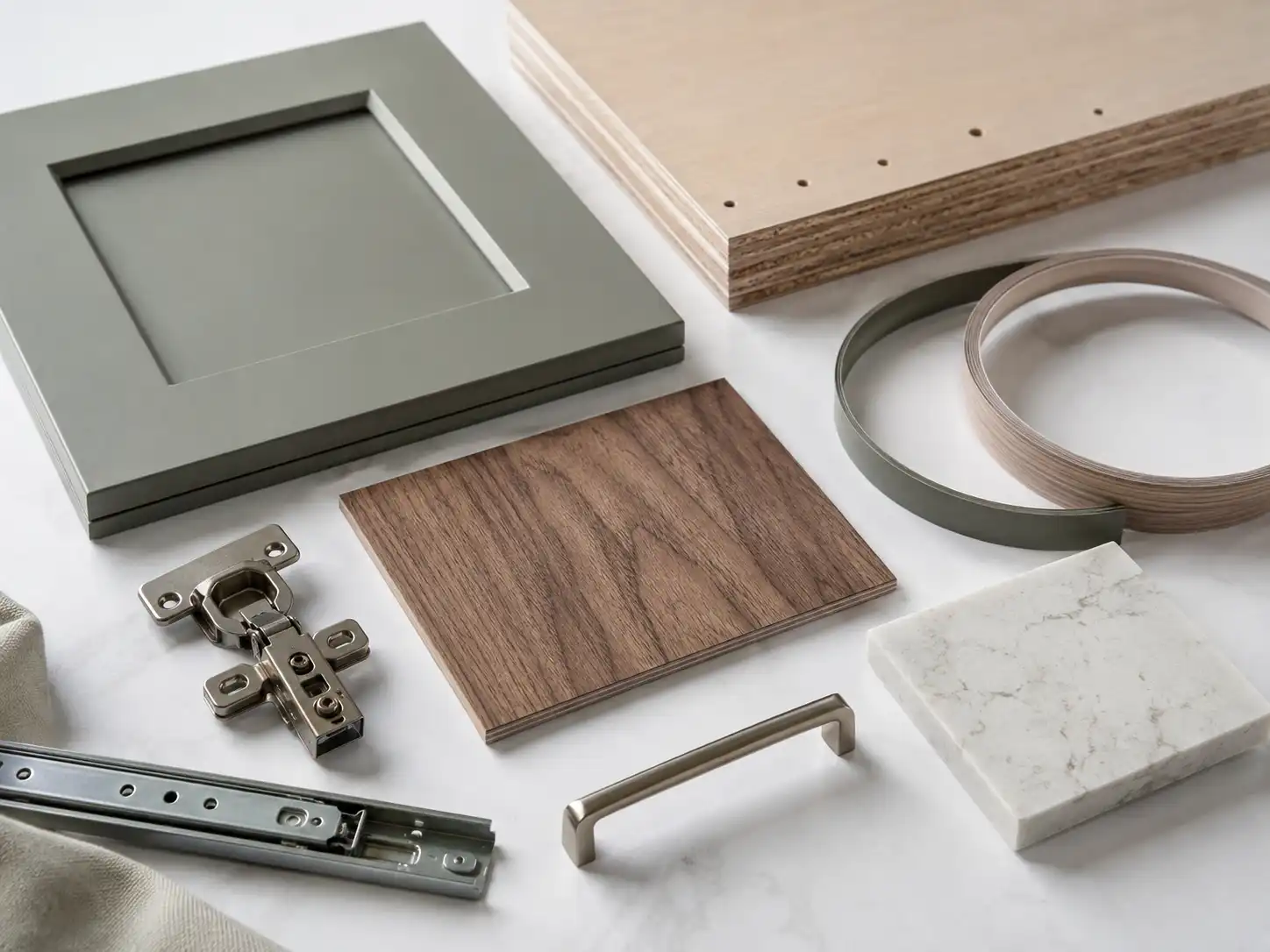
Material and hardware questions to answer
On mobile, swipe left or right to view all table columns.
| Component or condition | Ask the manufacturer | Why the answer matters |
|---|---|---|
| Door fronts | What is the substrate, surface finish, sheen, and edge construction? | It controls appearance, durability, and repairability |
| Carcass | What panel is used in dry and wet zones, and how are cut edges protected? | It affects screw holding and moisture resistance |
| Hinges and slides | Which series, load condition, adjustment range, and soft-close option apply? | It affects alignment and service life |
| Countertop interface | Who confirms templates, overhangs, support, and cut-outs? | It prevents clashes and unsupported stone |
| Tall units and islands | What anchoring, reinforcement, or service void is required? | It manages stability and utility access |
For sink bases, laundry rooms, bathrooms, and dishwasher-adjacent cabinets, specify moisture exposure, sealed edges, access to plumbing, and storage requirements. For rental and hospitality projects, identify which door fronts and hardware items need fast replacement availability after handover.
3. Evaluate a custom cabinet manufacturer beyond the brochure
The right partner is not necessarily the largest factory or the lowest-cost supplier. Evaluate whether the manufacturer can convert drawings into controlled production, explain material choices, make a sample that matches the batch, protect the goods in transit, and respond to a documented claim.
Factory due-diligence questions
- Who owns the shop-drawing review, and how are revisions approved?
- Can the factory show a typical QC checklist for dimensions, drilling, finish, hardware, and packing?
- How are door, carcass, edge-band, and hardware samples identified and retained for batch comparison?
- What is the process for a first article, pilot unit, or pre-shipment inspection?
- How are cartons labeled for building, floor, unit, room, and cabinet code?
- Which records support a damage or shortage claim, and what is the replacement ordering process?
Manufacturer insight: at KEJIA, a project should move through drawing confirmation, material/sample approval, production planning, in-process checks, pre-shipment review, and coded packing. Those steps are valuable only when the buyer gives a complete and stable scope; a factory cannot protect a project from unresolved site measurements or changing appliance selections without a disciplined change process.
4. Make quotations comparable and commercially complete
An itemized cabinet quotation makes risk visible. Request a separate line or clear note for cabinets by room or code, door and carcass materials, hardware brand/series when specified, accessories, countertop interface, samples, drawings, packing, inspection, spares, freight, insurance, duties, and installation. If a line is excluded, it should be named.
Compare total delivered risk, not just price
On mobile, swipe left or right to view all table columns.
| Comparison point | Lower-risk quotation | Higher-risk quotation |
|---|---|---|
| Drawings | Revision-controlled shop drawings included | “As per image” with no production drawings |
| Samples | Physical sample and approval record defined | Color confirmed by message or render only |
| QC | Hold points and inspection records stated | General promise of “good quality” |
| Packing | Carton protection and unit coding listed | Generic cartons with no installation sequence |
| Delivery | Named Incoterms® rule and responsibility handoffs | Freight mentioned without a rule or destination detail |
| Replacements | Spares and written claim route included | Undefined warranty statement |
Use the selected Incoterms® rule accurately in the purchase order and confirm the named place or port. It allocates delivery obligations and risk at defined points; it does not replace a clear packing, insurance, import, and site-receiving plan.
5. Approve samples and a pilot unit before mass production
Sample approval is a production control, not a ceremonial step. The approved set should represent door fronts, carcass interior, edge treatment, handles, hardware, countertop coordination, and any visible decorative panel. Record photos, date, sample code, finish direction, and the approver. Review it under lighting that resembles the project where practical.
When a pilot unit is worth the time
Use a pilot when the project has repeated units, complex appliance coordination, variable walls, non-standard finishes, or a new factory relationship. Install the highest-risk representative room, then verify widths, fillers, service clearances, door swings, hardware, finishing quality, and installation sequence. Do not release repeated production until the pilot’s comments are closed in writing.
6. Put quality control into the purchase order
Do not wait until arrival to decide what “acceptable” means. Write measurable checkpoints into the order: approved drawing revision, sample reference, quantities, cabinet codes, key dimensions, drilling, finish condition, hardware completeness, carton condition, and packing list accuracy. Agree who inspects, when they inspect, how findings are reported, and what corrective action is required before shipment.
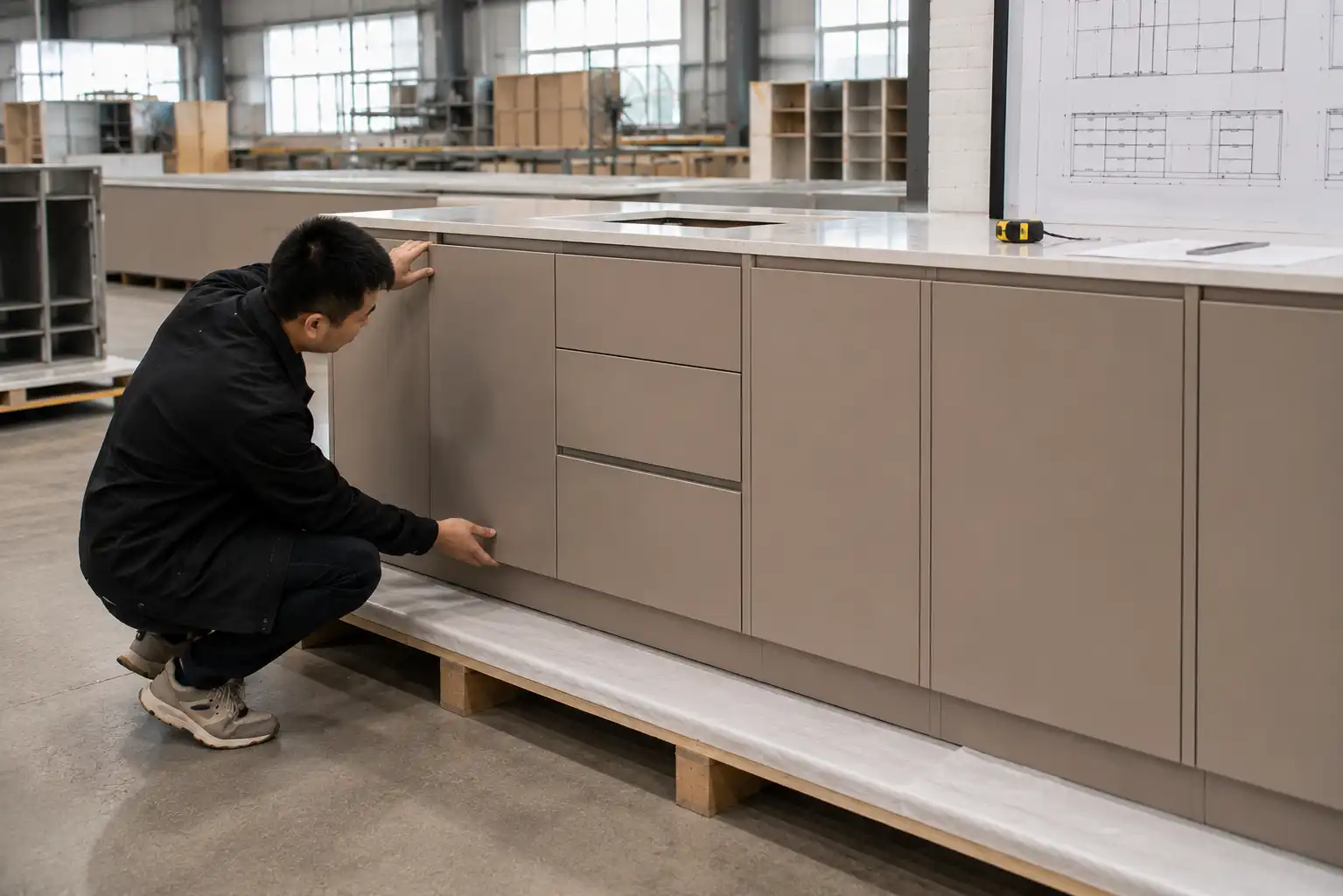
Pre-shipment inspection checklist
- Confirm the selected cartons match the cabinet schedule and unit-code matrix.
- Measure critical cabinet openings, tall-unit heights, appliance housings, drill patterns, and filler widths.
- Compare visible doors and panels with the approved sample for color, sheen, grain direction, and damage.
- Open representative hardware packs and check hinges, slides, fasteners, handles, legs, and connectors.
- Review carton protection, corners, moisture barrier where specified, and label durability.
- Photograph defects and carton codes; close corrective actions before container loading.
For a large project, inspect multiple room types and production batches. A clean sample from one kitchen does not prove that bathroom vanities, wardrobes, or later batches meet the same reference.
7. Plan packaging, shipping, and site receiving as one workflow
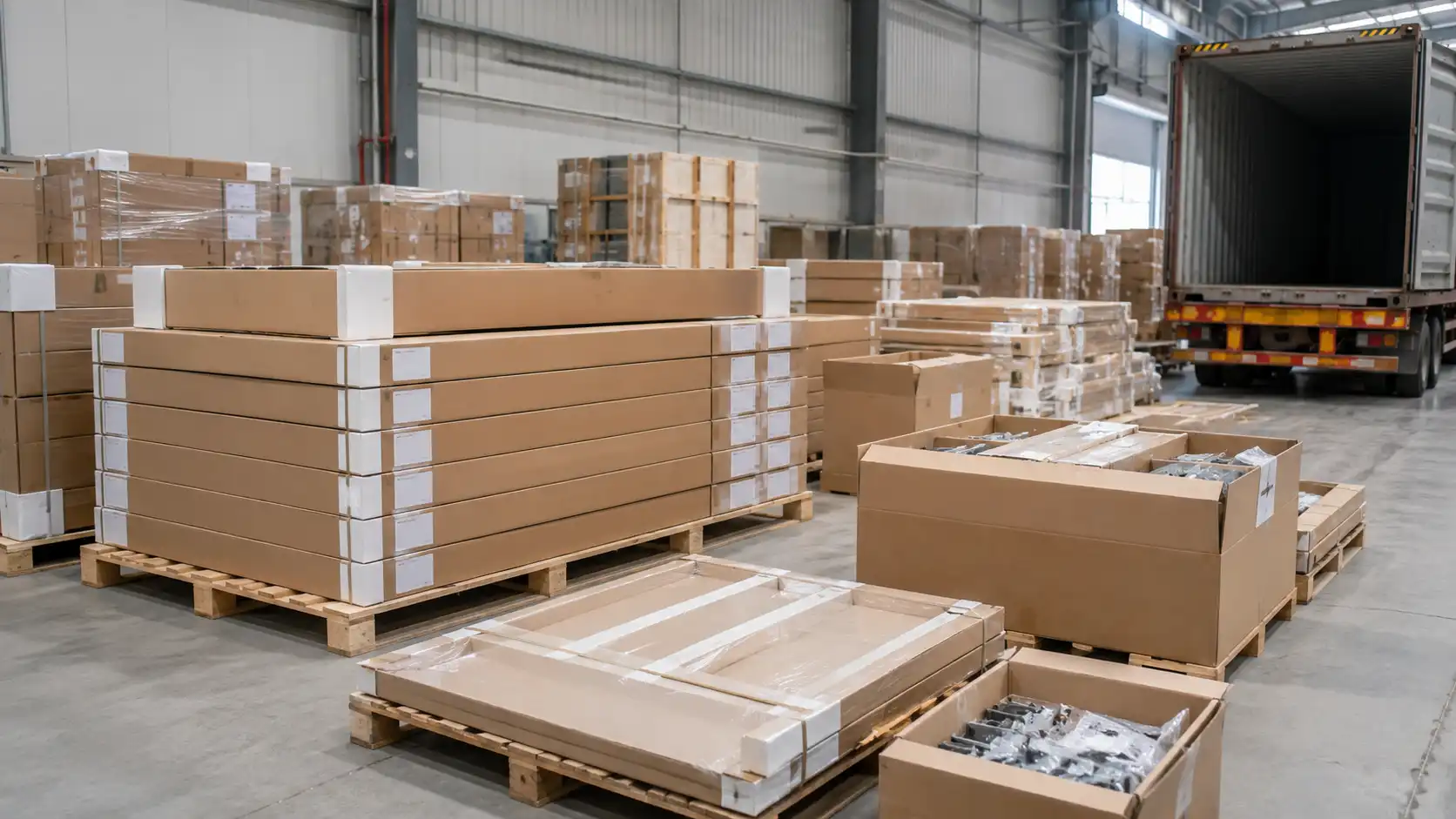
Packaging is part of product performance. Decide whether goods will move from factory to container, warehouse, distributor, or directly to a project site. Each stage changes the required carton strength, moisture protection, pallet method, lifting limits, labeling, and staging plan.
Give the site team the information it needs
Provide a packing list that maps every carton and loose hardware pack to building, floor, unit, room, and cabinet code. Send it before delivery so the receiving team can reserve space, plan lifts, and stage cartons near the install sequence. If an item arrives damaged, record the carton code, external condition, photographs, and packing-list reference immediately; this protects both the buyer and manufacturer during claims review.
8. Secure after-sales support before you place the order
After-sales support is most useful when it is designed before shipment. Ask for a named spare-parts list, the retained sample/reference process, hardware availability, touch-up materials where suitable, a claim form or evidence standard, and an estimated replacement workflow. Make sure the team knows who can authorize a replacement and who pays for secondary site costs when the cause is established.
For long programs or phased projects, ask how material and finish consistency will be maintained between production batches. A clear answer may include retained reference samples, production-batch records, and a process for approving an unavoidable material variation before it reaches site.
Complete B2B custom cabinet buying checklist
- Define every room type, cabinet code, quantity, and exclusion in a shared scope matrix.
- Issue the same dated drawings, finish schedule, appliance data, and delivery requirements to every bidder.
- Require an itemized quotation with materials, hardware, samples, drawings, packing, QC, spares, freight, and exclusions visible.
- Verify shop-drawing control, sample approval, QC hold points, and packing capabilities with each custom cabinet manufacturer.
- Specify wet-zone construction, exposed edges, service access, and performance priorities for the project type.
- Approve a physical sample record; use a pilot unit for repeated or high-risk installations.
- Put inspection standards, timing, evidence, and corrective-action rights in the purchase order.
- Use unit-coded packaging and a shared receiving plan.
- Agree the Incoterms® rule, named place, insurance responsibility, import requirements, and site handoff.
- Document spare parts, replacement process, response contacts, and expected lead time before shipment.
Frequently asked questions
What should be included in a cabinet RFQ for a developer project?
Include issue-controlled drawings, a cabinet and room schedule, quantities, finish and material requirements, appliance cut sheets, delivery location and date, commercial terms, inspection expectations, packaging and labeling needs, and a response deadline. Ask bidders to separate assumptions, exclusions, and proposed alternatives from confirmed scope.
How can I compare two cabinet factory quotations fairly?
Normalize them against the same coded schedule. Compare materials, hardware, drawings, sample process, QC, packing, delivery term, spares, and exclusions line by line. A lower total price is not comparable if it leaves critical components or controls undefined.
Should I choose plywood, MDF, or particle board for cabinet carcasses?
Choose by zone, performance requirement, budget, and local conditions rather than by a blanket rule. Ask the manufacturer to state the panel construction, edge protection, screw-holding needs, and wet-zone treatment. The specification should also define what will remain exposed after installation.
Is a physical cabinet sample necessary before production?
For custom finishes or visible projects, yes. A physical approved sample establishes the reference for color, sheen, texture, edges, and hardware. For multi-unit or complex work, add a pilot unit to verify fit and interfaces before committing the whole batch.
What cabinet quality checks should happen before shipment?
Check cabinet codes, quantity, critical dimensions, drilling, finish against the approved reference, hardware completeness, loose parts, labels, carton protection, and packing list. Inspect different unit types and production batches. Document defects by cabinet code and close them before loading.
How should custom cabinets be packed for a project site?
Use protection appropriate to the transport route and label cartons by building, floor, unit, room, and cabinet code. Keep the same code on drawings, packing lists, and hardware packs. Share the packing list in advance so the site team can stage cartons in installation order.
What after-sales terms should a cabinet buyer agree in advance?
Agree the evidence needed for a claim, response contacts, spare parts, retained-finish reference, hardware availability, replacement process, and estimated lead time. Define how transit damage and installation-related issues will be documented and assessed. Avoid accepting a generic warranty statement without an operating process.
Request a project-ready cabinet quotation
When you are ready to compare suppliers, send KEJIA your drawings, cabinet schedule, target market, quantity, and delivery constraints. We can review the specification, identify manufacturing and installation risks, and prepare a project quotation with a sample, QC, and packing-plan discussion.