



Who This Guide Is For
- Developers setting a repeatable cabinet specification for build-to-rent, serviced apartment, or multifamily projects.
- Asset managers balancing first cost, cleaning, repairs, vacancy turnaround, and replacement-part control.
- Procurement teams comparing material schedules from custom cabinet manufacturers.
- Buyers who need an apartment cabinet package that can be maintained room by room after handover.
Key Takeaways
- Specify material by cabinet component and risk zone; a door, sink base, wardrobe shelf, and utility cabinet do not need the same construction.
- For rental projects, a material easy to identify and replace can be more valuable than a higher-spec finish with no controlled replacement path.
- Moisture resistance is a full detail: substrate, exposed edge, cut-out, plumbing access, installation, and leak response all matter.
- Door finish selection should consider cleaning products, fingerprints, edge durability, repair visibility, and batch consistency.
- Ask for material codes, finish samples, cabinet codes, spare-part logic, and maintenance notes before releasing a multi-unit order.
Apartment Cabinet Materials: Durability, Budget, and Replacement Matrix
On mobile, swipe left or right to view all table columns.
| Cabinet area | Practical starting material system | Rental-project advantage | Main watchpoint | Replacement control |
|---|---|---|---|---|
| Dry wardrobes and storage | Melamine-faced particle board or appropriate plywood with edge banding | Repeatable décor, efficient batches, practical cleaning | Shelf spans, rail fixing, edge impact | Retain décor, thickness, edge-band, and cabinet codes |
| Kitchen sink base | Moisture-appropriate plywood or specified moisture-resistant panel with sealed edges | Better risk management at plumbing and floor-level exposure | Cut-outs, bottom edge, valve access, leak response | Code carcass, door, and cut-out configuration separately |
| Kitchen doors | Melamine, PET, HPL, or specified painted MDF by project level | Balances appearance and cleaning routine | Heat, impact, fingerprints, edge detail, batch | Keep sample, finish code, and door dimensions |
| Bathroom vanity | Moisture-appropriate carcass, sealed edges, protected cut-outs | Controls risk around basin, trap, cleaning, and humidity | Splash zones, plumbing penetrations, ventilation | Hold spare doors, matching edge material, and hardware reference |
| High-use utility or common area | Durable decorative surface on substrate matched to load and exposure | Fits repeated contact and housekeeping use | Corner wear, cleaning chemicals, fixing loads | Identify component, finish, and hardware by location |
Why Rental Projects Need a Material System, Not a Single “Best Board”

The most economical board at quotation stage is not automatically the lowest-cost material over a rental project’s operating life. Wardrobe interiors may stay dry and need efficient panel use; sink bases and vanities need moisture detailing; kitchen doors and pull-out fronts face frequent contact and cleaning. A material decision that ignores these differences can move cost from procurement to maintenance and vacancy turnaround.
Start with a room-and-component schedule. For each cabinet code, record substrate, thickness, visible finish, edge treatment, hardware, exposure level, and replacement identifier. This turns “melamine cabinets” into a verifiable specification and enables selective value engineering where water, loads, or service access justify an upgrade.
For U.S.-bound work, verify destination-specific composite-wood obligations before ordering. The U.S. EPA explains its TSCA Title VI framework covers hardwood plywood, MDF, particleboard, and certain finished goods. This is a market-specific compliance question, not evidence that an unrelated cabinet package meets the rule.
Which Material Fits Each Apartment Risk Zone?
Dry bedrooms, entry storage, and standard wardrobes
Melamine-faced particle board can be practical for dry interiors when density, thickness, edge banding, connector design, and shelf span are specified. It offers repeatable décor and efficient batch fabrication. Specify shelf load and hanging-rail fixing locations, and give exposed-side edge treatment and replacement code the same attention as the panel face. Plywood may be chosen for selected high-load or moisture-adjacent components but is not automatically necessary for every dry wardrobe panel.
Kitchens, sink bases, and utility areas
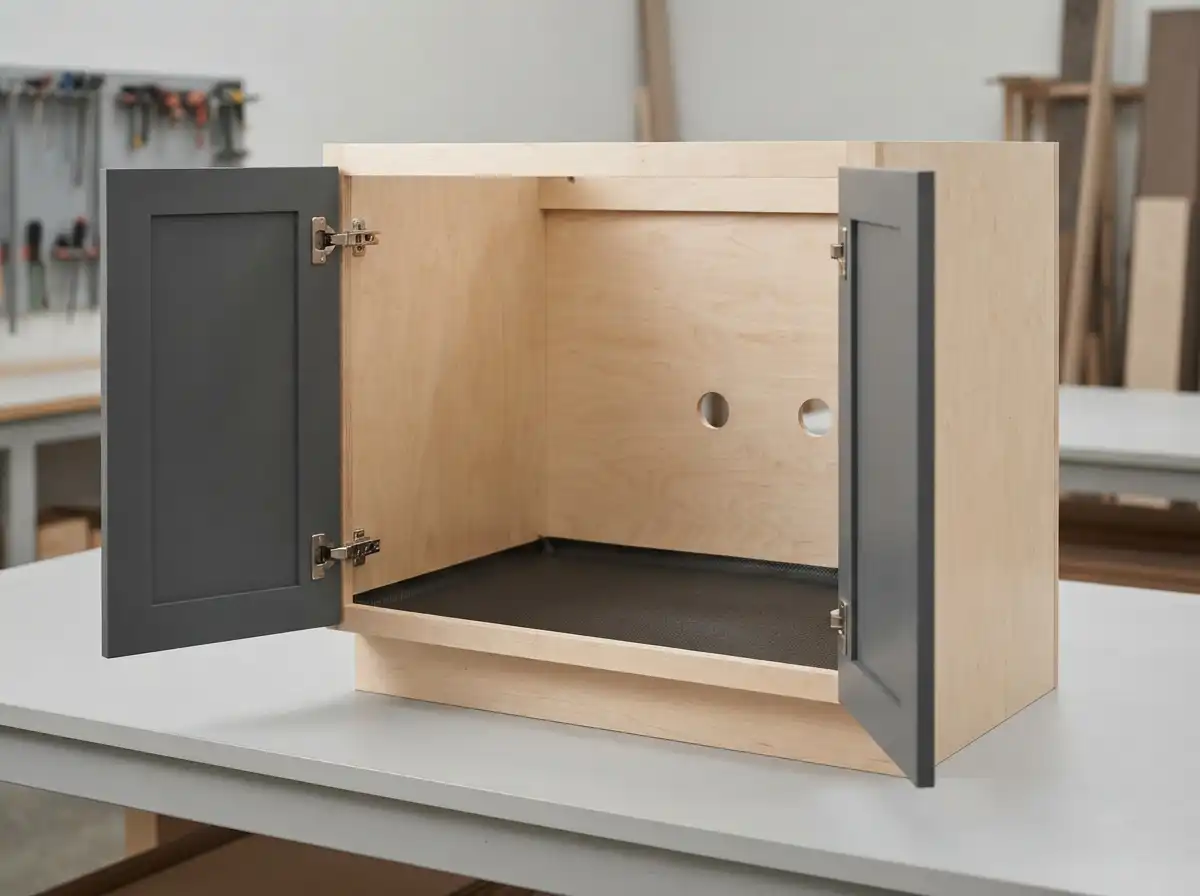
Water risk concentrates at joints, exposed edges, plumbing penetrations, floor-level leaks, and poorly ventilated voids. A sink-base specification should state carcass material, bottom-panel detail, edge sealing, pipe-cut-out treatment, accessible valve route, and service void. A moisture-appropriate carcass helps, but cannot compensate for a chronic leak or unsealed site cut. Component-coded construction makes targeted replacement easier when records are retained.
Doors, drawer fronts, and visible panels
Choose finish around cleaning, contact, appearance, and later replacement. Melamine offers repeatable décor; PET or similar polymer-faced panels require confirmed substrate, edge treatment, heat exposure, and finish batch; painted MDF requires stated paint system, sheen, edge preparation, and sample approval. HPL or similar durable decorative surfaces may suit higher-contact utility or common areas when the full construction is specified. Ask how each surface is cleaned and compared to a later replacement.
How Should Developers Compare First Cost Against Maintenance Cost?
Use the same cabinet schedule to compare quotations, maintenance assumptions, and replacement response. A fair comparison identifies the component, material system, visible finish, edge treatment, hardware, packaging, spare parts, and project documentation.
On mobile, swipe left or right to view all table columns.
| Decision question | Budget-led answer can miss | Better rental-project question | Evidence to request |
|---|---|---|---|
| Which board costs less? | Function and moisture risk | Which construction suits this zone and service condition? | Component schedule with substrate, thickness, edges |
| Which finish looks best? | Cleaning, contact, and later matching | Which finish can be cleaned and replaced under the operating routine? | Sample, care guidance, replacement code |
| Can damaged parts be replaced? | Panel may be untraceable after handover | Can one identified part be reordered without remaking a room? | Cabinet code, finish code, dimensions, hardware reference |
| Is plywood included? | Plywood type and wet-detail scope | Which components use which construction, and why? | Room-and-component matrix and cut-out details |
| Is the quote complete? | Packing and spares may be missing | Does price include identification, protection, and practical repair path? | Packing plan, label sample, spare-parts list |
Do not invent a maintenance saving percentage without project records. Identify water ingress, edge impact, damaged doors, failed hardware, unavailable décor, mixed components, and repair-access labour as cost events; then specify the controls that reduce them.
Factory Insight: Build a Replacement Path Before Batch Production
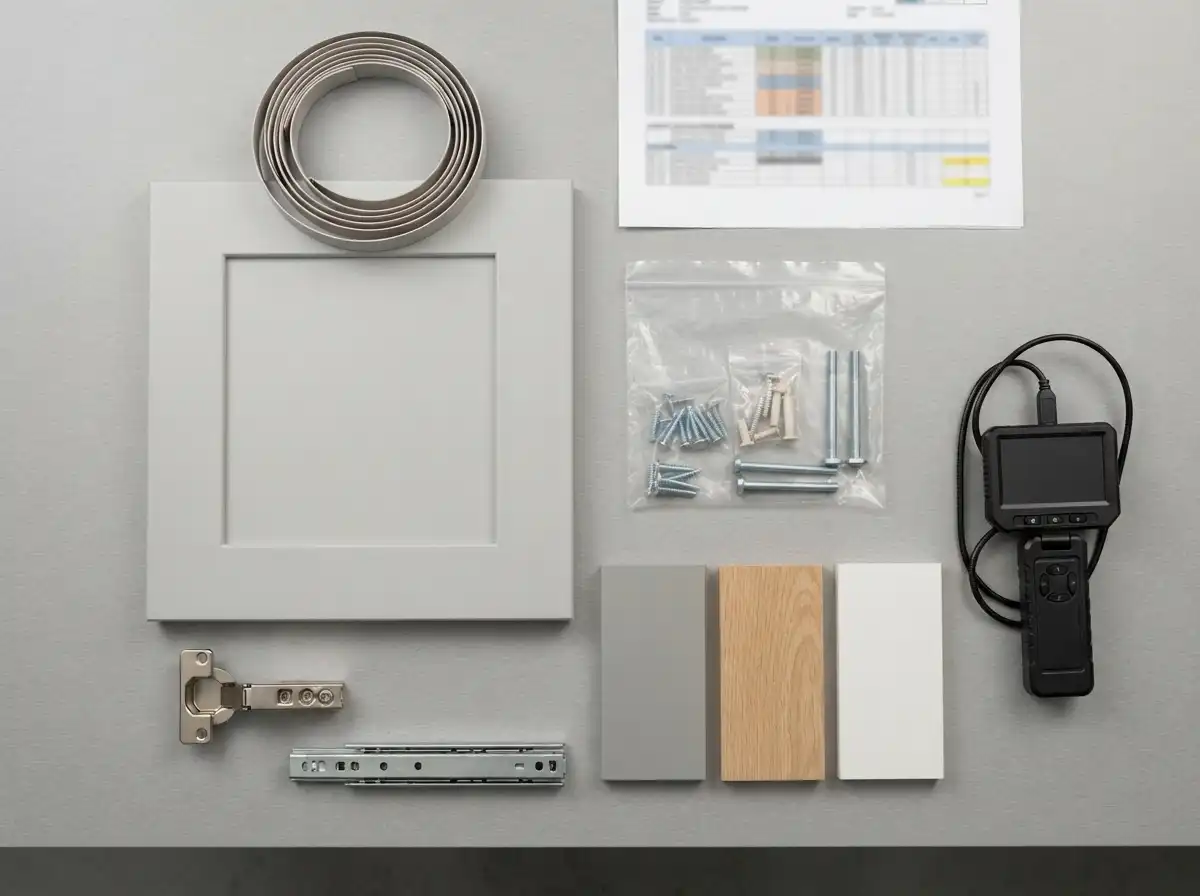
At KEJIA, an apartment specification should preserve enough information for later replacement. Align room and cabinet codes with drawing revision, material schedule, finish sample, edge-band reference, door orientation, hardware list, and packing labels. Final QC should verify visible components, drilling, and finish grouping against the approved record—not only carton count.
Separate the replacement strategy by component. Doors, drawer fronts, fillers, end panels, shelves, plinths, and hardware do not need the same stock level or record. A small controlled spare kit may suit frequently lost hardware; visible panels need a finish code and approved sample. When a later batch cannot match the original material lot exactly, the team needs a controlled comparison rather than a promise of identical colour.
Where formal performance evidence is required, define standard, product scope, and test basis before award. ANSI/KCMA A161.1 performance context can be relevant for kitchen and vanity cabinet requirements in North America, but relevance must be confirmed for actual cabinet line and supply format.
Six Material Decisions That Create Avoidable Rental Problems
1. Using one board specification in every room
Dry wardrobes, sink bases, vanities, and common-area storage face different loads and exposure. Specify by component and risk zone.
2. Calling a cabinet “waterproof” without detailing edges and cut-outs
Water reaches plumbing holes, bottom edges, joints, and site cuts. State edge treatment, access, leak response, and installation responsibilities with the substrate.
3. Selecting a door finish without a replacement record
Retain physical control sample, finish code, sheen or texture reference, and component dimensions. A generic colour name does not support later service.
4. Comparing quotations by plywood versus particle board only
Thickness, density, face, edge banding, hardware, drilling, back panel, and packing may differ. Compare the same component schedule line by line.
5. Forgetting cleaning routines and tenant turnover
Confirm care guidance before handover and train the maintenance team on products or abrasives that should not be used on the selected finish.
6. Leaving labels and spares until after shipment
Agree labels, packing lists, retained samples, and spare logic before production so a simple repair can be identified by cabinet and room code.
Apartment Material Specification Checklist
- List each component by room, cabinet code, exposure, and expected use.
- State substrate, thickness, face finish, edge treatment, back panel, and plinth construction.
- Identify sink bases, vanities, laundry, utility, and other moisture-risk zones.
- Show plumbing cut-outs, valve access, ventilation, bottom-edge protection, and service voids.
- Approve door samples for colour, sheen, texture, grain direction, and acceptable variation.
- Confirm loads for doors, drawers, shelves, rails, hinges, and runners.
- Add cleaning guidance and prohibited products to the handover pack.
- Freeze cabinet, room, finish, and hardware codes before batch production.
- Define replacement records for doors, fillers, panels, plinths, and hardware.
- Request room-by-room packing logic for multi-unit delivery.
- Confirm destination-market composite-wood documentation before award.
- Ask for apartment material matrix and project quotation before release.
For related controls, see the cabinet materials for apartments, villas, and hotels, cabinet labeling for multi-unit projects, and cabinet production readiness checklist.
Часто задаваемые вопросы
Are particle-board cabinets suitable for rental apartments?
They can suit controlled dry areas when panel quality, thickness, edge banding, connectors, hardware fixing, and shelf loads are specified. They are not universal for every component. Sink bases, vanities, and high-moisture areas need a separate risk review and appropriate detailing.
Is plywood always the best cabinet material for apartments?
No. Plywood may suit selected wet-risk, high-load, or structural components, but a full plywood package is not automatically the best rental-budget decision. Compare exposure, load, visibility, maintenance risk, and replacement needs by component, then specify construction and edge treatment.
Which door finish is easiest to replace later?
The most manageable finish has a retained approved sample, stable code, defined substrate and edge treatment, recorded dimensions, and linked cabinet code. Any finish becomes difficult to replace when batch, sheen, texture, and original sample are not controlled.
How should a developer plan cabinet maintenance at handover?
Receive room-and-component schedule, cabinet codes, finish and hardware references, cleaning guidance, spare-parts list, and defect-reporting path. The team should know cabinet code, finish code, dimensions, and photographs required when requesting a replacement.
Do rental cabinets need formal performance certification?
It depends on market, contract, cabinet type, and buyer requirement. Where a standard or certification is required, state it before award and confirm it applies to the actual product and supply format. Do not treat unrelated certificates as evidence for the offered package.
What should be supplied for U.S.-bound composite-wood cabinets?
Confirm product scope and responsible party with supplier and importer. EPA guidance covers regulated composite wood and certain finished goods, including labeling and recordkeeping. Request documents tied to proposed materials and shipment rather than relying on a broad “eco” claim.

Request an Apartment Cabinet Specification
Send KEJIA your apartment layouts, room schedule, target rental level, destination, budget priorities, cleaning routine, and desired handover date. We can prepare an apartment cabinet material matrix covering substrate, door finish, wet-zone details, maintenance, replacement parts, packing, and project quotation.