



The biggest fear of ordering cabinetry direct from a manufacturer is the “Measurement Gap.” A mere 1/4-inch error in a corner can throw off an entire run of cabinets, leading to expensive on-site fixes, delayed timelines, and mounting frustration. As a professional contractor, I always tell my clients: “Measure twice, cut once, but verify three times.”
In this comprehensive how to measure your L-shaped kitchen for custom cabinets guide, I will walk you through the exact technical process we use on-site to prepare for a factory-direct order. Follow these steps to ensure your custom-engineered cabinetry fits like a glove upon arrival.
Preparation: The Professional Measurement Toolkit
Before you touch the tape measure, you need the right gear. Accuracy starts with the tools:
-
Steel Measuring Tape: Never use fabric or plastic tapes; they stretch over time and provide “mushy” numbers.
-
Laser Measurer (Recommended): Use this to verify long wall-to-wall distances.
-
A 4-Foot Level: Essential for checking if your floors are sloped or your walls are “bowed.”
-
The Master Sketchpad: Use graph paper. A 1/4-inch grid makes it easier to keep your hand-drawn “L” shape somewhat to scale.
-
Digital Camera/Smartphone: You will need “context photos” to send to the factory engineers.
Step 1: The “Skeleton” Wall-to-Wall Dimensions
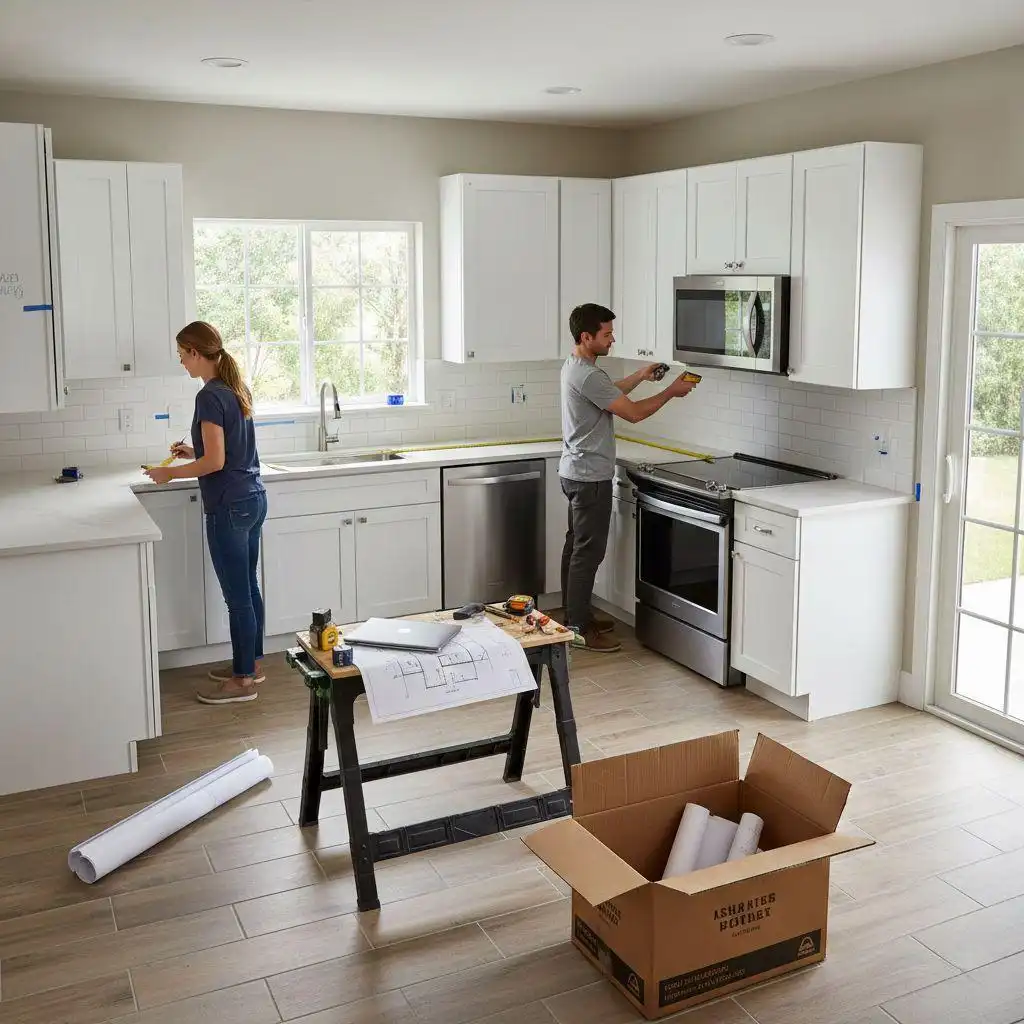
Start by sketching a bird’s-eye view (top-down) of your kitchen. When learning how to measure your L-shaped kitchen for custom cabinets, the gold rule is to work clockwise.
-
The Horizontal Run: Measure the total length of Wall A (from the corner to the end). Then measure Wall B (from the same corner to its end).
-
The “Three-Point” Check: Walls are rarely perfectly straight. Measure each wall at three different heights: at the floor, at the 36-inch mark (countertop height), and at the 80-inch mark (upper cabinet height).
-
The Contractor’s Secret: If your measurements vary, always provide the smallest dimension. We can always use a filler strip to close a gap, but we can’t “shrink” a cabinet that is too wide for a crooked wall.
Step 2: Mapping Openings (Windows & Doors)
Now, add the architectural details to your skeleton. Windows and doors are “fixed points” that your cabinets must work around.
-
Centerline Logic: Measure from the nearest corner to the center of the window. Then, measure the width of the window including the exterior trim (casing).
-
Vertical Clearance: Measure from the floor to the window sill. This is critical for an L-shaped layout—if the sill is lower than 36 inches, your countertop cannot run under the window without expensive modifications.
Step 3: The “Utility Audit” (Plumbing, Gas, & Electric)
Your cabinets are more than just boxes; they are the housing for your home’s infrastructure. This stage is where most DIY errors occur in the how to measure your L-shaped kitchen for custom cabinets process.
-
Sink Centerline: Mark the exact center of your sink’s drain pipe. Your sink base cabinet must be centered here.
-
Electrical Outlets: Locate every outlet. Are they 40 inches above the floor? If so, they will sit just above your backsplash. If they are lower, they may interfere with the countertop.
-
Gas & Water Lines: Note the height of the water valves. High-end custom cabinets often require “plumbing cut-outs” in the back panels.
Step 4: The Appliance Spec Sheet Protocol
Never measure your old appliances. Instead, find the Technical Specification Sheets for your new ones.
-
The Fridge “Niche”: A standard fridge needs at least 1 inch of “breathing room” on all sides for ventilation. Furthermore, if your fridge is tucked into the corner of the “L” against a wall, you must allow for the “Door Swing”—if the door can’t open past 90 degrees, you won’t be able to pull out the crisper drawers.
-
Dishwasher Placement: Ensure the dishwasher is placed within 3-5 feet of the sink for plumbing, but make sure its door doesn’t block the oven when both are open.
Step 5: Verifying Ceiling Height & Soffits
In an L-shaped kitchen, your upper cabinets usually define the “visual line” of the room.
-
Floor-to-Ceiling Height: Measure this at multiple points along the “L.” If your floor slopes 1/2 inch from one end to the other, your cabinets must be leveled using the “highest” point of the floor as the baseline.
-
Obstructions: Note any crown molding, HVAC vents, or recessed lighting that might prevent upper cabinets from reaching the ceiling.
Step 6: Corner Squaring (The 3-4-5 Method)
This is the advanced part of how to measure your L-shaped kitchen for custom cabinets. Most kitchen corners are not a perfect 90 degrees.
-
How to check: Mark a point 3 feet from the corner on Wall A. Mark a point 4 feet from the corner on Wall B. Measure the diagonal distance between the two marks. If it is exactly 5 feet, your corner is square. If it’s 5 feet and 1/2 inch, your corner is “wide,” and you will need a specialized filler strip to ensure the cabinets align.
Step 7: Contextual Photography
Numbers tell one story; photos tell the truth.
-
Take a photo of the “L” corner from the center of the room.
-
Take close-ups of the plumbing and any weird bumps in the wall.
-
The Factory Benefit: When our engineers look at your sketch alongside your photos, they can spot potential issues (like a low-hanging vent) that you might have missed.
Why Shop Drawings Are Your Best Friend
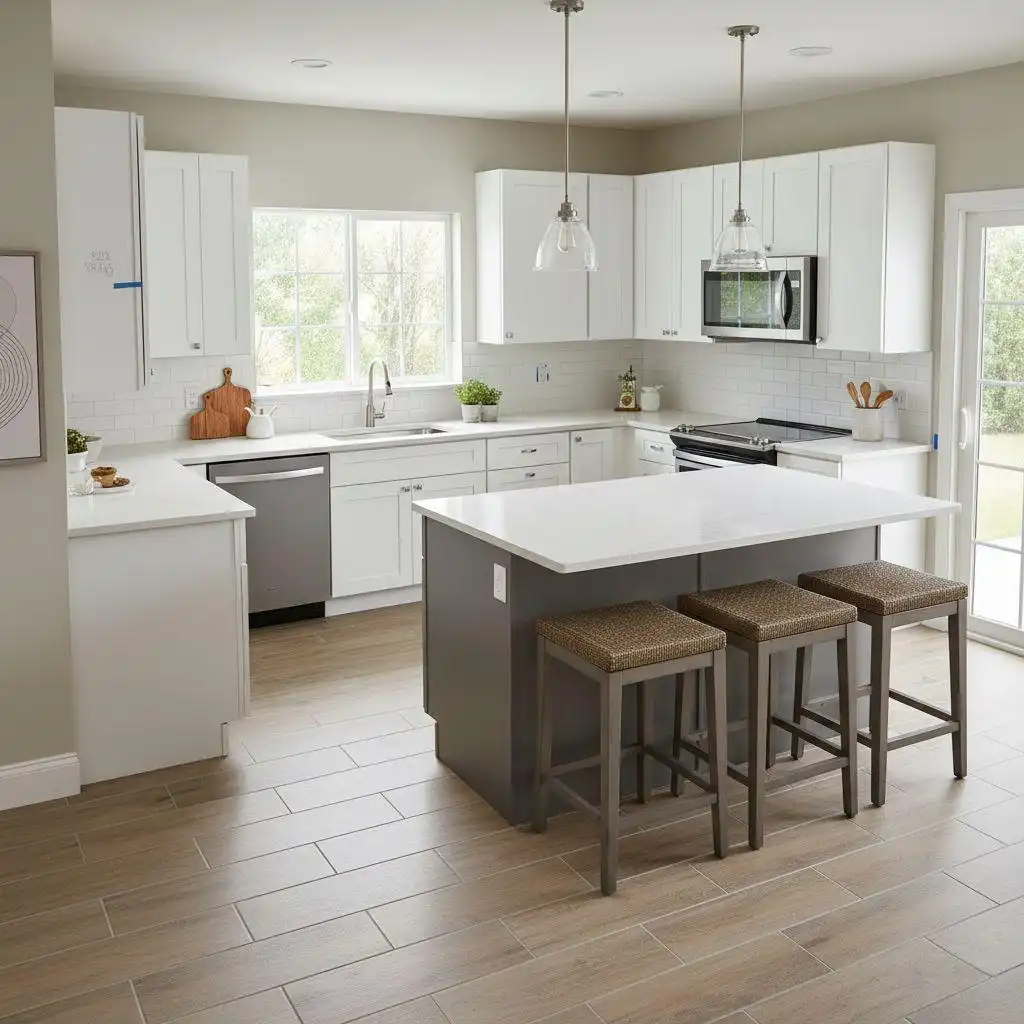
Once you submit your numbers using this how to measure your L-shaped kitchen for custom cabinets guide, our team at KEJIA Kitchen creates Detailed Shop Drawings.
-
The “Collision Check”: Our software simulates the opening of every door and drawer.
-
Scribe Allowances: We automatically add “Scribe Material” to the cabinets that touch the walls. These are extra-wide stiles that your installer can trim to follow the exact “wobble” of your home’s walls.
Conclusion: Precision Engineering Starts with You
Ordering custom cabinets direct from China is a brilliant way to save $20,000+ on a luxury renovation, but it requires a commitment to accuracy. By following this how to measure your L-shaped kitchen for custom cabinets guide, you are providing the “DNA” we need to build a flawless product.
At KEJIA Kitchen, we don’t just ship boxes; we provide a partnership. Our engineering team reviews every measurement, interrogates every appliance spec, and confirms every detail via CAD before the first board is cut.
Ready to Begin Your Project?
-
Download our “Measurement Master-Sheet”: A professional grid-template specifically for L-shaped kitchens.
-
Submit Your Sketch: Upload your hand-drawn measurements for a Free Technical Sanity Check by our engineers.