

The architectural landscape of 2026 has officially moved beyond the era of visible clutter. As the “Social Kitchen” becomes the primary living space and a hub for domestic entertaining, the demand for visual silence has reached an all-time high. This aesthetic shift has placed hidden kitchen pantry design at the very center of high-end cabinetry planning. It is no longer enough to simply have storage; that storage must now be an invisible, seamless extension of the kitchen’s structural DNA.
As a custom cabinetry specialist and general contractor, I have seen the “hidden” element transform from a luxury optional upgrade to a fundamental architectural requirement. However, achieving a truly seamless hidden kitchen pantry design requires more than just matching door panels to your island. It demands a sophisticated understanding of spatial flow, heavy-duty hardware engineering, and internal organization systems that remain functional even when concealed. If your hidden kitchen pantry design lacks structural integrity or fails to account for daily ergonomics, the “magic” of the disappearing act will quickly fade into mechanical frustration and wasted space.
1. The Engineering of Invisibility: Advanced Portal Systems
The most critical component of any hidden kitchen pantry design is the entry mechanism. To make a large-scale storage area vanish into a wall of cabinetry, we utilize three primary engineering approaches based on the floor plan’s requirements:
Integrated Portal Doors (The Secret Room)
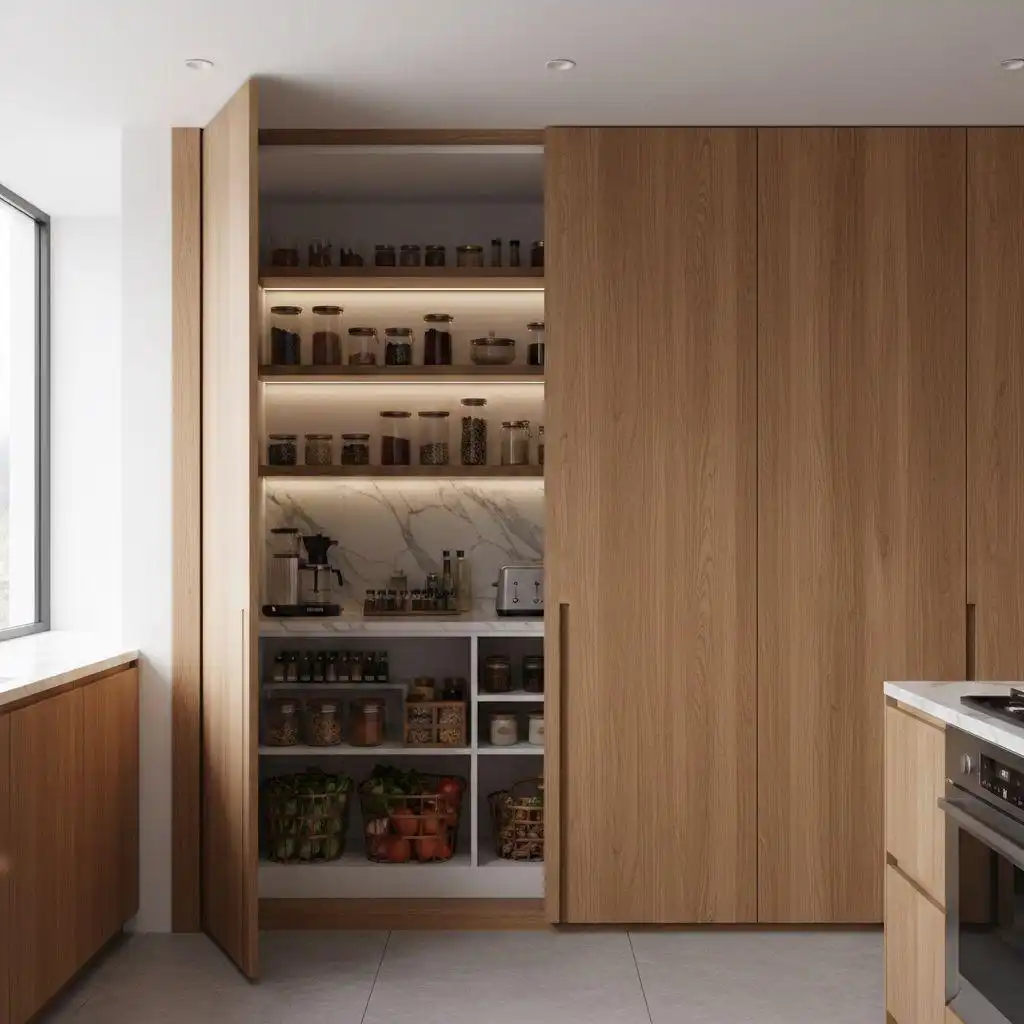
In this ambitious hidden kitchen pantry design, the door to a walk-in room is built to look identical to the surrounding tall cabinet doors. This requires “Heavy-Duty Pivot Hinges” that can support the weight of a full-height, 3/4-inch thick door while maintaining a razor-thin 3mm gap (reveal). These doors often lack external handles, utilizing “Touch-to-Open” magnetic latches to maintain the flat-plane aesthetic.
Pocket and Scissor-Slide Hardware
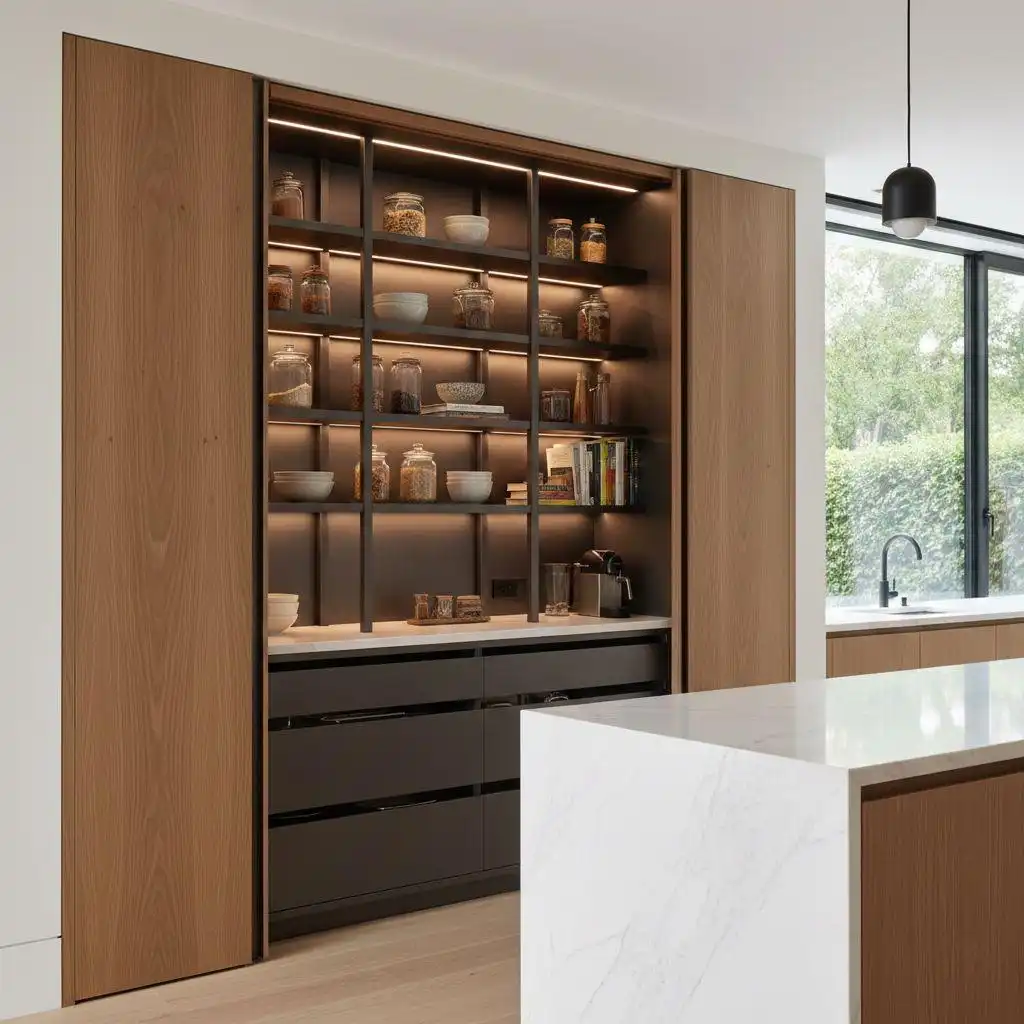
For compact footprints where a walk-in isn’t possible, hidden kitchen pantry design relies on “Scissor-style” pocket doors. These doors open and then slide back into a recessed “pocket” in the cabinet carcass. This is essential for functionality; it allows the homeowner to leave the pantry open during meal preparation without blocking the kitchen’s traffic flow. In 2026, we are seeing these systems equipped with “Electric Drive” assists, allowing the doors to retract with a simple voice command or tap.
Bifold Disappearing Walls
For wide-span storage, the hidden kitchen pantry design may use bifolding panels that stack neatly to the sides. This provides a “Full-Panorama” view of your pantry contents, turning a storage wall into a temporary open-shelf display during heavy cooking sessions.
2. Internal Ergonomics: The Anatomy of a Hidden Zone
Once the “hidden” door is opened, the interior must justify the complexity of the exterior. A professional hidden kitchen pantry design focuses on “Maximum Accessibility” through layered storage engineering.
The “Full-Access” Pull-Out Strategy
In deep pantry cabinets, standard fixed shelves are an ergonomic failure. A high-performance hidden kitchen pantry design incorporates internal pull-out drawers (often called “Inner Drawers” or “English Dovetail Pull-outs”). These allow the user to bring the contents of the pantry out into the light, ensuring that no item—no matter how small—is lost in the “dark zone” at the back of the cabinet. We utilize synchronized runners rated for up to 150 lbs of dry goods per drawer.
Vertical Zoning for Bulk and Daily Goods
In a walk-in hidden kitchen pantry design, we utilize the full vertical volume of the room.
-
The Gold Zone (Waist to Eye Level): Reserved for high-frequency items like coffee, grains, and daily snacks.
-
The Heavy Zone (Lower Tiers): Specialized deep drawers in the hidden kitchen pantry design for bulk bags of flour, pet food, or heavy kitchen appliances like stand mixers.
-
The Seasonal Zone (Upper Tiers): Accessible via an integrated rolling library ladder, which has become a hallmark of luxury hidden kitchen pantry design.
3. Technical Integration: Lighting, Power, and Climate
A common failure in amateur hidden kitchen pantry design is neglecting the environmental factors inside a closed, non-ventilated space.
Intelligent Sensor Lighting
Since a hidden pantry is, by definition, enclosed behind solid panels, integrated lighting is a non-negotiable safety and aesthetic feature. We specify “Door-Contact Sensors” for every hidden kitchen pantry design. The moment the door is cracked open, high-CRI (95+) LED strips—hidden in recessed channels—illuminate every shelf. This provides not only functionality but a “jewelry box” effect that defines luxury hidden kitchen pantry design.
Ventilation and Heat Management
Many 2026 hidden kitchen pantry design projects include “Countertop Zones” for secondary appliances like microwaves, wine coolers, or even secondary dishwashers. These generate heat. We incorporate “Passive Venting” in the toe-kicks and shadow gaps at the top of the cabinetry to ensure that heat does not damage the cabinet’s structural adhesives or spoil the food.
4. Material Science: Durability vs. Aesthetics
While the exterior of a hidden kitchen pantry design matches the kitchen’s fine wood veneer or matte lacquer, the interior must be built for “Industrial Durability.”
-
Anti-Fingerprint Nanotechnology: For the internal drawers of the hidden kitchen pantry design, we recommend high-pressure laminates (HPL) with anti-microbial properties. These are resistant to scratches from canned goods and are easy to wipe clean after a spill.
-
Reinforced Substrates: Because a pantry carries the highest weight load in the home, the hidden kitchen pantry design must utilize 3/4-inch plywood or high-density furniture board. We avoid particle board entirely to prevent shelf sagging over time.
FAQ: Professional Guidance on Hidden Pantry Systems
How much space is required for a walk-in hidden kitchen pantry design?
To accommodate a “hidden portal” door, you typically need at least 30 inches of width within your cabinetry run for the entrance alone. For the internal room, a minimum of 16 square feet is required to allow for comfortable movement and efficient shelving depth.
Can I retro-fit a hidden kitchen pantry design into an existing kitchen?
It is a complex undertaking. The primary challenge is matching the existing cabinetry’s patina and ensuring the subfloor can support the concentrated weight. Most successful hidden kitchen pantry design projects are best executed during a full “back-to-the-studs” remodel.
What is the most durable hardware for these heavy doors?
We exclusively use European-engineered hardware (such as Blum, Grass, or Hawa) for hidden kitchen pantry design. These brands offer lifetime warranties on the hinges and runners, which is crucial for a door that may be operated 20 to 30 times a day in a busy household.
Does a hidden pantry add more value than a standard one?
Undoubtedly. In the 2026 real estate market, “Visual Integration” and “Clutter Management” are top-tier selling points. A well-executed hidden kitchen pantry design creates a powerful “wow factor” during home tours and signals a custom, high-end build, often yielding a 100% to 120% ROI on the cabinetry costs.
Conclusion: The Mastery of Invisible Storage
The shift toward hidden kitchen pantry design represents a deeper understanding of how we live today. We want the convenience of a fully stocked, professional kitchen without the visual noise of packaging and small appliances. By prioritizing technical engineering, high-load hardware, and seamless integration, you can achieve a kitchen that serves as both a high-performance workspace and a serene, minimalist sanctuary.
If you are ready to explore the possibilities of hidden kitchen pantry design for your next project, our team is prepared to provide the structural analysis and creative vision required for a flawless execution. Contact us to begin your design journey.
[Consult a Designer – Request Your Hidden Pantry Blueprint Today]