


In the modern architectural era of 2026, kitchen design has finally evolved beyond the “one-size-fits-all” mentality that defined the mid-20th century. For decades, the industry standard for kitchen surfaces was a fixed height of 36 inches—a relic of post-war mass production that ignored the vast diversity of human biology. However, as we integrate more biological data and motion-capture technology into home design, we have discovered a staggering truth: this arbitrary standard is the leading cause of chronic back pain, shoulder strain, and repetitive motion injuries in the home. The solution lies in the precise application of countertop height ergonomics.
As a contractor and design consultant specializing in high-performance homes, I have seen clients spend thousands on luxury finishes while completely ignoring the “geometry of the body.” A kitchen that is aesthetically beautiful but biologically incompatible with its user is a fundamental design failure. By understanding the mechanical relationship between your spine, your elbows, and your work surface, we can use countertop height ergonomics to transform the kitchen into a space of physical restoration rather than physical stress.
1. The Biological Calculation: The Science of “Elbow Logic”
The primary reason standard cabinetry causes pain is that it fails to account for the “Elbow-to-Surface” ratio. In the professional field of countertop height ergonomics, the universal rule of thumb is that your work surface should be roughly 2 to 4 inches below your elbow height when standing in a neutral position.
The Biomechanics of Spinal Health
When a countertop is too low for the user’s height, the center of gravity shifts forward. To compensate, the user is forced into a “forward head posture” and a hunched thoracic spine—creating what we call the “C-Curve.” This puts immense compression on the L4 and L5 vertebrae, leading to sciatica and long-term disc degeneration.
Conversely, a surface that is too high forces the user to “shrug” their shoulders and lift their elbows out to the sides. This constant tension in the trapezius and levator scapulae muscles leads to tension headaches and rotator cuff strain. By applying custom countertop height ergonomics, we align the surface to the user’s unique skeletal structure, allowing for a neutral spine and relaxed shoulders.
2. Advanced Multi-Tier Zoning: Task-Specific Ergonomics
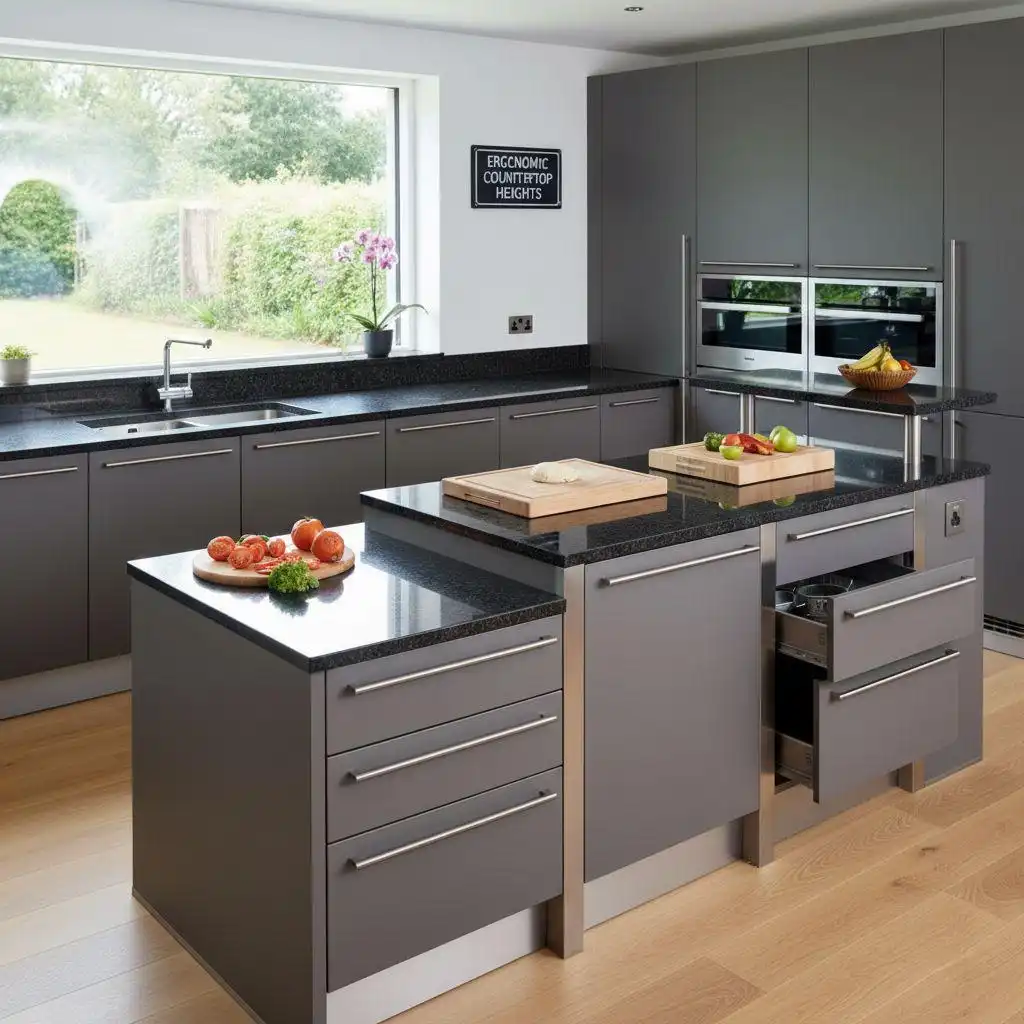
One of the most significant advancements in kitchen ergonomics for 2026 is the “Variable Height” layout. Not every task in the kitchen requires the same amount of leverage or visual focus. A professional countertop height ergonomics plan typically involves four distinct height tiers:
The Primary Prep and Chopping Zone
This is the standard work zone where 70% of precision knife work happens. Following the countertop height ergonomics formula, this surface is set at exactly 3 inches below the primary cook’s elbow height.
The High-Leverage Kneading Zone (The Baking Station)
For tasks that require significant downward force—such as kneading heavy dough or manual grinding—countertop height ergonomics dictates a much lower surface. A dedicated “baking station” is usually set 5 to 8 inches below elbow height. This allows the user to use their core strength rather than relying solely on their wrist and forearm muscles, preventing carpal tunnel syndrome.
The High-Visibility Cooking Zone
The cooktop area requires its own set of countertop height ergonomics. When you add the height of a 12-quart stockpot to a standard 36-inch counter, the “rim” of the pot can end up at chest height. A smart countertop height ergonomics layout drops the cooktop height by 3 inches, ensuring a neutral neck angle while stirring.
The Social and Beverage Zone
Often integrated into the kitchen island, this zone is set to “Bar Height” (42 inches). From a kitchen ergonomics perspective, this allows guests to lean comfortably while standing, promoting a healthy posture during social interaction without the need for constant sitting.
3. Appliance Ergonomics: Beyond the Countertop
A complete countertop height ergonomics strategy must also address the placement of appliances.
-
The Wall Oven: Instead of the traditional under-counter placement, we recommend the “Elbow Height” oven. This allows the user to slide heavy roasts in and out without bending their spine, a core principle of Universal Design.
-
The Dishwasher Lift: One of the biggest trends in 2026 is the “Comfort Lift” dishwasher. If your countertop height ergonomics are set for a tall person, bending down to the floor for dishes is even more painful. These units raise the lower basket to waist height during loading.
-
Microwave Placement: Placing a microwave above the range is an ergonomic nightmare and a safety hazard. We integrate microwave drawers into the countertop height ergonomics plan at 24 inches above the floor for maximum safety and ease of use.
4. Hardware and Technical Integration for 2026
For multi-generational households, the countertop height ergonomics debate has historically been a compromise. However, 2026 technology has introduced “Adaptive Cabinetry.”
Linear Actuators and Motorized Lifts
We are now installing motorized base cabinets that allow a section of the island to rise or fall at the touch of a button. These systems utilize synchronized linear actuators, allowing the countertop height ergonomics to adjust instantly from 32 inches (ADA compliant) to 42 inches.
The “Toe-Kick” Step and Foot Health
Ergonomics isn’t just about the counter; it’s about the floor. In a professional countertop height ergonomics setup, we integrate “Anti-Fatigue Sub-flooring” beneath the cabinetry. Furthermore, we design “Extended Toe-Kicks” (up to 6 inches deep) to allow the user to stand closer to the work surface without leaning forward.
5. Universal Design and ADA Compliance
In 2026, we focus heavily on “Aging-in-Place.” Countertop height ergonomics must account for users who may eventually transition to seated food preparation.
-
Knee-Space Integration: A section of the countertop height ergonomics plan should include a 30-inch wide opening under the counter. This allows a seated user to pull their chair or wheelchair directly up to the surface.
-
Tactile Edge Indicators: For users with visual impairments, we can integrate subtle tactile ridges on the edge of the counter within the countertop height ergonomics plan to indicate the proximity of the sink or cooktop.
FAQ: Resolving Chronic Kitchen Pain
How do I measure my own ideal ergonomic height?
Stand comfortably with your shoulders relaxed. Bend your elbow at a 90-degree angle. Measure from the floor to the underside of your elbow. Subtract exactly 3 inches. That is the “Absolute Authority” measurement for your primary countertop height ergonomics.
Will custom heights hurt my home’s resale value?
The trend in 2026 is toward “Wellness Real Estate.” A home that features professional countertop height ergonomics is marketed as a “Healthy Home.” Buyers are increasingly willing to pay a premium for spaces that prioritize long-term spinal health.
Can I fix my current kitchen without a full remodel?
Yes. You can improve your countertop height ergonomics by using “thick-milled” end-grain cutting boards (to raise a surface) or by using a sturdy, non-slip “Kitchen Helper” platform.
What is the best height for a kitchen island?
For social interaction, 42 inches is standard. For prep, we recommend a “Split-Level” countertop height ergonomics design: a 35-inch height for the chef and a 42-inch raised ledge for guests.
Conclusion: Investing in Your Physical Longevity
The kitchen is the heart of the home, but it shouldn’t be the cause of your chronic back pain. By applying the scientific principles of countertop height ergonomics, you are making a long-term investment in your physical well-being. A kitchen designed for your specific biology allows you to focus on the joy of the craft rather than the discomfort of the standing position.
If you are ready to stop compromising your spinal health for a standard cabinet box, it is time to analyze your space through the lens of countertop height ergonomics. Contact our design team today to schedule an ergonomic assessment.
[Schedule Your Ergonomic Assessment – Design for a Pain-Free Life]