

In the cabinetry industry, the corner is the most complex intersection of geometry and structural load. When we discuss a corner kitchen cabinet from a manufacturing perspective, we are referring to the carcass (the box) itself. While accessories are secondary, the box’s configuration determines the entire kitchen’s alignment, countertop support, and spatial efficiency.
As a specialized custom cabinetry factory, we treat the corner not as a problem to be hidden by hardware, but as a structural anchor. This technical analysis explores 5 specific manufacturing blueprints for the corner carcass, focusing on joinery, weight distribution, and volumetric engineering.
Blueprint I: The Blind Base Cabinet (The Overlap Strategy)
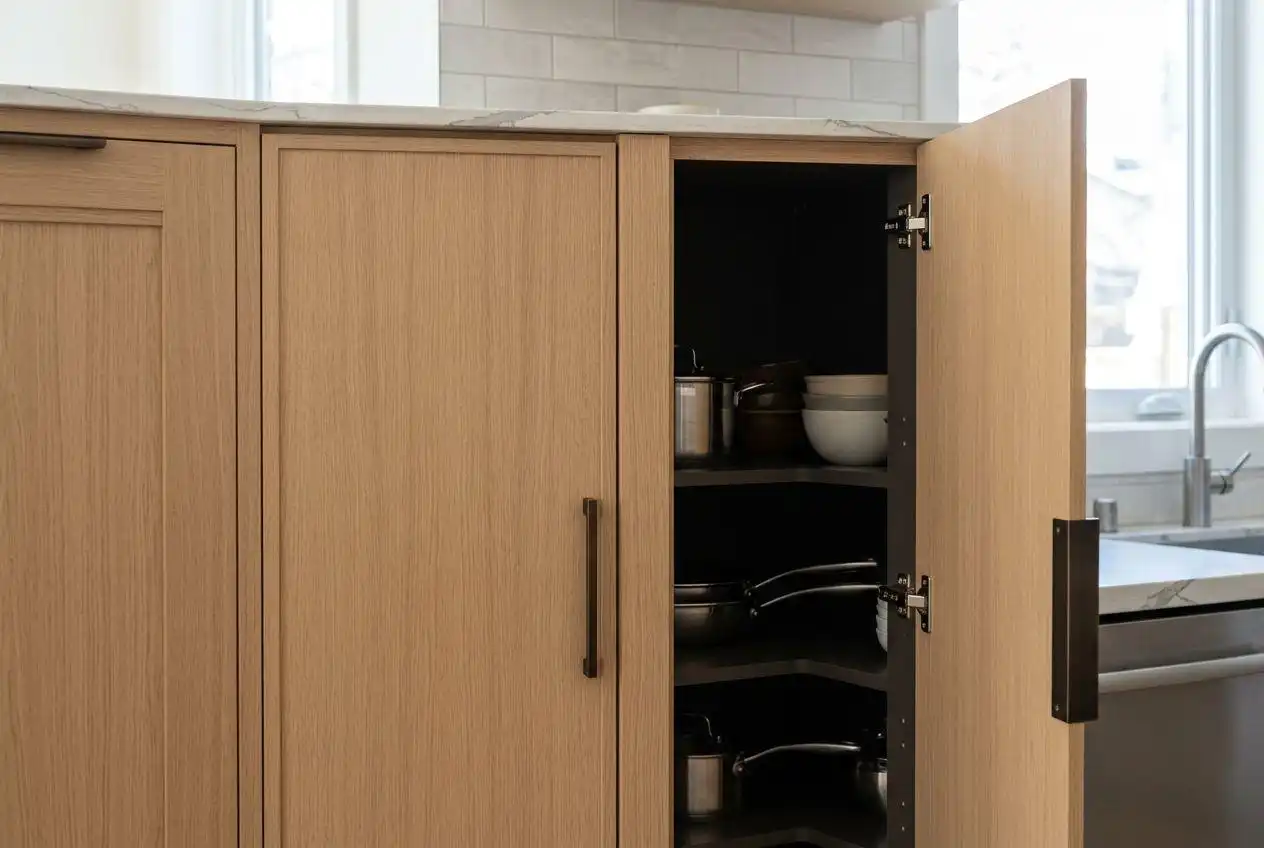
The Blind Base is the most common corner kitchen cabinet configuration. It consists of a standard rectangular box that extends past the adjacent cabinet, creating a “hidden” space.
The Internal Partition Wall
A factory-grade Blind Base isn’t just an empty box. We include a vertical internal partition (a “mullion”).
-
Structural Role: This partition provides a solid mounting point for the adjacent cabinet’s filler strip. Without this internal support, the two cabinets would only be connected by the countertop, leading to structural shifting over time.
-
The “Dead Zone” Engineering: We specify a minimum “blind” extension of 600mm to 1100mm. This ensures that the cabinet provides enough depth to be useful without becoming a structural liability.
-
Countertop Support: Because the back corner of a Blind Base is far from the front rail, we install extra-heavy-duty 18mm plywood stretchers across the top to prevent the stone countertop from cracking under its own weight.
Blueprint II: The Diagonal Base Cabinet (The 45-Degree Facade)
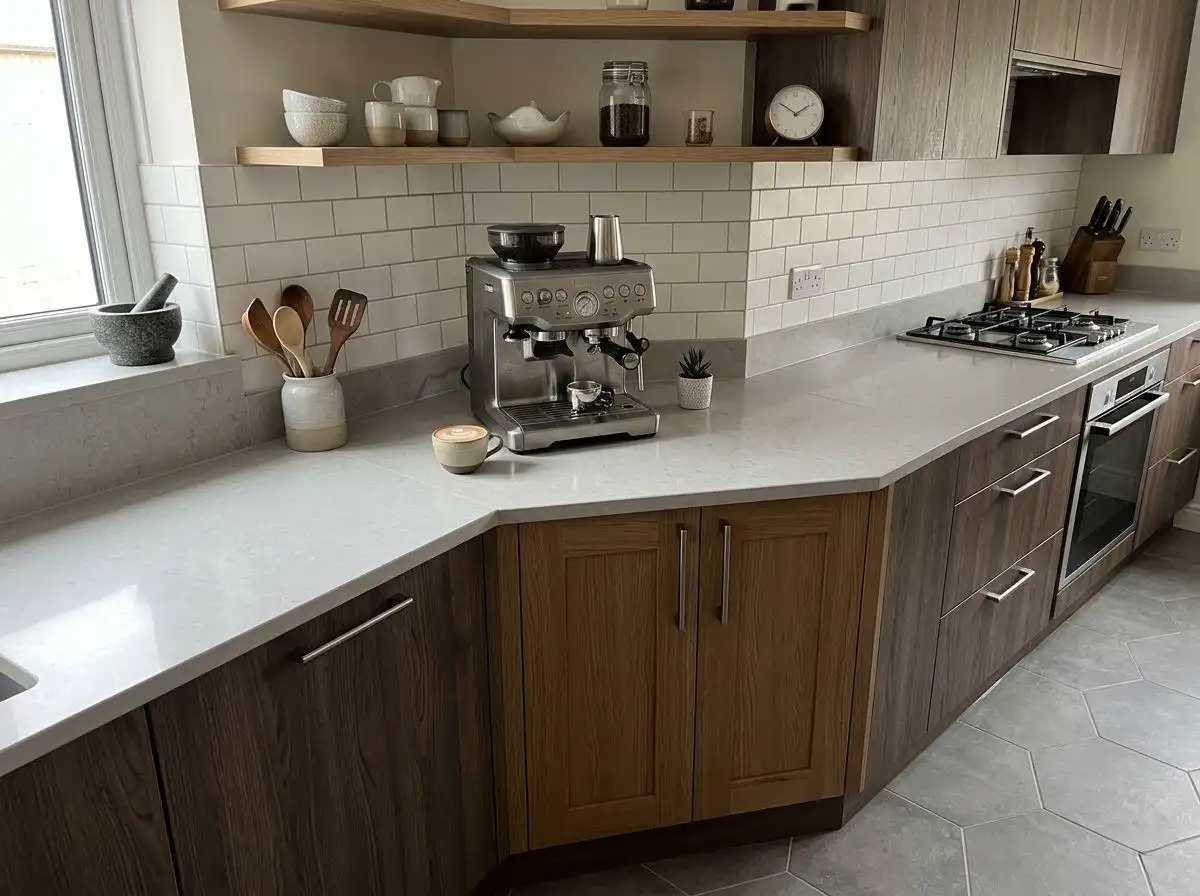
The Diagonal corner kitchen cabinet cuts across the corner at a 45-degree angle. This creates a hexagonal box shape that is significantly deeper than standard units.
Geometric Volume Maximization
The Diagonal cabinet is the king of “open storage.” Because it doesn’t have a 90-degree “blind” corner, everything inside is visible from the door.
-
Manufacturing Complexity: The side panels must be beveled at precisely 45 degrees. In our factory, this is done via 5-axis CNC to ensure the joint is perfectly airtight.
-
Shelf Engineering: The shelves in a Diagonal cabinet are large, five-sided polygons. Due to their increased surface area, we increase the shelf thickness to 25mm (1 inch) or add a solid wood nosing to prevent sagging under the weight of heavy appliances like mixers or bread machines.
-
The “Sink Base” Adaptation: This blueprint is often used for corner sinks. In this case, we remove the back corner of the hexagon to allow for plumbing stacks and waste pipes, reinforcing the remaining structure with steel corner braces.
Blueprint III: The L-Shaped Corner Box (The 90-Degree Cutout)
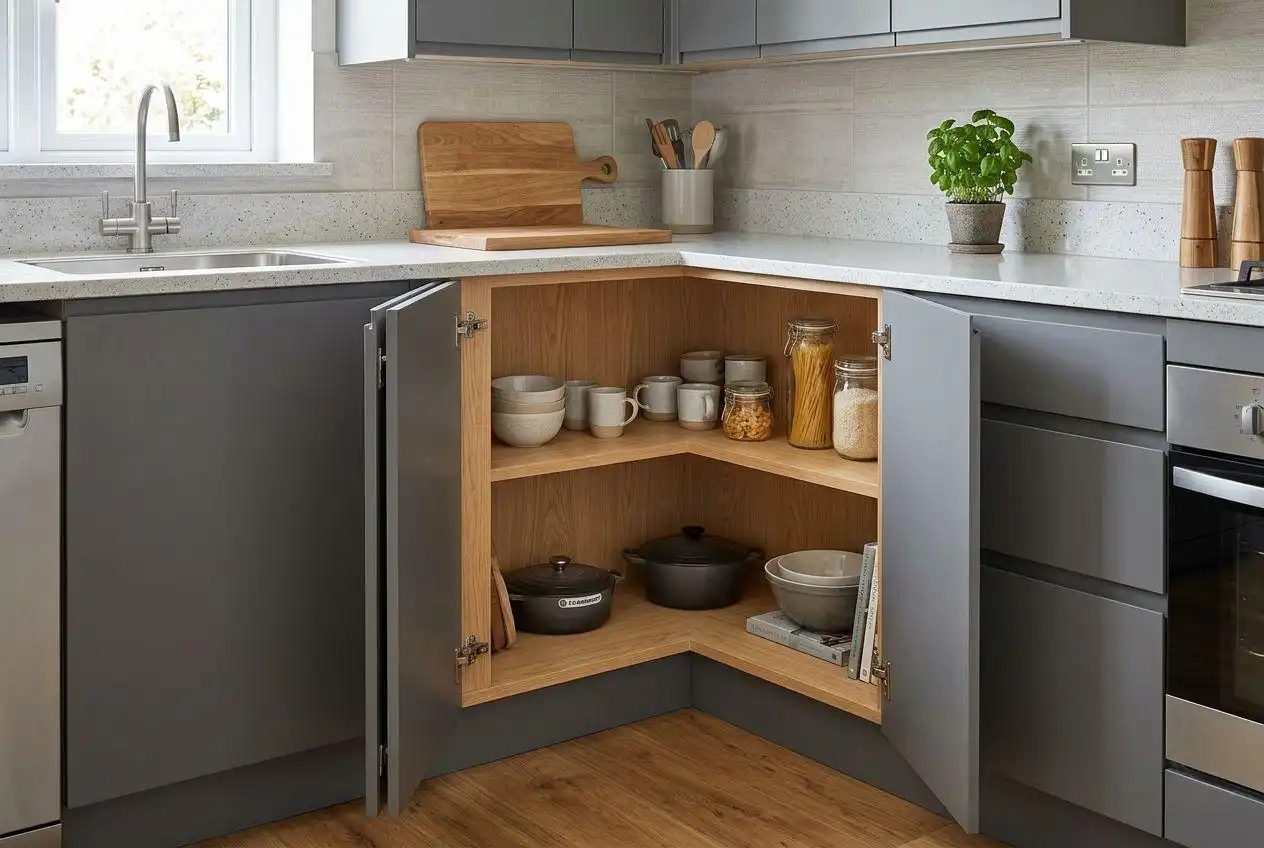
Often called a “Pie-Cut” or “L-shaped” cabinet, this corner kitchen cabinet features two doors that open to reveal a single, massive L-shaped interior.
The “Zero-Center” Structural Challenge
Unlike the Blind Base, the L-shaped box has no center stile. When the doors are open, the front of the cabinet is completely unsupported.
-
The Reinforced Top Frame: To compensate for the lack of a center support, we utilize a “G-shaped” 18mm plywood top rail. This rail acts as a structural bridge, transferring the weight of the countertop to the side and back panels.
-
The Bi-Fold Hinge Prep: The cabinet’s face frames must be milled to accept 170-degree or bi-fold hinges. We reinforce the hinge-mounting area with a double-thickness plywood block to ensure the heavy L-shaped doors do not sag over time.
-
Joinery: We use a “Blind Dado” joint where the two back panels meet at 90 degrees. This provides the rigidity needed to keep the large box square during shipping and installation.
Blueprint IV: The Corner Wall Cabinet (Upper Box Dynamics)
The corner kitchen cabinet for wall units faces a unique challenge: gravity. Unlike base cabinets, wall corners must support their own weight and their contents while hanging from two perpendicular walls.
Double-Panel Cleat System
In our factory, we don’t rely on the back panel alone for hanging.
-
The Structural Cleat: We integrate a solid wood “French Cleat” into both back panels of the corner unit. This allows the installer to anchor the cabinet into the studs of both intersecting walls, creating a “locking” effect that prevents the cabinet from ever pulling away.
-
Visual Symmetry: For Diagonal wall units, we ensure the door width matches the adjacent 300mm or 400mm units. This creates a continuous “line of sight” that makes the kitchen look architecturally balanced.
Blueprint V: The Corner Filler and Post Engineering
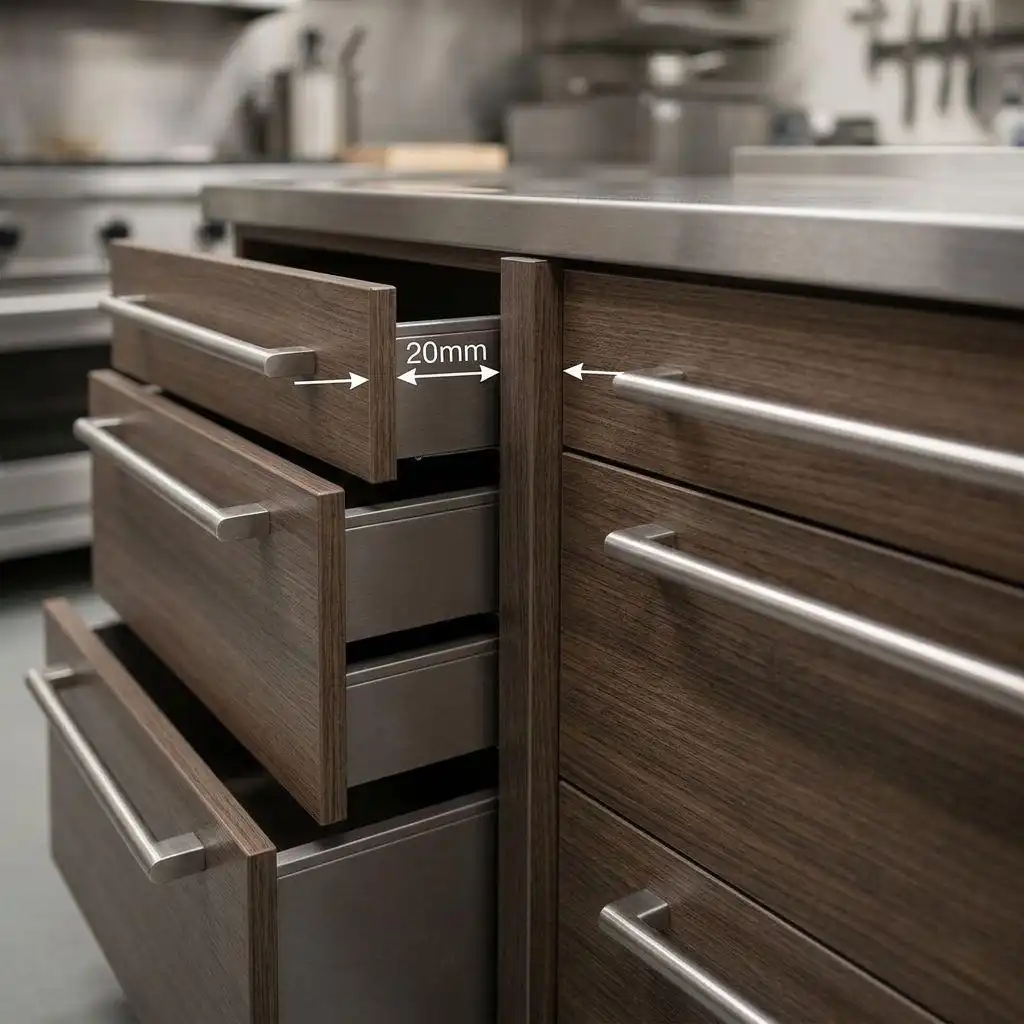
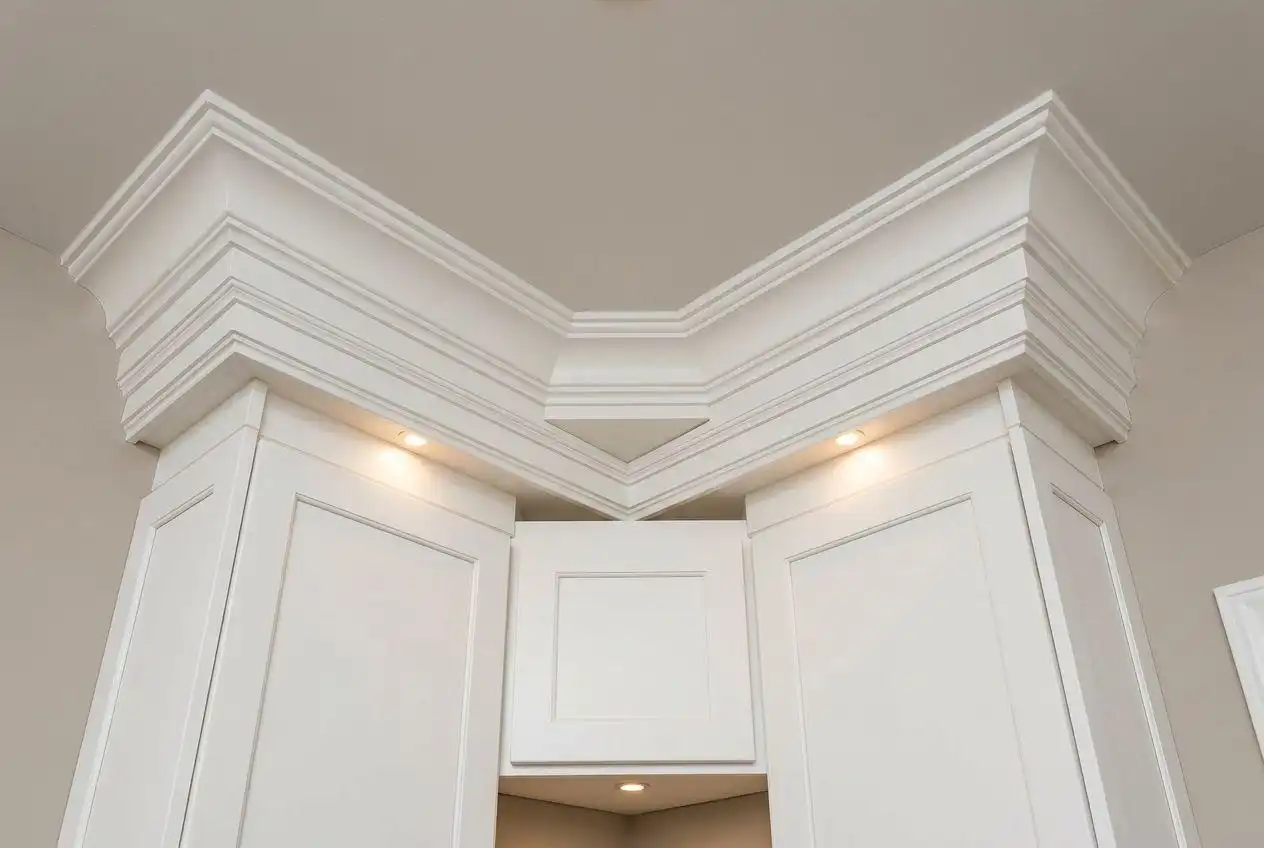
The most overlooked part of corner kitchen cabinet manufacturing is the “Corner Post” or “Filler.” This is the piece of wood that prevents drawers and handles from colliding at the 90-degree intersection.
Integrated vs. Attached Fillers
-
The Factory-Integrated Post: Instead of asking the installer to screw two pieces of wood together on-site, we manufacture a pre-assembled L-shaped corner post.
-
The “Handle Clearance” Metric: We calculate the depth of the filler based on your chosen hardware. If you are using “Pro-Style” bar handles that protrude 50mm, we manufacture a 70mm filler. This 20mm “Safety Margin” is the difference between a functional kitchen and one where the drawers are blocked by the stove handle.
-
Material Matching: The filler is made from the exact same batch of lacquered HDF or PET foil as the doors, ensuring 100% color consistency—a detail often missed by smaller workshops.
Structural Physics: The “Countertop Shear” Problem
A major reason we focus on the corner kitchen cabinet box construction is the weight of modern stone. A 30mm thick quartz countertop can weigh over 80kg per square meter. The corner is the point of maximum stress.
The Plywood “Spider” Support
In our factory, every corner base unit is fitted with a “Spider Support” system. This consists of three 18mm plywood stretchers that radiate from the back corner to the front and side rails. This triangulates the box’s strength, ensuring that the pressure from the stone is distributed across the entire footprint of the cabinet, not just the front edges.
Moisture Prevention in Dead Corners
Corners are often adjacent to “Wet Zones” (sinks and dishwashers).
-
The Vapor Barrier: We apply a foil-faced vapor barrier to the underside of the top rails in all corner units. This prevents steam from a dishwasher or heat from a range from penetrating the plywood core of the corner kitchen cabinet.
-
Airflow Channels: We mill 5mm “Breather Holes” into the back panels of corner units. This allows for minimal air exchange with the “service void” behind the cabinets, preventing the “musty smell” that often plagues old corner units.
Comparative Manufacturing Matrix
| Cabinet Type | Storage Volume | Manufacturing Difficulty | Installation Time | Best For |
| Blind Base | 70% | Low | Fast | Long Walls |
| Diagonal Base | 90% | High | Moderate | Corner Sinks |
| L-Shaped Box | 100% | Extreme | Slow | Maximum Access |
| Corner Wall | 80% | Moderate | Moderate | Upper Storage |
| Walk-in Box | 100%+ | High | Slow | Pantries |
FAQ: Technical Carcass Inquiries
Q: Why don’t you use “Butt Joints” for corner boxes?
A: A butt joint (simply screwing two boards together) has no mechanical resistance against twisting. In a corner kitchen cabinet, the box is subjected to “torsional stress” during installation. We use Dado and Rabbet joints which physically lock the panels together, ensuring the box stays perfectly square.
Q: Can a corner cabinet be “Frameless” (European Style)?
A: Yes, but it requires a thicker back panel. In framed cabinetry, the face frame provides the rigidity. In frameless corner kitchen cabinet manufacturing, we increase the back panel from the standard 5mm to 18mm to ensure the box doesn’t warp under the weight of the countertop.
Q: How do you ship such a large L-shaped box without damage?
A: For L-shaped boxes, we often use “Flat-Pack with Pre-Drilled Dadoes” or ship them in a specialized reinforced crate with internal bracing. This prevents the “wings” of the L-shape from snapping during transit.
Conclusion: The Foundation of the Kitchen
The corner kitchen cabinet is the most misunderstood component of the kitchen. It is not just a place to hide a rotating tray; it is a complex piece of structural engineering that supports the countertop, aligns the adjacent runs, and manages the most difficult geometry in the home.
By choosing a factory that understands the physics of the Blind Base mullion or the G-shaped top rail, you are ensuring that your kitchen’s foundation is as durable as its finish.
[Consult with our Engineering Team for Multi-Unit Logistics]