



Who This Guide Is For
- Interior designers specifying kitchens, wardrobes, vanities and feature cabinetry.
- Luxury residential developers standardizing finish packages across multiple units.
- Contractors coordinating site conditions, installation sequencing and handover.
- Procurement teams comparing custom cabinet manufacturers and material samples.
Key Takeaways
- A premium-looking finish can still be the wrong choice for a high-use or high-humidity location.
- Approve a full door sample, edge treatment and sheen level together; a small chip rarely reveals the final visual effect.
- Veneer requires a grain, matching and allowable-variation agreement before production.
- For lacquered doors, define color code, gloss level, handle/edge detail and approved touch-up approach.
- The cabinet carcass, edge sealing and hardware matter as much as the visible door finish.
- Multi-room projects need a signed finish schedule and a retained control sample to manage batch consistency.
Which Luxury Cabinet Finishes Fit Each Residential Project?
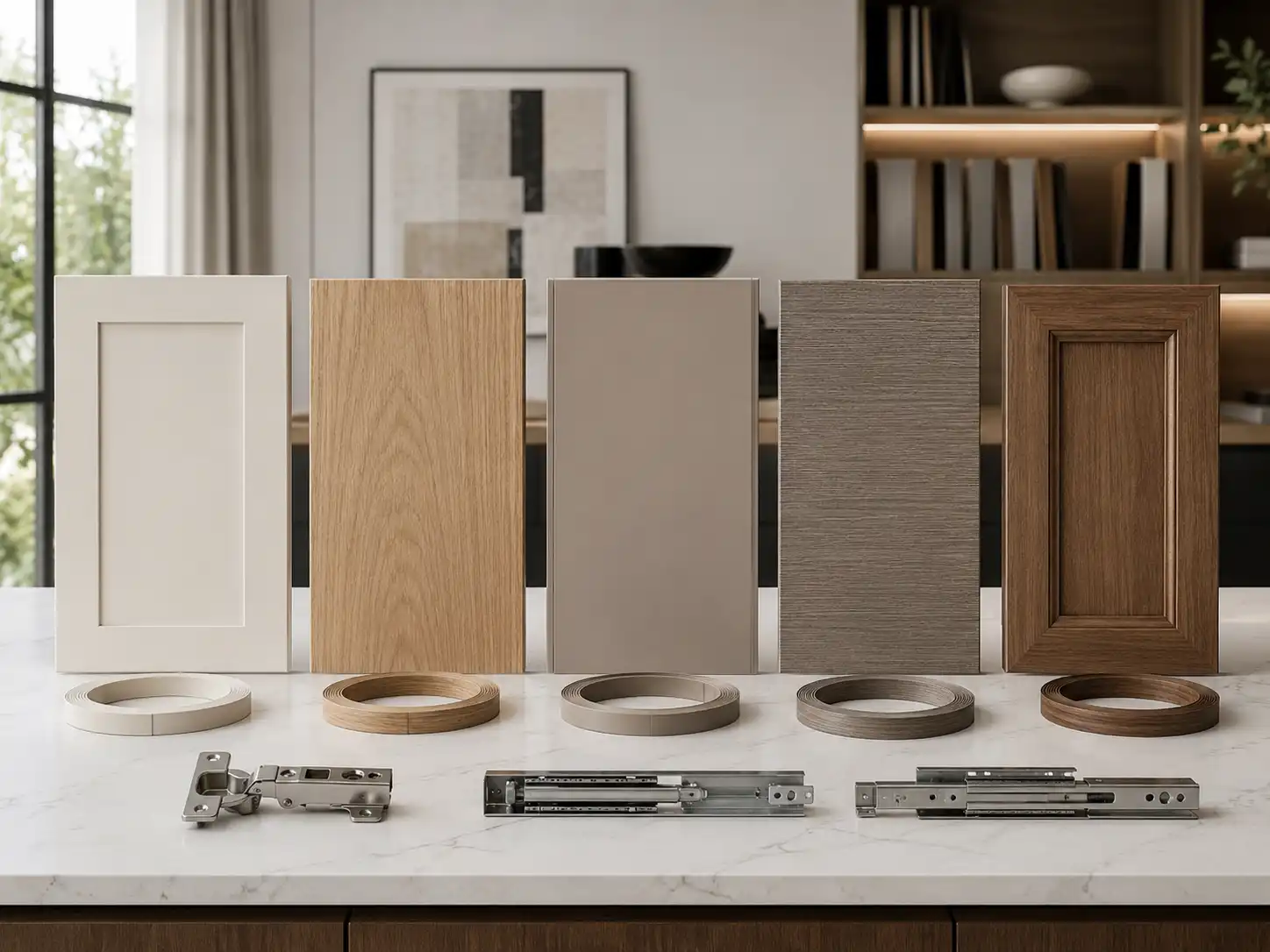
| Finish | Best for | Why designers choose it | Main risk to manage | Specify before production |
|---|---|---|---|---|
| Painted lacquer | Minimalist kitchens, feature walls, tailored wardrobes | Continuous color, refined sheen, clean profile options | Scratches and impact marks are more visible; color and gloss can vary between batches | Color code, sheen, door profile, edge radius, approved sample |
| Natural wood veneer | Villas, apartments, libraries, wine areas | Real timber character and directional grain | Natural variation, grain mismatch, moisture-related movement | Veneer species/cut, grain direction, sequence matching, stain and clear coat |
| PET | Contemporary kitchens and wardrobes | Smooth uniform appearance with practical repeatability | Edge treatment and reflected-light quality | PET color, surface sheen, edge-band match, panel orientation |
| Melamine | Secondary rooms, premium rental developments, built-ins | Consistent decor choice and controlled cost | Generic-looking selection or weak edge detailing | Board brand/spec, decor code, texture, edge band thickness and color |
| Solid wood | Framed doors, heritage details, selected feature pieces | Depth, joinery character and long-term repairability | Seasonal movement and natural variation | Species, construction, stain, panel allowance and acceptable variation |
The quick rule is simple: use lacquer when color precision and a tailored monolithic appearance are central; use veneer when natural timber is part of the story; use PET when the design needs a crisp modern plane with repeatable production; use melamine when the specification must be cost-controlled without compromising the cabinet build; and use solid wood where the design can celebrate natural material behavior.
How Should Designers Compare Lacquer, Veneer, PET and Melamine?
Painted lacquer: best for controlled, tailored color
Lacquered doors suit contemporary luxury kitchens, concealed storage walls and wardrobes where color is a major design element. They work especially well with slim shadow gaps, integrated pulls and soft matte surfaces. The important decision is not merely “lacquer or not”; it is the complete surface specification: color reference, gloss level, substrate, edge profile, door construction and sample approval.
Lacquer deserves more care around busy family kitchens, appliance garages and tight circulation corners. Designers should identify impact-prone edges and decide whether a slightly softer edge radius, a protective handle detail or a more forgiving adjacent material is appropriate. A touch-up plan should be agreed before handover rather than after a moving crew damages a door.
Wood veneer: best for material authenticity
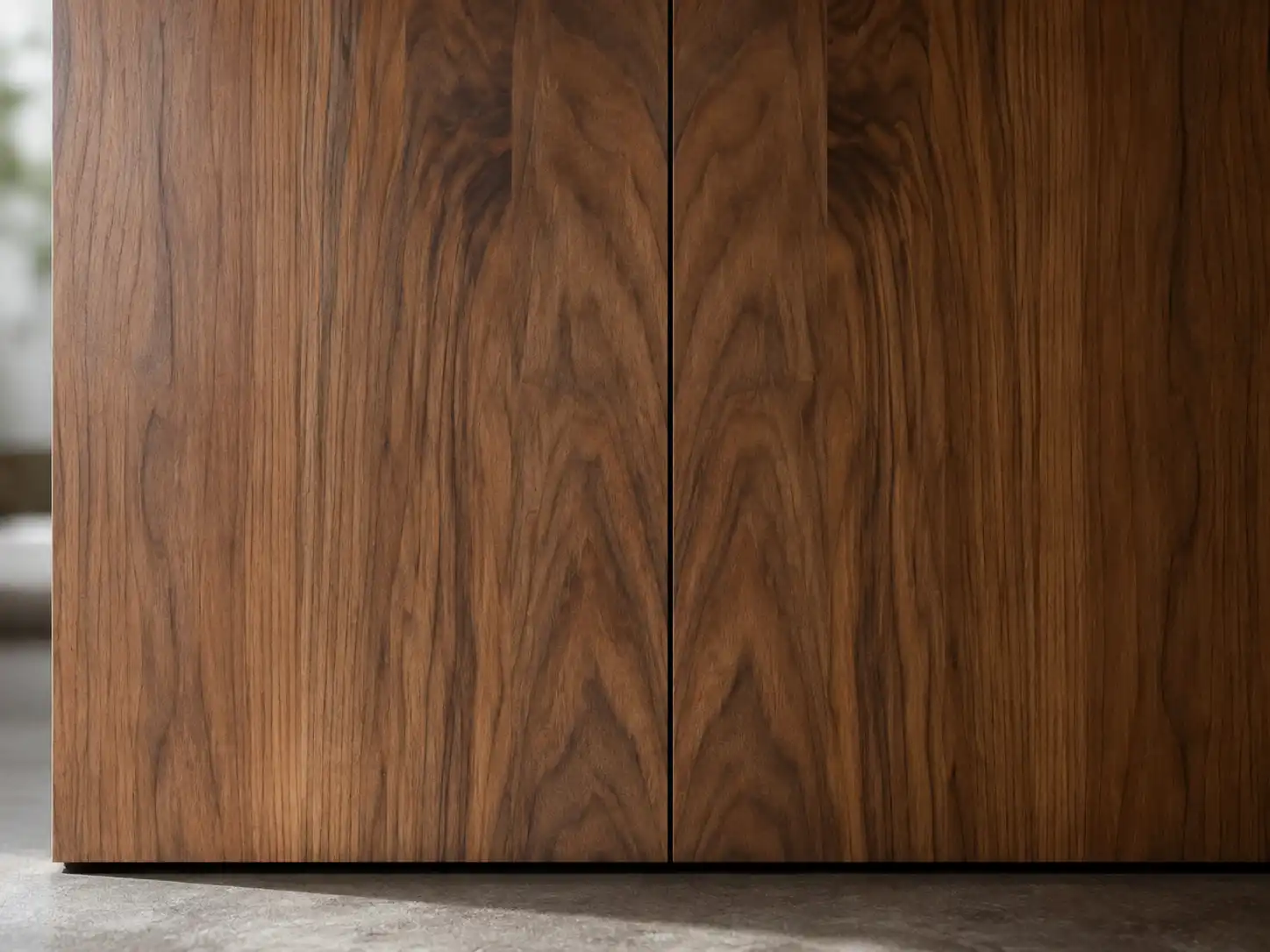
Veneer is the premium choice when a project needs real grain, warmth and visual depth without making every cabinet component from solid timber. It is excellent for tall pantry walls, media units, libraries, wine cabinets and paired kitchen zones. Its value comes from natural variation, so a contract should not promise artificial uniformity.
Specify the species, cut, tone, grain direction and matching method. Book matching, slip matching and random matching create different visual rhythms. Ask to approve a representative door-size sample or veneer layout–not only a pocket-sized chip. Timber is hygroscopic, so reasonable acclimatization, ventilation and clear expansion allowances remain sensible project controls; the USDA Wood Handbook provides useful technical context on wood and moisture.
PET: best for clean contemporary repetition
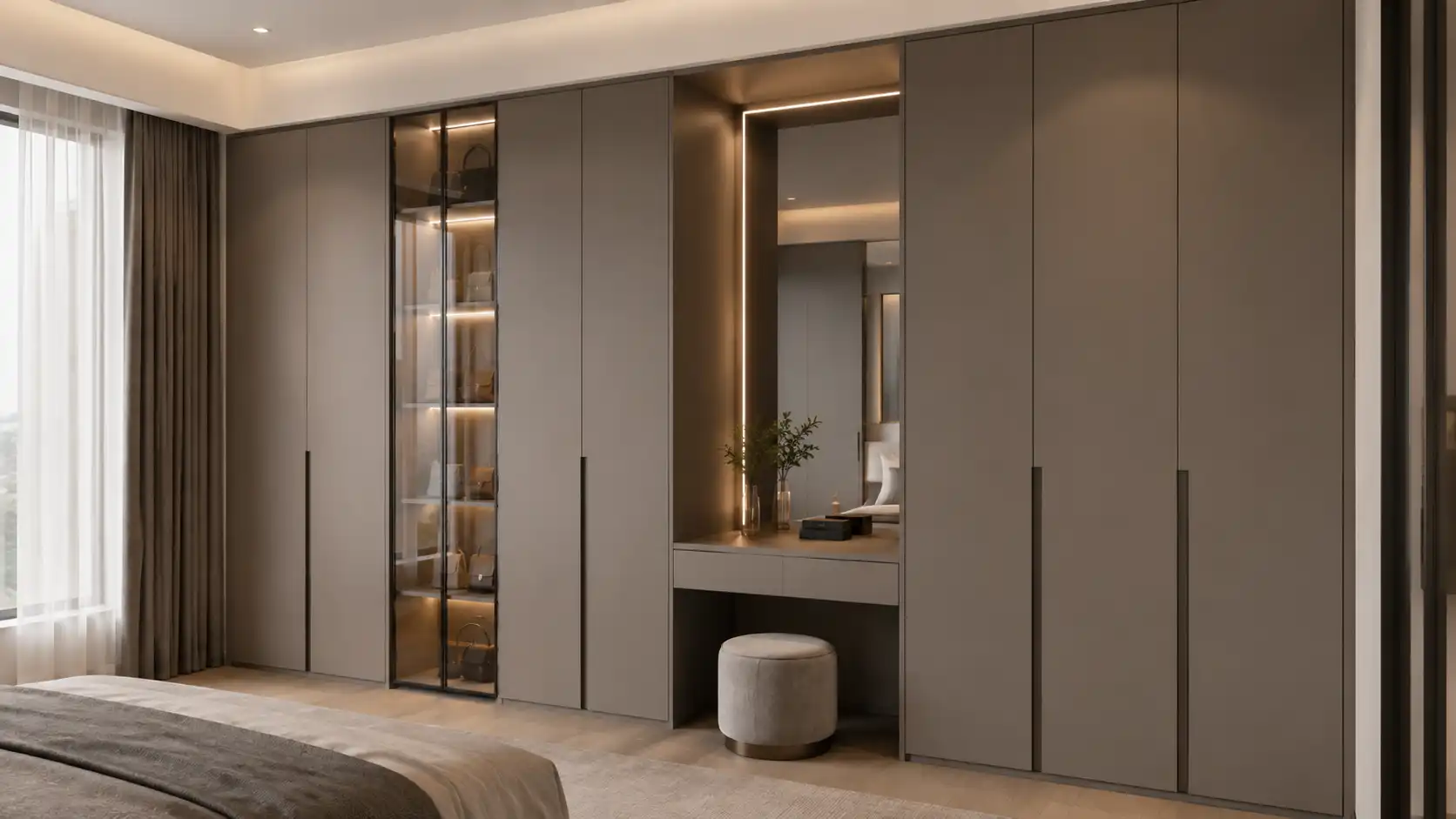
PET door panels are useful where a designer wants a calm, highly uniform contemporary surface. They are common in modern kitchen and wardrobe systems because the palette, sheens and surface appearance can be repeated more predictably than natural materials. PET does not remove the need for workmanship: mismatched edge bands, poor trimming or inconsistent panel orientation can undermine an otherwise premium design.
For a luxury result, review the door face under both daylight and warm interior lighting. Confirm that the edge-band color and sheen are compatible with the face, and include a rule for which way a directional surface must run on tall doors and drawer fronts.
Melamine: best for specification discipline
Melamine has a place in luxury projects when it is selected intentionally. It can support secondary wardrobes, utility rooms, interior carcass surfaces and multi-unit schemes where a controlled decor and robust cost structure matter. It is not automatically “budget”; a weak specification becomes budget-looking when the texture, panel thickness, edge banding and reveals are ignored.
Use a convincing decor and texture, specify the edge band thickness for exposed components, and coordinate the internal and external palette. In a full-house project, the same decor can create useful visual continuity in closet interiors, laundry rooms and storage areas while the public-facing rooms use veneer or lacquer.
Solid wood: best for crafted construction
Solid wood is strongest as a designed construction choice: framed doors, slatted elements, hand-finished details and selected furniture-like cabinet pieces. It is not a shortcut to luxury. The design needs to accommodate grain variation and normal seasonal movement. A floating-panel construction, appropriate clearances and the right finish system are more credible than forcing solid timber into wide, uninterrupted slabs where movement may be visible.
What Should Change by Room and Project Type?
| Project area | Strong finish direction | Detail to check | Avoid relying on |
|---|---|---|---|
| Open-plan kitchen | Lacquer, PET, veneer or a mixed package | Daylight reflection, appliance interfaces, handle wear | A finish sample viewed only under showroom lights |
| Sink base and wet-adjacent zones | A finish plus moisture-conscious carcass and sealed edges | Cut-outs, exposed edges, plumbing access | A beautiful door finish as proof of cabinet durability |
| Primary wardrobe | PET, lacquer, veneer or melamine, based on style | Long-door straightness, pull alignment, internal decor | Choosing purely from a fashion image |
| Bathroom vanity | Carefully specified lacquer, PET or veneer with protected edges | Basin cut-out, backsplash line, ventilation and splash exposure | Unsealed exposed panel edges |
| Library, wine cabinet or media wall | Veneer, lacquer or solid wood details | Grain continuity, lighting heat, glass/metal junctions | Random veneer layouts where symmetry matters |
| Multi-unit developer package | PET, melamine and selected lacquer/veneer upgrades | Approved master sample, finish coding, replacement protocol | Approving different samples room by room |
Manufacturer Insight: What Must Be Approved Beyond the Door Face?
From a custom cabinet manufacturer’s perspective, the visible finish is only one layer of the specification. Before release to production, KEJIA recommends confirming the cabinet carcass material for each zone, moisture exposure at sink and vanity locations, exposed-edge treatment, hinge and drawer-slide specification, handle drilling, lighting channels and panel junctions.
The drawing review should also show door gaps, filler panels, scribe pieces, appliance clearances and the installation sequence. For a veneer package, retain an approved control sample that states the grain direction and allowable variation. For lacquer or PET, retain the approved color and sheen sample. For multi-unit projects, label packs by room and elevation so installers do not exchange visually similar doors between apartments. Explore KEJIA’s kitchen and whole-house product range when building a coordinated cabinet package.
Six Costly Finish-Selection Mistakes–and How to Avoid Them
- Approving only a small chip. A chip cannot show full-door reflection, grain flow or edge appearance. Approve a door-size sample or mock-up.
- Ignoring the room’s light. Matt lacquer, glossy PET and veneer read differently in daylight, LED lighting and warm evening light. Review samples in the expected lighting range.
- Treating door finish and carcass as one decision. Specify both. Sink bases and bathroom units need moisture-conscious construction and sealed cut-outs.
- Leaving veneer matching undefined. State grain direction, matching approach and allowable variation on the approved schedule.
- Mixing brands or batches without a control sample. Retain signed samples and finish codes for additions, replacements and later phases.
- Forgetting installation tolerances. Include filler, scribe and service-access requirements in drawings; a premium finish cannot hide a poorly planned wall condition.
Luxury Cabinet Finish Specification Checklist
- Confirm the project room, use level and moisture exposure.
- Name the door finish, substrate, color/decor code and sheen.
- Approve a full door sample with edge treatment and handle detail.
- For veneer, record species, cut, grain direction, matching and permissible variation.
- Identify exposed edges, end panels, fillers, open shelves and interior decor.
- Define the carcass board, shelf thickness and sealing requirement for wet zones.
- Confirm hardware brand/series, opening type and pull-out loads where relevant.
- Review elevations for door gaps, appliance interfaces, lighting channels and stone returns.
- Keep a signed control sample and finish schedule for repeat orders.
- Agree packing labels, inspection points, replacement parts and touch-up expectations.
الأسئلة المتداولة
Is lacquer or veneer more luxurious for cabinets?
Neither is universally more luxurious. Lacquer is luxurious when the project needs refined color, clean planes and precise sheen. Veneer is luxurious when natural timber, grain direction and material variation are central to the design. The higher-value choice is the one specified, sampled and installed with enough detail to make its character intentional.
Are PET cabinet doors suitable for luxury kitchens?
Yes, especially for contemporary kitchens that rely on even color, smooth door faces and consistent repetition. PET should be evaluated as a complete door system: face sheen, edge-band match, substrate, door straightness and reflected-light appearance. It is particularly practical when the same palette runs across a kitchen and adjacent wardrobes.
Can melamine look premium in a residential project?
Yes. Premium results depend on the decor, texture, exposed-edge treatment, proportions and coordination with hardware and lighting. Melamine is especially useful for interiors, utility rooms and large repeatable packages. It should not be used as a vague substitution for another finish; the approved board and edge specification must be stated in the quotation and drawings.
What cabinet finish is best near a sink or bathroom basin?
Choose the visible finish for the design, then protect the cabinet construction. Specify sealed exposed edges, well-finished cut-outs, sensible plumbing access and a moisture-conscious carcass material. A door surface alone cannot protect an unsealed cut edge or a poorly ventilated vanity.
How do I control color consistency across multiple rooms?
Create one signed finish schedule with material codes, sheen and edge details, and retain physical control samples. Ask the manufacturer how it separates batches, labels rooms and handles replacement doors. For veneer, also define the acceptable range of natural variation rather than treating every panel as identical.
Should I specify a cabinet performance standard?
For projects that require formal performance verification, ask the supplier which test standard, report or internal quality process applies to the supplied cabinet system. In North America, buyers may use the ANSI/KCMA A161.1 performance standard as a reference point. Confirm scope and applicability rather than assuming a generic certificate covers your exact product.
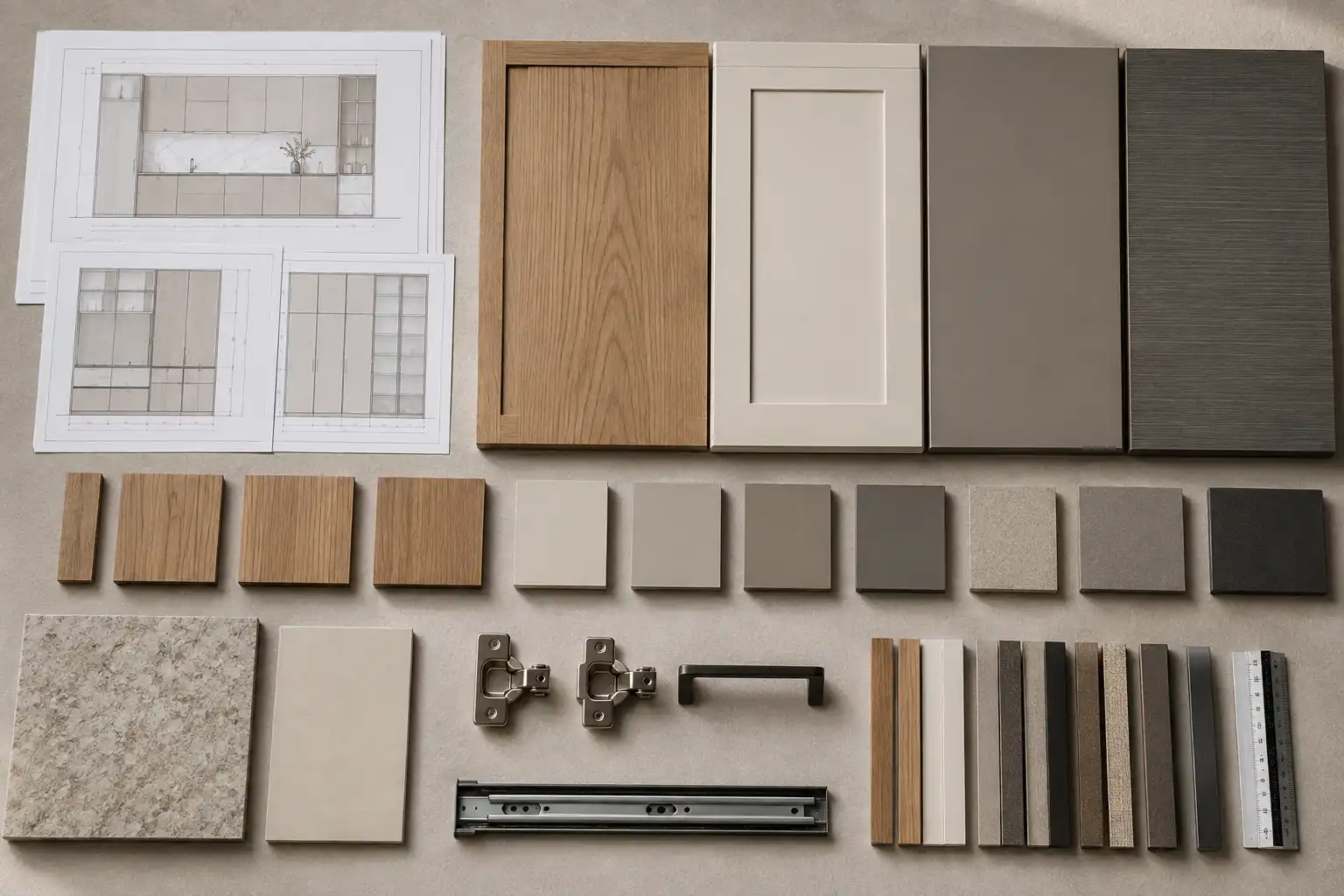
Turn a Finish Board into a Buildable Cabinet Package
Luxury cabinet finishes perform best when they are turned into a full specification: visible surface, substrate, edge, hardware, drawings, packing and approval controls. If you are developing a villa, apartment, showroom or multi-unit residential package, send KEJIA your drawings and finish references for a material recommendation, door sample plan and project quotation.