


When people hear “galley kitchen,” they often picture something narrow, dark, and outdated—a relic of 1970s apartment living. In reality, most of the best-performing small kitchens we’ve built over the decades follow this parallel structure. It remains the layout of choice for professional chefs and high-end restaurant lines because it prioritizes the one thing that matters most: the economy of movement.
If your kitchen space is limited, embracing the right galley kitchen layout ideas to maximize space isn’t a compromise; it’s a strategic advantage. It is often the most honest, efficient solution, especially when cabinets are custom-built to fit the specific footprint instead of forcing standard sizes into a tight area.
This guide moves beyond theory to provide actionable galley kitchen layout ideas to maximize space based on what actually works on-site—what saves inches, what prevents future bottlenecks, and where design decisions truly impact your daily workflow. Whether you are renovating a compact apartment or a historic townhouse, the following insights will help you transform a “corridor” into a high-performance culinary zone.
1. Defining the Modern Galley: More Than Just Two Walls
In practical terms, a galley kitchen (sometimes called a corridor kitchen) means everything happens along two parallel walls. There is no island to walk around and no unnecessary circulation space. Just cabinets, appliances, and a working aisle in between.
From a contractor’s point of view, the galley layout creates a clear, controlled work zone. By implementing specific galley kitchen layout ideas to maximize space, we can transform a “hallway” into a culinary powerhouse.
The Anatomy of the Workflow
In a galley, the “Kitchen Work Triangle” (the distance between the sink, fridge, and stove) is compressed. This is an advantage. In a massive U-shaped kitchen, you might walk 20 steps to get a bell pepper from the fridge to the cutting board. In a galley, it’s a simple pivot.
2. Why Galley Layouts Win the “Small Space” War
We often see homeowners try to “open up” a small kitchen by removing cabinets or forcing an island into the plan. Most of the time, that makes storage worse and workflow awkward. Here is why the galley remains the champion of efficiency:
Every Wall Earns Its Place
With two full cabinet runs, there’s very little dead space. Corner cabinets—the “blind corners” that haunt L-shaped kitchens—are eliminated. Every drawer is a straight pull; every shelf is accessible.
Total Budget Control
From a renovation standpoint, galley kitchens are often easier to price accurately. Fewer corners mean fewer expensive countertop miters and fewer complex cabinet joins. This allows you to reallocate your budget toward higher-quality materials, like quartz surfaces or custom-built internal organizers.
Predictable Engineering
Plumbing and electrical runs are typically concentrated along two straight lines. This reduces the labor costs associated with “chasing” pipes through floors or ceilings to reach a kitchen island.
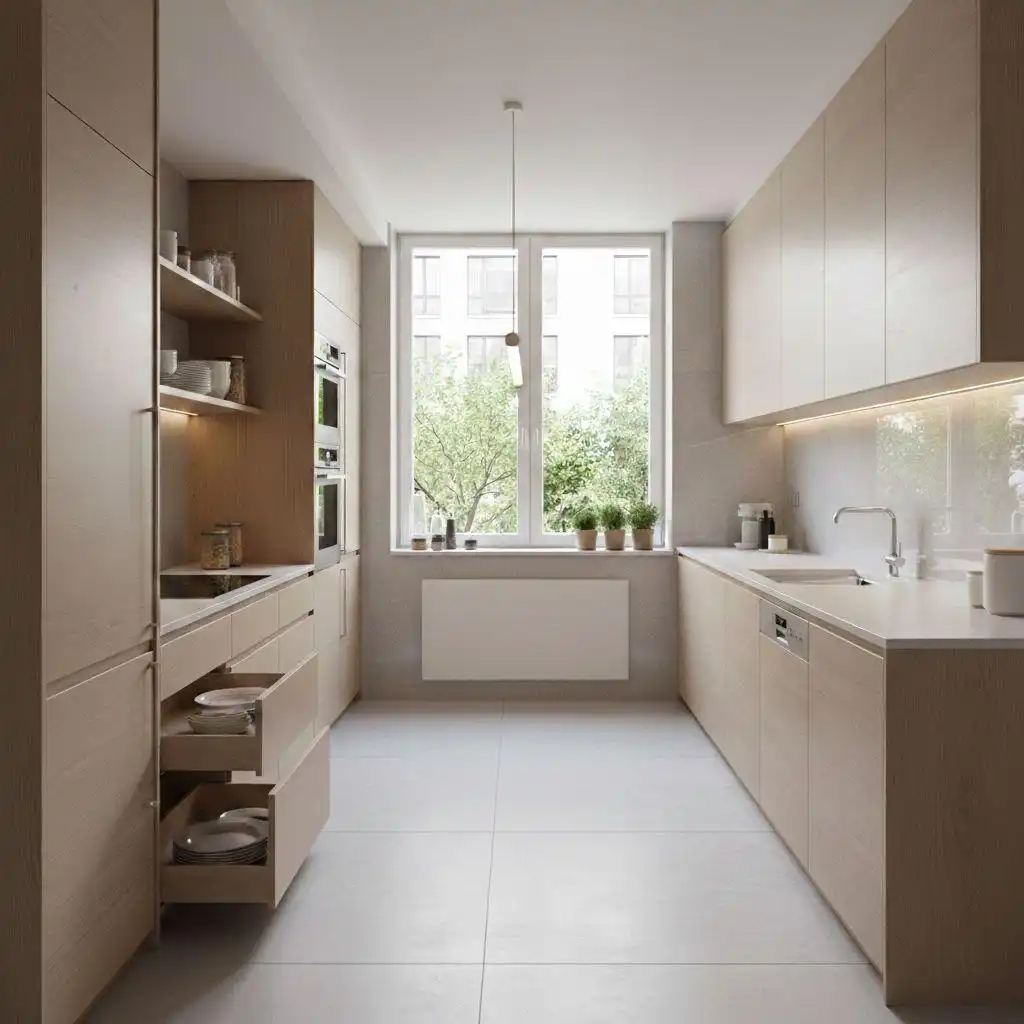
3. Top 15 Galley Kitchen Layout Ideas to Maximize Space
When the footprint is fixed, you must get creative with the vertical and internal dimensions. Here are the professional strategies we use to make a small galley feel like a grand kitchen.
1. The “Vanishing” Cabinet: Flat-Panel Minimalism
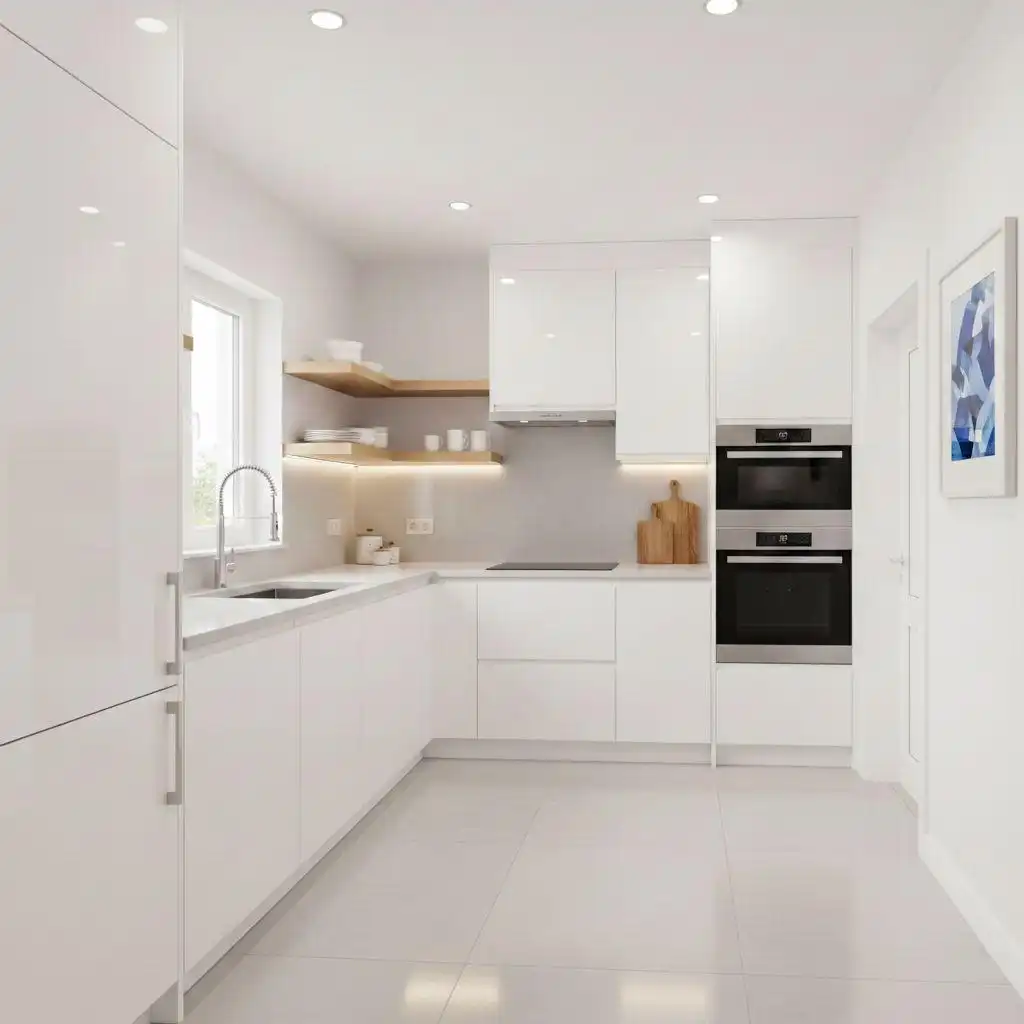
In a narrow space, visual noise adds up fast. Shaker-style doors or ornate moldings create shadows that make a room feel smaller. Flat-panel (slab) cabinet doors with integrated “J-pull” handles or push-to-open mechanisms create a seamless wall of color. This is one of the premier galley kitchen layout ideas to maximize space because it eliminates physical protrusions that catch on clothing in tight aisles.
2. The Power of “Full-Height” Verticality
The gap between the top of the cabinets and the ceiling is wasted air. In a galley, we always recommend “stacking” cabinets to the ceiling. Use the top-most tier for seasonal items (turkey platters, holiday linens). This draws the eye upward, creating the illusion of height.
3. Integrated and Slimline Appliances
Standard refrigerators are 36 inches deep, meaning they stick out past 24-inch cabinets like a sore thumb. For a galley, we recommend “counter-depth” or fully integrated appliances. A 24-inch wide “European-style” refrigerator can offer more usable vertical storage while keeping the aisle clear.
4. Strategic Lighting: The Three-Layer Rule
A single ceiling light will cast your own shadow over your prep work. To maximize space, you need:
-
Task Lighting: LED strips under every upper cabinet.
-
Ambient Lighting: Recessed “can” lights in the ceiling.
-
Accent Lighting: Kickboard (toe-kick) lighting that makes the cabinets look like they are floating, which expands the perceived floor area.
5. Two-Tone Color Theory
A common mistake is making a small kitchen entirely dark. However, an all-white kitchen can look “flat.” We suggest “Tuxedo” cabinets: dark navy or charcoal for the base cabinets to ground the room, and crisp white or light oak for the uppers. This “top-heavy” lightness prevents the feeling of being closed in.
6. Mirror Backsplashes
While it sounds like a 1980s relic, a smoked-glass or mirrored backsplash can literally double the visual depth of a galley kitchen. It reflects light and provides a “window” effect where there is none.
7. Over-the-Sink Workstations
When counter space is at a premium, use a “workstation sink” that comes with integrated cutting boards, colanders, and drying racks that slide over the basin.
8. The “One-Wall” Visual Break
If the space feels too claustrophobic, consider replacing one side’s upper cabinets with thick, floating wood shelves. This maintains the storage of the base cabinets but opens up “breathing room” at eye level.
9. Pocket Doors for Entryways
Traditional doors that swing into the kitchen take up nearly 9 square feet of floor space. Replacing these with pocket doors or “barn-style” sliders keeps the entrance clear.
10. Toe-Kick Drawers
Don’t waste the 4 inches of space under your cabinets. Toe-kick drawers are perfect for flat items like baking sheets, muffin tins, or step stools.
11. Custom Internal Organizers
Maximize space within the drawers. Pull-out spice racks that are only 4 inches wide can fit into gaps that would otherwise be filled with “filler” wood.
12. Hidden Appliances
Hide the microwave inside a “garage” or a lower cabinet. Keeping the countertops clear of small appliances is the fastest way to make a galley feel twice as large.
13. Glass Front Uppers
Using fluted or frosted glass on upper cabinet doors allows the eye to travel into the cabinet, adding depth without showing off messy stacks of plates.
14. Continuous Flooring
Run the flooring planks parallel to the kitchen walls. This “long-line” effect makes the room feel significantly longer than it actually is.
15. Matte Finishes for Durability
In narrow spaces, you will bump into cabinets. High-gloss finishes show every fingerprint and scratch. Matte or “Suede” finishes are much more forgiving and look premium under soft lighting.
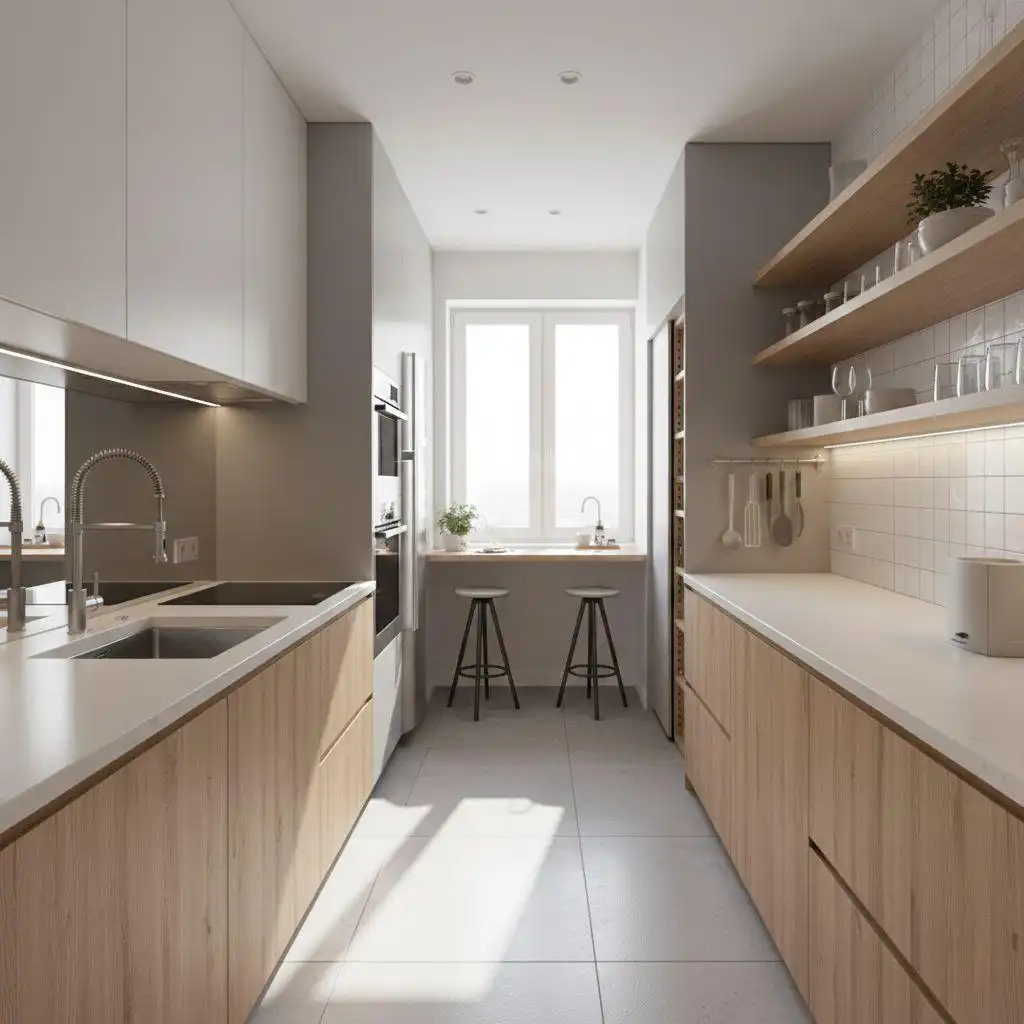
4. Technical Specifications: The “Golden Rules” of the Aisle
Design is nothing without ergonomics. If you ignore the math, even the most beautiful galley kitchen layout ideas to maximize space will fail in daily use.
The Aisle Width Debate
-
Minimum: 36 inches (91cm). This is the “one-cook” minimum. Any less and you cannot fully open an oven door while standing in front of it.
-
Ideal: 48 to 60 inches (1.2m to 1.5m). This allows two people to pass each other comfortably.
-
The Trap: If the aisle is wider than 6 feet, the efficiency of the galley is lost. You spend too much time walking back and forth.
Countertop Depth Customization
Standard counters are 24 inches deep. However, in a very tight galley, we often “shallow-out” one side to 18 or 21 inches. This provides a “perch” for coffee makers and small items while giving 3–6 extra inches back to the walking aisle.
5. Material Selection for High-Traffic Galleys
In a galley, you are always close to the surfaces. Material quality matters more here than in a sprawling open-plan kitchen.
كونترتوب
Avoid “busy” patterns. Granite with heavy veining can make a narrow room feel “cluttered.” Instead, opt for solid-color quartz or subtle marble-effect porcelain. These long, unbroken lines make the counters look endless.
Backsplashes
Large-format tiles (like 24×48 inch slabs) minimize grout lines. Fewer lines mean a cleaner visual field, which is essential when implementing galley kitchen layout ideas to maximize space.
6. Common Pitfalls: What to Avoid
Even with a great plan, these three mistakes can ruin a galley renovation:
-
The “Refrigerator Block”: Placing the fridge in the middle of a cabinet run. It breaks up the counter space and creates a visual “mountain” in the center of the room. Always place the fridge at the end of the run.
-
Poor Ventilation: In a small, narrow space, heat and smells linger. Never skimp on the CFM (Cubic Feet per Minute) rating of your range hood.
-
Standard Lighting: Relying only on a central fluorescent fixture. It’s depressing and impractical.
7. The Psychology of the Galley Kitchen
There is a reason why many of the world’s most expensive yachts and private jets use galley layouts. It feels “purposeful.” When you are in a galley, you are in “the zone.” There is a psychological comfort in having everything within arm’s reach. By using galley kitchen layout ideas to maximize space, you aren’t just building a room; you are building a tool for better living.
8. Custom vs. Off-the-Shelf: Why it Matters Here
In a large kitchen, a 3-inch “filler” piece of wood to make a cabinet fit isn’t a big deal. In a small galley, that 3 inches could have been a pull-out towel rack or a knife drawer.
Custom cabinetry is the secret weapon of the galley. It allows us to:
-
Build cabinets to the exact millimeter of your wall.
-
Adjust depths to accommodate non-standard pipes or pillars.
-
Integrate appliance panels so the dishwasher disappears into the cabinetry.
9. Conclusion: Embracing the Corridor
A galley kitchen layout isn’t about trends or style labels. It’s about making limited space work properly. When cabinets are designed around how you actually cook—and built to fit the space instead of forcing standard sizes into it—the galley layout becomes one of the most reliable kitchen solutions in existence.
If you’re working with a small or narrow kitchen and want it to function better, remember: Layout comes first. Cabinets come second. Style comes third. That order matters more than most people realize.
Ready to Design Your Custom Galley?
If you’re planning a renovation and want to see how these galley kitchen layout ideas to maximize space can work for your specific home, we are here to help. Our team specializes in precision manufacturing for tight spaces.
Contact us today for a layout consultation. Let’s turn your narrow kitchen into your favorite room in the house.