





A mobile-friendly guide for controlling cabinet RFQs, supplier selection, approvals, QC, packing, and site handover.
Who should use this cabinet procurement guide for contractors?
- General contractors coordinating cabinetry with site measurement, appliances, countertops, MEP, and installation.
- Project managers and developers purchasing repeatable cabinet packages for apartments, villas, hotels, or mixed-use projects.
- Procurement teams comparing custom cabinet manufacturers, export packing, lead times, and technical support.
- Designers and B2B buyers who need an installation-ready package rather than a price based on loose assumptions.
Key takeaways
- Compare quotations only after the cabinet scope, construction, hardware, packing, and delivery terms are aligned.
- An initial budget quote is not a production release; shop drawings and visible-finish samples must be approved later.
- The lowest price can exclude panels, accessories, packing, labels, QC, spares, or freight coordination.
- Factory QC is useful only when the contractor supplies the approved drawings, cabinet codes, material schedule, and acceptance criteria.
- Room-coded labels and hardware packs protect installation productivity as much as protective cartons do.
What should contractors procure in a custom cabinet package?
| Procurement area | What to confirm | Control point for contractors |
|---|---|---|
| Product scope | Cabinets, doors, panels, fillers, plinths, countertops, accessories, appliances, installation exclusions | Use a room-and-cabinet schedule so no scope is hidden in a lump sum |
| Technical basis | Drawings, dimensions, site-measurement status, material and hardware schedule, appliance data | Identify each provisional item and request the factory’s written assumption |
| Commercial basis | Currency, quote validity, payment stages, price-increase conditions, trade term, taxes and freight scope | Compare totals only after matching inclusions and exclusions line by line |
| Approvals | Shop drawings, samples, mock-ups, change control, production-release owner | Do not allow buying or machining before a controlled release |
| Quality and delivery | Inspection stages, defect closure, packing, labels, spares, dispatch documents, installation support | Make project acceptance visible in the purchase order and inspection plan |
1. How should contractors prepare an RFQ for cabinet procurement?
Send a package that allows a custom cabinet manufacturer to price the real project: dimensioned plans and elevations, quantities, cabinet scope, appliance and service data, target materials and finish level, hardware direction, destination country, trade term, delivery location, and required date. State whether dimensions are concept-stage, preliminary site measurements, or final construction dimensions. Mark every unresolved issue as an assumption request rather than leaving it unspoken.
The RFQ should also state the project type and procurement stage. A design-budget quote can use controlled allowances. A tender quote normally needs a detailed scope and quantity schedule. A production quote requires approved shop drawings, finish samples, exact appliance data, and a release owner. For a detailed input list, link to what to prepare before requesting a cabinet quotation.
2. How can contractors compare cabinet manufacturers fairly?

Compare technical and delivery capability before comparing price. Ask each manufacturer to quote the same material, thickness, finish, edge treatment, hardware, packing, labels, QC, drawing service, spare parts, and commercial terms. If a line is missing, determine whether it is excluded, included elsewhere, or substituted. A responsible manufacturer should state its assumptions rather than conceal them inside a low total.
| Comparison area | Questions to ask | Evidence to request |
|---|---|---|
| Project experience | Has the factory produced comparable apartments, villas, hotels, or commercial cabinet packages? | Relevant project process, product range, sample or documented capability鈥攏ot unverified claims |
| Technical review | Who checks drawings, appliances, service interfaces, and construction risks before production? | Drawing-review workflow, clarification log, shop-drawing sample |
| Materials and hardware | What exact substrate, thickness, finish, edge treatment, and hardware model are proposed? | Component schedule, physical sample process, technical data where relevant |
| Quality control | When are first pieces, in-process work, final products, and packing inspected? | QC checklist, defect-closure process, inspection photo/report example |
| Packing and logistics | How are cartons protected, labelled, grouped by room, and supplied with hardware and spares? | Packing plan, label example, packing-list structure, loading method |
| After-sales support | How are missing, damaged, or mismatched parts identified and resolved? | Cabinet-code system, replacement-parts process, response responsibility |
3. What should be approved before a purchase order becomes a production release?
Treat the purchase order as a commercial document and the production release as a technical decision. Before the factory starts machining, approve the latest shop drawings, cabinet code schedule, material and finish schedule, hardware list, appliance and service data, visible-finish control sample, quantity schedule, packing requirements, and agreed quality criteria. Name the person authorised to approve changes.

A change to door finish, appliance model, countertop thickness, room quantity, or site dimension can affect price and lead time. Record it in a revised drawing or change order. The cabinet project timeline provides a useful sequence from quotation through drawings, samples, production, QC, packing, freight, and installation.
4. How should contractors control cabinet materials and samples?
Specify by component and project exposure. A sink base, vanity, long shelf, painted door, veneer panel, and dry pantry carcass may need different solutions. Confirm the proposed board type, thickness, visible finish, edge treatment, hardware, and required sample. Do not rely on a general statement such as 鈥渨aterproof cabinet鈥?or 鈥渟ame as picture.鈥?Moisture performance also depends on sealed cut edges, plumbing details, ventilation, and installation.
For visible doors and panels, approve a physical control sample that identifies the project, component, finish code, sheen, edge detail, and permitted variation. The factory should check early production against it under consistent lighting. For substrate selection by performance rather than marketing label, link to the cabinet materials guide.
5. Which quality-control checkpoints should be included in procurement?
Write the inspection plan into the purchase order or controlled project documents. It should define when inspections happen, who receives the evidence, which cabinet codes and components are sampled, what defects require correction, and how reinspection is closed. The aim is not to create paperwork; it is to find an error while it can still be corrected before packing and freight.
| Stage | Check | Procurement decision |
|---|---|---|
| Pre-production | Drawing revision, cabinet codes, materials, samples, hardware, appliances, quantities | Release only when all production assumptions are visible and approved |
| First piece | Construction, drilling, dimensions, finish, edge treatment, function | Correct the method before repeated units are made |
| In-process | Batch consistency, hardware, panel orientation, cutouts, visible finish | Stop repeat errors from spreading across rooms or units |
| Final inspection | Dimensions, door gaps, drawer operation, accessories, appearance, cabinet codes | Close all defects with an identified owner and recheck record |
| Packing and dispatch | Face protection, corner guards, carton label, hardware pack, spares, packing list | Release cargo only when the package can be sorted and installed on site |
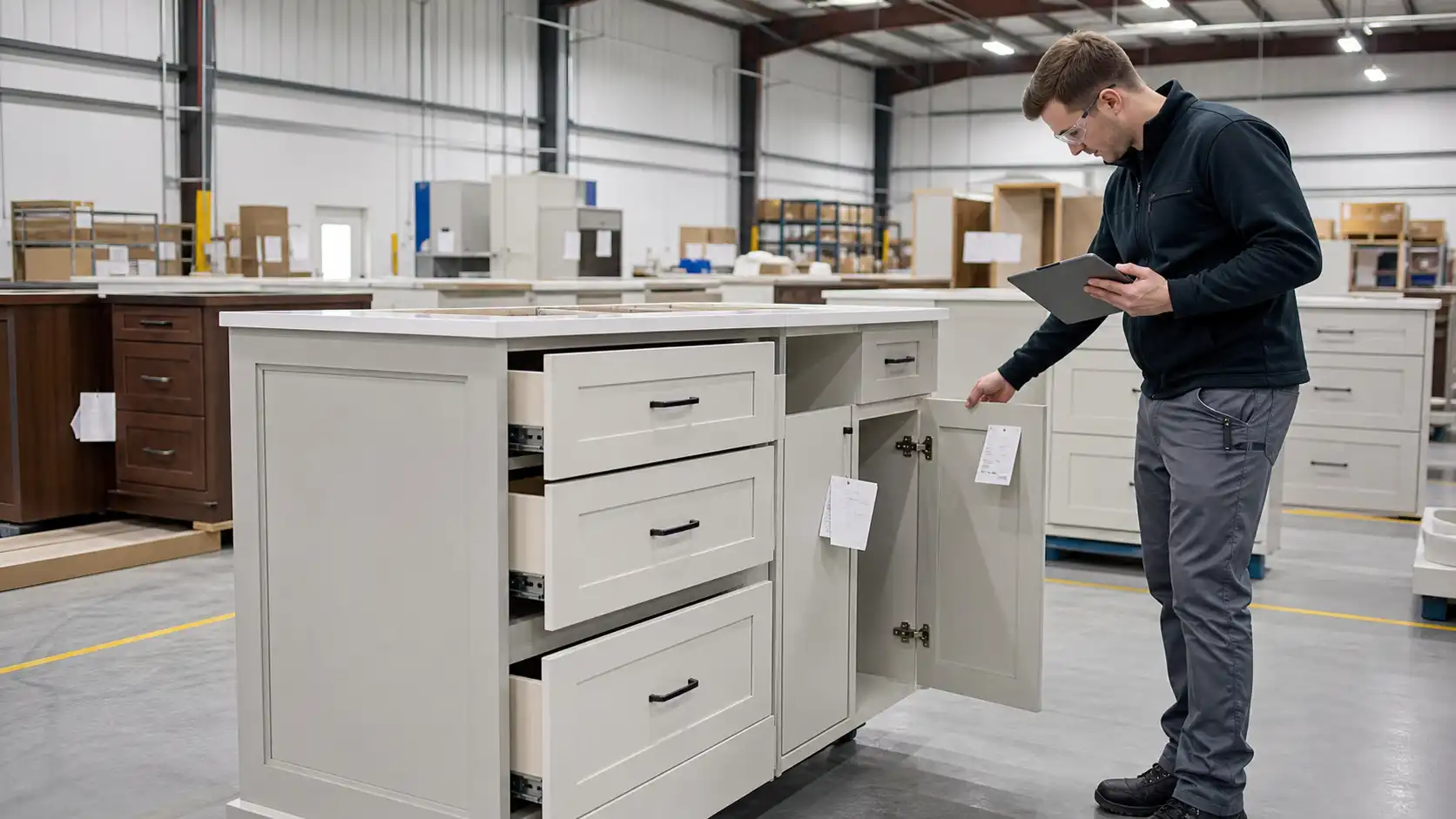
For a detailed inspection checklist, link to cabinet quality control checklist for contractors. Give any third-party inspector the approved drawings, control sample, cabinet schedule, packing requirement, and acceptance criteria; otherwise it can report defects without knowing whether the product meets the project decision.
6. What packing and shipping terms prevent installation delays?

Confirm the delivery format: assembled, flat-packed, or mixed. Then specify carton limits, face and corner protection, glass protection, hardware-pack method, room and cabinet coding, spare-parts allocation, packing-list structure, and loading sequence. Contractors should be able to receive cartons by room or unit without opening every package to find a filler, hinge, or handle.
Clarify the trade term and boundaries for export packing, inland transport, sea or air freight, insurance, destination handling, taxes, unloading, and site delivery. When solid-wood packaging applies, verify destination and shipment requirements with the freight partner; the IPPC ISPM standards are the international framework, but they do not replace destination-specific confirmation.
Common cabinet procurement mistakes that create cost or site risk
| Mistake | Why it creates risk | Better control |
|---|---|---|
| Selecting only by lowest total price | Scope, material, hardware, packing, and service omissions remain hidden | Compare a shared technical and commercial schedule line by line |
| Releasing production from a quote or rendering | Factory must guess dimensions, codes, and interfaces | Approve controlled shop drawings and samples before machining |
| Accepting an unidentified finish sample | There is no reliable reference for batch inspection | Label and retain a control sample for the project and component |
| Checking only finished appearance | Drilling, cabinet codes, hardware, cutouts, and packing may still fail | Inspect construction, function, labels, and packing against the schedule |
| Treating packing as a logistics afterthought | Damage, missing parts, and room-sorting delays appear at site | Make packing, labels, hardware packs, and spares part of the purchase order |
| Allowing informal changes after approval | Price, lead-time, and responsibility disputes follow | Use a dated drawing revision or change order for every production-impacting change |
Cabinet procurement checklist for contractors
- Create a room-and-cabinet schedule with quantities and scope inclusions or exclusions.
- Issue the latest drawings, site-measurement status, appliance/service data, and requested delivery date.
- State material, finish, hardware, countertop, accessory, packing, freight, and installation requirements by component.
- Ask every factory to list assumptions, substitutions, exclusions, payment terms, quote validity, and trade term.
- Compare suppliers against the same technical and commercial schedule before comparing totals.
- Approve shop drawings, cabinet codes, physical control samples, and a named production release.
- Agree first-piece, in-process, final, and pre-dispatch inspection checkpoints with defect closure and recheck.
- Require room-coded cartons, separate hardware packs, protective packing, a packing list, and required spares.
- Record every post-approval change in a revised drawing or change order with price and schedule impact.
Frequently asked questions
What should contractors ask a cabinet manufacturer before placing an order?
Ask about comparable project capability, technical drawing review, proposed materials and hardware, sample approval, quality-control checkpoints, packing and labels, production lead time, trade terms, and replacement-parts process. Request evidence that matches the project scope. The most useful answer explains how the factory will control the exact package, not only its general product range.
How do I compare cabinet quotations fairly?
Convert each quote into the same component schedule. Match rooms, quantities, substrate, thickness, finish, edge treatment, hardware, countertops, accessories, drawings, samples, QC, packing, spares, and delivery terms. Ask the factory to state every omission or substitution. Only then compare price, lead-time exposure, and after-sales support.
Is a purchase order enough to start cabinet production?
No. It confirms the commercial purchase, but production needs a controlled technical release. Approve the latest shop drawings, cabinet codes, material and hardware schedule, appliance data, samples, quantities, packing requirements, and quality criteria. If any item remains provisional, record it as an open hold point rather than letting the factory assume a final choice.
Should contractors inspect cabinets at the factory?
For project packages, factory inspection is a strong risk control when it uses a clear reference package. Inspect first pieces, key repeated units, visible finishes, dimensions, hardware function, cabinet codes, packing, and spares against approved drawings and samples. A third-party inspector can help, but it still needs the contractor鈥檚 acceptance criteria and defect-closure process.
What should be on a cabinet packing list?
The list should identify each carton or package, project, room or unit, cabinet code, contents, quantity, package type, and related hardware or accessory packs. It should match the drawing and room schedule. This lets the site team receive and sort the package without opening every carton or guessing which components belong together.
How should a contractor manage a late design change?
Issue a dated drawing revision or change order that identifies the affected cabinet codes, materials, hardware, quantities, price effect, and lead-time effect. Confirm whether the factory has purchased material or started machining. Do not rely on a chat message or verbal instruction, because it cannot reliably control the production reference or responsibility.
Procure the complete cabinet system, not only the cabinet price
Strong cabinet procurement protects the contractor site programme by making scope, approvals, inspection, packing, and change control visible before a factory begins production. A clear procurement package also gives the manufacturer a fair basis to price, build, inspect, and deliver the same result the project team approved.