


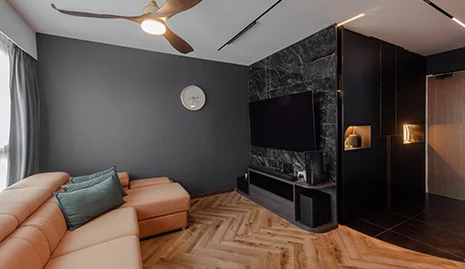

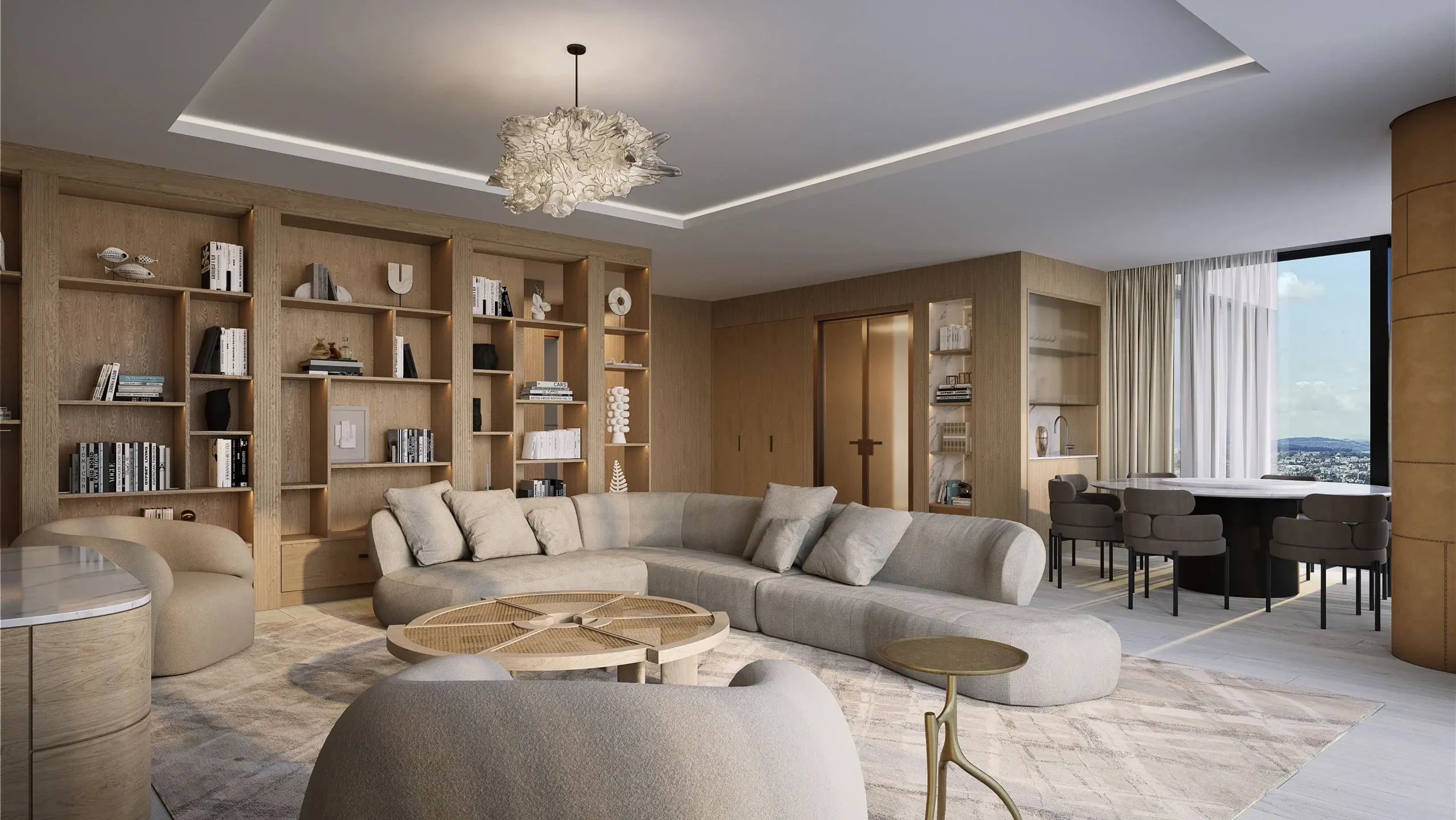
The best cabinet materials for projects depend on the building type and the component being specified. Apartment projects usually need repeatable modules, durable finishes, and practical replacement parts. Villas allow more finish variety, but wet zones, large spans, and mixed materials need closer coordination. Hotels need surfaces and hardware that tolerate frequent cleaning and repeated use, while still allowing room-by-room batch consistency. For designers, contractors, and B2B buyers, choose each component by water exposure, expected load, finish requirement, maintenance routine, and replacement plan. A project-ready specification identifies the substrate, thickness, finish, edge treatment, hardware, and approved sample for every major component.
Who should use this cabinet material guide?
- Interior designers preparing material schedules for residential or hospitality projects.
- Developers and procurement teams standardizing cabinets across multiple units.
- Contractors who need fewer installation, moisture, and replacement issues.
- Dealers and B2B buyers comparing custom cabinet quotations from different factories.
Key takeaways
- Specify materials by component. The best door material may be unsuitable for a sink base or long shelf.
- Moisture protection depends on sealed edges, plumbing cutouts, ventilation, and installation quality as much as the board itself.
- Apartment projects benefit from controlled material codes and replacement parts; villas need finish matching across a wider furniture package.
- Hotel projects need extra attention to cleaning exposure, hardware cycles, room labels, and batch color control.
- Approve physical samples and production drawings before the factory buys materials for the full batch.
How to Choose the Best Cabinet Materials for Projects
Swipe horizontally to view the full table on mobile.
| Project type | Practical starting specification | Best for | Watch closely |
|---|---|---|---|
| Apartment | Melamine-faced particle board or plywood carcasses; MDF or melamine doors by finish | Repeatable kitchens, wardrobes, TV units, and cost-controlled batches | Sink bases, edge damage, finish continuity, replacement codes |
| Villa | Plywood or moisture-resistant boards by component; MDF for painted or profiled fronts; veneer where specified | Bespoke kitchens, walk-in wardrobes, wall panels, and mixed finishes | Long spans, stone interfaces, color matching, site changes |
| Hotel | Project-grade particle board, plywood, or moisture-resistant boards selected by zone; hard-wearing door surfaces | Guestroom wardrobes, vanities, minibars, and public-area storage | Cleaning chemicals, repeated use, fire or local requirements, and room-by-room labels |
This table is a starting point, not a substitute for a project specification. The same hotel may need different construction for a dry guestroom wardrobe, a bathroom vanity, and a housekeeping cabinet.
How should you choose a cabinet substrate?
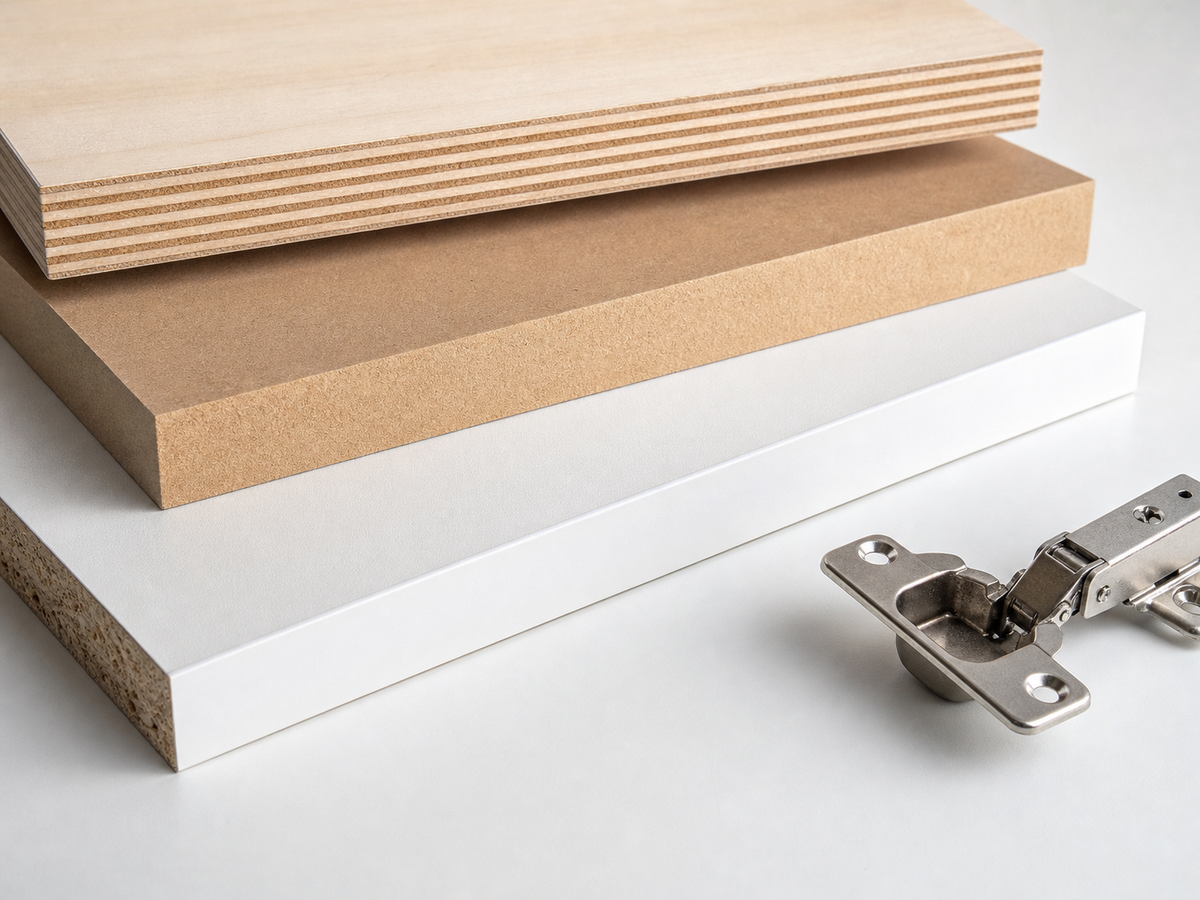
Plywood for wet zones, heavy loads, and repeated assembly
Plywood is a sensible starting point for sink-base carcasses, bathroom vanity boxes, utility cabinets, and shelves that carry substantial loads. Its layered construction generally provides better screw holding than standard particle board. Specify panel thickness, core quality, face finish, and exposed-edge treatment. Plywood still needs protection at plumbing penetrations, cutouts, and bottom edges. It does not make a leaking cabinet waterproof.
For apartment kitchens, plywood can be reserved for the sink run and other higher-risk components instead of upgrading every hidden panel. In villas, it is useful where wide shelves, premium hardware, or frequent adjustment is expected. In hotels, use it where service access and moisture risk justify the added cost.
MDF for painted, routed, and detailed cabinet fronts
MDF has a smooth, uniform face that suits painted, lacquered, routed, shaker-style, and fluted door panels. It is normally selected for the front, not automatically for the full carcass. The specification should state the MDF grade, door thickness, edge preparation, paint system, sheen, and sample approval method.
Keep MDF away from repeated water exposure unless the project has an appropriate moisture-resistant grade and complete edge protection. This matters most around vanity basins, laundry rooms, floor-level leaks, and cleaning practices in hospitality projects.
Particle board for controlled dry interiors and melamine systems
Melamine-faced particle board can be an efficient option for dry wardrobe interiors, apartment storage, hotel guestroom cabinets, and other large batches. It performs well when density, panel thickness, edge banding, connectors, and hardware match the load. A quotation that only says “particle board” does not provide enough information for comparison.
Request a component list with board thickness, surface finish, edge-banding specification, and fixing method. Check high-stress points such as wardrobe hanging rails, long shelves, drawer-slide screws, and tall-unit connectors.
Which door finish works for apartments, villas, and hotels?
Swipe horizontally to view the full table on mobile.
| Finish | Suitable projects | المزايا | Limits to specify |
|---|---|---|---|
| Melamine | Apartments, guestroom wardrobes, dry utility areas | Consistent colour, practical maintenance, efficient batch production | Surface, edge-band colour, texture direction, repair and replacement code |
| Painted or lacquered MDF | Villas, selected apartment upgrades, feature furniture | Smooth appearance and flexible colour matching | Sheen, approved sample, edge quality, and transport protection |
| PET or similar polymer-faced panel | Apartments, villas, selected hotel rooms | Clean contemporary surface and factory consistency | Substrate, edge treatment, colour batch, and heat exposure near appliances |
| Wood veneer | Villas and higher-spec public areas | Natural variation and a tailored visual result | Veneer cut, grain direction, stain sample, balance panels, and repair policy |
| HPL or other durable decorative surface | Hotels, service areas, high-use public furniture | Suitable for frequent contact and cleaning when correctly specified | Substrate, edge construction, joint detail, and cleaning compatibility |
Choose the finish after confirming operating conditions. A dark matte door may look right in a villa sample room but show fingerprints in a high-turnover hotel. A veneer control sample should define acceptable tone and grain variation rather than promise identical panels.
What changes from one project type to another?
Apartment projects: keep the schedule repeatable
Apartments often succeed with a disciplined set of carcass, door, handle, and countertop options. The objective is to make the approved specification easy to manufacture, inspect, pack, install, and replace. Use a cabinet code for each standard unit. The code should link to a drawing, material schedule, finish sample, hardware list, and carton label. Confirm which panels are interchangeable and which fillers or appliance openings are site-specific.
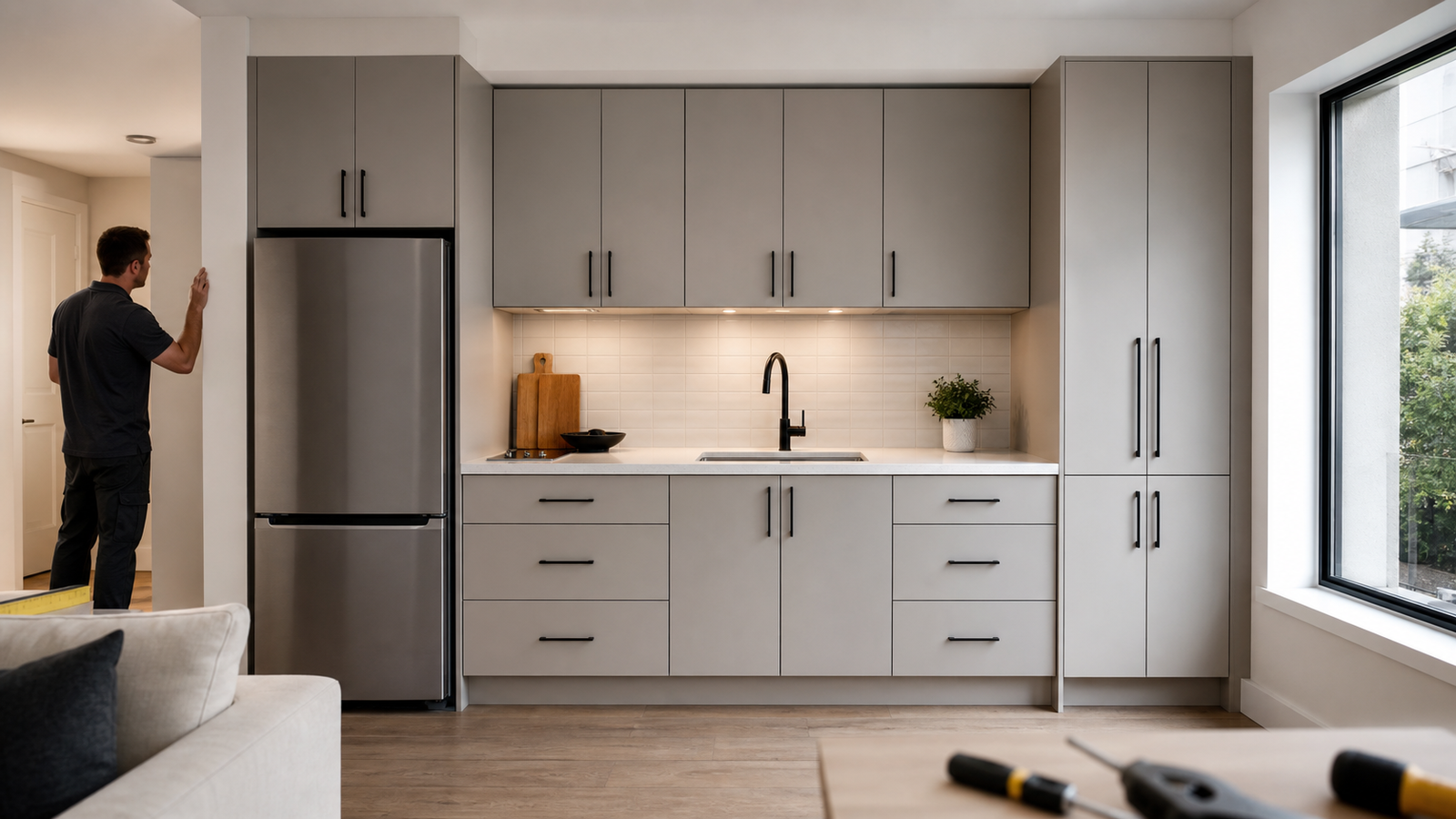
Villa projects: control interfaces and visual continuity
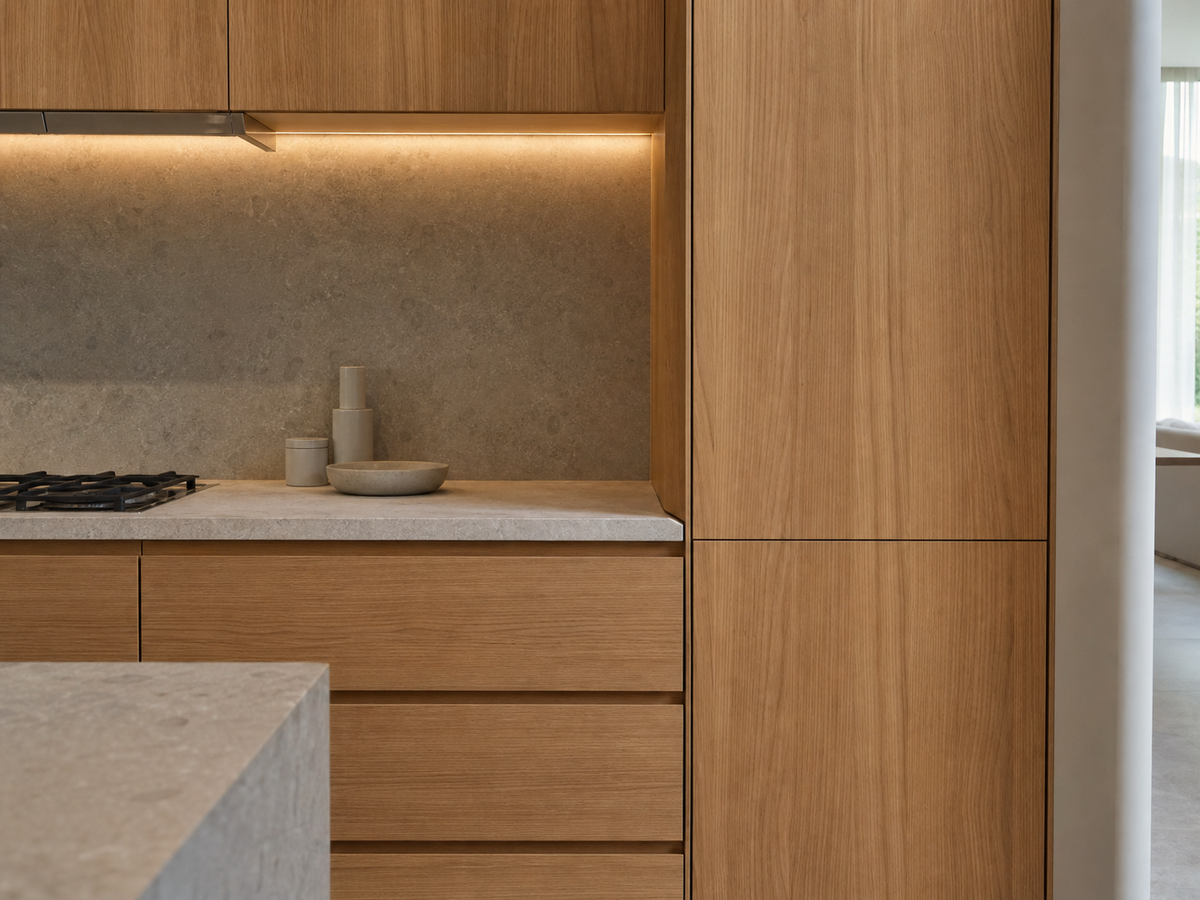
Villas commonly combine kitchen cabinets, wardrobes, bathroom vanities, wall panels, wine cabinets, and freestanding furniture. Material choices are often controlled by what meets at an edge: stone, metal, glass, wall cladding, flooring, or a different cabinet finish. Review large doors, long shelves, concealed lighting, stone overhangs, and grain direction before production. Approve veneer or painted finishes beside the actual stone and wall samples where possible.
Hotel projects: plan for use, cleaning, and room-level replacement
Hotel furniture follows a different wear pattern. Doors and drawers are opened by many users, housekeeping can expose surfaces to moisture and chemicals, and a damaged component may need replacement without remaking an entire room. Select materials by zone: guestroom wardrobe, minibar, entry cabinet, vanity, housekeeping store, and public-area joinery do not carry the same risk. Maintain a control sample for each finish and a room-by-room packing list.
Factory checks that affect cabinet material performance
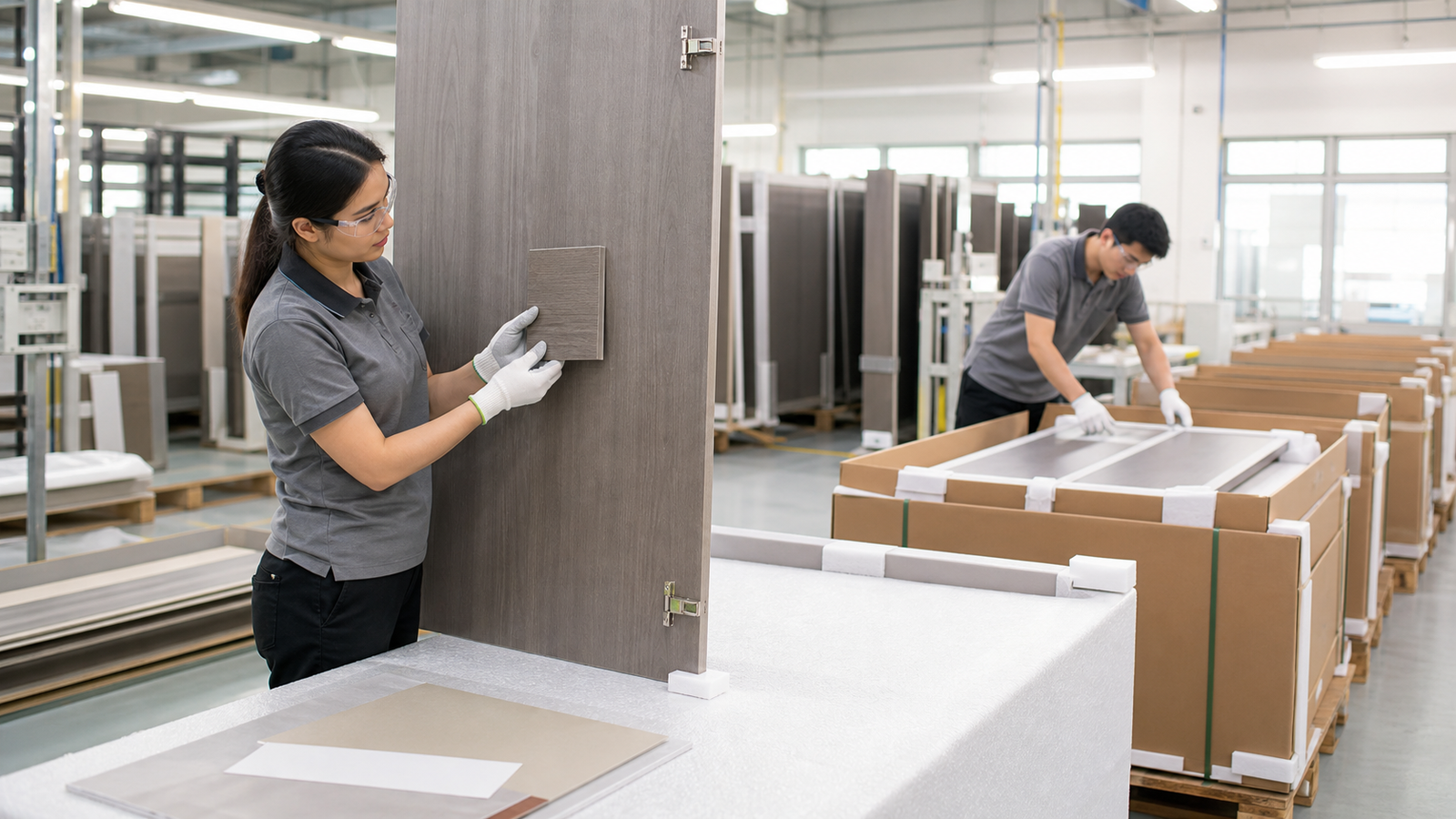
At KEJIA, a useful pre-production review covers more than the board name. Confirm the following before release:
- Substrate, thickness, and finish for each carcass, door, shelf, back panel, filler, and plinth.
- Edge-banding thickness and treatment at visible edges, cutouts, and wet-zone components.
- Hinge, drawer-slide, hanging-rail, and connector fixing points.
- Door gaps, panel alignment, grain direction, and color control samples.
- Plumbing, ventilation, lighting, and appliance cutouts before machining.
- Packing protection for corners, finished faces, glass, hardware, and replacement parts.
If a destination market requires a composite-wood emission rule, submit the destination and required documentation with the RFQ. The US Environmental Protection Agency’s composite wood resources can be used as a reference, but project-market requirements must be verified before production.
Common cabinet material mistakes
Swipe horizontally to view the full table on mobile.
| Mistake | Why it creates a problem | Better approach |
|---|---|---|
| Using one substrate for every cabinet part | Doors, carcasses, shelves, and wet-zone units have different needs | Specify by component and exposure |
| Calling plywood waterproof | Water can enter through cut edges, joints, and plumbing openings | Seal vulnerable edges and control leaks |
| Choosing a painted finish without a signed sample | Colour and sheen disputes appear during batch production | Approve a labelled control sample before material purchase |
| Comparing quotations by board name alone | Thickness, density, finish, hardware, and edge banding may differ | Compare a line-by-line technical schedule |
| Omitting hotel room or apartment labels | Similar parts are mixed during delivery and installation | Use cabinet codes and room-level carton labels |
| Ignoring cleaning and maintenance | A suitable residential finish may fail in a hospitality routine | Confirm cleaning exposure and surface recommendation |
Cabinet material checklist before requesting a quotation
- Identify every cabinet component and its intended room or zone.
- State substrate, thickness, finish, color code, and edge-band detail.
- Mark sinks, plumbing routes, appliances, ventilation, and other moisture or heat risks.
- Provide elevations for grain direction, panel joints, fillers, and large door fronts.
- Confirm hardware model, load requirement, opening angle, and soft-close preference.
- Send stone, flooring, metal, and wall-panel samples when finish matching matters.
- Define required emission, timber, fire, or project documentation for the destination market.
- Approve samples, shop drawings, packing labels, QC standard, and replacement-part process.
Frequently asked questions
What cabinet material is best for apartment projects?
There is no single best board for every apartment component. Melamine-faced particle board is often practical for dry wardrobes and storage, MDF suits painted doors, and plywood or another moisture-resistant board is a stronger starting point for sink bases and higher-risk zones. The value comes from a repeatable, component-level schedule with clear replacement codes.
Should villas use plywood for all cabinets?
Not necessarily. Plywood can be useful for wet zones, heavy-load shelves, and components needing stronger fixing. MDF may be preferable for painted or profiled fronts, while particle board can work in dry wardrobe interiors. The correct villa specification balances performance, finish quality, and the way materials meet stone, metal, and wall panels.
Which cabinet materials are suitable for hotel rooms?
Choose by zone. Dry guestroom wardrobes and entry units may use project-grade melamine systems. Vanities need more careful moisture protection. High-touch or frequently cleaned surfaces need a finish that matches the hotel’s maintenance routine. Confirm hardware cycles, room labels, spare parts, and the project’s local compliance requirements before issuing the final order.
Is MDF suitable for bathroom vanity doors?
MDF can be used for a painted vanity front when an appropriate grade, paint system, and edge treatment are specified. It should not be treated as an unprotected wet-area material. The basin, plumbing cutouts, splash zones, floor condition, and ventilation all affect the decision. Review the whole vanity construction, not the door alone.
What should a hotel buyer ask a cabinet factory to provide?
Ask for a component-level material schedule, approved finish samples, shop drawings, hardware list, room-by-room packing plan, QC checkpoints, carton labels, spare parts, and a replacement process. The buyer should also provide the destination market, project standards, cleaning routine, and any required documentation before production is scheduled.
How can a developer compare material quotations fairly?
Put every quotation into one comparison sheet. Match components, panel thickness, substrate, finish, edge banding, hardware, countertop scope, packing, labels, QC, and replacement parts. A lower price may omit details that affect installation or after-sales. Compare the complete cabinet package, then clarify substitutions in writing.
Specify the system, not only the board
Good cabinet material selection comes from a controlled system: the right substrate for each component, an approved finish, protected edges, compatible hardware, clear drawings, and a replacement path. Apartment projects need repeatability. Villas need coordinated details. Hotels need durable, traceable room-level packages.