
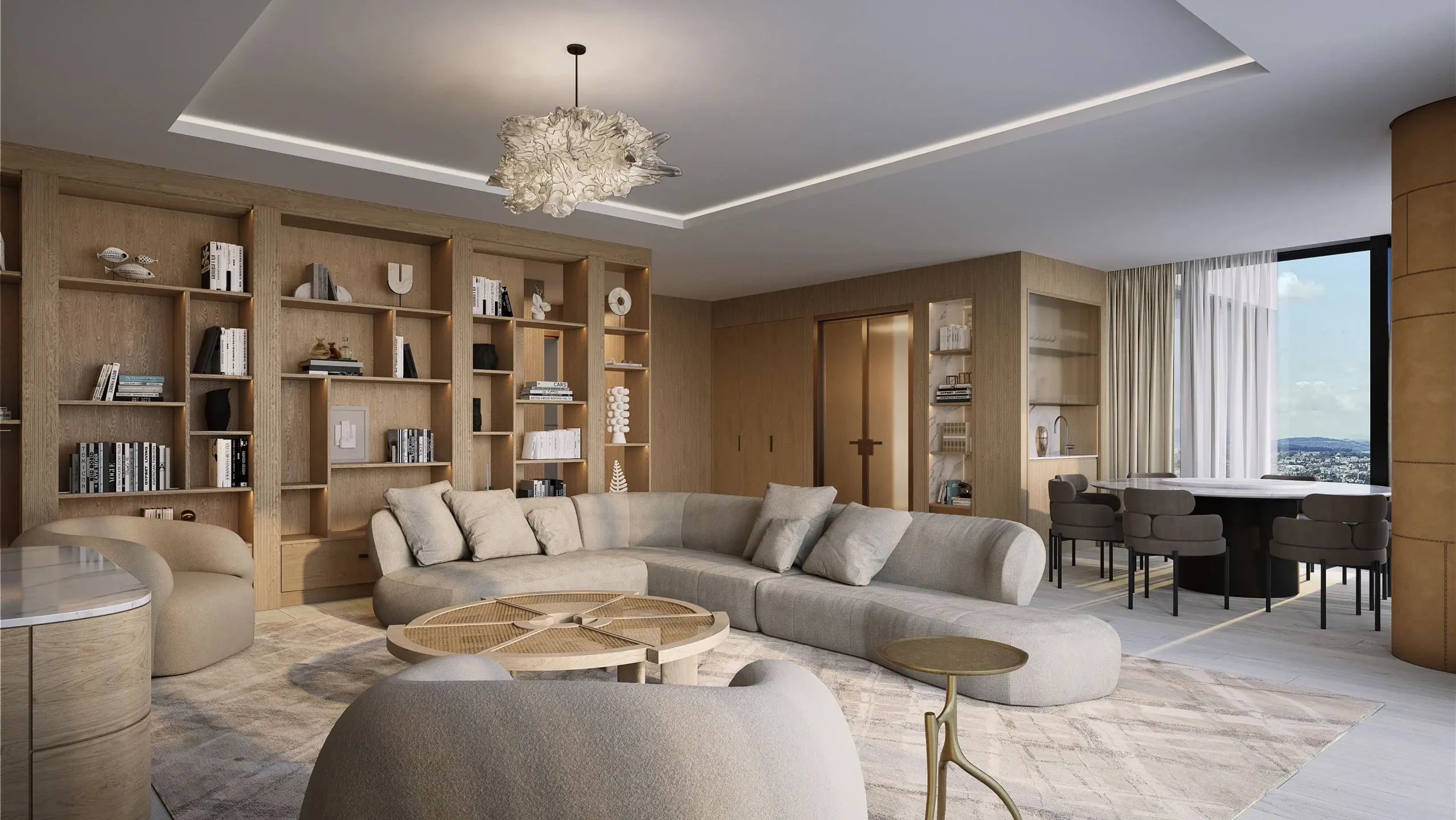
In high-end residential development, the transition from the kitchen to the living area and into the private suites must be fluid. When a project utilizes different suppliers for different rooms, the result is often a “Visual Conflict”—slight variations in wood grain, mismatched hardware finishes, and inconsistent joinery logic. From a factory engineering perspective, whole house custom cabinetry is the science of maintaining a unified design language across multiple functional zones.
This technical analysis deconstructs 5 architectural blueprints for achieving perfect cohesion in whole-house projects, focusing on material synchronization and spatial alignment.
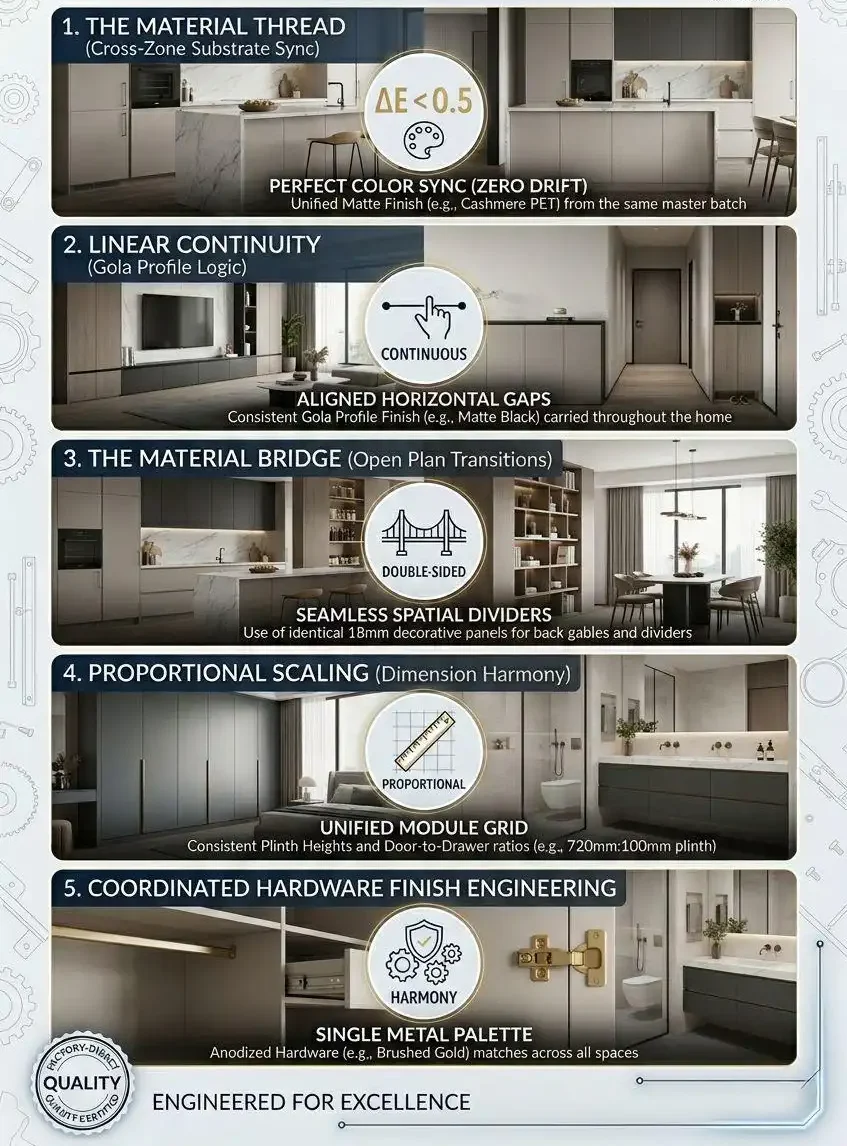
1. Blueprint I: The Material Thread (Cross-Zone Substrate Sync)
The foundation of a cohesive home is the “Material Thread.” This is the practice of using the exact same decorative surface and core material across different cabinetry units.
The “Unity Collection” Engineering
-
Technical Strategy: We utilize the same master batch of PET foil or UV lacquer for the kitchen island, the living room media console, and the master bedroom wardrobe.
-
The Performance Edge: By synchronizing the Delta-E (Color Variance) to < 0.5, we ensure that under different lighting conditions (warm LED in the bedroom vs. natural daylight in the kitchen), the cabinetry maintains a consistent tonal identity. This creates a psychological sense of “Calm and Order” that defines luxury interiors.
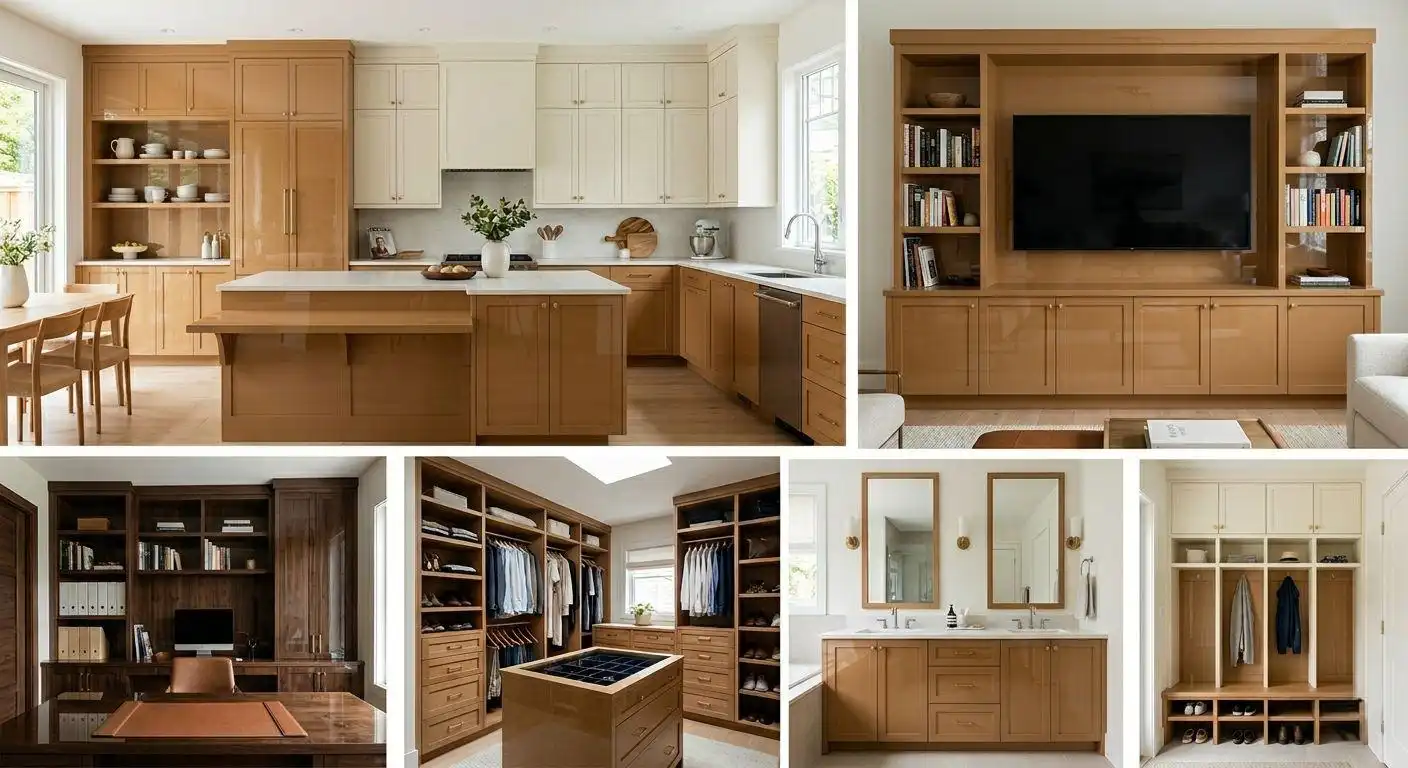
2. Blueprint II: Linear Continuity (The Gola and Profile Logic)
Cohesion is not just about color; it is about the “Lines.” In modern minimalist whole house custom cabinetry, the handleless profile (Gola) acts as a recurring architectural motif.
Horizontal and Vertical Alignment
-
The Blueprint: We carry the same aluminum profile finish (e.g., Brushed Champagne or Matte Black) from the kitchen base units into the hallway storage and vanity units.
-
Geometric Precision: Our factory engineers align the horizontal “shadow gaps” of the cabinetry across adjacent rooms. When the line of a kitchen drawer perfectly continues into a built-in sideboard in the dining area, the architecture feels intentional and custom-built, significantly increasing the perceived value of the property.
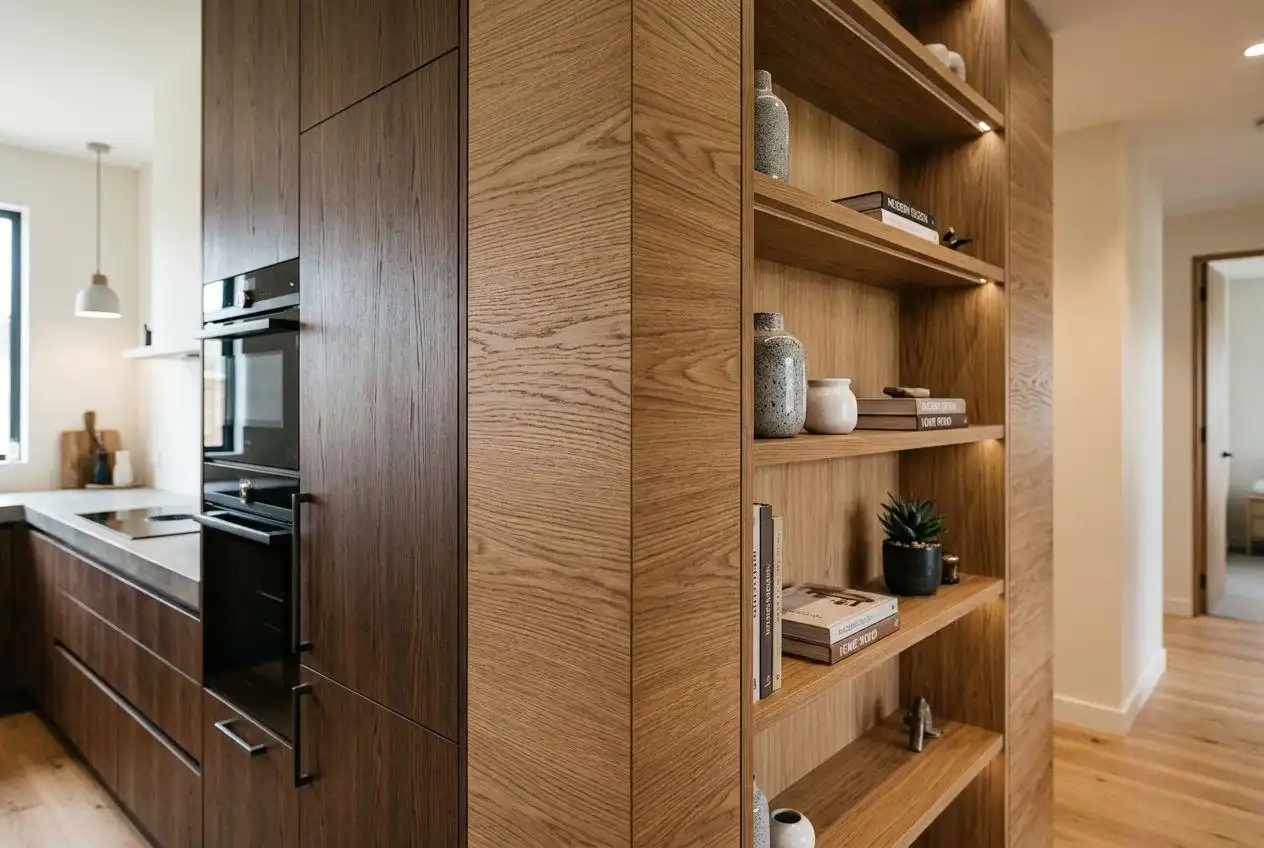
3. Blueprint III: The “Material Bridge” (Open Plan Transitions)
In open-plan layouts, the cabinet is the wall. The “Material Bridge” blueprint focuses on the back panels and side gables of cabinetry that act as room dividers.
Double-Sided Finished Panels
-
The Engineering: Instead of using standard white backing boards, we manufacture Double-Sided Decorative Panels for units that separate the kitchen and living room.
-
Seamless Integration: This allows the “back” of the kitchen pantry to serve as the “front” of a living room bookshelf. By using the same 18mm reinforced plywood core with matching veneers on both sides, we eliminate the need for unsightly drywall partitions, creating more usable floor space and a cleaner aesthetic.
4. Blueprint IV: Proportional Scaling (Dimension Harmony)
A common mistake in non-custom projects is mismatched proportions. A heavy, chunky wardrobe in the bedroom can feel disconnected from a slim, minimalist kitchen.
The Proportional Grid
-
The Blueprint: We apply a unified “Module Grid” to the entire project. For example, if the kitchen uses a 720mm carcass height with a 100mm plinth, we apply the same ratio to the bathroom vanities and laundry units.
-
Visual Rhythm: Maintaining consistent door-to-drawer ratios and panel thicknesses (e.g., 18mm doors throughout) creates a “Visual Rhythm.” This consistency is subtle, but it is exactly what distinguishes a factory-engineered whole house custom cabinetry project from a collection of miscellaneous furniture.
5. Blueprint V: Coordinated Hardware Finish Engineering
Nothing breaks a design language faster than mismatched metal finishes—chrome hinges in the bathroom vs. black handles in the kitchen vs. brass accents in the bedroom.
The Metal Specification Protocol
-
The Blueprint: We offer a “Hardware Harmony” package. This ensures that every visible and semi-visible metal component—from the Gola profiles to the drawer sides и closet rods—comes from the same anodized color palette.
-
Kinetic Consistency: Beyond aesthetics, we ensure the “Opening Force” and “Soft-Close Speed” are calibrated identically across the home. Opening a wardrobe door should feel as premium and silent as opening a high-end kitchen cabinet.
6. Cohesion Performance Matrix: Whole House vs. Room-by-Room
| Особенность | Room-by-Room Sourcing | Whole-House (Factory Integrated) | Impact on ROI |
| Color Match | Visible Variance (ΔE > 2.0) | Perfect Sync (ΔE < 0.5) | High (Aesthetics) |
| Edge Quality | Inconsistent (EVA/PUR mix) | Unified PUR Sealing | High (Durability) |
| Аппаратное обеспечение | Mismatched Finishes | Coordinated Metal Palette | Medium (UX) |
| Proportions | Random / Non-linear | Aligned Horizontal Grids | High (Architecture) |
| Установка | Multiple Teams / Conflict | Single-Source Logic | Maximum (Cost) |
7. FAQ: Whole House Customization Logistics
Q: Is it more expensive to do a whole house custom cabinetry project with one factory?
А: Actually, it is often 15-20% more cost-effective. By consolidating the shipment into a single container and optimizing the material yield across multiple rooms, the factory reduces waste and logistics costs, which we pass on to the B2B client.
Q: How do you handle different durability needs? (e.g., Water-resistant in bathrooms vs. Aesthetic in bedrooms)
А: We use a “Same Skin, Different Core” approach. We can use the exact same aesthetic finish (like a specific Oak veneer) but apply it to a highly water-resistant Green-Core HMR (High Moisture Resistant) board for bathrooms and a standard plywood for the bedroom. This maintains the look while ensuring the technical performance for each zone.
8. Conclusion: The Masterwork of Integration
Whole house custom cabinetry is the ultimate expression of a factory’s engineering maturity. It requires more than just making boxes; it requires a deep understanding of architectural flow, material science, and color management. By synchronizing substrates, alignment, and hardware, we transform a series of rooms into a unified, high-value living environment.
For developers and designers, a single-source partnership is the only way to guarantee the “Invisible Quality” that buyers demand in the luxury market.