

How to Choose Kitchen Cabinets: The Ultimate Factory-Direct Buyer’s Guide
Choosing a kitchen is arguably the most significant investment in a home renovation or a multi-unit residential project. When people ask me how to choose kitchen cabinets, they usually expect a conversation about colors and handle styles. However, as an operations expert at a custom cabinetry factory, I know that the longevity of a kitchen is determined in the first few millimeters of the board and the chemical composition of the adhesive.
In this exhaustive guide, we will break down the “DNA” of a high-performance kitchen. Whether you are a homeowner, a contractor, or a developer, this is the technical blueprint you need to move from a “pretty” kitchen to a “generational” one.
1. Understanding the Core: The Material Science of Cabinetry
The foundation of any durable kitchen cabinet is the box material. In the industry, we categorize materials based on their density, resin content, and moisture resistance.
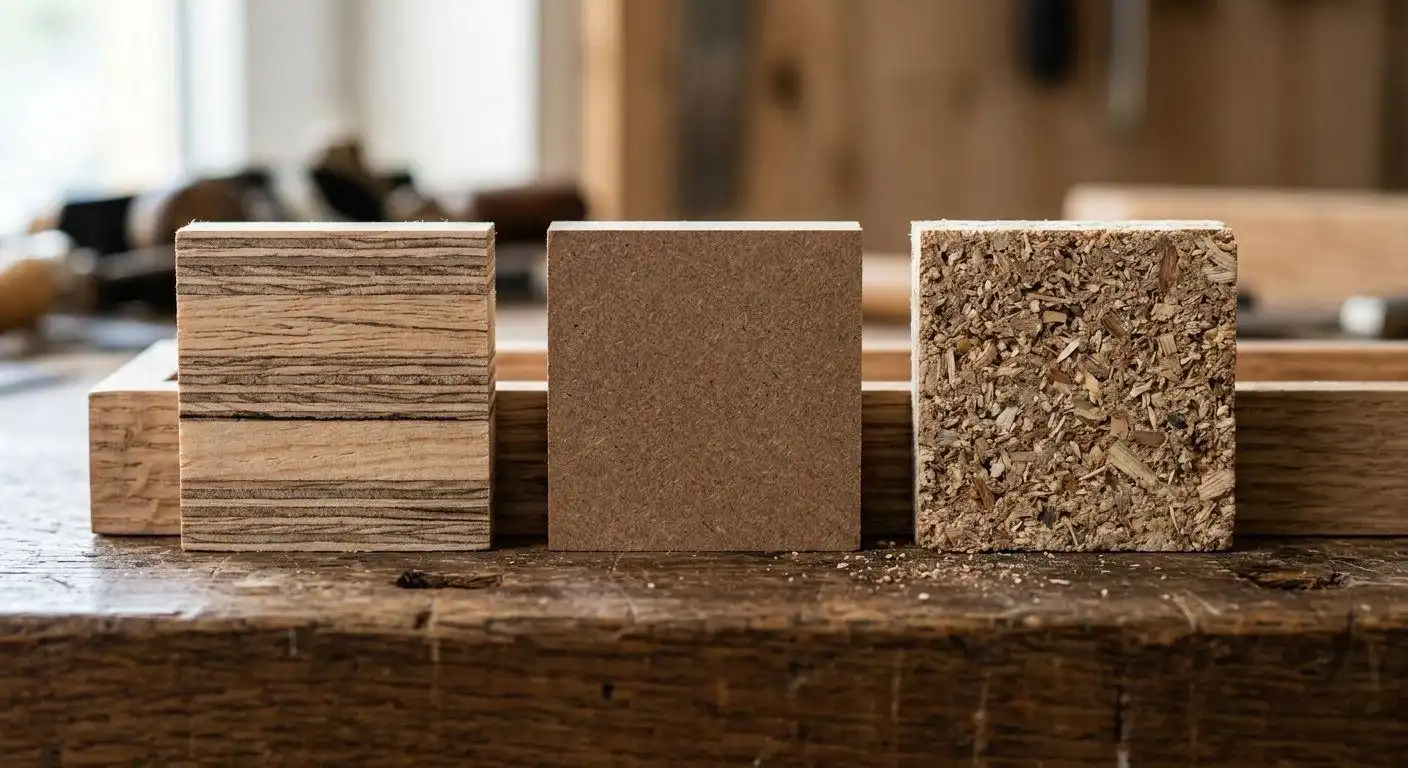
Plywood: The Structural Gold Standard
When researching how to choose kitchen cabinets, you’ll consistently hear that plywood is superior. But why?
-
Cross-Grain Stability: Plywood is made of thin wood veneers glued in alternating directions. This prevents the board from expanding or contracting in one direction, making it nearly warp-proof.
-
Screw Retention: Because it’s made of actual wood layers, screws “bite” into the fibers. This is crucial for wall-hung cabinets that must support the weight of heavy stoneware.
-
Factory Spec: At our facility, we recommend 11-layer Marine Grade Plywood for high-humidity areas like sink bases.
MDF & HDF: The Surface Perfectionists
Medium-Density Fiberboard (MDF) often gets a bad reputation, but in high-end custom cabinetry, it is essential for door panels.
-
Seamless Finishes: Unlike solid wood, MDF doesn’t have a grain. This makes it the perfect substrate for high-gloss lacquer or matte finishes.
-
HDF Advantage: High-Density Fiberboard (HDF) is even denser and more water-resistant. If you want the look of a modern European kitchen, HDF doors are often more durable than solid wood because they won’t crack at the joints.
Particle Board: The Cost-Effective Choice
Often used in RTA (Ready-to-Assemble) furniture, particle board is fine for dry areas, but it requires superior edge banding (which we will discuss later) to survive a kitchen environment.
2. Construction Methods: How the “Box” is Built
A critical part of knowing how to choose kitchen cabinets is understanding how the panels are joined.
Dovetail Joinery
Mostly found in drawer boxes, dovetail joints are the hallmark of quality. They rely on mechanical interlocking rather than just glue. If you pull a drawer and see those “puzzle-piece” joints, you know the manufacturer prioritizes craftsmanship.
Dado and Rabbet Joints
In a factory setting, we mill “grooves” (dadoes) into the side panels so the back and bottom panels slide into place. This creates a much stronger structure than simply butt-joining two boards with nails or staples. When the cabinet is full of heavy dishes, a dadoed back panel prevents the entire unit from sagging or pulling away from the wall.
Cam-Lock vs. Factory Glued
-
Cam-Locks: Common in IKEA-style flat-pack furniture. They are great for DIY but lack long-term rigidity.
-
Factory-Glued and Pressed: In our factory, we use industrial clamps and wood glue to assemble the boxes. This “monocoque” structure is significantly more rigid and stays square during the stresses of shipping and installation.
3. The “Hidden” Hero: PUR Edge Banding Technology
If you want to know how to choose kitchen cabinets that won’t peel after two years, you must understand edge banding. This is the thin strip of material that covers the raw edges of the board.
The Failure of EVA Glue
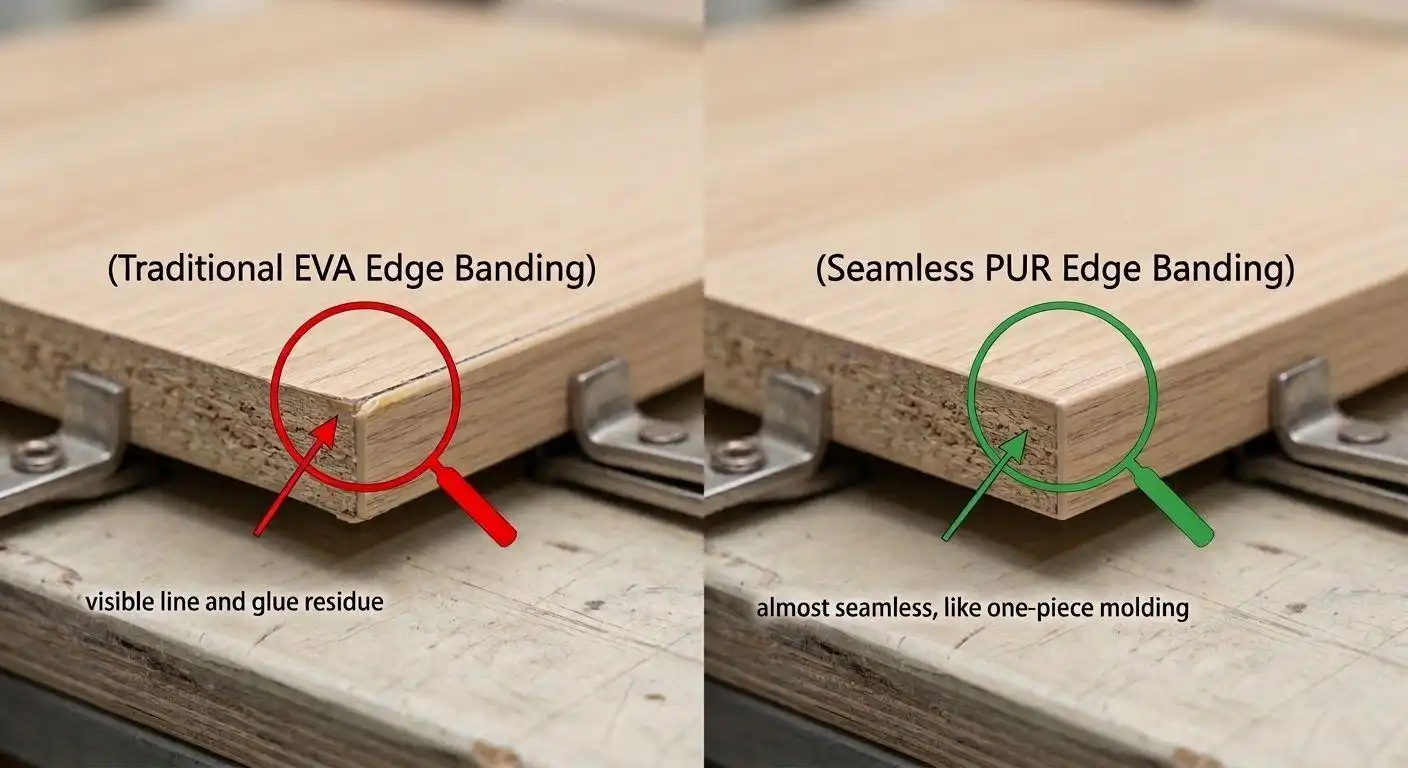
Most retail cabinets use EVA (hot-melt) glue. It is cheap and fast. However, it is a physical bond that can be “re-melted.” When you open a hot dishwasher, the steam hits the cabinet edges. Over time, the EVA glue softens, and the edges begin to peel. This is the #1 cause of cabinet replacement.
The PUR Revolution
In our custom cabinetry factory, we utilize PUR (полиуретановая) кромка.
-
Chemical Reaction: PUR reacts with moisture in the air to create a permanent chemical bond. Once it cures, it cannot be melted or dissolved by water.
-
Zero-Joint Aesthetic: PUR allows for a much thinner glue line (nearly invisible), which prevents the accumulation of dirt and moisture at the seam. This is non-negotiable for premium white or high-gloss kitchens.
4. Hardware: The Mechanics of Daily Life
You will touch your cabinet handles and hinges thousands of times a year. In the world of how to choose kitchen cabinets, hardware is the one area where you should never compromise.
Hinge Cycle Ratings
Standard hinges are often rated for 20,000 cycles. That sounds like a lot, but in a busy family kitchen, you’ll hit that in a few years. Premium brands like Blum or Hettich are rated for 200,000 cycles.
-
Soft-Close Dampers: High-quality hinges have integrated dampers that prevent slamming, which protects the cabinet’s structural joints from vibration damage over time.
Drawer Slide Weight Capacity
A typical drawer slide is rated for 25kg (55lbs). However, a deep drawer full of cast-iron pots can easily exceed that.
-
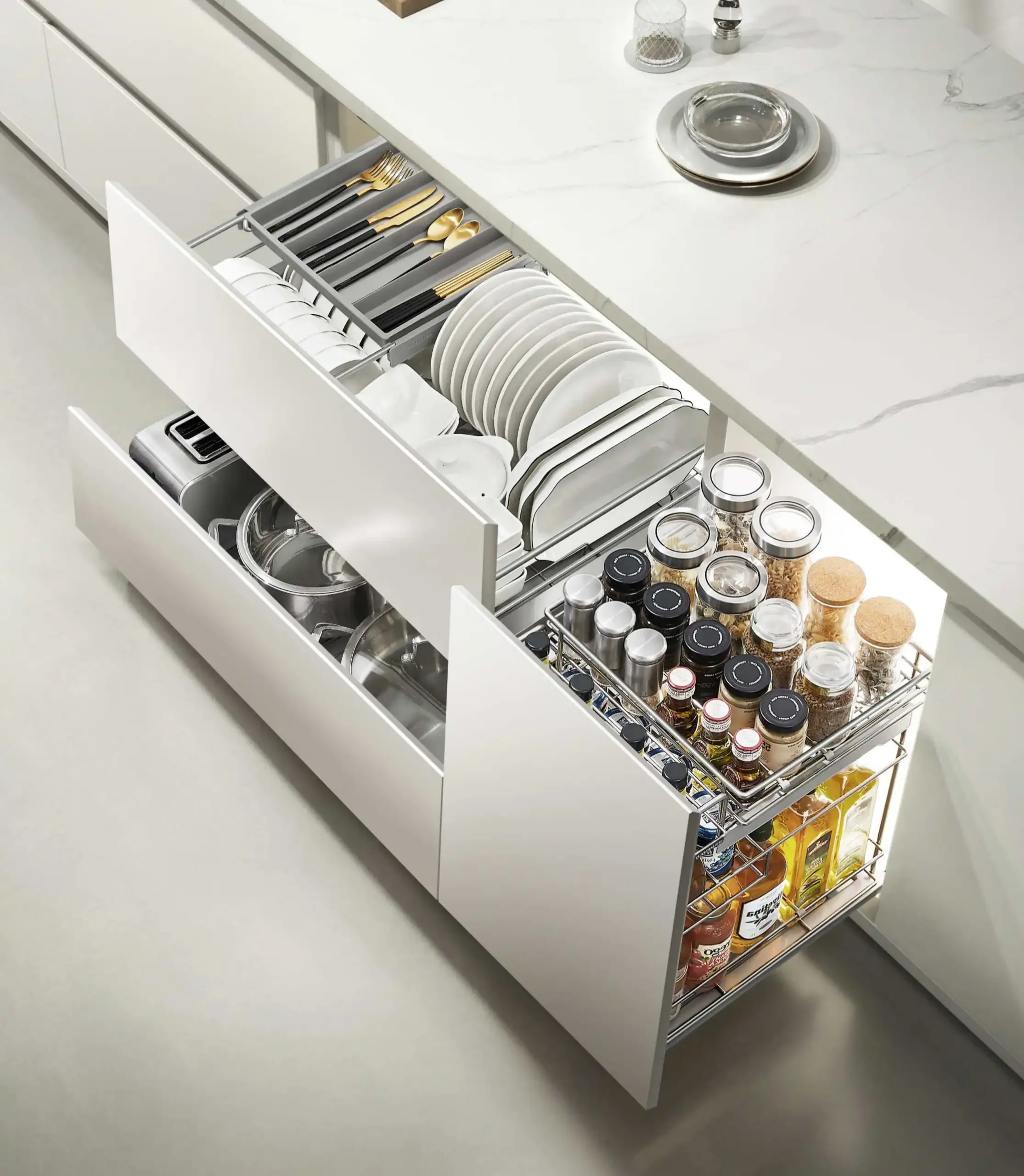
Совет для профессионалов: For “Pot and Pan” drawers, request Heavy-Duty Slides rated for 50kg or 70kg. This ensures the drawer glides smoothly even when fully loaded.
5. Aesthetics & Finishes: The 2026 Trends
While durability is key, the “look” is what sells. In 2026, the market is moving away from “busy” designs toward clean, functional textures.
-
Ultra-Matte Anti-Fingerprint: Thanks to electron-beam (EB) coating technology, we can now produce surfaces that resist oil and smudges. This is a game-changer for families with young children.
-
Sintered Stone (Rock Plate) Integration: We are seeing a massive trend in using ultra-thin Sintered Stone as cabinet door cladding. It is fireproof, scratch-proof, and creates a monolithic, architectural look.
-
The Return of Warm Woods: Natural oak and walnut textures are being used as accents against dark “Navy Blue” or “Forest Green” islands—a popular query we see in current search data.
6. The Supply Chain: Why Buying Factory Direct is a Strategic Move
For contractors and developers, knowing how to choose kitchen cabinets also means knowing how to manage a budget.
Eliminating the Showroom Markup
When you buy from a local showroom, you are paying for their rent, their salespeople, and their marketing. By working directly with a cabinetry factory, you bypass these “middleman” costs.
-
Direct-to-Jobsite Shipping: We coordinate logistics from the factory floor directly to your project site. This reduces handling and the risk of damage.
Lead Times and Planning
A common concern with factory-direct orders is the lead time. Typically, a custom order takes 4–6 weeks for production and shipping. However, for a project where you are saving 30–40% on total costs, this lead time is easily offset by the massive increase in ROI.

7. Installation: The Final 10% That Makes or Breaks the Project
Even the most durable kitchen cabinets will fail if installed poorly.
-
Leveling is Everything: If the base cabinets aren’t perfectly level, the weight of the stone countertop (which can exceed 500kg) will cause the cabinet boxes to twist and eventually crack.
-
Wall Cleats: Professional installers use a “ledger board” or cleat to support the weight of the upper cabinets, ensuring they are anchored into the wall studs, not just the drywall.
FAQ: Expert Insights on Choosing Cabinets
Q: Is “solid wood” really the best material for cabinets? А: Not necessarily. While solid wood is beautiful for doors and frames, high-quality Фанера is often more stable for the box itself because it doesn’t expand and contract as much as solid planks.
Q: How do I know if a factory is using high-quality glue? А: Ask for a PUR Seam Test or an ISO certificate. A professional factory will be proud to show you their edge-banding machinery and the “near-invisible” joints it produces.
Q: Can I get custom sizes without a massive price increase? А: Yes. Because our factory uses CNC (Computer Numerical Control) machinery, changing a cabinet width from 600mm to 585mm is as simple as changing a number in the software. This is the beauty of modern custom cabinetry.
Conclusion: Making an Informed Investment
Mastering how to choose kitchen cabinets requires a balance of aesthetic vision and technical scrutiny. By focusing on 11-layer plywood, PUR edge banding, and high-cycle hardware, you ensure that your kitchen remains an asset for decades.
As a dedicated custom cabinetry factory, we are committed to transparency. We don’t just build furniture; we build the structural heart of the home.
Are you ready to elevate your next project with factory-direct precision?