



After twenty years of tearing out dated kitchens and rebuilding them from the studs up, I can tell you this with confidence: Small kitchens don’t fail because they’re small—they fail because they’re planned like big ones.
Homeowners often walk into my office discouraged. They’ve spent hours looking at massive farmhouse kitchens on social media, and now their own 80-square-foot space feels like a design dead-end. In reality, I’ve seen small kitchen cabinet layouts outperform luxury kitchens every single day. Why? Because in a tight space, efficiency isn’t a luxury—it’s a requirement.
When you prioritize small kitchen cabinet layouts that emphasize movement over aesthetics, the workflow becomes lightning-fast. Here is the “no-nonsense” guide to the layouts that actually work in the real world.
Why Most Small Kitchen Cabinet Layouts Fail
In a sprawling kitchen, design mistakes are easy to hide. If the trash pull-out is three steps too far from the sink, you barely notice. However, in small kitchen cabinet layouts, that same mistake makes the space feel broken.
From the job site, here are the three “space killers” I see most often:
-
The Symmetry Trap: Designers love to center sinks under windows. But if that leaves you with two useless 12-inch counters instead of one 24-inch prep zone, your small kitchen cabinet layouts have failed the functionality test.
-
Ignoring “Swing Zones”: I’ve walked into many DIY remodels where the dishwasher door hits the oven handle. Successful small kitchen cabinet layouts must account for how doors and drawers interact in a confined “cockpit.”
-
Over-Sizing Appliances: Trying to cram a 36-inch fridge into a tiny room is a mistake. Strategic small kitchen cabinet layouts often rely on 24-inch or 30-inch “apartment-sized” appliances to save cabinet real estate.
1. The One-Wall Layout: The Efficiency Powerhouse
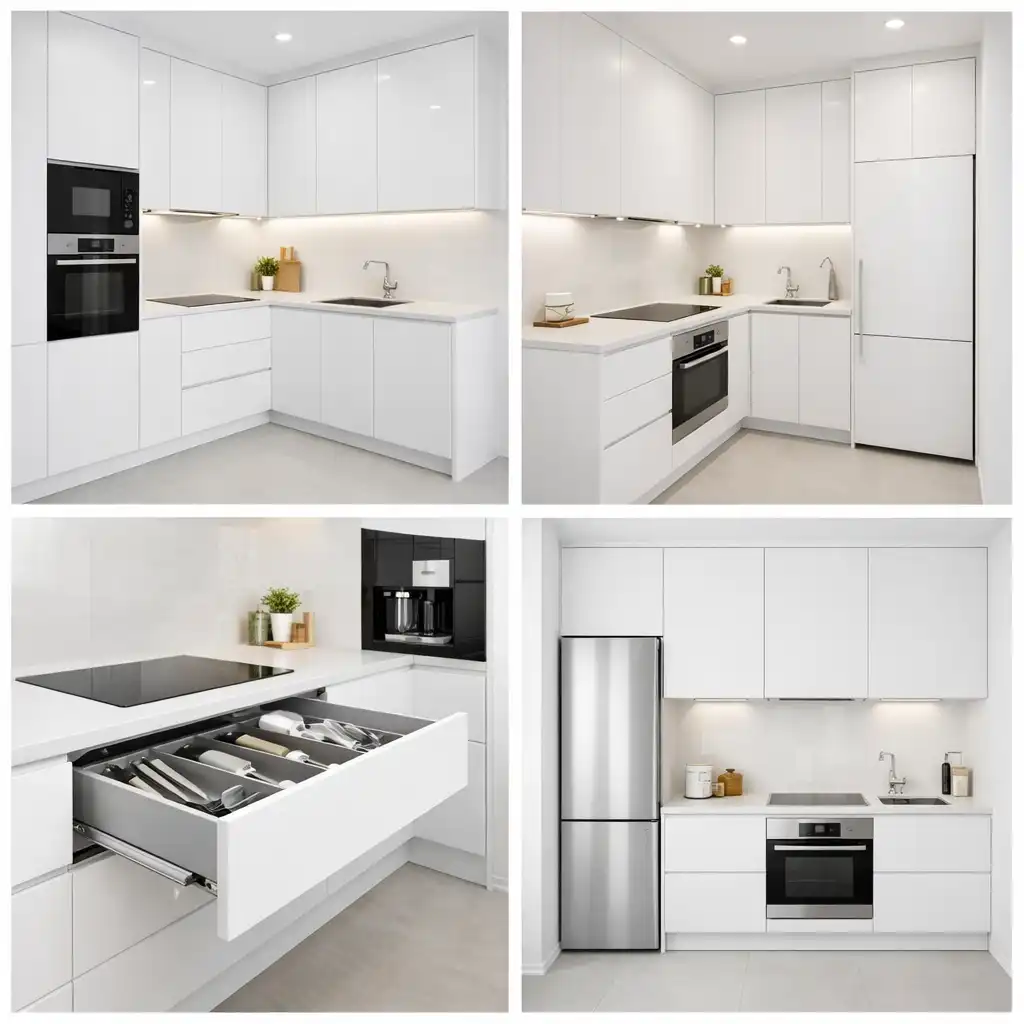
Often dismissed as a “basic” option, the one-wall design is a masterclass in minimalism. When looking at small kitchen cabinet layouts, this one is the smartest for narrow lofts or open-plan studios.
-
Why it works: It eliminates traffic bottlenecks entirely. By keeping all plumbing on a single plane, you also save a fortune in plumbing labor costs.
-
請負業者の秘密: To maximize small kitchen cabinet layouts with only one wall, you must go vertical. I always recommend 42-inch upper cabinets that touch the ceiling.
-
プロのヒント: Use a “tall pantry” cabinet at one end. This anchors the kitchen visually and provides more organized storage than three standard base cabinets combined.
2. Galley Kitchens: The Professional’s Gold Standard
If you ask a line cook what their dream workspace is, they won’t say “Island.” They’ll say “Galley.” Among all small kitchen cabinet layouts, the galley (two parallel runs) creates the most efficient “Work Triangle” in existence.
-
The 42-Inch Rule: This is non-negotiable for small kitchen cabinet layouts. You need 42 inches between cabinet faces for two people to pass.
-
Asymmetrical Advantage: If your space is too narrow for a standard galley, try a “Modified Galley.” Use full-depth 24-inch cabinets on one side and 15-inch deep pantry cabinets on the opposite wall. This is one of those small kitchen cabinet layouts that saves floor space without sacrificing storage.
3. L-Shaped Layouts: The Most Flexible Option
The L-shape is the most popular of all small kitchen cabinet layouts because it feels the most “open.” It utilizes one corner and two walls, leaving the center of the room clear for a small dining table or a mobile cart.
-
Solving the Corner Problem: The biggest waste of space in small kitchen cabinet layouts is the “blind corner.”
-
My Recommendation: Skip the basic shelf and install a Cloud Swing-out または レイジー・スーザン. Accessible storage is the hallmark of well-executed small kitchen cabinet layouts。
4. U-Shaped Layouts: High-Density Storage
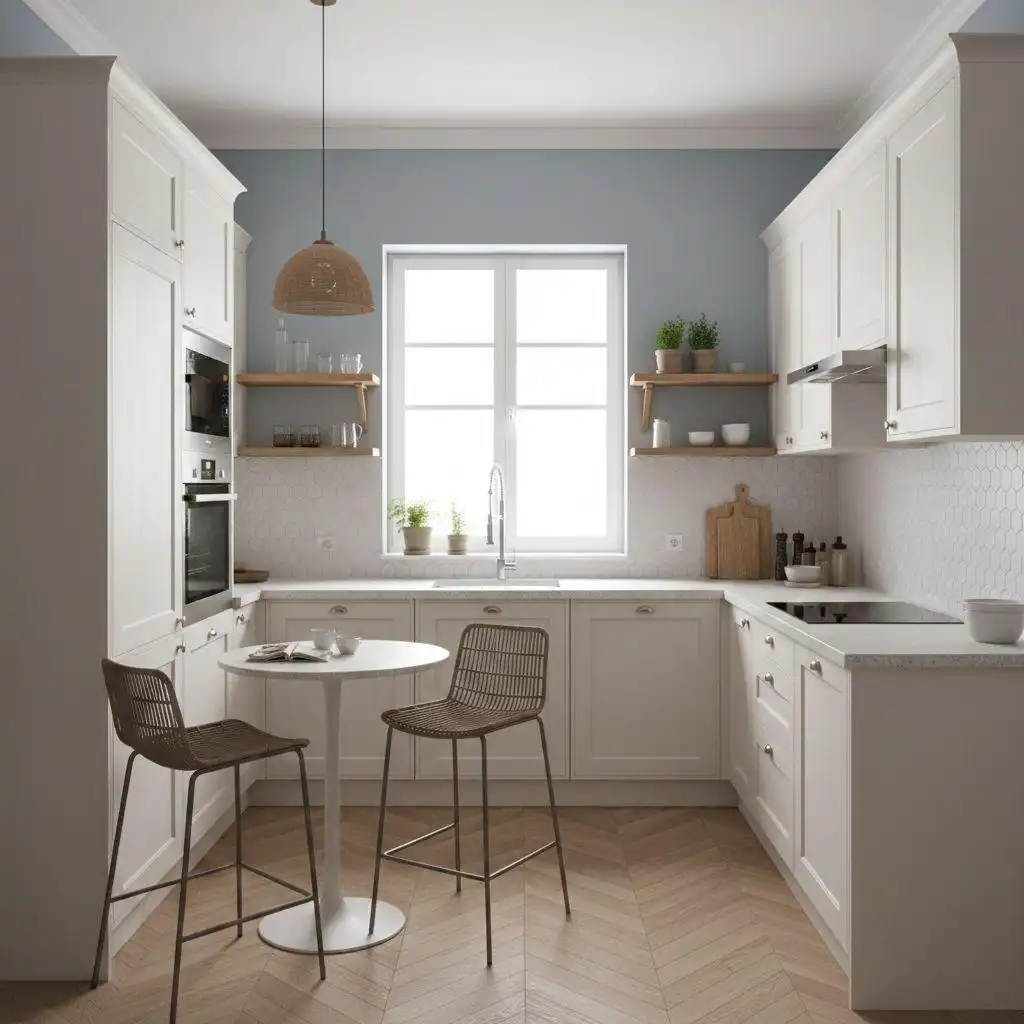
U-shaped small kitchen cabinet layouts provide a massive amount of countertop space, but they are high-risk. If the “U” is too tight, you’ll feel like you’re cooking in a closet.
-
The “One-Side Open” Rule: To keep small kitchen cabinet layouts from feeling claustrophobic, avoid upper cabinets on at least one side. Use floating shelves to let the room breathe.
-
Filler Strips: Always allow for a 3-inch “filler” at the corners. I’ve seen too many small kitchen cabinet layouts where drawers won’t open because they hit the hardware of the adjacent cabinet.
The Details That Make or Break Your Layout
Choosing between different small kitchen cabinet layouts is just the first step. The hardware and cabinet types you choose will dictate the daily experience.
-
Drawer-First Policy: In all small kitchen cabinet layouts, I tell my clients: “Drawers over Doors.” A base cabinet with a door requires you to move three things to find the one in the back. A deep drawer brings the items to you.
-
Integrated Lighting: Dark kitchens always feel smaller. Regardless of the small kitchen cabinet layouts you choose, always budget for LED tape lighting under the upper cabinets.
-
Ditch the Knobs: In tight small kitchen cabinet layouts, big chunky hardware is a “hip-snagger.” Go with integrated finger pulls for a sleek, snag-free environment.

よくある質問
Q: Can I fit an island into most small kitchen cabinet layouts?
答え: Usually, no. If you have to “sideways-shuffle” to get around it, it’s an obstacle, not an asset. A better alternative for small kitchen cabinet is a peninsula or a mobile butcher block on casters.
Q: What is the single best way to save space in small kitchen cabinet layouts?
答え: Move the microwave! Taking the microwave off the counter and putting it into a microwave drawer or a wall cabinet frees up vital prep space.
Q: Should I use custom sizes for my small kitchen cabinet layouts?
答え: You don’t need full custom, but “semi-custom” allows you to reduce cabinet depth. Reducing a cabinet from 24 inches to 21 inches is a secret weapon in tight small kitchen cabinet.
Stop Guessing and Start Planning
A small kitchen shouldn’t be a daily struggle against your own home. It should be a precision-tuned workspace. The biggest mistake you can make is trying to force a “big house” design into a small-scale reality.
Need a second pair of eyes on your project? Before you swing the sledgehammer or sign a non-refundable contract, let’s make sure your small kitchen cabinet layouts are battle-ready. We help homeowners navigate the technicalities of clearances, storage optimization, and contractor-grade materials.
👉 [Contact Us for a Professional Layout Review] – Let’s make your kitchen the most efficient room in your house.