
Vous vous trouvez dans une salle d’exposition (ou naviguez en ligne) et regardez deux devis de cuisine. En surface, les armoires semblent identiques : même style shaker blanc, mêmes poignées noires mates. Mais le devis A coûte 2 000 $ de moins que le devis B.
La différence ? Le matériau de base à l’intérieur de la boîte. L'un est construit avec Armoires en panneaux de particules, et l'autre est Construction entièrement en contreplaqué (APC).
Pour les propriétaires confrontés à une rénovation, la décision entre Armoires en contreplaqué ou en panneaux de particules est la plus critique et souvent la plus déroutante. Le contreplaqué vaut-il vraiment le coût supplémentaire ? Ou est-ce juste une vente incitative ? En tant que fournisseurs d'armoires expérimentés et spécialistes de l'industrie, nous allons dévoiler la vérité honnête sur Armoires en contreplaqué ou en panneaux de particules basé sur la durabilité, la résistance à l’eau et la valeur à long terme, vous garantissant de faire le bon investissement.
Définir les concurrents : armoires en contreplaqué ou en panneaux de particules
Avant de commencer le combat, soyons techniques. Nous ne parlons pas des portes ; nous parlons de la « construction en boîte » – le squelette structurel qui contient vos appareils électroménagers et vos comptoirs.
Armoires en contreplaqué (la norme de l'industrie)
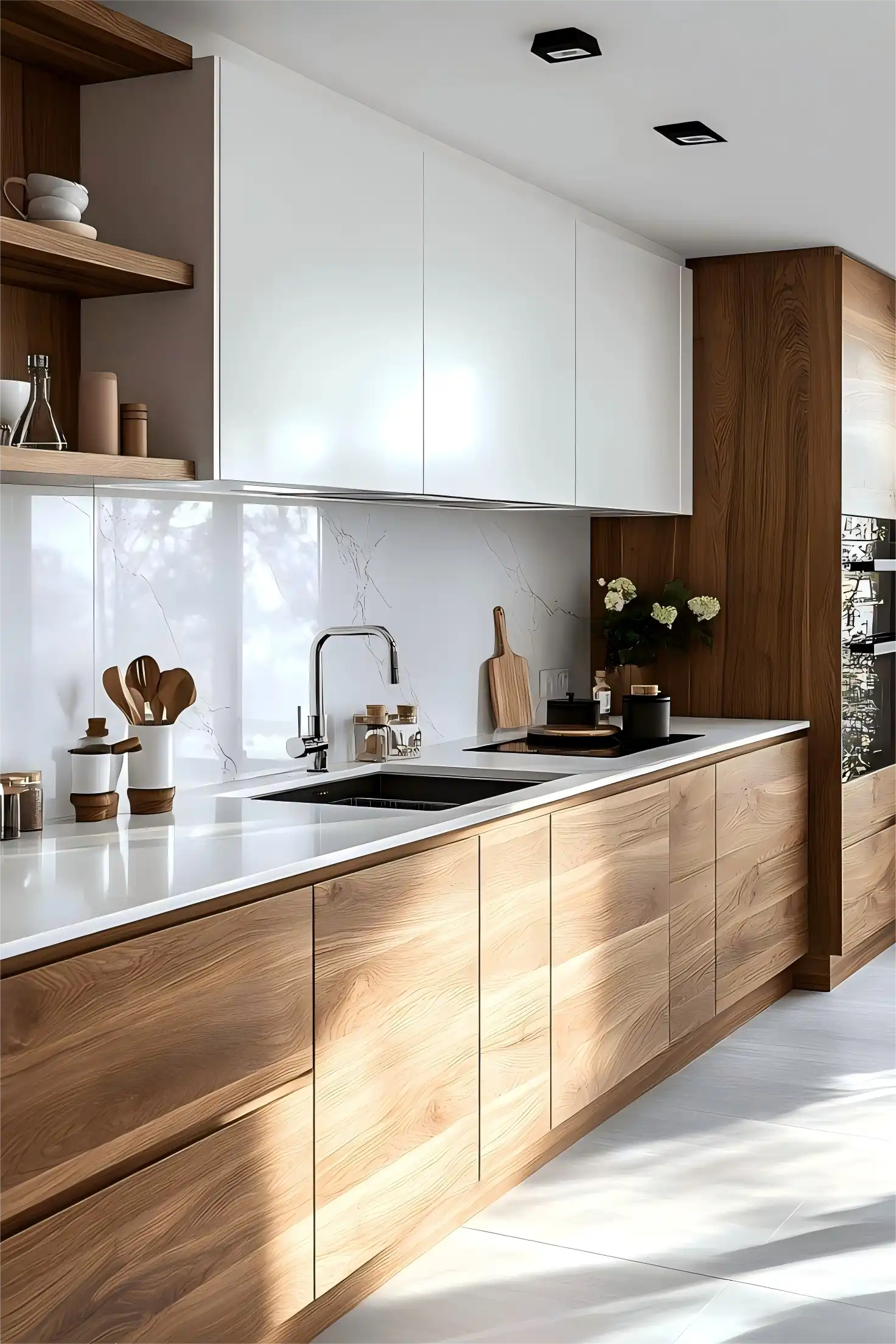
Armoires en contreplaqué sont conçus en collant des couches de placage de bois ensemble, le grain de chaque couche étant perpendiculaire à celui situé en dessous.1
-
Pourquoi c'est important : Cette technique de « grain croisé » crée un matériau incroyablement rigide et dimensionnellement stable. Cela ne se déforme pas facilement. Lorsque vous voyez « Construction entièrement en contreplaqué » (APC), vous savez que vous recherchez la qualité.
Armoires en panneaux de particules (l'option budgétaire)
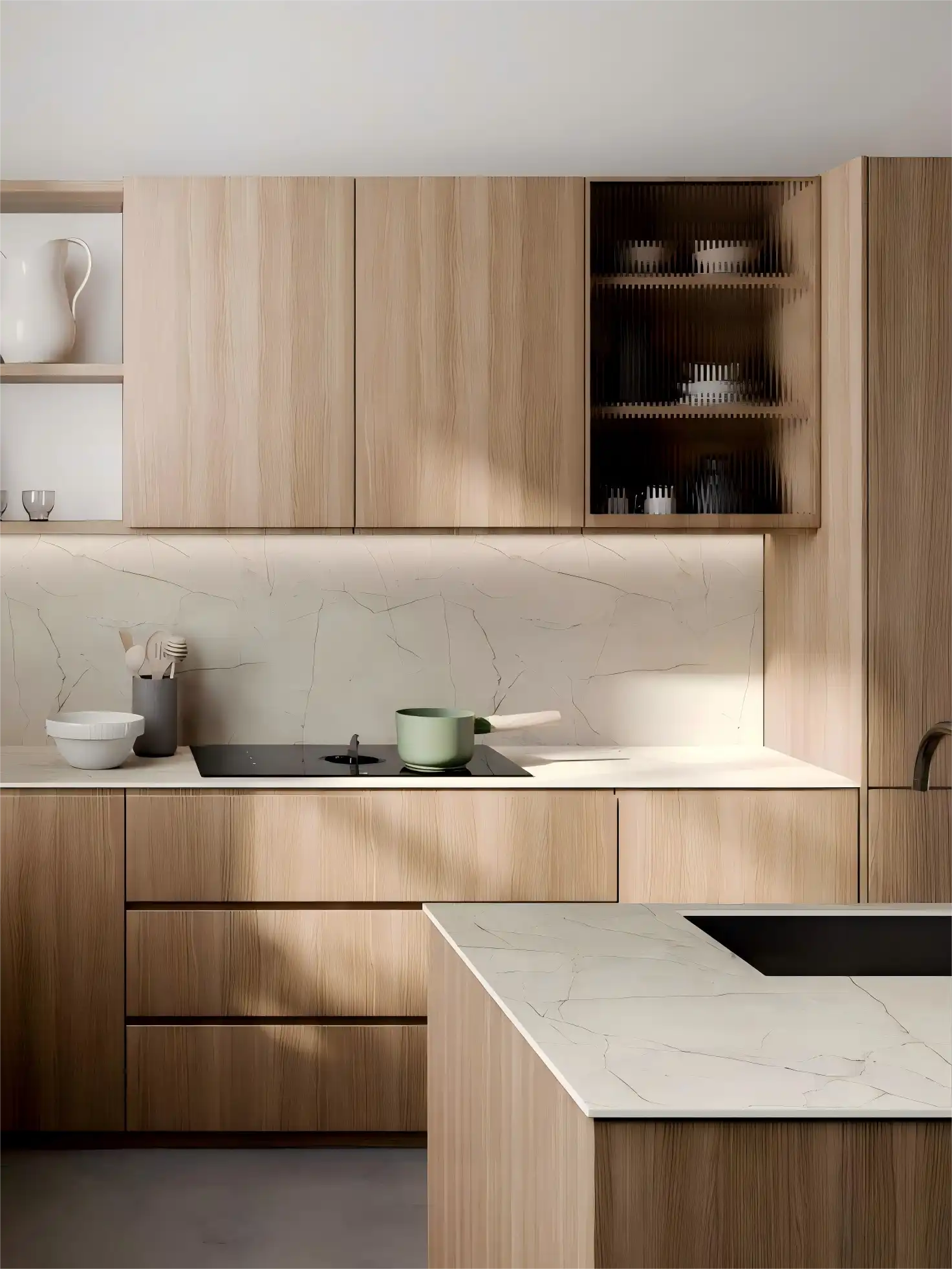
Souvent appelé « Conseil de meubles » Armoires en panneaux de particules sont fabriqués à partir de copeaux de bois, de copeaux et de sciure de bois compressés avec de la résine et de la colle à haute température.2 Ils sont ensuite recouverts d'une couche de stratifié (généralement de la mélamine ou du film thermoplastique).3
-
Contexte crucial : La qualité de Armoires en panneaux de particules varie énormément. Les versions européennes à haute densité peuvent être décentes, mais les matériaux génériques à faible densité que l'on trouve couramment dans les magasins à grande surface sont ceux qui présentent les principaux risques.
Round 1 : Résistance à l’eau et à l’humidité (le « test d’évier »)
C'est là que se situe la différence réelle entre Armoires en contreplaqué ou en panneaux de particules devient douloureusement évident. Les cuisines sont des zones humides. Les tuyaux qui fuient, la vapeur provenant des lave-vaisselle et les déversements sont inévitables.
Armoires en panneaux de particules : l’effet éponge
Armoires en panneaux de particules sont essentiellement une éponge qui attend de se produire. Si le joint du stratifié est rayé ou compromis, même un tout petit peu autour d'un trou de vis, de l'eau s'infiltrera dans les copeaux de bois. Lorsque les panneaux de particules sont mouillés, ils gonflent rapidement.
La mauvaise nouvelle : une fois qu'il gonfle, il ne rétrécit pas. Ce désordre pétillant et écaillé que vous avez vu sous un vieil évier de cuisine ? C'est un dégât d'eau classique sur Armoires en panneaux de particules. C’est la principale raison pour laquelle nous recommandons la prudence lorsque l’on envisage des produits bon marché. Armoires en panneaux de particules.
Armoires en contreplaqué : résilience structurelle
Armoires en contreplaqué sont naturellement plus résistants à l’eau.4 Bien qu’aucun bois ne soit étanche à 100 %, un noyau en contreplaqué peut bien mieux gérer une fuite. S'il est mouillé, la structure en couches croisées l'aide à conserver sa forme. Il sèche généralement sans perdre son intégrité structurelle ni gonfler en taille.
Gagnant: Armoires en contreplaqué. Si vous voulez que votre cuisine survive à l'inévitable fuite de plomberie ou à des années d'humidité, la tranquillité d'esprit offerte par Armoires en contreplaqué vaut facilement son prix.
Round 2 : Résistance, stabilité et capacité de charge
Les cuisines modernes sont lourdes. Nous ne stockons pas seulement des boîtes de céréales ; nous parlons de lourdes poêles en fonte (comme votre collection Le Creuset), de mixeurs KitchenAid et de piles d'assiettes en céramique. Le combat entre Armoires en contreplaqué ou en panneaux de particules cela revient aussi à la physique.
Maintenir le poids et le support du comptoir
-
Armoires en contreplaqué sont plus rigides.5 Ceci est essentiel pour éviter que les étagères larges (plus de 30 pouces) ne s'affaissent au milieu sous de lourdes charges.
-
Plus important encore, les comptoirs en granit et en quartz sont incroyablement lourds. Armoires en contreplaqué offrent un cadre robuste et stable qui minimise la déflexion et la courbure à long terme sous ce poids extrême.6
Le pouvoir du « maintien des vis »
Il s'agit d'un terme technique qui dicte la façon dont le matériau adhère au matériel comme les charnières et les glissières de tiroir.
-
Armoires en contreplaqué ont une forte adhérence mécanique sur les vis grâce aux couches de bois imbriquées.7
-
Armoires en panneaux de particules tenir les vis avec des copeaux compressés. Dans des scénarios réels, si vous avez une porte d'armoire qui s'ouvre et claque vingt fois par jour, la charnière se visse sur un Armoire en panneaux de particules peut éventuellement se démonter et tomber en panne, nécessitant des réparations complexes.8 Cet échec se produit rarement avec Armoires en contreplaqué.
Gagnant: Armoires en contreplaqué. Pour la longévité, le levage de charges lourdes et la résistance à l'usure d'un usage quotidien, Armoires en contreplaqué sont supérieurs.9
Round 3 : Analyse des coûts et investissement à long terme
C'est le seul tour où Armoires en panneaux de particules avoir un net avantage dès le départ.
Le prix initial
Armoires en panneaux de particules sont peu coûteux à fabriquer. Choisir ce matériau peut vous faire économiser 10% à 20% sur votre facture totale du cabinet immédiatement. Pour une rénovation à budget serré ou un changement de maison rapide, ces économies sont importantes.
Le vrai coût par an
Cependant, les entrepreneurs savent qu'il faut réfléchir à Coût par an (CPY).
| Matériel | Coût initial | Durée de vie prévue | Risque de défaillance catastrophique |
| Armoires en contreplaqué | Plus haut | 20+ ans | Très faible (haute réparabilité) |
| Armoires en panneaux de particules | Inférieur | 5 à 10 ans (dans les zones très humides) | Élevé (nécessite un remplacement complet en cas de gonflement) |
Si vous devez remplacer un appareil endommagé par l'eau Armoire en panneaux de particules après 8 ans, le coût de possession à long terme est bien supérieur à l'investissement initial dans Armoires en contreplaqué.
Le facteur de revente
Si vous envisagez de vendre votre maison, inscrivez «Armoires en bois massif/contreplaqué" est un argument de vente puissant. Les acheteurs instruits et les inspecteurs en bâtiment connaissent la différence. Les acheteurs haut de gamme rechercheront activement la durabilité uniquement. Armoires en contreplaqué peut offrir.
Gagnant: Armoires en panneaux de particules pour des économies à court terme ; Armoires en contreplaqué pour un investissement à long terme et une valeur de revente maximale.
Quand les armoires en panneaux de particules sont-elles réellement le bon choix ?
Nous croyons qu’il est important d’être honnête – le contreplaqué ne l’est pas toujours nécessaire. Il existe des scénarios spécifiques dans lesquels Armoires en panneaux de particules sont un très bon choix :
-
Des changements de budget stricts : Si vous rénovez une propriété que vous prévoyez vendre rapidement, les panneaux de particules maximisent votre retour sur investissement (ROI) immédiat.
-
Zones sèches uniquement : Pour un dressing personnalisé, une armoire de chambre ou un centre multimédia où l'eau ne sera jamais un problème, un basique Armoires en panneaux de particules sont suffisants.
-
Marques européennes haut de gamme : Certaines marques européennes ultra-luxueuses utilisent des panneaux de particules de très haute densité et une technologie de chant supérieure. Ces produits de haute qualité Armoires en panneaux de particules sont de loin supérieurs aux types génériques de qualité inférieure que l'on trouve dans les grands centres de rénovation nord-américains.
FAQ : questions que se posent les entrepreneurs sur les armoires en contreplaqué et en panneaux de particules
Q : Puis-je mélanger et assortir des armoires en contreplaqué et en panneaux de particules ?
R : Oui ! Une stratégie « hybride » intelligente consiste à commander une base d’évier entièrement en contreplaqué (là où le risque d’eau est le plus élevé) et à utiliser des panneaux de particules pour les armoires supérieures (où le risque est faible). Cependant, la plupart des sociétés RTA vendent généralement des ensembles complets d’un seul matériau.
Q : Le MDF est-il la même chose que les panneaux de particules ?
R : Non. Le MDF (panneau de fibres à densité moyenne) est plus dense et plus lisse.10 Il est excellent pour les portes d'armoires peintes car il ne se déforme pas et ne se dilate pas comme le bois massif, mais il est rarement utilisé pour le caisson d'armoire lui-même.
Q : Comment puis-je savoir de quoi sont faites mes armoires ?
R : Ouvrez un tiroir et regardez le bord du tiroir ou le bord de l'étagère sous l'évier. Si vous voyez des couches de placage de bois comme un sandwich, c’est du contreplaqué. S’il ressemble à de la farine d’avoine compressée ou à des flocons pressés, il s’agit de panneaux de particules.
Le verdict : armoires en contreplaqué ou en panneaux de particules : laquelle devriez-vous choisir ?
S'il s'agit de votre « maison pour toujours » ou d'une cuisine qui est soumise à une cuisine quotidienne intense, nous vous recommandons fortement Armoires en contreplaqué. La tranquillité d’esprit concernant les dégâts d’eau et la résistance structurelle nécessaire pour maintenir les comptoirs en granit font que la mise à niveau vaut chaque centime.
Le choix ultime entre Armoires en contreplaqué ou en panneaux de particules se résume à la tolérance au risque et au budget. Ne laissez pas une petite économie initiale mettre en péril l’espace le plus important de votre maison.
Saviez-vous?
Chez KEJIA Kitchen, nous nous spécialisons dans les armoires RTA (prêtes à assembler) dotées d'une construction entièrement en contreplaqué à des prix qui rivalisent avec les armoires en panneaux de particules de grande taille. En les assemblant vous-même, vous obtenez du matériel haut de gamme sans le coût de la main d’œuvre haut de gamme.
[Bouton: Magasinez nos collections d’armoires en contreplaqué] 👉Contactez-nous!
Articles connexes :
La grande fracture : armoires de garde-manger minimalistes et de luxe en 2025
7 différences ultimes entre une armoire et une armoire : transformez le stockage de votre maison