

When you walk into a kitchen showroom, it’s easy to get distracted by the shimmering quartz countertops and the trendy brass hardware. However, as a veteran contractor who has seen the “guts” of thousands of kitchens, I’m here to tell you that the most critical decision you will make happens behind the door. It is the fundamental battle of construction engineering: Frameless vs framed cabinets.
Most homeowners think this is purely an aesthetic choice. They assume that if the doors look the same, the cabinets are the same. This is a massive misconception. The structural difference between these two styles affects your storage capacity, your cleaning routine, and even the resale value of your home. There is a “shocking truth” about usable square footage that big-box retailers often gloss over. Understanding the technical nuances of frameless vs framed cabinets is the only way to ensure you aren’t paying for wasted air.
1. The Anatomy Lesson: Frames vs. Boxes
To settle the frameless vs framed cabinets debate, we have to look at the skeletal structure.
-
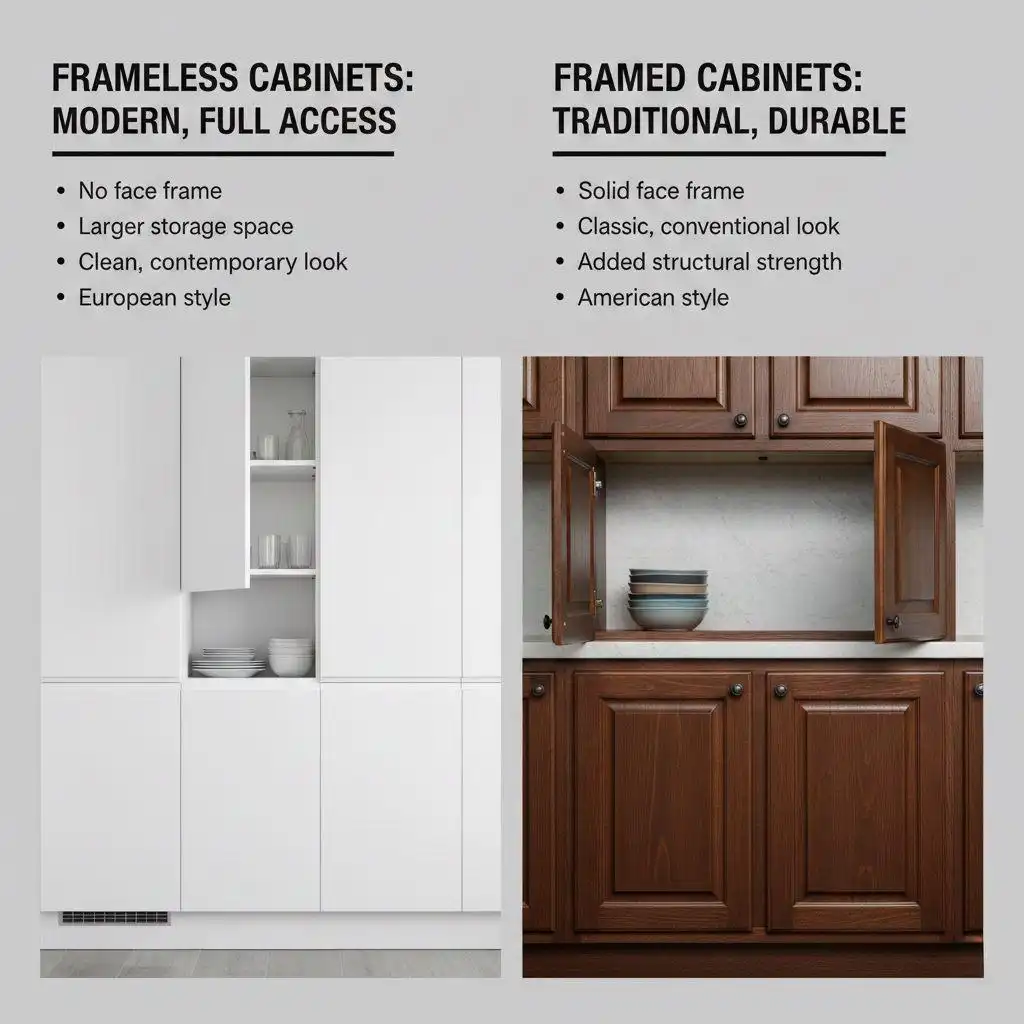
Framed Cabinets (The American Standard): Imagine a picture frame made of 1.5-inch solid wood stiles and rails. This frame is glued and nailed to the front of the cabinet box. The hinges are then attached to this frame. This has been the standard in North America for over a century.
-
Frameless Cabinets (The European Revolution): This style eliminates the front frame entirely. The cabinet box is built with thicker, high-density side walls, and the doors are attached directly to the interior of those walls. This is often called “Full Access” cabinetry.
When comparing frameless vs framed cabinets, the absence of that 1.5-inch border is what changes the entire functionality of your kitchen.
2. The Storage Math: Reclaiming Your “Ghost Space”
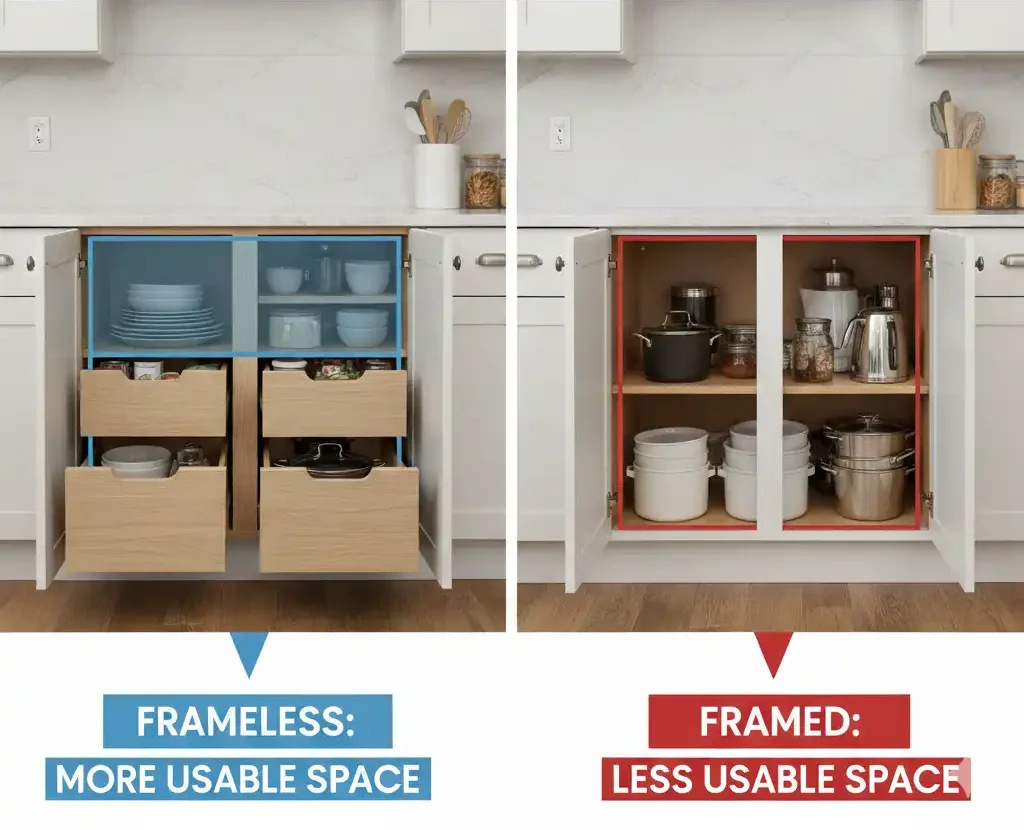
Here is the most significant factor in the frameless vs framed cabinets comparison: The Frame Lip. In a framed cabinet, the face frame creates a “lip” that hangs over the interior opening of the cabinet box on all four sides.
If you have an 18-inch wide cabinet, the actual opening is only 15 inches wide because the frame eats up 1.5 inches on each side. In contrast, a 18-inch wide frameless cabinet gives you a full 18-inch opening. In the world of frameless vs framed cabinets, this means that in a typical kitchen with 10 base cabinets, you are losing nearly 15 inches of horizontal accessibility just to wooden frames. That is the equivalent of losing an entire cabinet! For small kitchens or urban condos, choosing frameless in the frameless vs framed cabinets battle is the only way to maximize every square inch.
3. The Center Stile Barrier: A Contractor’s Nightmare
Many wider framed cabinets (30 inches or more) require a “center stile”—a vertical wooden bar in the middle of the opening to prevent the frame from sagging. This bar is a functional nightmare. Try putting a large Thanksgiving turkey platter or a wide pizza stone into a cabinet with a center stile, and you’ll find yourself angling, tilting, and cursing.
Dans le frameless vs framed cabinets showdown, frameless cabinets never have center stiles. Because the box is engineered for strength without a frame, the entire interior is open. You can slide in wide organizers, oversized slow cookers, and large mixing bowls with zero obstruction. This is why professional chefs almost always prefer frameless when forced to choose between frameless vs framed cabinets.
4. Drawer Volume: The Hidden 20%
If you want to see where frameless vs framed cabinets really diverge, look at the drawer boxes. In a framed cabinet, the drawer glides must be mounted to the face frame. To clear the frame’s edges, the drawer box must be significantly narrower than the cabinet itself.
In a frameless setup, the drawer glides are mounted directly to the 3/4-inch side walls. This allows for a much wider drawer box. When we measure the interior volume of drawers in frameless vs framed cabinets, the frameless drawer typically offers 15% to 22% more usable cubic space. If you are planning a kitchen with many deep drawers for pots and pans, the winner of frameless vs framed cabinets is clear.
5. Overlay Styles: The “Secret” to the Look
How the door covers the cabinet is a major part of the frameless vs framed cabinets aesthetic.
-
Framed Cabinets allow for three styles: Partial Overlay (shows some frame), Full Overlay (covers most of the frame), and Inset (door sits inside the frame). Inset is a gorgeous, high-end look that is unique to framed construction.
-
Frameless Cabinets only offer Full Overlay. However, because there is no frame, the “reveal” (the gap between doors) is incredibly tight—usually only 2mm to 3mm.
This leads to a “wall of cabinetry” look that is impossible to achieve with framed units. When comparing frameless vs framed cabinets for a modern, minimalist home, frameless is the only choice that delivers that seamless, high-tech European vibe.
6. Durability and Climate Stability
A common “brutal mistake” is believing that frameless cabinets are weaker. In reality, because they lack a frame, frameless cabinets are built with much higher specifications. While a framed cabinet might use 1/2-inch plywood for the box, a quality frameless cabinet uses 3/4-inch plywood or high-density furniture board.
In terms of climate, frameless vs framed cabinets react differently to humidity. Solid wood frames on framed cabinets can expand and contract, occasionally causing inset doors to stick during a humid summer. Frameless cabinets, being made of stable engineered cores or thick plywood, tend to stay perfectly “square” regardless of the weather. This makes them one of the best idées d'éclairage d'armoires de cuisine companions because the tight, straight lines look incredible under LED washes.
7. Installation Precision: The Pro’s Warning
I must be honest with you: frameless cabinets are much harder to install correctly. Because the gaps between doors are so small, there is zero room for error. If your walls aren’t perfectly plumb or your floors aren’t perfectly level, a frameless kitchen will look like a disaster.
Framed cabinets are more “forgiving.” The frame adds a layer of rigidity that can handle slightly uneven walls. When choosing between frameless vs framed cabinets for an older home (built before 1950), I often recommend framed unless the homeowner is willing to pay for significant wall-leveling work.
FAQ: Deciding Between Frameless and Framed
Which style has a better ROI for resale?
In 2026, modern and transitional designs are dominating the market. Most buyers associate the “full access” look of frameless with a modern, high-end remodel. In the frameless vs framed cabinets debate for resale, frameless usually wins in urban markets, while framed (especially Inset) remains the king of high-end suburban estates.
Can I get “Soft-Close” on both?
Yes. Quincaillerie d'armoires de cuisine de haute qualité from brands like Blum or Grass is available for both. However, frameless hinges are often easier to adjust in three dimensions, allowing for that perfect alignment.
Why do some contractors hate frameless?
Installation time. It takes a skilled crew longer to perfectly align a frameless kitchen. If a contractor is steering you away from the frameless vs framed cabinets choice you want, it might be because they lack the precision tools required for a frameless install.
Are frameless cabinets more expensive?
On paper, yes—usually about 10% to 15% more. But when you factor in the 20% gain in usable space, the “value per square inch” is actually better with frameless in the frameless vs framed cabinets calculation.
Conclusion: Engineering Your Dream Kitchen
Your cabinets are the most expensive part of your remodel. Don’t let a traditional frame limit your storage or your style. Whether you choose the structural heritage of Armoires à cadre or the high-efficiency volume of Armoires sans cadre, make sure your choice aligns with your home’s architecture and your storage needs.
The “shocking truth” is that space is a luxury. If you want a kitchen that feels larger, works harder, and looks cleaner, the frameless vs framed cabinets debate usually ends with a “full access” victory.
Ready to see these construction styles side-by-side? Let’s evaluate your kitchen layout and find the best engineering for your lifestyle. Contact me today for a factory-level consultation!
[Claim Your Wasted Space – Request a Cabinet Consultation Now]