




After more than 15 years in the trenches of kitchen remodeling, I’ve seen it all. I’ve seen $100,000 renovations that felt “cheap” because the flow was off, and I’ve seen modest budget flips that felt like luxury suites.
The difference? It’s almost never the cabinet color or the quartz brand. It’s the math.
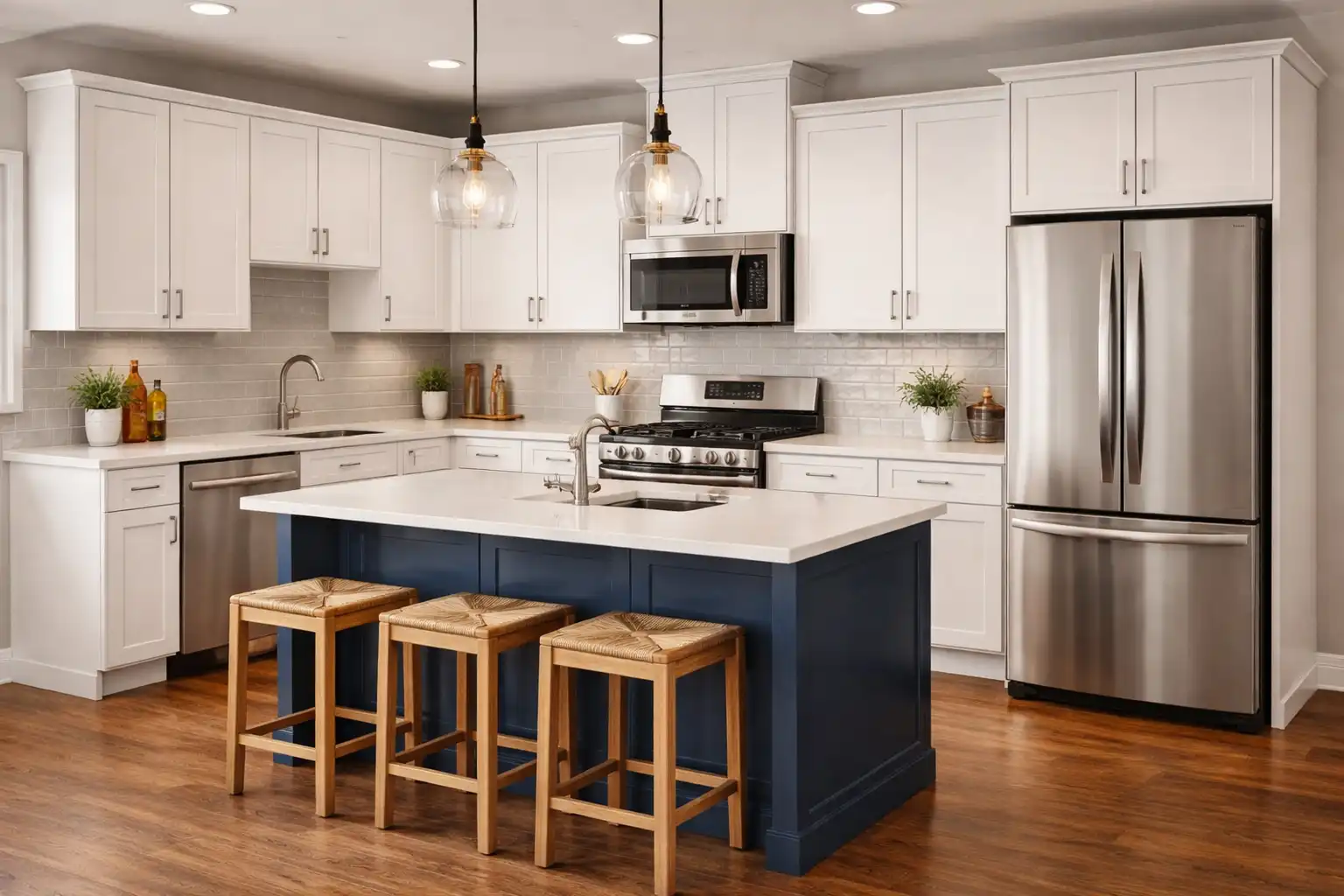
Most homeowners show up to our first meeting with a Pinterest board full of navy blue shaker doors and brass hardware. But almost no one leads with the question that actually dictates if they’ll hate their kitchen in six months:
“Are these standard kitchen cabinet dimensions actually going to work for my height, my house, and my cooking style?”
In this business, we talk about standard kitchen cabinet dimensions like they’re holy scripture. But the truth is, these standards were designed for the factory’s convenience, not for your comfort. Here is everything I wish every client knew before they signed that cabinet contract.
The “Standard” Trap: Why One Size Doesn’t Fit All
In the world of manufacturing, standard kitchen cabinet dimensions exist to make production fast and cheap. If every cabinet is a multiple of 3 inches, the robots in the factory stay happy.
But your house isn’t a factory.
If you live in a 1920s bungalow with sagging floor joists, or a 1980s ranch with a ceiling that dips an inch from left to right, “standard” is going to be your worst enemy. When we try to force mass-produced, standard kitchen cabinet dimensions into an irregular space, we end up using “fillers”—those flat pieces of wood used to bridge gaps. Too many fillers, and your “custom” kitchen starts to look like a puzzle that was forced together.
1. Base Cabinets: The 36-Inch Rule is a Suggestion, Not a Law
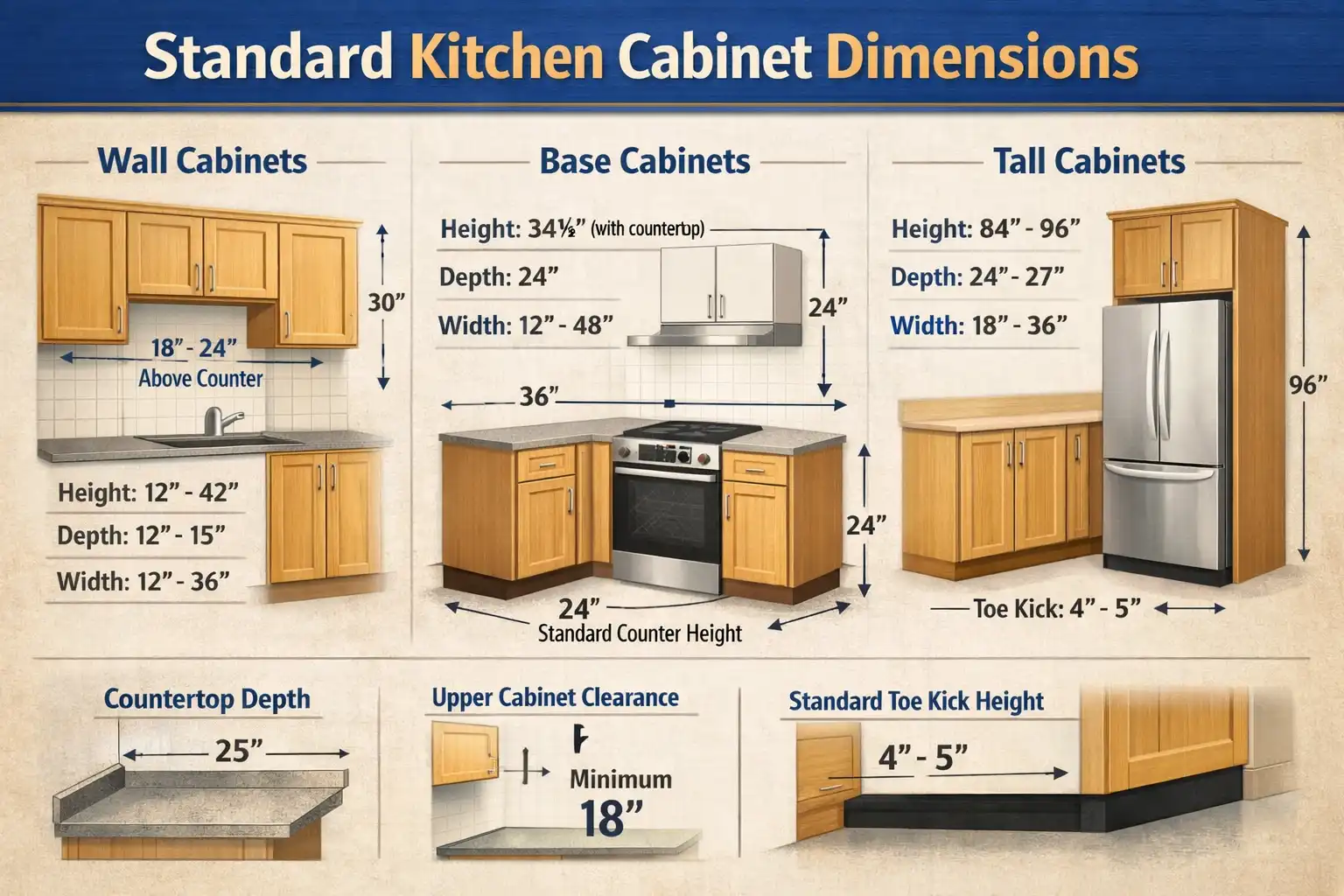
The industry standard kitchen cabinet dimensions for base units call for a 34.5-inch tall box. Add a 1.5-inch slab of stone, and you’re at 36 inches.
Here’s where the trouble starts. I once had a client who was 6’4″ and another who was 4’11”. If I gave them both the same “standard” height, one would have chronic lower back pain and the other would need a step-stool to chop an onion.
The Pro Tip: You can cheat the system. By building up the toe-kick or choosing a thicker mitered-edge countertop, you can raise that working surface to 37 or 38 inches for taller families. Never let a contractor tell you that standard kitchen cabinet dimensions can’t be tweaked for ergonomics.
2. The Depth Dilemma (24 Inches Isn’t Always 24 Inches)
On a blueprint, the standard kitchen cabinet dimensions for depth are 24 inches. But that’s just the box.
Once you add the door, the drawer front, and that chunky oversized handle you liked at the showroom, you’re looking at 26 inches of protrusion.
-
The Mistake: Homeowners measure their kitchen aisle based on the 24-inch box.
-
The Reality: Once the dishwasher door is open and the handles are installed, that “spacious” 42-inch aisle turns into a 36-inch bottleneck where two people can’t pass each other without a “squeeze me.”
3. Wall Cabinets: The 18-Inch Gap That Can Ruin Your Workflow
The distance between your countertop and the bottom of your upper cabinets is the most contested real estate in the house. The standard kitchen cabinet dimensions for this clearance is 18 inches.
I’ve had clients ask to drop the wall cabinets to 15 inches because they want to reach the top shelf. Don’t do it. Modern countertop appliances—high-end coffee makers, stand mixers, and blenders—are getting taller. If you ignore the 18-inch clearance standard, you’ll end up pulling your toaster oven out into the middle of the room every time you want to use it. Plus, it makes the kitchen feel dark and claustrophobic.
4. Tall Cabinets: The Ceiling Height Showdown
Tall pantry units and oven towers usually come in standard kitchen cabinet dimensions of 84, 90, or 96 inches.
Here is a costly mistake: Ordering 96-inch cabinets for an 8-foot (96-inch) ceiling. In a perfect world, that works. In the world of home remodeling, your ceiling is likely 95.5 inches in one corner and 96.2 in another. If you buy the 96-inch “standard” unit, it simply won’t fit without cutting into your ceiling or your floor. I always recommend leaving at least 3-4 inches of “breathing room” for crown molding to hide those inevitable ceiling slopes.
11 Costly Cabinet Dimension Mistakes I’ve Seen (and Fixed)
Over the years, these 11 errors have cost my clients thousands in “re-stocking” fees and change orders:
-
Buying the Fridge Last: I’ve seen $5,000 built-in refrigerators that couldn’t open their doors because the adjacent cabinet was too deep.
-
The “Dead Man’s” Corner: Eligiendo standard kitchen cabinet dimensions that leave a 24-inch void in the corner because you didn’t want to pay for a Lazy Susan or a Magic Corner.
-
Ignoring the Toe-Kick: Shrinking the toe-kick height to get more drawer space. You’ll hate this the first time you try to wash dishes and realize your toes have nowhere to go.
-
The Microwave Trap: Buying a standard 12-inch deep upper cabinet for a microwave that actually needs 15-18 inches of depth to sit safely.
-
Aisle Shrinkage: Designing an island with a 36-inch aisle. That’s fine for one person, but a disaster for a family.
-
Symmetry Over Sanity: Making two cabinets the same width for “balance” even if one becomes a 12-inch “spice pull-out” that’s impossible to clean.
-
Overhanging Countertops: Forgetting that your countertop adds 1.5 inches to your base cabinet’s footprint.
-
Faucet Clearance: Placing wall cabinets so low over a sink that you can’t install a high-arc professional faucet.
-
The Window Clash: Ordering standard kitchen cabinet dimensions that overlap the window casing by half an inch. It looks amateur and drives me crazy.
-
Crown Molding Math: Forgetting that crown molding adds height. If you go to the ceiling, you need to plan for that trim.
-
Assuming the Floor is Level: If your floor is out by an inch, your “standard” 36-inch counter will be 35 inches on one end and 37 on the other unless you shim the life out of it.
When to Stop Following the Rules
There are times when standard kitchen cabinet dimensions are exactly what you need. If you’re flipping a rental or building a starter home in a new subdivision, stay standard. It’s predictable.
But if this is your “forever home,” or if you have a kitchen smaller than 10×10, you need to break the rules. In small kitchens, every 1/2 inch is a battle. Customizing the depth of a pantry by just 3 inches can be the difference between a kitchen that feels like a hallway and one that feels like a chef’s sanctuary.
My Final Advice from the Job Site
If I could leave you with one piece of advice, it’s this: The tape measure doesn’t lie, but the brochure might. Standard kitchen cabinet dimensions are a great starting point, but they are just that—a start. Before you fall in love with a cabinet door style or a specific shade of “Greige,” take a piece of blue painter’s tape and mask out the dimensions on your floor. Open your existing dishwasher. See where the “standard” lines hit.
FAQ: From the Contractor’s Desk
-
Are standard dimensions the same for all brands? Mostly, yes. But some European “frameless” brands use metric standards that can be slightly off from American “framed” cabinets. Always check the spec sheet.
-
Can I mix and match? I do it all the time. Use standard kitchen cabinet dimensions for the main runs to save money, and go custom on the island or the pantry where the “wow factor” and utility really matter.
-
Is custom worth the 30% price jump? In a small kitchen? 100%. In a massive 20×20 kitchen? Probably not; you have enough room to make the “standards” work.
Ready to Start Your Layout?
Don’t guess on your measurements. If you’re feeling overwhelmed by standard kitchen cabinet dimensions or worried that your older home’s quirks will ruin your layout, let’s talk.
Our team doesn’t just look at pictures; we look at the math of your lifestyle.
👉 Contact us today for a layout review. We’ll help you spot the “clearance traps” before you spend a dime on cabinets that don’t fit. A few inches of planning now will save you thousands of dollars in headaches later.