



In the specialized world of custom cabinetry manufacturing, the carcass provides the form, but the hardware provides the function. A kitchen cabinet hardware system is the most high-wear component of any interior environment, subjected to thousands of cycles of kinetic stress, moisture exposure, and fluctuating vertical loads. From a factory engineering perspective, hardware is not an accessory; it is a critical mechanical interface.
This technical analysis deconstructs 5 mechanical blueprints for high-performance hardware, focusing on alloy composition, dampening physics, and load-bearing logistics.
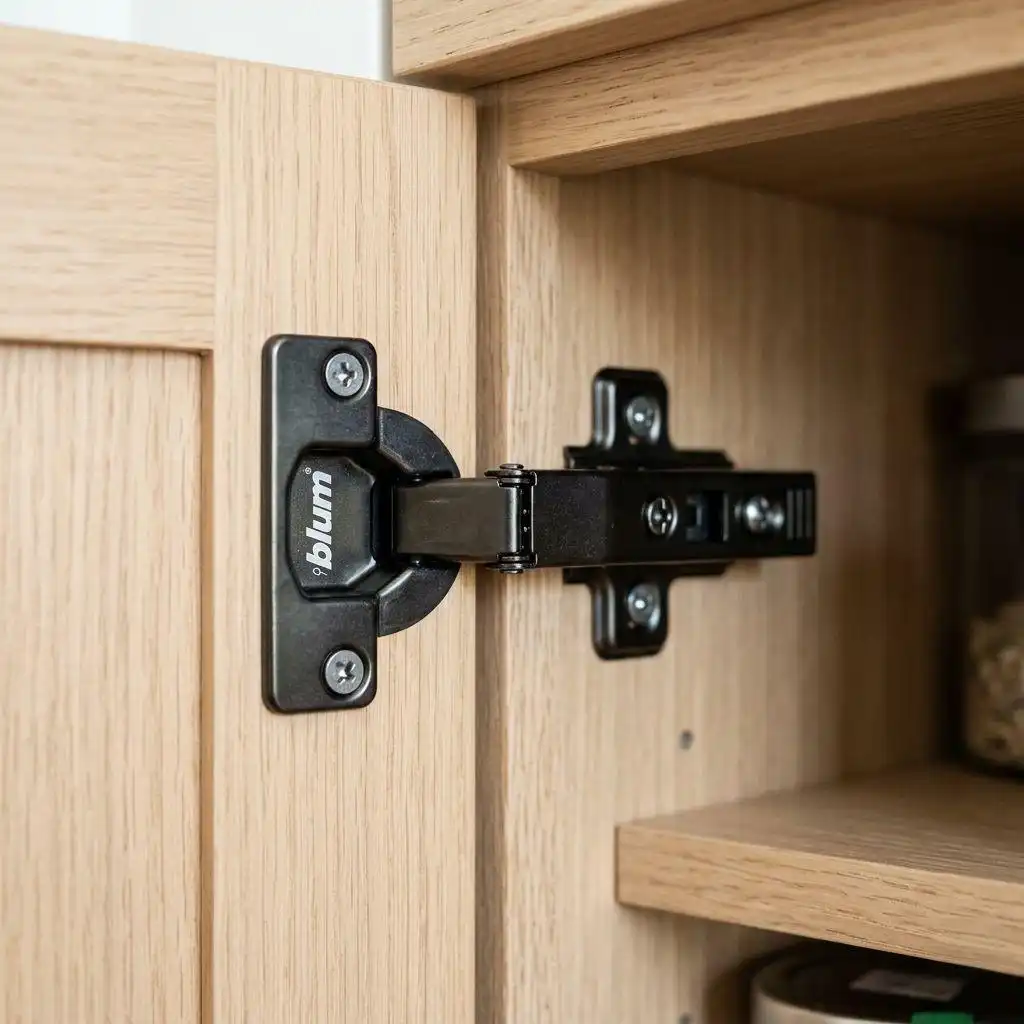
Blueprint I: The Physics of Hydraulic Soft-Close Hinges
The hinge is the primary pivot point for every door panel. In our factory, we analyze hinges based on their “Degradation Curve.”
Steel Composition and Corrosion Resistance
High-performance kitchen cabinet hardware must be manufactured from cold-rolled steel with a minimum nickel-plating thickness of 3 microns.
-
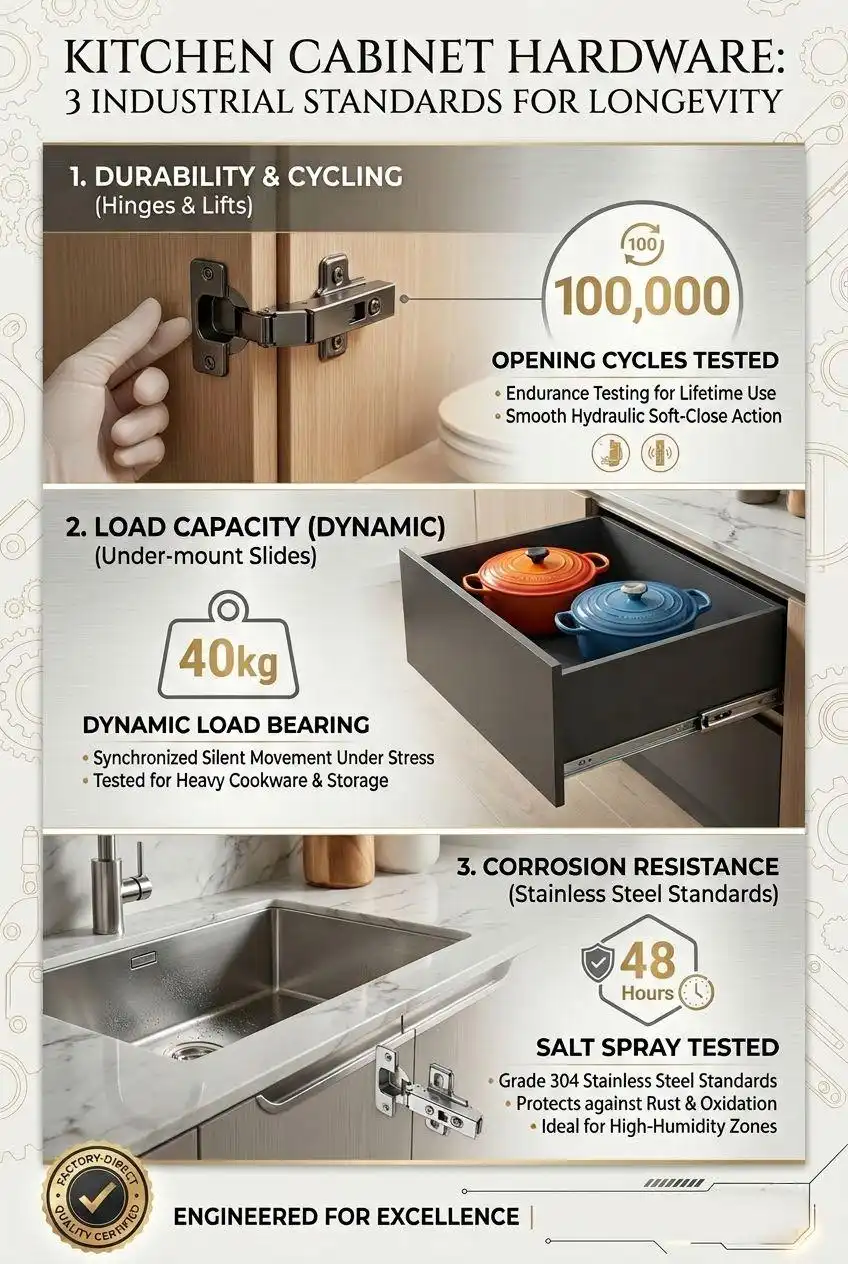
The 48-Hour Salt Spray Test: We specify hinges that pass the NSS (Neutral Salt Spray) test, ensuring that in high-humidity environments (like coastal regions or near kitchen sinks), the springs and pivots will not develop surface oxidation.
-
The Dampening Logic: Our “Silent-Core” hydraulic pistons are filled with high-viscosity silicone oil. Unlike cheap spring-only hinges, these pistons provide a linear deceleration curve, preventing the door from “slamming” even when closed with force.
Blueprint II: Synchronized Full-Extension Drawer Slides
The drawer slide is where the most significant mechanical failure occurs in lower-quality kitchens. For a kitchen cabinet hardware setup to be considered “Industrial Grade,” it must feature synchronized movement.
Load-Bearing Architecture
We utilize “Under-Mount” slides (such as Blum Movento or equivalent factory-grade versions).
-
Dynamic vs. Static Load: While a slide may hold 40kg statically, its performance changes when in motion. Our slides are rated for a 40kg Dynamic Load, meaning they can open and close 100,000 times under full weight without losing their “smooth-glide” feel.
-
Synchronization Technology: In wide drawers (over 600mm), the two sides of the slide must communicate. Our synchronized gear system ensures that even if a user pulls the drawer from one corner, the entire unit moves perfectly straight, preventing “racking” or jamming of the drawer box.
Blueprint III: Vertical Lift Systems for Upper Cabinetry
Modern kitchen design often moves away from side-hinged doors for upper units. This introduces the “Gravity-Defying” lift system.
The Compression Spring Engineering
A vertical lift system (like the Aventos series) relies on a heavy-duty power factor (PF) calculation.
-
The “Stay-Put” Feature: The hardware must be calibrated to the exact weight of the door (HDF, Glass, or Plywood). When engineered correctly, the door should remain stationary at any opening angle, providing ergonomic access to the cabinet interior without the user needing to hold the door up.
-
Safety Integration: These systems include an adjustable safety release to prevent the door from snapping shut if the tension is lost, a critical safety feature for high-traffic residential kitchens.
Blueprint IV: The Structural Handle and Profile Integration
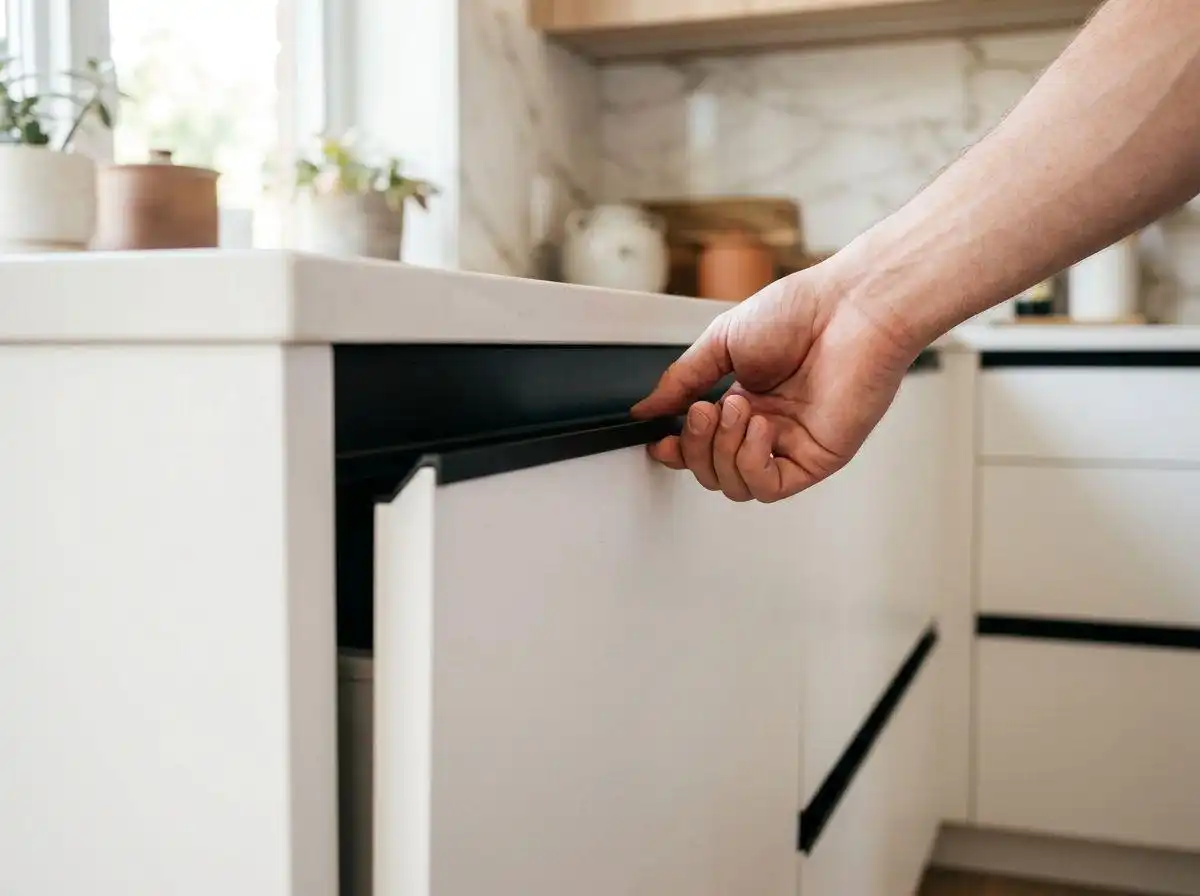
In a “Handleless” (Gola) kitchen, the kitchen cabinet hardware is actually integrated into the carcass.
The Aluminum Profile Channel
Instead of traditional pulls, we mill C-shaped and J-shaped aluminum profiles directly into the cabinet carcass.
-
Anodized Durability: These profiles are made from 6063-T5 aluminum, anodized to a thickness of 10-15 microns. This ensures that frequent contact with fingernails and rings does not scratch the finish.
-
Ergonomic Clearance: We engineer a 25mm “Finger-Gap” into the profile. This depth is specifically calculated to allow for easy operation while maintaining a sleek, flush-mount aesthetic that defines modern European design.
Blueprint V: Adjustable Leveling and Suspension Logistics
The final blueprint covers the “Invisible Hardware” that holds the kitchen together: Leveling legs and wall suspension brackets.
The ABS High-Impact Leg
أ kitchen cabinet hardware system starts at the floor. Our leveling legs are made from high-impact ABS plastic, capable of supporting 250kg per leg.
-
The Uneven Floor Solution: With an adjustment range of -5mm to +20mm, these legs ensure that even if the subfloor is uneven, the cabinet carcasses remain perfectly plumb, which is essential for the smooth operation of drawers and hinges.
-
Heavy-Duty Wall Brackets: For “floating” or wall-mounted units, we utilize all-metal suspension brackets that anchor directly into the studs, capable of supporting 100kg of dead weight per cabinet.
Hardware Performance Matrix
| Component | Standard Cycles | سعة التحميل | مادة | Best Application |
| Soft-Close Hinge | 200,000 | N/A | Nickel-Plated Steel | Standard Doors |
| Under-mount Slide | 100,000 | 40kg – 70kg | Cold-Rolled Steel | Heavy Pot Drawers |
| Lift System | 80,000 | 5kg – 18kg | Alloy/Polymer | Upper Wall Units |
| Gola Profile | N/A | High Tension | Anodized Aluminum | Handleless Kitchens |
| Leveling Leg | N/A | 250kg/unit | High-Impact ABS | Base Cabinet Support |
FAQ: Hardware Maintenance and Engineering
Q: Why does my soft-close drawer feel “heavy” to pull?
ج: This is often due to an over-calibrated “push-to-open” or “soft-close” mechanism. أجهزة خزانة المطبخ عالية الجودة allows for the adjustment of the tension settings. We suggest a 20-newton pull force for optimal ergonomic balance.
Q: Can I use standard hardware in a humid tropical climate?
ج: No. For high-humidity markets, we exclusively recommend Grade 304 Stainless Steel hardware. While standard nickel-plated steel is durable, only stainless steel provides the 10-year rust-free guarantee required in tropical or coastal environments.
Q: How often should I tighten the cabinet hinges?
ج: With our factory-grade “Clip-On” hinges, the screws are fitted with nylon expansion sleeves. This prevents the screw from backing out due to vibration, meaning you should only need to check alignment every 2 to 3 years.
Conclusion: The Mechanical Soul of the Kitchen
The longevity of a kitchen is not determined by its color or its countertop; it is determined by the quality of its kitchen cabinet hardware. By engineering these five mechanical blueprints into every project—from the hydraulic dampening of the hinges to the dynamic load-rating of the slides—we ensure that the kitchen performs as a precision instrument for decades.
As a factory-direct manufacturer, we partner with the world’s leading hardware innovators to bring industrial-grade movement to your custom home or development project.